ACT 4
Henry V Act 4, Scene 7: Retold in Modern English Verse
Fluellen compares Harry to Alexander
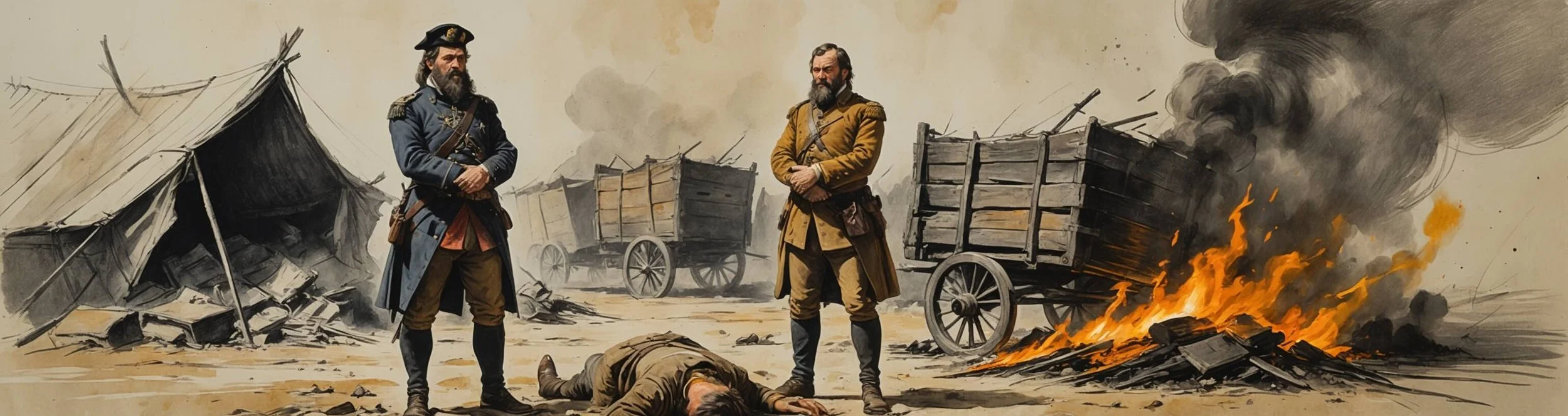
The French have slaughtered the boys guarding the luggage, and Gower and Fluellen agree the king is right to be angry; Fluellen, in his roundabout Welsh way, compares Harry of Monmouth to Alexander of Macedon – one killed his best friend in his cups, the other turned away the fat knight. Henry declares he was never angry in France until this hour; then Montjoy comes to beg leave to number the French dead, and concedes the day is England’s. Henry names the field Agincourt, and sets a practical joke in motion: Williams’s glove goes to Fluellen’s cap, with Warwick and Gloucester sent after to see no harm comes of it.
Characters appearing: Fluellen | Gower | King Henry V | Warwick | Gloucester | Exeter | Montjoy | Williams
Key themes: War and Violence | Patriotism and Nationalism | Kingship and Leadership
ANOTHER PART OF THE FIELD.
[ENTER FLUELLEN AND GOWER]
FLUELLEN
Kill the poys and the luggage! 'Tis expressly
Killing the boys who looked after the luggage! That’s expressly
against the law of arms: 'tis as arrant a piece of
against the accepted code of war. It’s the worst type of
knavery, mark you now, as can be offer't; in your
villainy, I tell you, as anyone can do. Is it on your
conscience, now, is it not?
conscience now?
GOWER
'Tis certain there's not a boy left alive; and the
It’s certain that no boys survived, and that the
cowardly rascals that ran from the battle ha' done
cowards who ran from the battlefield have carried out
this slaughter: besides, they have burned and
this slaughter. As well as that, they burned and
carried away all that was in the king's tent;
looted everything in the king’s tent;
wherefore the king, most worthily, hath caused every
that’s why the king has worthily ordered every
soldier to cut his prisoner's throat. O, 'tis a
soldier to cut each prisoner’s throat. Oh, he’s a
gallant king!
courageous king!
FLUELLEN
Ay, he was porn at Monmouth, Captain Gower. What
Yes, he was born in Monmouth, Captain Gower. What
call you the town's name where Alexander the Pig was born!
was the name of the town where Alexander the Big was born?
GOWER
Alexander the Great.
You mean, Alexander the Great.
FLUELLEN
Why, I pray you, is not pig great? The pig, or the
Well, I ask you, isn’t a ‘big’ the same as ‘great’? The big, or the
great, or the mighty, or the huge, or the
great, or the mighty, or the huge, or the
magnanimous, are all one reckonings, save the phrase
magnanimous, all have the same meaning, yet merely sound
is a little variations.
a little different.
GOWER
I think Alexander the Great was born in Macedon; his
I think Alexander the Great was born in Macedon; his
father was called Philip of Macedon, as I take it.
father was called Philip of Macedon, as I understand.
FLUELLEN
I think it is in Macedon where Alexander is porn. I
I think Alexander was born in Macedon. I
tell you, captain, if you look in the maps of the
assure you, captain, if you look at maps of the
'orld, I warrant you sall find, in the comparisons
world, I guarantee you will find, when comparing
between Macedon and Monmouth, that the situations,
Macedon and Monmouth, that they are situated,
look you, is both alike. There is a river in
you see, in the same place. There is a river in
Macedon; and there is also moreover a river at
Macedon; and, importantly, there is also a river in
Monmouth: it is called Wye at Monmouth; but it is
Monmouth: it is called the River Wye in Monmouth, but
out of my prains what is the name of the other
my brain forgets what the other river is called.
river; but 'tis all one, 'tis alike as my fingers is
But it doesn’t matter, they’re the same as my fingers
to my fingers, and there is salmons in both. If you
are to each other, and there are salmon in both. If you
mark Alexander's life well, Harry of Monmouth's life
study Alexander’s life closely, Harry of Monmouth’s life
is come after it indifferent well; for there is
follows pretty much the same path, for there is
figures in all things. Alexander, God knows, and
symbolism in everything. God and you know that Alexander
you know, in his rages, and his furies, and his
had fits of rage, a furious temper, suffered
wraths, and his cholers, and his moods, and his
wrath, was irritable, and his mood swings and his
displeasures, and his indignations, and also being a
irritations and anger at perceived injustice, and also
little intoxicates in his prains, did, in his ales and
when he was a little intoxicated in the brain, did, through beer
his angers, look you, kill his best friend, Cleitus.
and subsequent anger, you see, kill his best friend, Cleitus.
GOWER
Our king is not like him in that: he never killed
Our king is not like him in doing that: he has never killed
any of his friends.
any of his friends.
FLUELLEN
It is not well done, mark you now take the tales out
It is not polite, I have to say, to take the words I am
of my mouth, ere it is made and finished. I speak
speaking before I’ve finished what I’m saying. I’m speaking
but in the figures and comparisons of it: as
merely in parallels and comparisons of them both: as
Alexander killed his friend Cleitus, being in his
Alexander killed his friend Cleitus, when he was
ales and his cups; so also Harry Monmouth, being in
intoxicated, so Harry of Monmouth, being
his right wits and his good judgments, turned away
sober and of sound judgement, turned away
the fat knight with the great belly-doublet: he
the fat knight with the beer belly. He
was full of jests, and gipes, and knaveries, and
was full of jest and jokes and tricks and
mocks; I have forgot his name.
mockery; but I’ve forgotten his name.
GOWER
Sir John Falstaff.
Sir John Falstaff.
FLUELLEN
That is he: I'll tell you there is good men porn at Monmouth.
That’s him; I tell you good men are born in Monmouth.
GOWER
Here comes his majesty.
Here comes the king.
[ALARUM. ENTER KING HENRY, AND FORCES; WARWICK, GLOUCESTER, EXETER, AND OTHERS]
KING HENRY V
I was not angry since I came to France
I’ve not been angry since I’ve been in France
Until this instant. Take a trumpet, herald;
Up until now. Pick up your trumpet, herald,
Ride thou unto the horsemen on yon hill:
Ride over to the horsemen on that hill.
If they will fight with us, bid them come down,
If they will fight with us, tell them to come here,
Or void the field; they do offend our sight:
Or leave the field: the sight of them’s offensive.
If they'll do neither, we will come to them,
If they’ll do neither, we will go to them
And make them skirr away, as swift as stones
And make them scatter off as quick as rocks
Enforced from the old Assyrian slings:
Flung from a sling of old Assyrians.
Besides, we'll cut the throats of those we have,
Besides, we’ll cut the throats of all our prisoners,
And not a man of them that we shall take
And not a single prisoner we capture
Shall taste our mercy. Go and tell them so.
Will know our mercy. Go and tell them that.
[ENTER MONTJOY]
EXETER
Here comes the herald of the French, my liege.
Here’s Montjoy, herald of the French, my lord.
GLOUCESTER
His eyes are humbler than they used to be.
His eyes look humbler than they did before.
KING HENRY V
How now! What means this, herald? Know'st thou not
Hello there! Fancy seeing you! Don’t you know
That I have fined these bones of mine for ransom?
That I have offered up my bones for ransom?
Comest thou again for ransom?
Are you here for another ransom?
MONTJOY
No, great king:
No, king:
I come to thee for charitable licence,
I’ve come to ask your merciful permission
That we may wander o'er this bloody field
To walk across this bloodied battlefield
To book our dead, and then to bury them;
Recording who has died, then bury them;
To sort our nobles from our common men.
And sort our noblemen from commoners.
For many of our princes – woe the while! –
For many of our princes – oh my goodness! –
Lie drowned and soaked in mercenary blood;
Lie drowned and soaked in common soldiers’ blood;
So do our vulgar drench their peasant limbs
And limbs of ghastly commoners lie dripping
In blood of princes; and their wounded steeds
In blood of princes; and their wounded horses,
Fret fetlock deep in gore and with wild rage
Knee-deep in blood and guts, irately flounder
Yerk out their armed heels at their dead masters,
And kick their heeled hooves at their dead masters,
Killing them twice. O, give us leave, great king,
Thus killing them again. Allow us, great king,
To view the field in safety and dispose
To safely view the battlefield and rid it
Of their dead bodies!
Of their dead bodies!
KING HENRY V
I tell thee truly, herald,
Truthfully now, herald,
I know not if the day be ours or no;
I don’t know if we’ve won the fight or not;
For yet a many of your horsemen peer
For even now your horsemen are appearing
And gallop o'er the field.
To gallop on the field.
MONTJOY
The day is yours.
You’ve won the battle.
KING HENRY V
Praised be God, and not our strength, for it!
Praise God for this! But do not praise our strength.
What is this castle called that stands hard by?
What is the castle called that’s close to here?
MONTJOY
They call it Agincourt.
They call it Agincourt.
KING HENRY V
Then call we this the field of Agincourt,
So we’ll call this the field of Agincourt,
Fought on the day of Crispin Crispianus.
Where we have fought on this Saint Crispin’s Day.
FLUELLEN
Your grandfather of famous memory, an't please your
Your famous grandfather, if it pleases your
majesty, and your great-uncle Edward the Plack
majesty to recall, and your great-uncle Edward the Black,
Prince of Wales, as I have read in the chronicles,
Prince of Wales, as I have read in history books,
fought a most prave pattle here in France.
fought a very brave battle here in France.
KING HENRY V
They did, Fluellen.
They did, Fluellen.
FLUELLEN
Your majesty says very true: if your majesties is
Your majesty states the truth: if your majesty can
remembered of it, the Welshmen did good service in a
remember it, the Welshmen served well in a
garden where leeks did grow, wearing leeks in their
garden where leeks were growing, and wore leeks in their
Monmouth caps; which, your majesty know, to this
woollen soldiers’ caps, which, I’m sure your majesty knows, even
hour is an honourable badge of the service; and I do
to this day is a badge of honourable service; and I
believe your majesty takes no scorn to wear the leek
believe your majesty doesn’t mind wearing a leek
upon Saint Tavy's day.
on Saint Davy’s day.
KING HENRY V
I wear it for a memorable honour;
I wear it as a tribute badge of honour;
For I am Welsh, you know, good countryman.
For I am Welsh, you know, dear countryman.
FLUELLEN
All the water in Wye cannot wash your majesty's
All of the water in the River Wye cannot wash your majesty’s
Welsh plood out of your pody, I can tell you that:
Welsh blood out of your body, I can tell you that.
God pless it and preserve it, as long as it pleases
God bless it and look after it, as long as it pleases
his grace, and his majesty too!
his grace and majesty!
KING HENRY V
Thanks, good my countryman.
Thank you, my dear countryman.
FLUELLEN
By Jeshu, I am your majesty's countryman, I care not
In Jesus’ name, I am a countryman to your majesty, and I don’t
who know it; I will confess it to all the 'orld: I
care who knows it; I will tell this to the whole world. I
need not to be ashamed of your majesty, praised be
will not be ashamed of your majesty, praise be to
God, so long as your majesty is an honest man.
God, so long as your majesty remains an honest man.
KING HENRY V
God keep me so! Our heralds go with him:
God keep me honest! Messengers, go with him:
Bring me just notice of the numbers dead
Return to let me know how many died
On both our parts. Call yonder fellow hither.
On either side. Now bring that man to me.
[POINTS TO WILLIAMS. EXEUNT HERALDS WITH MONTJOY]
EXETER
Soldier, you must come to the king.
Soldier, come forward to the king.
KING HENRY V
Soldier, why wearest thou that glove in thy cap?
Why are you wearing that glove in your cap?
WILLIAMS
An't please your majesty, 'tis the gage of one that
If it pleases your majesty, it is the glove of someone
I should fight withal, if he be alive.
I’m obliged to fight, should he still be alive.
KING HENRY V
An Englishman?
An Englishman?
WILLIAMS
An't please your majesty, a rascal that swaggered
If it pleases your majesty, a scallywag who picked a fight
with me last night; who, if alive and ever dare to
with me last night; who, if he’s still alive and ever dares to
challenge this glove, I have sworn to take him a box
challenge me for this glove, I’ve sworn I’ll give him a clip
o' th' ear: or if I can see my glove in his cap,
round the ear. Or if I ever see my glove in his cap,
which he swore, as he was a soldier, he would wear
which as a soldier he swore he would wear
if alive, I will strike it out soundly.
if he survived, I will knock the glove out of his cap.
KING HENRY V
What think you, Captain Fluellen? Is it fit this
What do you think, Captain Fluellen? Is it appropriate for this
soldier keep his oath?
soldier to carry out his commitment?
FLUELLEN
He is a craven and a villain else, an't please your
He’d be a coward and a villain if he didn’t, assuming your
majesty, in my conscience.
majesty agrees; that’s what I believe.
KING HENRY V
It may be his enemy is a gentleman of great sort,
It may be that his enemy is a high-ranking gentleman,
quite from the answer of his degree.
far above needing to answer to one so low ranking.
FLUELLEN
Though he be as good a gentleman as the devil is, as
Even if he were as decent as the devil, like
Lucifer and Belzebub himself, it is necessary, look
Lucifer and Belzebub, it is essential, you see
your grace, that he keep his vow and his oath: if
your grace, that he keeps his promised oath; if
he be perjured, see you now, his reputation is as
he breaks his oath, you see, his reputation then becomes
arrant a villain and a Jacksauce, as ever his black
as wretched as a villain and a rascal that ever wore his black
shoe trod upon God's ground and his earth, in my
shoes upon God’s earth. That’s my
conscience, la!
opinion, anyway!
KING HENRY V
Then keep thy vow, sirrah, when thou meetest the fellow.
Then honour your oath, sir, when you meet that chap again.
WILLIAMS
So I will, my liege, as I live.
I will, my lord, as long as I live.
KING HENRY V
Who servest thou under?
Who do you serve under?
WILLIAMS
Under Captain Gower, my liege.
Under Captain Gower, my lord.
FLUELLEN
Gower is a good captain, and is good knowledge and
Gower is a good captain, and has excellent knowledge and
literatured in the wars.
is well-read in warfare.
KING HENRY V
Call him hither to me, soldier.
Bring him to me, soldier.
WILLIAMS
I will, my liege.
I will, my lord.
[EXIT]
KING HENRY V
Here, Fluellen; wear thou this favour for me and
Here, Fluellen; wear this as a decorative token for me and
stick it in thy cap: when Alencon and myself were
put it in your cap: when Alencon and I were
down together, I plucked this glove from his helm:
fighting on the ground, I plucked this glove from his helmet.
if any man challenge this, he is a friend to
If anyone challenges you for this, he is a friend of
Alencon, and an enemy to our person; if thou
Alencon and an enemy of ours; if you
encounter any such, apprehend him, an thou dost me love.
come across such a person, apprehend him, if you do love me.
FLUELLEN
Your grace doo's me as great honours as can be
Your grace gives me the greatest honour that
desired in the hearts of his subjects: I would fain
those who serve him could ever desire. I would dearly love
see the man, that has but two legs, that shall find
to see the two-legged man that takes
himself aggrieved at this glove; that is all; but I
offence at this glove; that is all I’ll say. But I would
would fain see it once, an please God of his grace
dearly love to see him, if it pleases God and your grace
that I might see.
that I might see him.
KING HENRY V
Knowest thou Gower?
Do you know Gower?
FLUELLEN
He is my dear friend, an please you.
He is my dear friend, if you please.
KING HENRY V
Pray thee, go seek him, and bring him to my tent.
Then, please, go and find him and bring him to my tent.
FLUELLEN
I will fetch him.
I will fetch him.
[EXIT]
KING HENRY V
My Lord of Warwick, and my brother Gloucester,
My Lord of Warwick and my brother Gloucester:
Follow Fluellen closely at the heels:
Follow Fluellen, hot upon his heels;
The glove which I have given him for a favour
The glove I’ve given him to be a token
May haply purchase him a box o' th' ear;
Will, hopefully, get him clipped round the ear.
It is the soldier's; I by bargain should
It is the soldier’s; from the deal, I should
Wear it myself. Follow, good cousin Warwick:
Be wearing it myself. Follow him, Warwick:
If that the soldier strike him, as I judge
And if the soldier hits him, as predicted
By his blunt bearing he will keep his word,
Because he’s tough and sure to keep his word,
Some sudden mischief may arise of it;
Some trouble may erupt because of it,
For I do know Fluellen valiant
For I’m aware Fluellen’s valiant,
And, touched with choler, hot as gunpowder,
And, when annoyed, his temper is explosive
And quickly will return an injury:
And quickly he’ll return the injury:
Follow and see there be no harm between them.
So, follow them, preventing injury.
Go you with me, uncle of Exeter.
Come with me, uncle Exeter, let’s go.
[EXEUNT]