Henry V: Act 4, Scene 7 – Analysis
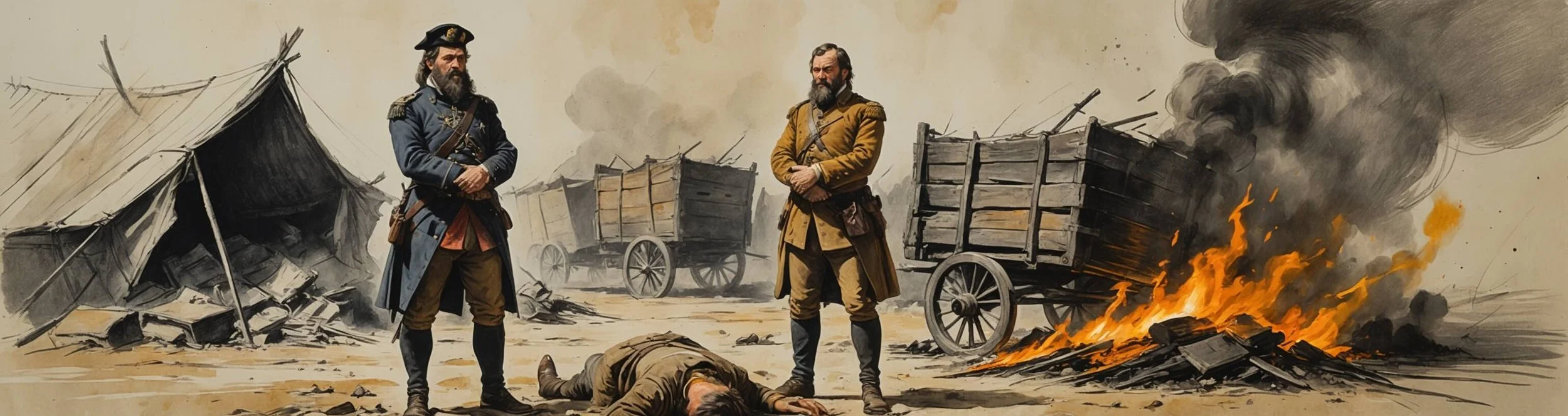
Scene Profile – At a Glance
- Location: Another part of the field of Agincourt, as the fighting ends.
- What Happens: Fluellen rages at the killing of the boys and compares Henry to “Alexander the Pig”; the King, angry at last, repeats his order to kill the prisoners – then Montjoy concedes the day. Henry names the battle, embraces his Welshness, and sets the glove trick running.
- Key Characters: King Henry V, Fluellen, Gower, Montjoy, Williams, Warwick and Exeter.
- Dramatic Function: Victory arrives – sideways. The scene mixes atrocity, comedy, national pride and a practical joke, refusing to let Agincourt resolve into any single feeling.
- Famous Quote:
"Then call we this the field of Agincourt,
Fought on the day of Crispin Crispianus."
(King Henry V, Act 4, Scene 7) - Why It Matters: Fluellen’s accidental comparison of Henry to Alexander – who killed his best friend – and the double account of the prisoner order make this the play’s most quietly subversive scene.
Scene Summary
The scene opens on outrage: the French have slaughtered the boys guarding the English luggage, and Fluellen declares it “expressly against the law of arms”. Gower agrees – and, in the same breath, reports that the King has “most worthily” ordered every soldier to cut his prisoner’s throat: “O, ’tis a gallant king!”
Fluellen’s tribute takes an unexpected route. Henry was born at Monmouth, as Alexander the Great – “Alexander the Pig”, in Fluellen’s Welsh consonants – was born in Macedon; there are rivers in both, “and there is salmons in both”. And as Alexander, drunk, killed his best friend Cleitus, so Harry of Monmouth, sober, “turned away the fat knight with the great belly-doublet” – Falstaff. Gower’s protest that the King never killed any of his friends is not, on the evidence, quite an answer.
Henry enters angry for the first time in France, threatens the horsemen still on the hill, and repeats the order: the prisoners’ throats will be cut, and no man taken hereafter will taste mercy. Then Montjoy arrives – humbled – asking leave to bury the French dead, and concedes: “The day is yours.” Henry names the battle for the castle nearby – Agincourt – accepts Fluellen’s delighted claim of kinship (“I am Welsh, you know, good countryman”), and, spotting Williams with a glove in his cap, sets up the practical joke that will detonate in the next scene.
Kill the Poys and the Luggage
The scene opens with the war’s ugliest fact, filtered through two captains’ professional judgement.
Original
Kill the poys and the luggage! 'Tis expressly against the law of arms: 'tis as arrant a piece of knavery, mark you now, as can be offer't...
(Fluellen, Act 4, Scene 7)
Shakespeare Retold (Modern Verse)
Killing the boys who looked after the luggage! That’s expressly against the accepted code of war. It’s the worst type of villainy, I tell you, as anyone can do...
The killing of the boys – the camp’s children, including, the play lets us assume, the Boy who followed Pistol from Eastcheap – is condemned by the book: “expressly against the law of arms”. But the scene’s real disturbance is Gower’s next sentence, which reports the King’s prisoner order as the fitting response – “the king, most worthily, hath caused every soldier to cut his prisoner’s throat. O, ’tis a gallant king!” The chronology, as the play staged it, says otherwise: Henry gave the order in the previous scene, before anyone knew about the boys. Gower’s version – atrocity first, reprisal after – is the story as loyalty needs it to be, and the play lets both versions stand in the text, unreconciled, for the audience to notice or not.
Alexander the Pig
Fluellen’s praise of the King is the most dangerous speech in the play – because he means every word of it kindly.
Original
Alexander killed his friend Cleitus, being in his ales and his cups; so also Harry Monmouth, being in his right wits and his good judgments, turned away the fat knight with the great belly-doublet...
(Fluellen, Act 4, Scene 7)
Shakespeare Retold (Modern Verse)
Alexander killed his friend Cleitus, when he was intoxicated, so Harry of Monmouth, being sober and of sound judgement, turned away the fat knight with the beer belly...
The comparison starts as comedy – Macedon and Monmouth, a river in each, “salmons in both” – and walks, with perfect Welsh method, into catastrophe: as Alexander in his cups killed his best friend Cleitus, so Harry – “in his right wits and his good judgments” – turned away Sir John Falstaff. The defence is worse than the charge: Alexander was drunk; Henry was sober. Gower’s objection – the King never killed any of his friends – stands beside the play’s own record: the Hostess’s account in Act 2 of Falstaff’s broken heart. Shakespeare puts the play’s sharpest criticism of its hero in the mouth of his most loyal admirer, wrapped in the play’s broadest comedy, at the moment of his greatest triumph – where no one on stage can hear it as criticism at all.
The King’s Anger
Henry enters transformed: “I was not angry since I came to France / Until this instant.”
Original
Besides, we'll cut the throats of those we have,
And not a man of them that we shall take
Shall taste our mercy. Go and tell them so.
(King Henry V, Act 4, Scene 7)
Shakespeare Retold (Modern Verse)
Besides, we’ll cut the throats of all our prisoners,
And not a single prisoner we capture
Will know our mercy. Go and tell them that.
The threat is double: the horsemen still loitering on the hill will be swept away, and – “besides” – the prisoners already taken will die, with no mercy for any taken hereafter. This is the order’s second issuing, now in rage where Act 4, Scene 6 gave it in cold calculation, and the repetition is the point: the play will not let the moment pass as a single regrettable reflex. Whether the anger is at the killing of the boys, at the French rally, or at the day’s whole cost, the text does not say – and the mercy that made the King “the mirror of all Christian kings” is, for the space of five lines, formally revoked. Montjoy’s entrance with the concession is what ends the crisis; nothing in the scene tells us what would have happened had he come later.
The Day Is Yours
The victory, when it finally arrives, is spoken by the defeated.
Original
For many of our princes – woe the while! –
Lie drowned and soaked in mercenary blood;
So do our vulgar drench their peasant limbs
In blood of princes...
(Montjoy, Act 4, Scene 7)
Shakespeare Retold (Modern Verse)
For many of our princes – oh my goodness! –
Lie drowned and soaked in common soldiers’ blood;
And limbs of ghastly commoners lie dripping
In blood of princes...
Montjoy’s description of the field – princes drowned in mercenary blood, peasants’ limbs soaked in the blood of princes, wounded horses lashing at their dead masters – is the battle the stage could not show, and it is horror, not glory: the social order itself dissolved in gore, rank indistinguishable from rank. His errand is burial, and his concession, when Henry presses, is four words: “The day is yours.” Henry’s response sets the pattern for everything that follows – “Praised be God, and not our strength, for it!” – and then, with striking modesty of means, he asks the name of the castle nearby and names the victory after it. The greatest battle in English memory gets its name from a question and a courtesy.
Language and Technique
- Comic anti-climax: The play’s climactic victory is announced not by trumpets but by a grieving herald’s four words – the scene’s emotional engineering runs on understatement.
- Fluellen’s method: The Alexander comparison is a formal rhetorical exercise – the “figures and comparisons” of classical parallel – applied with such literal-minded rigour that it exposes what politer speech would hide.
- Dialect as texture: The Welsh consonants (“porn”, “plood”, “Alexander the Pig”) keep the scene’s most serious content audibly comic – the play’s standing trick of hiding its knives in accents.
- Blood imagery inverted: Montjoy’s field – princes soaked in mercenary blood, peasants drenched in princes’ – collapses the class distinctions the play’s casualty lists will carefully restore.
Key Quotes from Act 4, Scene 7
Quote 1
Original
The day is yours.
(Montjoy, Act 4, Scene 7)
Shakespeare Retold (Modern Verse)
You’ve won the battle.
Quote Analysis: Four words carrying the whole battle. Shakespeare gives the announcement of Agincourt – the climax of the entire play – to the enemy’s herald, in a line of one sentence, in the middle of a request to bury the dead. The choice is masterly: no English boast could be as absolute as the French concession, and Henry’s instant deflection – praised be God, not our strength – completes the play’s official theology of the victory in the same breath. The quietest line in the play is its turning point.
Original
Then call we this the field of Agincourt,
Fought on the day of Crispin Crispianus.
(King Henry V, Act 4, Scene 7)
Shakespeare Retold (Modern Verse)
So we’ll call this the field of Agincourt,
Where we have fought on this Saint Crispin’s Day.
Quote Analysis: The christening of the legend. Henry asks the name of the castle hard by, is told “Agincourt”, and fixes the battle to the place and the day – Crispin Crispian, exactly as his dawn speech promised the feast would be remembered. The moment is deliberately modest – a name taken from geography rather than glory – and deliberately self-fulfilling: the play’s audience, two centuries on, is itself the proof that the naming worked.
Original
I wear it for a memorable honour;
For I am Welsh, you know, good countryman.
(King Henry V, Act 4, Scene 7)
Shakespeare Retold (Modern Verse)
I wear it as a tribute badge of honour;
For I am Welsh, you know, dear countryman.
Quote Analysis: Henry’s embrace of the leek and the daffodil: he wears the Welsh badge “for a memorable honour”, being Welsh born – Harry of Monmouth. The line is warm, politically deft (the army he leads is British, not merely English), and true to the play’s pattern: the King becomes whatever his hearer most needs – a brother to soldiers, a plain wooer to a princess, a countryman to Fluellen. The affection feels real precisely because it costs him nothing.
Original
All the water in Wye cannot wash your majesty's
Welsh plood out of your pody, I can tell you that...
(Fluellen, Act 4, Scene 7)
Shakespeare Retold (Modern Verse)
All of the water in the River Wye cannot wash your majesty’s
Welsh blood out of your body, I can tell you that...
Quote Analysis: Fluellen’s reply – all the water in Wye cannot wash the King’s Welsh blood out of his body – converts Henry’s courtesy into something indelible: identity as bloodstream, not costume. The comedy of the consonants (“plood”, “pody”) should not hide the force of the claim, nor its condition; Fluellen’s loyalty is to an honest king – “so long as your majesty is an honest man” – a proviso Henry answers with “God keep me so!” The play’s warmest exchange of national feeling carries, in its tail, a subject’s terms.
Key Takeaways
- Two stories of one order: The play stages the prisoner order before the boys are found dead; Gower retells it as reprisal. Both versions stand in the text – the play’s most pointed test of how history gets written.
- The loyal critique: Fluellen’s Alexander comparison – meant as praise – convicts the sober King of what the drunk conqueror did: destroying his closest friend.
- Victory by concession: Agincourt is won in four words from the French herald – and instantly assigned to God. The play’s greatest triumph is its most understated scene.
- Welshness embraced: Harry of Monmouth claims his birth – a king who becomes countryman to his captain, and a nation-building gesture the leek scene of Act 5 will defend.
Study Questions and Analysis
Did Henry order the prisoners killed because the French murdered the boys?
Not in the order the play staged it – and the discrepancy is one of the most discussed cruxes in Henry V. In Act 4, Scene 6, hearing only that the French have reinforced, Henry gives the order coldly: “every soldier kill his prisoners”. This scene then opens with the discovery of the murdered boys, after which Gower reports the order as the King’s worthy response to the massacre. The audience has seen the sequence; Gower narrates the justification.
Historically, the massacre of prisoners at Agincourt is well attested and was long debated; Theodor Meron, in Henry’s Wars and Shakespeare’s Laws (1993), the standard authority on the play’s law of war, shows the order stood on contested but arguable military grounds – a threatened rally, too few guards. Shakespeare’s choice is subtler than either verdict: he stages the cold version and voices the warm one, letting loyalty’s narrative visibly overwrite the event. Norman Rabkin, in his 1977 essay Rabbits, Ducks, and Henry V, treated this doubleness as the play’s essence – the same act legible as ruthless necessity or righteous reprisal, “virtually daring us to choose”. For essays, cite the staging order; it is the play’s own evidence.
What is the point of Fluellen’s "Alexander the Pig" comparison?
On the surface, patriotic pedantry: Fluellen, delighted that his countryman-king has matched the ancients, builds a formal classical parallel – birthplace for birthplace, river for river, “salmons in both”. But his method requires a matching deed, and the one he lands on is lethal:
Original
Alexander killed his friend Cleitus, being in his ales and his cups; so also Harry Monmouth, being in his right wits and his good judgments, turned away the fat knight with the great belly-doublet...
(Fluellen, Act 4, Scene 7)
Shakespeare Retold (Modern Verse)
Alexander killed his friend Cleitus, when he was intoxicated, so Harry of Monmouth, being sober and of sound judgement, turned away the fat knight with the beer belly...
Alexander, drunk, killed his best friend; Harry, sober and in “his good judgments”, turned away Falstaff – whose name Fluellen cannot even remember, though the play’s audience could never forget it. The comparison is meant as praise and lands as indictment: what Alexander did in madness, Henry did in policy. Gower’s correction – the King never killed any of his friends – is answered by the play itself, which showed the Hostess in Act 2 describing Falstaff’s death: “the king has killed his heart”. Shakespeare hides the play’s harshest verdict on its hero inside its funniest speech, spoken by his most devoted subject – deniable, unmissable, and impossible to answer.
Why does Montjoy return – and what does his speech reveal?
He comes, for the first time, without a demand. The herald who twice offered Henry the chance to name his ransom now asks a favour:
Original
I come to thee for charitable licence,
That we may wander o'er this bloody field
To book our dead, and then to bury them...
(Montjoy, Act 4, Scene 7)
Shakespeare Retold (Modern Verse)
I’ve come to ask your merciful permission
To walk across this bloodied battlefield
Recording who has died, then bury them...
The speech’s power is in what it describes: a field where the social order has drowned – princes soaked “in mercenary blood”, peasants’ limbs drenched in the blood of princes, wounded horses killing their own dead masters twice. It is the play’s only eyewitness account of what Agincourt actually looked like, and Shakespeare gives it to the French: grief, not glory, and a bureaucracy of burial – “to book our dead” – that answers the English casualty lists of the next scene. Montjoy’s dignity in defeat is deliberate; the play’s chivalric France dies well, and the herald’s “The day is yours” carries more weight than any English trumpet could.
Why does Henry say he does not know whether he has won?
Because, remarkably, he doesn’t – and the admission is worth attention:
Original
I tell thee truly, herald,
I know not if the day be ours or no;
For yet a many of your horsemen peer
And gallop o'er the field.
(King Henry V, Act 4, Scene 7)
Shakespeare Retold (Modern Verse)
Truthfully now, herald,
I don’t know if we’ve won the fight or not;
For even now your horsemen are appearing
To gallop on the field.
French horsemen still “peer and gallop o’er the field”; the day is not formally decided until the enemy concedes it. Dramatically, the moment does three things. It keeps the battle’s outcome subordinate to French acknowledgement – victory arrives as a gift of the defeated, not a boast of the victor. It preserves the scene’s tension one beat longer, so that “The day is yours” lands as release. And it feeds the play’s theology: a king who genuinely cannot tell whether he has won is a king positioned to mean “Praised be God, and not our strength” when he says it seconds later. Sincerity and stage-management, as everywhere in this play, share the line.
Why does the Welsh exchange with Fluellen matter?
Because it is where the play’s idea of a British nation becomes personal. Henry was born at Monmouth; Fluellen claims him – the Welshmen “did good service” in a garden where leeks grew, and the King wears the leek on Saint Tavy’s day “for a memorable honour; for I am Welsh, you know, good countryman”. The captain’s answer – all the water in Wye cannot wash the Welsh blood from the King’s body – makes the bond biological, and his proviso (“so long as your majesty is an honest man”) makes it conditional: loyalty as a covenant, not a reflex.
Michael Neill, in his 1994 essay Broken English and Broken Irish, reads the play’s four captains – English, Welsh, Scots, Irish – as Shakespeare’s working model of the composite nation England was anxiously assembling, with Wales as the union’s success story: distinct in speech, absolute in service. The exchange here is that model’s warmest proof, and it sets up the leek’s defence in Act 5, Scene 1, where mocking Fluellen’s emblem becomes an offence the play punishes on stage. A king who is also a countryman – the idea Agincourt’s “band of brothers” promised – is, for one exchange, simply true.
What is Henry doing with Williams’s glove?
Setting up a practical joke – with royal machinery. Henry recognises Williams as the soldier who challenged him in the night debate, confirms the man means to keep his oath, and then hands Williams’s glove to Fluellen with a cover story about Alençon, guaranteeing that the blow meant for the King lands on the hottest-tempered captain in the army. He even dispatches Warwick and Gloucester to make sure the farce stops short of harm:
Original
If that the soldier strike him, as I judge
By his blunt bearing he will keep his word,
Some sudden mischief may arise of it...
(King Henry V, Act 4, Scene 7)
Shakespeare Retold (Modern Verse)
And if the soldier hits him, as predicted
Because he’s tough and sure to keep his word,
Some trouble may erupt because of it...
The joke is genuinely funny, and it is also worth reading closely, because it is the King’s way of digesting the night’s unfinished argument. He cannot answer Williams as a king without revealing that the king was eavesdropping in disguise; he will not punish an honest man for keeping his word; so he converts the quarrel into comedy, at Fluellen’s expense, with soldiers posted to manage the consequences. It is grace, control and evasion in one gesture – the glove debate of Act 4, Scene 1 will be settled in the next scene not with an answer but with crowns, and the trick played here is how the play gets there.