Henry V: Act 4, Scene 6 – Analysis
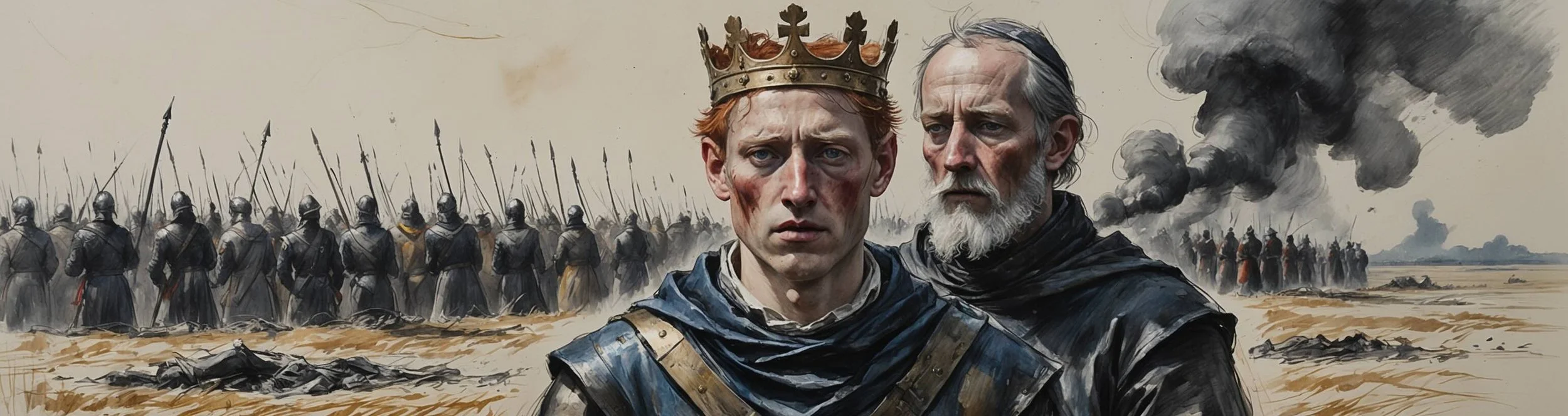
Scene Profile – At a Glance
- Location: The field of Agincourt, mid-battle.
- What Happens: Exeter describes the deaths of York and Suffolk – dying together, kiss to kiss, in the play’s great set piece of chivalric love. Then a new alarum sounds, and Henry gives the order: every soldier kill his prisoners.
- Key Characters: King Henry V and Exeter.
- Dramatic Function: Thirty-eight lines holding the play’s two extremes: war at its most beautiful, and war at its most ruthless – back to back, in the same breath.
- Famous Quote:
"But, hark! What new alarum is this same?
The French have reinforced their scattered men:
Then every soldier kill his prisoners:
Give the word through."
(King Henry V, Act 4, Scene 6) - Why It Matters: The prisoner order – given here coldly, before anyone knows the boys are dead – is the hardest fact any reading of Henry has to absorb. The play places it seconds after its tenderest passage, and the collision is deliberate.
Scene Summary
The battle is going well but is not over – “all’s not done; yet keep the French the field” – when Exeter brings the King the Duke of York’s dying commendations, and an account that stops the scene. Suffolk fell first; York, hacked all over, came to where his cousin lay steeped in gore, took him by the beard, kissed his wounds, and called on him to tarry – their souls would fly to heaven abreast, as they had kept together in the field.
Exeter cheered him; York smiled, reached him a feeble hand, asked that his service be commended to his sovereign – and then turned, threw his wounded arm over Suffolk’s neck, kissed his lips, and “espoused to death”, sealed with blood a “testament of noble-ending love”. Exeter wept – “all my mother came into mine eyes” – and Henry, hearing it, admits he must fight back tears of his own.
Then an alarum. The French have reinforced their scattered men – and the King’s grief converts instantly to command: “Then every soldier kill his prisoners: / Give the word through.” The scene ends on the order.
York and Suffolk
The play’s only extended account of dying in this battle is a love story.
Original
Suffolk first died: and York, all haggled over,
Comes to him, where in gore he lay insteeped,
And takes him by the beard; kisses the gashes
That bloodily did spawn upon his face...
(Exeter, Act 4, Scene 6)
Shakespeare Retold (Modern Verse)
Suffolk was first to die; then mangled York,
Comes over to him, lying mutilated,
And holds him by the beard, kissing his wounds
That gushed with blood disgorging from his face...
Agincourt’s fighting happens offstage; what Shakespeare stages instead is this narration – formal, tender, and deliberately exquisite. York kisses Suffolk’s gashes, takes his beard, speaks to him as “dear cousin”, and dies mouth to mouth with him, “espoused to death”. The language is nuptial – espoused, testament, love – and the play means the shock of it: the deepest tenderness in Henry V passes between two dying soldiers on a battlefield. This is chivalry’s self-portrait, war as the theatre of noble love, and Exeter’s tears – and the King’s – ratify it. The scene grants the ideal its full beauty for thirty lines, because what follows in the last four requires us to have believed it.
Then Every Soldier Kill His Prisoners
An alarum sounds – and the play’s most debated order is given in eleven words.
Original
But, hark! What new alarum is this same?
The French have reinforced their scattered men:
Then every soldier kill his prisoners:
Give the word through.
(King Henry V, Act 4, Scene 6)
Shakespeare Retold (Modern Verse)
But, listen up! What is this call to arms?
The French have reinforced their scattered men.
So, every soldier: kill your prisoners,
And spread this order out.
Note what Henry knows and when: the French have regrouped, nothing more. The killing of the boys and the burning of the tents are still undiscovered – they arrive at the top of the next scene. The order as given here is a battlefield calculation: prisoners under light guard are a danger if the fighting resumes, so the prisoners die. No anguish is voiced, no line of justification offered; command follows intelligence in the space of a breath, from the man whose eyes were misting a moment earlier. Whether this is the necessary arithmetic of survival or the moment the “mirror of all Christian kings” shows another face is the play’s sharpest open question – and Shakespeare sharpens it further in the next scene, where Gower will retell the order as pious reprisal for an atrocity Henry had not yet heard of.
Language and Technique
- Reported action: The deaths are narrated, not staged – epic technique that lets the language do what stage combat cannot, and keeps the battle itself invisible.
- Nuptial imagery for death: “Espoused to death”, a “testament” sealed in blood, the kiss – the vocabulary of marriage applied to dying comrades, chivalric love at its highest pitch.
- The tears of soldiers: Exeter’s “all my mother came into mine eyes” frames weeping as the mother’s inheritance in a man – emotion acknowledged, gendered, and permitted.
- The brutal pivot: Four end-stopped words – “Give the word through” – snap the scene from elegy to execution. The structure, not any comment, delivers the shock.
Key Quotes from Act 4, Scene 6
Quote 1
Original
And cries aloud 'Tarry, dear cousin Suffolk!
My soul shall thine keep company to heaven;
Tarry, sweet soul, for mine, then fly abreast...
(Exeter, Act 4, Scene 6)
Shakespeare Retold (Modern Verse)
He shouts aloud, ‘Wait up, dear cousin Suffolk!
My soul will join you on the path to heaven;
Wait there for me, sweet soul, then fly together...
Quote Analysis: York’s cry over the dying Suffolk, quoted by Exeter: tarry, dear cousin – wait for me – so their souls can fly to heaven side by side, as they fought side by side. The lines make death a continuation of comradeship rather than its end, and “fly abreast” gives the two souls the formation of cavalry. It is the “band of brothers” promise of the dawn speech made literal – brotherhood persisting past the last breath.
Original
But I had not so much of man in me,
And all my mother came into mine eyes
And gave me up to tears.
(Exeter, Act 4, Scene 6)
Shakespeare Retold (Modern Verse)
But I could not behave just like a man should,
And, like my mother would, my eyes welled up
And made me cry my eyes out.
Quote Analysis: Exeter’s confession of tears, and one of the play’s most quoted moments on masculinity: he tried to stop the “waters”, but “had not so much of man” in him – and “all my mother” came into his eyes. Weeping is framed as the maternal inheritance breaking through the soldier’s discipline – and the play does not mock it. The hardest man in Henry’s council cries at beauty, and the King immediately confesses he is close behind.
Original
I blame you not;
For, hearing this, I must perforce compound
With mistful eyes, or they will issue too.
(King Henry V, Act 4, Scene 6)
Shakespeare Retold (Modern Verse)
I don’t blame you;
For hearing this I’m forced to fight the tears back
From my own glassy eyes, or else I’ll sob too.
Quote Analysis: Henry’s answer – I blame you not – extends the permission to the whole audience: this grief is legitimate, and the King himself must “compound with mistful eyes” to keep from joining it. The line matters doubly because of what follows within seconds: the same man, tears barely mastered, issues the prisoner order without a flicker. The scene’s emotional engineering – permission to weep, then the killing word – is the play’s double vision compressed to its smallest span.
Key Takeaways
- Chivalry gets its masterpiece: York and Suffolk’s deaths are the play’s most beautiful passage – war’s official ideal, fully honoured.
- The order is cold in the text: As staged, Henry orders the prisoners killed on hearing of a French rally – before the boys’ deaths are known. The chronology is the crux; quote it precisely.
- Tears are allowed: Exeter weeps, Henry nearly does – the play’s martial world makes room for grief, which makes the pivot to ruthlessness harder, not easier.
- Structure is the argument: Elegy, alarum, execution order – thirty-eight lines that hold the play’s two truths about war in a single scene.
Study Questions and Analysis
How do York and Suffolk die – and why does the play report it rather than show it?
Together, and by narration. Suffolk dies first; York – the same Duke of York who begged the vanguard from Henry that morning – crawls to him through the gore, kisses his wounds, calls his soul to wait, and dies with his arm over Suffolk’s neck and his lips on his:
Original
So did he turn and over Suffolk's neck
He threw his wounded arm and kissed his lips;
And so espoused to death, with blood he sealed
A testament of noble-ending love.
(Exeter, Act 4, Scene 6)
Shakespeare Retold (Modern Verse)
And then he turned, and over Suffolk’s neck
He lay his wounded arm and kissed his lips;
And so, united as they died, he sealed
A bloodied bond of noble love in death.
Reporting it is the point. Staged combat could only show bodies falling; Exeter’s narration can show what the deaths meant – the wounds kissed, the “testament of noble-ending love” sealed in blood – and can show its effect on the hearers, which is the scene’s real subject: the toughest men in the play in tears. The technique is epic messenger-speech, the oldest way of bringing battle indoors, and Shakespeare gives it his full lyric power precisely here so that the chivalric ideal stands at its absolute height – four lines before the prisoner order knocks it flat.
Why does Henry order the prisoners killed?
The text gives one reason, and gives it in sequence:
Original
The French have reinforced their scattered men:
Then every soldier kill his prisoners:
Give the word through.
(King Henry V, Act 4, Scene 6)
Shakespeare Retold (Modern Verse)
The French have reinforced their scattered men.
So, every soldier: kill your prisoners,
And spread this order out.
A reinforced enemy, a battle not yet won, thousands of prisoners held behind the lines by an exhausted and outnumbered army – the order, as given, is military arithmetic, and Theodor Meron, in Henry’s Wars and Shakespeare’s Laws (1993), the standard study of the play’s law of war, shows that the historical order was debated in exactly those terms: brutal, arguable, and within the period’s contested rules when a guarded rear threatened to become a second front. What the play adds is placement. Shakespeare puts the order seconds after the York elegy and before the discovery of the murdered boys – so the audience receives it raw, without the justification Gower will supply in the next scene. Alternative texts and productions soften or re-motivate the moment; the Folio’s staging does not. Quote the sequence as it stands: it is the strongest evidence the play ever offers against its own hero – and it offers it deliberately.
Why do Exeter’s – and Henry’s – tears matter?
Because the play stops its battle to show them. Exeter, the play’s plainest and hardest official voice, tries to hold back the “waters” and fails – “all my mother came into mine eyes” – and Henry, far from rebuking him, confesses he must struggle not to follow. In a play whose men are constantly performing hardness – at the breach, at the gates of Harfleur, over the ransom demands – this is the one moment where feeling wins, and it is treated as honourable in both men.
For essays on masculinity and war, the exchange is a set text in miniature. Weeping is gendered maternal – the mother in the man – but not despised: the “man” who cannot stop his tears has just watched the most beautiful thing in the play. And structurally, the tears are load-bearing: they certify that Henry feels – fully, demonstrably – four lines before he orders the prisoners killed. Without the tears, the order would show a cold king; with them, it shows something more unsettling: a king in whom feeling and ruthlessness operate in the same minute without touching.
How should I use this scene in an essay?
As the play’s sharpest juxtaposition – and quote the sequence exactly. Thirty-four lines of chivalric elegy; one alarum; an eleven-word execution order. No scene in the play sets its two visions of war – the noble fellowship and the killing machine – closer together, and none is more useful for the central critical debate. Norman Rabkin, in his 1977 essay Rabbits, Ducks, and Henry V, argued that the play is built to sustain two contradictory readings at once, “virtually daring us to choose”; this scene is that structure in miniature, the rabbit and the duck in adjacent speeches.
Two precise moves pay off. First, the chronology: the order comes before anyone knows about the boys, whatever Gower says in the next scene – the play stages the cold version and then shows loyalty rewriting it, which is evidence about propaganda as well as about Henry. Second, the echo: York and Suffolk die “espoused” in noble love while the prisoners – unnamed, unnumbered here – die by a word. Who gets an elegy and who gets an order is the play’s quietest statement about rank, and pairing this scene with the casualty lists of Act 4, Scene 8 completes it.