Henry V: Act 4, Scene 5 – Analysis
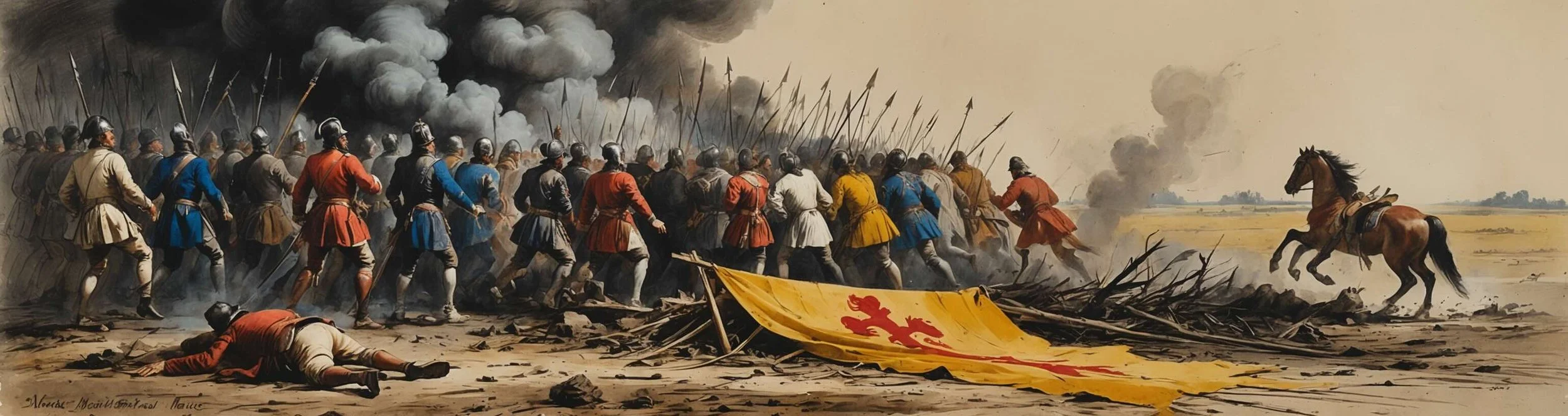
Scene Profile – At a Glance
- Location: The field of Agincourt – the French side, as the battle collapses.
- What Happens: The French commanders – the Constable, Orleans, Bourbon and the Dauphin – discover in twenty-four lines that the day is lost. Amid cries of “shame”, Bourbon leads them back into the field to die.
- Key Characters: The Dauphin, Bourbon, the Constable and Orleans.
- Dramatic Function: The battle’s turn, seen from the losing side – the boasters of the night before reduced to a single repeated word: shame.
- Famous Quote:
"The devil take order now! I'll to the throng:
Let life be short; else shame will be too long."
(Bourbon, Act 4, Scene 5) - Why It Matters: Agincourt’s miracle is staged as French disintegration, not English prowess – and the lords who diced for prisoners the night before now talk of stabbing themselves.
Scene Summary
Twenty-four lines of collapse. The Constable enters crying “O diable!”, Orleans that the day and all is lost – “tout est perdu!” – and the Dauphin that everything is confounded: reproach and everlasting shame “sits mocking in our plumes”. A short alarum punctuates the panic; all their ranks are broken.
The talk turns wild – the Dauphin proposes stabbing themselves, and remembers with disbelief that these were “the wretches that we played at dice for”; Orleans, that this was the king they sent to for ransom. Bourbon takes command of the despair: shame, and eternal shame, nothing but shame – let them die in honour, back into the field; any man who will not follow him can hold the door, like a pander, while his daughter is violated by a slave.
The Constable’s last hope inverts the play’s great theme of order: “Disorder, that hath spoiled us, friend us now!” Let them go and offer up their lives “on heaps”. Orleans notes there are still enough French living to smother the English – if any order could be found; Bourbon answers for the scene: “The devil take order now!” – and they exit to the throng, choosing short life over long shame.
All Is Confounded
The night before, these men diced for English prisoners. Now the play gives them two dozen lines to lose everything.
Original
Mort de ma vie! All is confounded, all!
Reproach and everlasting shame
Sits mocking in our plumes. O merchante fortune!
Do not run away.
(the Dauphin, Act 4, Scene 5)
Shakespeare Retold (Modern Verse)
My life has died! And everything is ruined!
Disgrace and shame forever
Will mock our helmets’ feathers. Wretched luck!
Don’t run away.
The scene opens in two languages, both broken: French oaths – “O diable!”, “Mort de ma vie!” – colliding with English despair. The Dauphin’s image is exact for a chivalry that lived by display: shame does not strike or wound, it “sits mocking in our plumes” – perched in the very feathers that were the armour’s pride, so that every emblem of glory is now a perch for disgrace. His “Do not run away” – to others, or to himself – completes the collapse: the prince who spent the eve of battle praising his horse now has one line of command left, and it is a plea.
Bourbon’s Charge
Out of the panic, one voice organises the despair into action.
Original
Shame and eternal shame, nothing but shame!
Let us die in honour: once more back again;
And he that will not follow Bourbon now,
Let him go hence, and with his cap in hand...
(Bourbon, Act 4, Scene 5)
Shakespeare Retold (Modern Verse)
We’ve nothing left except eternal shame!
Let’s die in honour, with one more attack;
And any man that will not follow me,
Let him depart, to stand, collecting money...
Bourbon’s speech is the scene’s pivot – despair converted into a death-charge by an appeal to shame more graphic than any hope of victory. The alternative he paints is deliberately obscene: the man who will not follow him is a “base pander” holding the chamber door while a slave “no gentler than my dog” violates his daughter – dishonour imagined, characteristically for this play’s aristocracy, as sexual possession by the low-born. It works: the Constable and Orleans fall in, and the French nobility ride back into the field not to win – no one suggests winning – but to die expensively. It is the chivalric code’s last act: when glory fails, purchase a good death.
Language and Technique
- Code-switching panic: The scene opens in French exclamation and collapses into English – the losing side’s very language breaking under pressure.
- The word made theme: “Shame” sounds five times in eight lines – repetition hammering a single idea until it becomes the scene’s whole content.
- Inverted personification: The Constable prays to Disorder – “friend us now!” – inverting the play’s great image of the ordered hive: the French, who had order and lost it, now enlist chaos itself.
- Couplet as epitaph: Bourbon’s exit rhyme – “short” against “long” – compresses the scene’s choice into a jingle: a short life or a long shame.
Key Quotes from Act 4, Scene 5
Quote 1
Original
Disorder, that hath spoiled us, friend us now!
Let us on heaps go offer up our lives.
(the Constable, Act 4, Scene 5)
Shakespeare Retold (Modern Verse)
Confusion that has ruined us, now help us!
Let’s go en masse and risk our lives together.
Quote Analysis: The Constable’s prayer to chaos is the scene’s most striking line – and the play’s theme of order turned inside out. Canterbury’s honey-bees made order nature’s law and victory’s guarantee; now the French commander, whose ranks are broken, petitions Disorder itself for friendship, and proposes to offer up their lives “on heaps” – the same word the play uses for the ruin of France’s gardens. The side that loses this battle loses the play’s whole cosmology with it.
Original
The devil take order now! I'll to the throng:
Let life be short; else shame will be too long.
(Bourbon, Act 4, Scene 5)
Shakespeare Retold (Modern Verse)
To hell with plans! I’ll fight in this endeavour:
Let life be short, else shame will last forever.
Quote Analysis: Bourbon’s exit couplet, and the scene’s epitaph: order is the devil’s now; he will go to the “throng” – the press of dying men – and the rhyme settles the arithmetic: life short, shame long. It is genuinely brave and entirely futile, the chivalric bargain stated at its barest – death purchased as the last commodity honour can afford. Set it against Henry’s “band of brothers” arithmetic, where the fewer men, the greater share of honour: the French can now only share shame.
Key Takeaways
- The miracle is French collapse: Shakespeare stages Agincourt’s turn not as English heroics but as the disintegration of French command – panic, shame and a death-charge.
- The boasters answered: The lords who diced for prisoners on the eve of battle now propose stabbing themselves – the play’s tidiest reversal.
- Order changes sides: The Constable’s prayer to Disorder inverts the honey-bee commonwealth – the play’s official theory of victory, surrendered by the losers.
- Shame is the whole script: One word, repeated to exhaustion, is all the French have left – chivalry reduced to its final currency.
Study Questions and Analysis
What is this scene actually showing us?
The battle’s decisive moment – from the only vantage the play ever uses for it. Shakespeare stages no English fighting at Agincourt beyond Pistol’s ransom farce; the victory is rendered entirely through French eyes, and this scene is its hinge: between the Dauphin’s boasts of Act 3 and Montjoy’s surrender in Act 4, Scene 7 stand these twenty-four lines of raw collapse. “All is confounded” is the audience’s only sight of the rout itself.
The technique matters for essays. By showing defeat rather than triumph, the play keeps English hands clean of visible slaughter – the killing happens between scenes – and makes the miracle a matter of report and consequence rather than spectacle. It also completes a character arc begun in the French camp scenes: the lords who spent the night before the battle in competitive wit about horses, mistresses and dice are given exactly the ending their glamour earned. The play’s Agincourt is not something England does; it is something France suffers – a choice worth naming in any essay on how Shakespeare stages war.
Why is "shame" repeated so many times?
Because it is the only concept the French have left, and the scene beats it like a drum – “Reproach and everlasting shame”, “O perdurable shame!”, “Shame and eternal shame, nothing but shame!” The repetition enacts the state of mind: minds in panic circle one word.
Original
O perdurable shame! Let's stab ourselves.
Be these the wretches that we played at dice for?
(the Dauphin, Act 4, Scene 5)
Shakespeare Retold (Modern Verse)
Such everlasting shame! Let’s kill ourselves.
Are these the lousy men we gambled on?
The Dauphin’s couplet shows what the shame is made of: not grief for the dead, but the unbearable memory of last night’s arrogance – these were “the wretches that we played at dice for”. The shame is social, not moral; what stings is having boasted, in front of witnesses, about a game they then lost. That is why the only remedy anyone proposes is death – suicide first, then Bourbon’s charge – because in the chivalric ledger a death in the field is the one payment that cancels disgrace. The scene is the play’s clearest anatomy of honour culture at its limit: a value system with no procedure for losing.
Does the scene make the French tragic or ridiculous?
The text keeps both fully available, and productions have played it both ways. The case for ridicule: the scene opens in scrambled bilingual exclamations, the Dauphin’s contribution to the crisis is “Let’s stab ourselves”, and the panic of the men who preened all night is broad comic justice. The case for tragedy: Bourbon’s fury is real and his charge is brave; the Constable’s prayer to Disorder has genuine desolation in it; and everything they fear – the heaped dead, the drowned social order – Montjoy’s speech in Scene 7 will confirm as fact.
William Hazlitt, in Characters of Shakespear’s Plays (1817), called the play “a very splendid pageant” – and the French lords are the pageant’s designated losers, costumed for defeat from their first scene. But Shakespeare complicates the pageant here: he gives the losers the scene, the feelings and the exit line, while the English victory happens unwatched. A strong essay can argue either reading – or, better, that the scene’s doubleness is the play’s: the same twenty-four lines are farce from the English side of the field and tragedy from the French, and Shakespeare, as usual, declines to choose a side of the field for us.