Henry V: Act 4, Scene 4 – Analysis
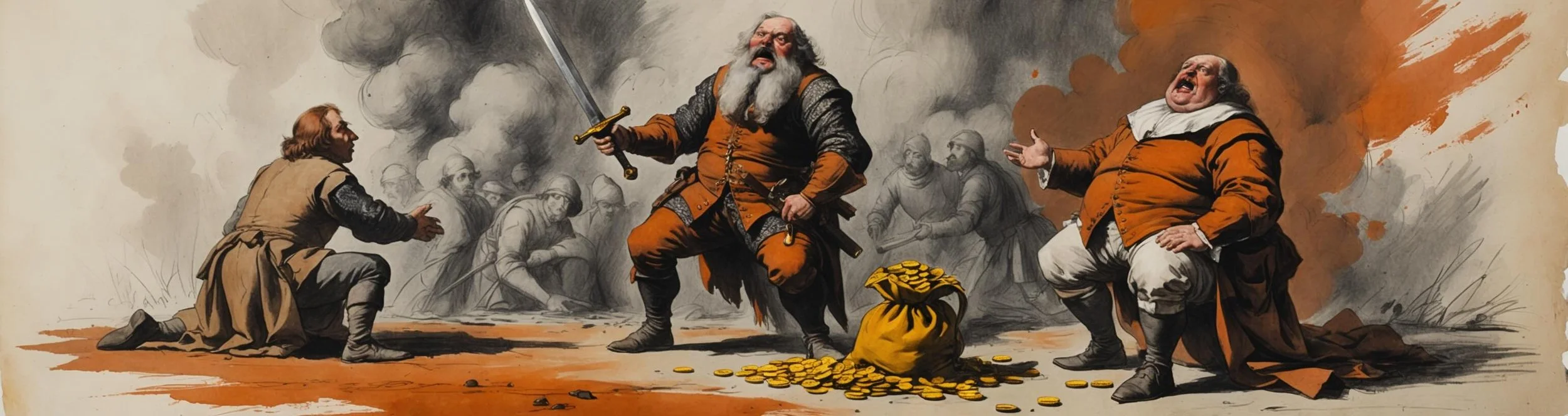
Scene Profile – At a Glance
- Location: The field of Agincourt, during the battle.
- What Happens: Pistol captures a terrified French soldier and – through the Boy’s reluctant interpreting – extorts two hundred crowns for his life. Alone, the Boy delivers his verdict on Pistol, and mentions that only boys are left guarding the luggage.
- Key Characters: Pistol, the French soldier Monsieur le Fer, and the Boy.
- Dramatic Function: The play’s only staged combat at Agincourt – and it is a ransom farce. The battle of the age, represented by its least heroic transaction.
- Famous Quote:
"As I suck blood, I will some mercy show.
Follow me!"
(Pistol, Act 4, Scene 4) - Why It Matters: The scene parodies the entire war – a claim pressed in bad French, mercy sold for crowns – and ends with the Boy’s foreshadowing of his own death: there is “none to guard” the luggage “but boys”.
Scene Summary
While Agincourt rages offstage, Pistol takes a prisoner. “Yield, cur!” The Frenchman – Monsieur le Fer – speaks no English, Pistol no French, and the negotiation proceeds by magnificent misunderstanding: “Qualtitie calmie custure me!”; the man’s plea to “Seigneur Dieu” becomes a gentleman named “Signieur Dew”; his terrified “moi” becomes “moys”, of which Pistol will have forty; and his “bras” (arm) becomes “brass”, indignantly refused.
The Boy is summoned to interpret, and does so with visible embarrassment – translating Pistol’s throat-cutting threats into polite French and the soldier’s grovelling gratitude back into English. The deal lands at two hundred crowns; Pistol’s “fury shall abate”, and he exits with his prisoner in tow, promising that “as I suck blood”, he will show some mercy. The Frenchman thanks the “most brave, valorous, and thrice-worthy signieur of England” on his knees.
Alone, the Boy files his report: he never knew “so full a voice issue from so empty a heart” – the empty vessel makes the greatest sound. Bardolph and Nym had ten times Pistol’s courage, and both were hanged. Then the quiet chill: he must go mind the camp’s luggage, where “there is none to guard it but boys” – a prize for the French, if they only knew.
Yield, Cur!
Shakespeare’s staging of the greatest battle in English legend begins – and, for English combat, ends – with Pistol shaking down a prisoner.
Original
O, Signieur Dew should be a gentleman:
Perpend my words, O Signieur Dew, and mark;
O Signieur Dew, thou diest on point of fox,
Except, O signieur, thou do give to me
Egregious ransom.
(Pistol, Act 4, Scene 4)
Shakespeare Retold (Modern Verse)
Oh, Signior Dew thinks he’s a gentleman:
Reflect upon my words, oh Signior Dew:
Oh Signior Dew, you’ll die upon this sword
Unless, oh Signior, you will give to me
A massive ransom payment.
The comedy is linguistic: Pistol conducts the entire capture in mishearings, converting the Frenchman’s prayers and pleas into names and coins. “Signieur Dew” – the Lord God repackaged as a ransomable gentleman – is the joke at its sharpest, and “on point of fox” (a sword) keeps the menace real: the farce has a blade in it. The scene’s placement is the point. The Chorus promised us Crispin’s day glory; the play delivers, as its only staged English fighting at Agincourt, a mugging with an interpreter. Whatever the battle is, the play insists we watch this be part of it.
The Boy in the Middle
Between the swaggering captor and the kneeling captive stands a child, translating both into civilisation.
Original
He prays you to save his life: he is a gentleman of a good house; and for his ransom he will give you two hundred crowns.
(the Boy, Act 4, Scene 4)
Shakespeare Retold (Modern Verse)
He begs that you save his life: he is a gentleman from a good house, and for his ransom payment he will give you two hundred gold coins.
The Boy’s French is good, his tact better, and his position excruciating: he must render “I will cut his throat” into courteous French and the Frenchman’s flattery – “the most brave, valorous, and thrice-worthy signieur of England” – back to a man he despises. The interpreting scenes with Katharine and Alice make language-crossing charming; this one makes it commerce, with a life on the invoice. And the Frenchman’s gratitude is the scene’s quietest irony: he believes he has fallen into the hands of a great knight, because everything reached him through the Boy’s polite translation. Monsieur le Fer will never know that the “brave, valorous” signieur was Eastcheap’s emptiest vessel – reputation, here as everywhere in the play, is a translation effect.
The Boy’s Verdict
Left alone, the play’s youngest character delivers its most precise character assassination.
Original
I did never know so full a voice issue from so empty a heart: but the saying is true: 'The empty vessel makes the greatest sound.'
(the Boy, Act 4, Scene 4)
Shakespeare Retold (Modern Verse)
I’ve never heard a voice so loud from such a hollow heart. But the proverb is true: ‘When empty, vessels make the loudest noise.’
“So full a voice” from “so empty a heart” – the Boy has watched Pistol’s bluster from the inside since Act 2, and the proverb he reaches for is final: the empty vessel makes the greatest sound. His comparison is exact and damning – Bardolph and Nym had “ten times more valour” and were hanged for stealing; Pistol survives precisely because he dares nothing. Then the register drops to something colder: the Boy must go and guard the luggage with the other boys – and the French “might have a good prey of us, if he knew of it”. The audience will hear of the luggage again in Act 4, Scene 7, when Fluellen cries that the boys have all been killed. Shakespeare gives the child one clear-eyed soliloquy, and inside it, his own death warrant.
Language and Technique
- Bilingual punning: The scene runs on cross-language mishearing – “Dew” for Dieu, “moys” for moi, “brass” for bras – greed converting every French word into English money.
- Mock-heroic register: Pistol’s inflated archaisms (“Perpend my words”, “Egregious ransom”) dress extortion in epic costume – the play’s grand style parodied from below.
- The interpreter frame: Threats and flattery both pass through the Boy’s translations, so the audience hears each exchange twice – raw and laundered – a running lesson in how language cleans up power.
- Proverb as judgement: The Boy’s “empty vessel” proverb does in six words what the play’s critics do in essays – and his plain prose outweighs all Pistol’s thunder.
Key Quotes from Act 4, Scene 4
Quote 1
Original
Moy shall not serve; I will have forty moys;
Or I will fetch thy rim out at thy throat
In drops of crimson blood.
(Pistol, Act 4, Scene 4)
Shakespeare Retold (Modern Verse)
One moy won’t work; I’ll need some forty moys;
Or I will gut your innards out your throat
And spill your crimson blood.
Quote Analysis: Pistol’s finest mishearing: the Frenchman’s “moi” – me – becomes “moy”, apparently a coin, and one will not serve: he will have forty. The threat attached – fetching the man’s “rim” out at his throat – is anatomically vague and dramatically vivid, which is Pistol exactly: the violence is real enough to terrify a lost, unarmed man, and that is the only sort of enemy Pistol fights. The line prices the scene: a life, negotiated by a man who cannot count it in the right currency.
Original
Tell him my fury shall abate, and I the crowns will take.
(Pistol, Act 4, Scene 4)
Shakespeare Retold (Modern Verse)
Tell him my anger will subside and I will take his gold coins.
Quote Analysis: The turn of the scene in one line of doggerel: fury abates the instant money appears. The rhyme-shaped sentence – abate/take – gives the extortion the sing-song finality of a nursery moral, and that is its comedy and its judgement at once. Two hundred crowns buys what all Monsieur le Fer’s pleading could not; Pistol’s mercy, like everything else in his war, is a commodity with a price reached by haggling.
Original
As I suck blood, I will some mercy show.
Follow me!
(Pistol, Act 4, Scene 4)
Shakespeare Retold (Modern Verse)
Although I am a leech, I will show mercy.
Follow me!
Quote Analysis: Pistol’s exit line is his self-portrait: “as I suck blood” – the leech’s confession delivered as though it were a knight’s vow – “I will some mercy show”. The Retold’s “Although I am a leech” makes the image plain: he feeds on the war rather than fighting it. The grandiosity of the framing against the parasitism of the content is the whole character in nine words – and the Boy will spend his soliloquy, seconds later, saying exactly this in cooler prose.
Key Takeaways
- The only English combat we see: Shakespeare stages Agincourt’s English fighting once – as an extortion with an interpreter. The choice is the commentary.
- The war in miniature: A claim pressed in a language the other side barely understands, and mercy exchanged for crowns – the scene parodies the play’s grandest transactions.
- The Boy sees everything: His “empty vessel” verdict on Pistol is the play’s own; the child is its clearest moral eye.
- The luggage line is a fuse: “None to guard it but boys” – the soliloquy’s last thought detonates three scenes later, when the boys are killed.
Study Questions and Analysis
What happens between Pistol and the French soldier – and what is the scene parodying?
A capture, a mistranslated negotiation, and a sale. Pistol takes a prisoner he cannot talk to, mishears every French word as either an insult or a coin, and lands – via the Boy’s interpreting – on two hundred crowns for the man’s life:
Original
Owy, cuppele gorge, permafoy,
Peasant, unless thou give me crowns, brave crowns;
Or mangled shalt thou be by this my sword.
(Pistol, Act 4, Scene 4)
Shakespeare Retold (Modern Verse)
Oui, couper la gorge, par ma foi,
Peasant, unless you give me proper gold coins,
You will be chopped up by this sword of mine.
“Owy, cuppele gorge, permafoy” – Pistol’s only French, learned from somewhere, is “cut the throat”. The parody is structural, and worth spelling out in an essay: a claim asserted in a language the other party cannot follow (as Canterbury’s Latin genealogy was to the court), backed by a throat-cutting threat (as Henry’s ultimatum was to Harfleur), settled by payment (as the war will be settled by treaty and a princess). Every step of the King’s war has its gutter equivalent here. The play does not say the two are the same – Henry’s claim has law, counsel and consequence behind it – but it makes very sure we see the family resemblance.
What does the Boy’s soliloquy tell us?
Three things, in descending temperature. First, the verdict on Pistol:
Original
I did never know so full a voice issue from so empty a heart...
(the Boy, Act 4, Scene 4)
Shakespeare Retold (Modern Verse)
I’ve never heard a voice so loud from such a hollow heart...
The proverb – the empty vessel makes the greatest sound – is the play’s definitive word on bombast, delivered by the character best placed to know. Second, the comparison: Bardolph and Nym, both hanged, had “ten times more valour” – a child’s honest accounting in which even the play’s petty thieves outrank its loudest survivor. And third, the chill: the Boy must return to the luggage, guarded by “none… but boys”, a “good prey” for any Frenchman who finds it. Shakespeare lets the play’s youngest voice diagnose its biggest theme – the gap between the sound a man makes and what is actually in him – and then walks him offstage toward the massacre of Act 4, Scene 7. The soliloquy is the last time we hear him.
Why is the scene partly in French?
Because the comedy – and the meaning – live in the gap between the languages. Monsieur le Fer’s French is ordinary, frightened and perfectly clear to anyone who speaks it: he asks if escape is possible, begs for mercy for the love of God, offers his ransom. Pistol’s mishearings convert all of it into gibberish and money – and the audience, catching more of the French than Pistol does, watches meaning being mangled in real time. The laughter is at the Englishman’s ignorance as much as the Frenchman’s terror.
The scene also completes a triptych. The play stages three bilingual encounters: Katharine’s English lesson (French learning English, in comedy), this ransom (English extracting French, at swordpoint), and the wooing to come (the King of England negotiating in both, for a queen). Language-crossing in Henry V is never neutral – it is always the war by other means – and this scene is the triptych’s brutal middle panel: the version where the translator is a child, the vocabulary is money, and the phrasebook entry that matters is “couper la gorge”.
How does this scene comment on the main plot?
By doing everything the heroes do, at the bottom of the social scale, for cash. Henry demands France or destruction; Pistol demands crowns or a cut throat. Henry’s mercy at Harfleur follows a surrender; Pistol’s “fury shall abate” follows an offer of two hundred crowns. The French soldier’s kneeling gratitude to the “thrice-worthy signieur” even parodies the diplomatic courtesies of the treaty scenes – deference paid to a reputation that exists only in translation.
Stephen Greenblatt, in his 1988 essay Invisible Bullets, famously argued that the play generates its own subversive voices – the perspectives from below that call the official story into question – and contains them: they are heard, and the pageant rolls on. This scene is his argument in action. The parody is complete, the Boy’s verdict is unanswerable, and none of it stops Agincourt from becoming a miracle two scenes later; the empty vessel is beaten home to England while the full ones are canonised. Whether the subversion is thereby neutralised or preserved – planted in the audience even as the plot dismisses it – is one of the richest questions an essay on this play can take up.