Henry V: Act 4, Scene 3 – Analysis
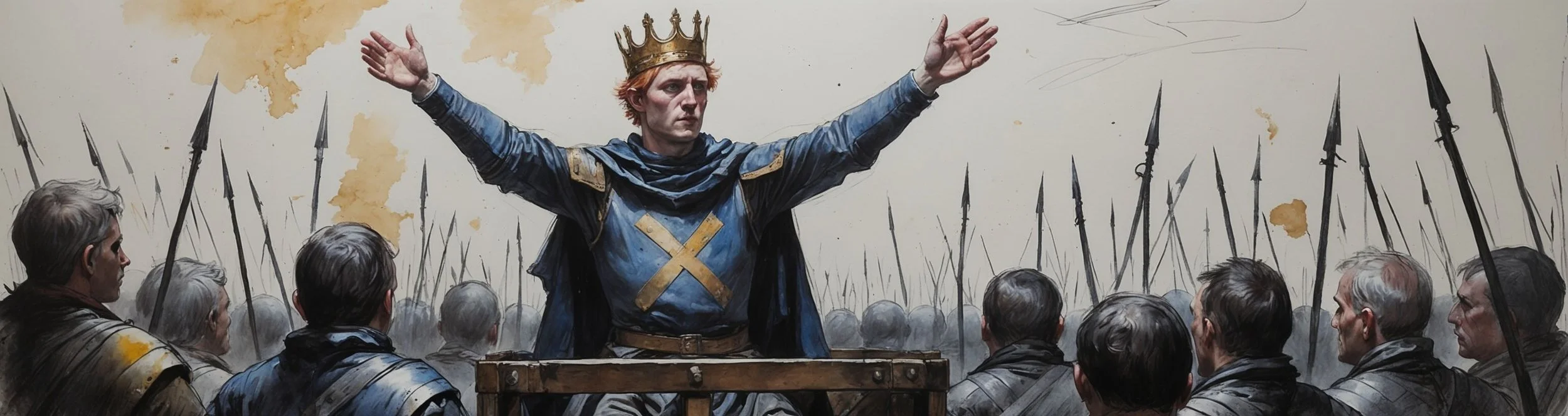
Scene Profile – At a Glance
- Location: The English camp, the morning of Agincourt.
- What Happens: Facing odds of five to one, Westmoreland wishes for ten thousand more men – and King Henry answers with the Crispin’s Day speech: the fewer men, the greater share of honour; we few, we happy few, we band of brothers. He refuses Montjoy’s last ransom demand, and the army marches to battle.
- Key Characters: King Henry V, Westmoreland, Salisbury, Exeter, Gloucester, Bedford, York and Montjoy.
- Dramatic Function: The play’s summit. Everything the Chorus promised, the night questioned and the battle will test is gathered into one speech – the most famous battle oration in the language.
- Famous Quote:
"We few, we happy few, we band of brothers..."
(King Henry V, Act 4, Scene 3) - Why It Matters: The Crispin’s Day speech is the play’s beating heart and the case study for its central question: is this transcendent leadership, magnificent persuasion – or both, and does the difference matter?
Scene Summary
Morning, and the arithmetic is in: sixty thousand French – “five to one; besides, they all are fresh”. Salisbury takes his leave for his post with a soldier’s farewell – if we do not meet again until heaven, then joyfully, warriors all, adieu – and Westmoreland, surveying the odds, wishes aloud for “but one ten thousand of those men in England / That do no work to-day”.
The King overhears – “What’s he that wishes so?” – and builds, from that one wish, the most famous battle speech ever written. No, cousin: if we are marked to die, we are loss enough; if to live, “the fewer men, the greater share of honour”. Any man with no stomach for the fight may leave with passport and purse. But whoever stays and outlives this day – the feast of Crispian – will stand tall every year at the day’s name, show his scars, and remember “with advantages” what feats he did; and the King’s own name, and Bedford’s and Exeter’s, will be “familiar in his mouth as household words”. From this day to the ending of the world, “we few, we happy few, we band of brothers” will be remembered – for whoever sheds his blood with the King today shall be his brother, however humble; and gentlemen now abed in England will hold their manhoods cheap that they were not here.
Westmoreland, converted, now wishes the army smaller still. Montjoy arrives for the last time to offer ransom before the “assured overthrow”; Henry answers with weary pride – they are warriors for the working-day, their gilt all besmirched, but their hearts are in the trim – and swears the French shall have no ransom but his joints. York begs and receives the vanguard, and the King gives the day to God: “And how Thou pleasest, God, dispose the day!”
A Fearful Odds
The scene opens with the numbers – and with the play’s calmest courage.
Original
God's arm strike with us! 'Tis a fearful odds.
God be wi' you, princes all; I'll to my charge:
If we no more meet till we meet in heaven...
(Salisbury, Act 4, Scene 3)
Shakespeare Retold (Modern Verse)
God fight with us! Those odds are terrifying.
May God be with you all; I’ll start my duty:
If we don’t meet again till we’re in heaven...
Sixty thousand against twelve; five to one, and the French fresh. Shakespeare lets the odds be stated flatly by the commanders because their plainness is the speech’s launching pad – but before Henry says a word, Salisbury shows what the army already possesses: an unforced readiness to die, expressed as courtesy. His farewell – if we no more meet till we meet in heaven, then joyfully, adieu – is Crispin’s Day in miniature, spoken by a man who needs no oration. The detail matters for essays: the speech that follows does not create the army’s courage; it gives that courage a story to belong to.
The Wish for More Men
The speech needs a spark, and Westmoreland supplies it.
Original
O that we now had here
But one ten thousand of those men in England
That do no work to-day!
(Westmoreland, Act 4, Scene 3)
Shakespeare Retold (Modern Verse)
I wish we had here
Ten thousand men who are today in England
And not at work!
It is the most reasonable wish in the world – ten thousand of the men idle in England today – and Henry seizes it as if it were heresy: “What’s he that wishes so?” The whole oration is technically an answer to this one sigh, and its first move is the speech’s boldest inversion: not only do we not need more men, we would not want them – “the fewer men, the greater share of honour”. Honour is recast as a fixed treasure to be divided, so that every missing Englishman enriches the men who are here. The logic is outrageous and irresistible – by its end Westmoreland wishes the army smaller – and it shows Henry’s essential gift: he does not deny the terrible arithmetic; he changes what is being counted.
We Band of Brothers
The speech’s climax makes a promise no king of the age could literally keep – and makes it anyway, magnificently.
Original
We few, we happy few, we band of brothers;
For he to-day that sheds his blood with me
Shall be my brother; be he ne'er so vile,
This day shall gentle his condition...
(King Henry V, Act 4, Scene 3)
Shakespeare Retold (Modern Verse)
We few, we lucky few, fight here as brothers;
For he that sheds his blood with me today
Will be my brother; even if a pauper,
Will from this day be called a gentleman....
Everything converges here. The feast-day gives the battle a name and a calendar – an annual resurrection in every survivor’s cup. Memory is enlisted – old men remembering “with advantages”, the story taught to sons – so that the battle is won in the future before it is fought in the present. And then the vow itself: whoever sheds his blood with the King shall be my brother, “be he ne’er so vile” – this day shall gentle his condition. For one morning, the entire social order is suspended by royal decree: blood shed together outranks blood inherited. Whether the play keeps that promise – the casualty list of Scene 8 will name four gentlemen and count the rest – is a question the speech itself, in the moment, makes unaskable. That is what the greatest persuasion does.
Warriors for the Working-Day
Montjoy comes once more for ransom, and Henry’s refusal finds a new register: shabby, weary, and proud.
Original
Let me speak proudly: tell the constable
We are but warriors for the working-day;
Our gayness and our gilt are all besmirched
With rainy marching in the painful field...
(King Henry V, Act 4, Scene 3)
Shakespeare Retold (Modern Verse)
I will speak proudly: tell the constable
We’re all just average working warriors;
Our military regalia is filthy
From marching in the rain in muddy fields...
After the speech’s soaring futures, this is prose-coloured verse: no gayness, no gilt, not a piece of feather in the host – “good argument, I hope, we will not fly” – an army worn into “slovenry” with its hearts “in the trim”. The working-day image completes the speech’s work in a different key: where Crispin’s Day made the soldiers legends, this makes them labourers – men doing a hard job in the rain – and both are ennobling. The ransom refusal itself is absolute: the French may have his joints if they can take them. Henry’s last line before the march hands the result to heaven – “how Thou pleasest, God, dispose the day” – the piety and the performance, as ever, indivisible.
Language and Technique
- Honour as arithmetic: The speech’s engine is a redefinition: honour becomes a fixed sum divided among the survivors – so fewer men means richer shares. Logic in service of morale.
- The future perfect: Much of the oration is spent in imagined years to come – the annual feast, the scars shown, the story taught – winning the battle in memory before a blow is struck.
- Naming as magic: The roll of names – “Harry the king, Bedford and Exeter” – performs the “household words” it prophesies: the audience hearing the line is the prophecy fulfilled.
- The lowered register: To Montjoy, Henry swaps glory for the working-day – plain, wry, soiled – proof that the King commands every register and chooses each for its hearer.
- Inclusive pronouns: “We few, we happy few, we band of brothers” – the relentless first-person plural dissolves rank into fellowship for exactly as long as the speech lasts.
Key Quotes from Act 4, Scene 3
Quote 1
Original
If we are marked to die, we are enow
To do our country loss; and if to live,
The fewer men, the greater share of honour.
(King Henry V, Act 4, Scene 3)
Shakespeare Retold (Modern Verse)
If we’re destined to die, there are enough men
For our country to lose; and if we live,
Then fewer share the honour and the glory.
Quote Analysis: The speech’s foundation stone: the terrible odds accepted, then inverted. If they die, England loses few; if they live, each man’s share of honour is the greater for every absent friend. The move is pure Henry – he never denies a hard fact; he re-prices it – and “share” quietly makes honour a commodity, something ownable and divisible. The economics of glory: worth unpacking in any essay on the play’s language of value.
Original
This day is called the feast of Crispian:
He that outlives this day, and comes safe home,
Will stand a tip-toe when the day is named...
(King Henry V, Act 4, Scene 3)
Shakespeare Retold (Modern Verse)
Today, one celebrates Saint Crispian’s Day:
Survivors of today that get home safely
Will stand up tall each time this day is mentioned...
Quote Analysis: The invention of the anniversary. Henry gives the unfought battle a feast-day, a ritual – standing “a tip-toe” – and a future of yearly celebration, so that surviving today purchases distinction for life. The genius is temporal: fear lives in the next hour, so the speech relocates every listener twenty years downstream, looking back on this morning as the best thing he ever did. No promise of victory is made – only of memory – and that proves enough.
Original
Then will he strip his sleeve and show his scars,
And say 'These wounds I had on Crispin's day.'
(King Henry V, Act 4, Scene 3)
Shakespeare Retold (Modern Verse)
Then he’ll remove his shirt and show his scars,
And say, ‘I got these wounds on Crispin’s day.’
Quote Analysis: The scene the whole speech paints in miniature: an old man, sleeve stripped, scars shown – “These wounds I had on Crispin’s day.” The image is domestic, tavern-sized, utterly concrete after the abstractions of honour – and it is for everyone, not just the lords. A scar is the one decoration a common soldier can win and keep. Set beside it the speech’s subtlest concession: old men remember “with advantages” – the story will improve in the telling, and the speech knows it.
Original
And gentlemen in England now a-bed
Shall think themselves accursed they were not here,
And hold their manhoods cheap whiles any speaks
That fought with us upon Saint Crispin's day.
(King Henry V, Act 4, Scene 3)
Shakespeare Retold (Modern Verse)
And gentlemen in England now asleep
Will think that they’ve been cursed not being here,
And won’t think they are real men when hearing
You fought with us upon Saint Crispin’s day.
Quote Analysis: The speech’s final weapon is aimed at men who are not there: the gentlemen “now a-bed” in England, who will think themselves “accursed” and hold their manhoods cheap when anyone speaks who fought upon Saint Crispin’s day. Envy is conscripted – the audience for the survivors’ glory is created inside the speech itself – and manhood is redefined as presence at this battle. It is also the line that reverses the scene’s opening: Westmoreland wished absent men here; Henry makes absence the only thing worth pitying.
Original
Take it, brave York. Now, soldiers, march away:
And how Thou pleasest, God, dispose the day!
(King Henry V, Act 4, Scene 3)
Shakespeare Retold (Modern Verse)
You can, brave York. Now, soldiers, march in stride:
Dear God, we’ll pass the day as you decide.
Quote Analysis: The scene’s exit couplet: the vanguard granted to York – who will die holding it – and the day handed to God. After two hundred lines of the most self-assured rhetoric in the canon, the last word is surrender of control: dispose the day as Thou pleasest. Sincere piety, faultless theology for a commander who has just told his men God’s will decides – and the play’s standing question in miniature: with this king, devotion and dramaturgy are always the same gesture.
Key Takeaways
- The speech answers a sigh: One wish for reinforcements triggers the whole oration – Henry’s greatest performance is an act of overhearing, seized and transformed.
- Honour is re-priced, not proven: The speech never disputes the odds; it changes the currency – fewer men, greater shares, and memory as the payout.
- The brotherhood is real and temporary: “Be he ne’er so vile, this day shall gentle his condition” – a promise the battle’s casualty list will quietly test.
- Two registers, one king: Crispin’s Day for the army, working-day plainness for the herald – Henry fits the speech to the hearer, flawlessly, every time.
- The day is given to God: The scene ends by handing victory to heaven – the piety that Scene 8 will enforce on pain of death begins here as free devotion.
Study Questions and Analysis
What is the Crispin’s Day speech actually promising?
Not victory – the word never appears. The speech promises memory: a feast-day, an annual ritual, scars with a story, names like household words, and a place in a narrative that runs “to the ending of the world”. Its boldest stroke is honesty about how that memory will work:
Original
Old men forget: yet all shall be forgot,
But he'll remember with advantages
What feats he did that day: then shall our names,
Familiar in his mouth as household words...
(King Henry V, Act 4, Scene 3)
Shakespeare Retold (Modern Verse)
In old age, you’ll become forgetful, yet
You’ll have embellished memories of what
You did that day. Then all our names will be
As common as are household words to people –...
“Old men forget”, and what they keep, they will remember “with advantages” – improved, embellished, polished in the telling. The speech openly licenses the exaggeration of the legend it is founding, which is either a disarming candour or the most sophisticated move in the whole oration: the King admits the story will outgrow the facts, and makes that growth part of the reward. For essays on language and power, this is the crown jewel – a speech that manufactures the future myth of the battle it precedes, and tells you it is doing so. The play’s own audience, watching two centuries later, is the proof that every promise in it was kept.
Is the "band of brothers" promise sincere – and does the play keep it?
In the moment, it is real: whoever sheds his blood with the King “shall be my brother”, however vile his condition – a suspension of the entire Tudor social order, offered by the man at its summit. Nothing in the delivery is winking; Westmoreland’s instant conversion measures its power, and at Agincourt the army fights as if it believed every word.
What happens afterwards is the play’s own commentary. The casualty list of Act 4, Scene 8 names the English dead of rank – four names – and counts the rest: “of all other men but five and twenty”, brothers in the speech, a number in the ledger. Williams’s challenge is settled with crowns, not brotherhood; Bardolph hanged, Pistol cudgelled home. Jonathan Dollimore and Alan Sinfield, in their 1985 essay in Alternative Shakespeares, took this gap – the ideology of unity produced for the emergency, rank restored the morning after – as the play’s central instance of how power manufactures belief. The generous reading answers that a promise kept for one day, on that day, was still kept. Both positions are argued from the same lines, which is why this question, honestly handled, is among the strongest an essay can choose.
Why does Henry offer to let unwilling men leave?
The offer is real, and it is the speech’s masterstroke of psychology:
Original
Rather proclaim it, Westmoreland, through my host,
That he which hath no stomach to this fight,
Let him depart; his passport shall be made
And crowns for convoy put into his purse...
(King Henry V, Act 4, Scene 3)
Shakespeare Retold (Modern Verse)
Instead, declare to everyone, Westmoreland,
That if you are not brave enough to fight,
You’re free to leave; you will receive your passport
And have some money for your journey home....
Any man with no stomach for the fight may go – passport made, travel money in his purse. The offer transforms every soldier who stays from a conscript into a volunteer: after it, no man at Agincourt can say he had no choice. It also purifies the fellowship in advance – “We would not die in that man’s company / That fears his fellowship to die with us” – making departure shameful and staying an election into the “happy few”. Practically, of course, the offer is close to costless: leaving alone through hostile France is hardly safer than standing with the army. But the psychology does not depend on the practicality. Compare the night before, when the disguised King argued that subjects owe their duty regardless; by morning, duty has been rebranded as choice – and chosen danger is the one kind men boast of surviving.
How does the speech redefine honour?
As a share, a keepsake, and a memory – everything except what the play’s aristocrats have meant by it. To the French lords, honour is inherited display: plumes, pedigrees, the finest armour on the finest horse. Henry’s speech re-founds it three times over. It becomes divisible property (“the greater share of honour”) – a treasure the humble can own. It becomes the one thing the King admits to coveting – “if it be a sin to covet honour, / I am the most offending soul alive” – sanctifying ambition as virtue. And it becomes democratic: a scar on a common soldier’s arm outranks a gentleman’s untested name, and men “now a-bed” will hold their manhoods cheap beside any veteran of this day.
James L. Calderwood, in Metadrama in Shakespeare’s Henriad (1979), noted the “built-in obsolescence” of Henry’s rhetoric – speech engineered for its moment, spending itself completely in the act – and this speech is his best exhibit: its definitions of honour hold precisely as long as the emergency does. By Scene 8, honour has reverted to the heralds’ ledger of rank. But for the space of one morning, the speech makes a version of honour that twelve thousand men can afford – and that, not the definition’s durability, is what it was built to do.
Why does Henry refuse ransom – again?
Because ransom is the loophole that would unravel everything the speech just built. A king who might buy himself home fights a different battle from his men – the night debate turned on exactly this suspicion, Williams scoffing that the King would be ransomed while the soldiers drowned. The refusal closes the gap absolutely:
Original
I pray thee, bear my former answer back:
Bid them achieve me and then sell my bones.
(King Henry V, Act 4, Scene 3)
Shakespeare Retold (Modern Verse)
I ask you tell them what I said before:
Tell them to capture me, then sell my bones.
“Achieve me and then sell my bones” – the French may have him dead or not at all. His body is the only ransom on offer, and his joints, if taken, “shall yield them little”. The grim jest – the lion-skin sold before the hunt, the buyer killed hunting – wraps the vow in wit, but the vow is the speech’s collateral: the King has staked the same currency as the meanest archer, his life on this field. Montjoy’s farewell – “Thou never shalt hear herald any more” – concedes the negotiation is over; Henry’s dry aside that he fears the herald will come again for ransom (he will – asking for it, in defeat) gives the scene its last flick of confidence.
What are the historical facts behind the scene?
The battle was fought on 25 October 1415 – the feast of Saints Crispin and Crispinian, two shoemaker-martyrs – near the castle of Azincourt in northern France. The English army, perhaps six to nine thousand men and sick with dysentery after the siege of Harfleur and a long forced march, met a French force that substantially outnumbered it – though modern historians put the odds nearer three or two to one than the play’s five, and dispute every figure. The victory itself was real and stunning: mud, terrain and the longbow destroyed the French cavalry and nobility in hours.
The speech, however, is Shakespeare’s. Holinshed gives Henry a brief, businesslike oration – and, tellingly, the historical King is reported to have said he would not wish a single man more, which may be the seed the dramatist grew into everything else. The St Crispin’s Day speech as the world knows it – the brotherhood, the anniversary, the household words – exists only in this play. For exam purposes the distinction is gold: when the speech promises the day will be remembered “to the ending of the world”, the promise was kept not by the battle but by the play you are quoting – literature manufacturing the memory it describes.
How should I use this scene in an essay?
As the play’s summit – and always in tension with its surroundings. The speech read alone is the patriotic masterpiece; the speech read in place is framed by the night before (a king arguing anonymously with the men he will exalt by daylight) and by Scene 8 after (the brotherhood counted back into ranks). Every serious question about the play – leadership or manipulation, faith or theatre, nation or performance – runs straight through these two hundred lines.
The critical tradition splits cleanly here, and naming the split earns marks. John Dover Wilson, in his 1947 New Cambridge edition, heard the speech as the authentic voice of a “righteous war” – for his generation, which had just fought one, its sincerity was self-evident. Harold C. Goddard, in The Meaning of Shakespeare (1951), heard a supreme salesman closing the biggest sale of his life – rhetoric whose beauty is precisely its technique. The speech itself will not settle the dispute, because it is built to work either way: that is Shakespeare’s deepest joke about persuasion, and the strongest essays say so. Quote “remember with advantages” – the speech’s own confession that legend outgrows fact – and you hold the key to both readings at once.