Henry V: Act 4, Scene 8 – Analysis
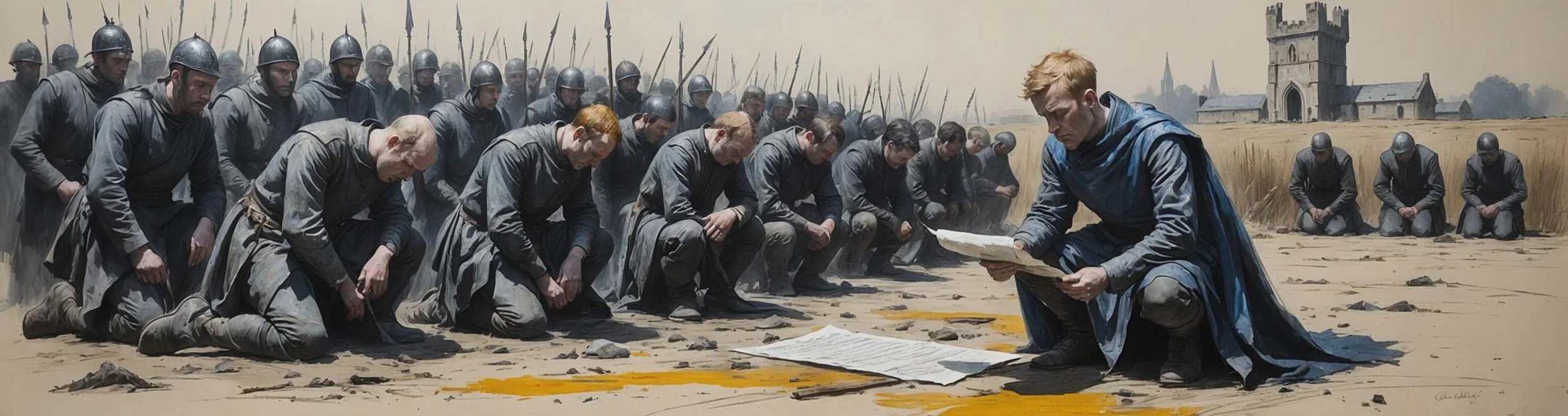
Scene Profile – At a Glance
- Location: Before King Henry’s pavilion, after the battle.
- What Happens: The glove trick detonates: Williams strikes Fluellen, the King reveals the joke and fills the glove with crowns. Then the herald brings the casualty lists – ten thousand French dead against twenty-nine English – and Henry gives the whole victory to God, on pain of death.
- Key Characters: King Henry V, Williams, Fluellen, Gower, Exeter and the heralds.
- Dramatic Function: The battle’s account is settled twice: the King’s private quarrel with a soldier, paid in gold; and the war’s ledger of dead, paid to God.
- Famous Quote:
"Here was a royal fellowship of death!"
(King Henry V, Act 4, Scene 8) - Why It Matters: The numbers that made Agincourt a legend are read out here – and Henry’s reaction to them, absolute humility enforced by decree, is the play’s last word on his piety before the peace.
Scene Summary
Williams, sent to fetch Gower, meets Fluellen – wearing Williams’s own glove in his cap, where the King planted it. Williams recognises it and strikes him, as he swore he would. Fluellen, who believes the glove belongs to the traitor Duke of Alençon’s ally, roars treason, and the confusion escalates until the King arrives to unwind his own practical joke: it was Henry whom Williams promised to strike, and Henry who wore the glove that night.
Cornered, Williams defends himself with plain-man’s logic: the King “came not like yourself” – he appeared a common man, and whatever the King suffered in that disguise, the fault belongs to the disguise, not the soldier. Henry answers not with an argument but with a gesture: the glove filled with crowns. Fluellen, mollified, adds twelve pence of his own, which Williams, still bristling, refuses.
Then the heralds bring the numbers. Ten thousand French dead – princes, nobles, knights, “a royal fellowship of death” – against an English list of four names “and of all other men but five and twenty”. Henry’s response is total ascription: “O God, thy arm was here”. He proclaims death for any soldier who boasts of the victory, orders Non nobis and Te Deum sung, and turns for Calais and home, “the happiest men alive”.
The Glove Comes Home
The joke Henry set in motion the night before arrives on schedule – on Fluellen’s head.
Original
My liege, this was my glove; here is the fellow of it; and he that I gave it to in change promised to wear it in his cap: I promised to strike him, if he did: I met this man with my glove in his cap, and I have been as good as my word.
(Williams, Act 4, Scene 8)
Shakespeare Retold (Modern Verse)
My lord, this was my glove; and here’s the corresponding glove I swapped with; and the man I gave it to promised to wear it in his cap. I promised to hit him, if he did: I met this man with my glove in his cap, and I have been true to my word.
Williams’s account of himself is exact and unashamed: he swore an oath, and he has “been as good as my word”. That phrase is the scene’s quiet keynote. The play’s common soldiers keep their words with a literalness the great scenes rarely require of the great – Williams strikes the glove because he said he would, exactly as Fluellen wore the leek until he could answer its mockery. The comedy of mistaken gloves runs on a bedrock of plebeian honour, and the King’s joke, whatever else it does, proves the thing Williams claimed in the night debate: the man he argued with keeps faith.
The Soldier’s Defence
Asked how he will make satisfaction for abusing the King, Williams declines to be guilty.
Original
Your majesty came not like yourself: you appeared to me but as a common man; witness the night, your garments, your lowliness...
(Williams, Act 4, Scene 8)
Shakespeare Retold (Modern Verse)
Your majesty wasn’t dressed like you are now: you seemed to be a common man to me. Recall that night, what you were wearing, your common appearance...
It is one of the boldest speeches a commoner makes to a monarch anywhere in Shakespeare – and it is unanswerable. The King disguised himself; whatever he heard while “appearing a common man” was addressed to the common man he appeared to be; let him “take it for your own fault and not mine”. The defence turns the play’s great night-scene inside out: Henry borrowed anonymity to hear the truth, and Williams now insists that truth spoken to the borrowed face cannot be charged against the speaker. Henry’s response – gold in the glove, no argument offered – can be read as royal grace, or as the quiet concession of a king who knows the soldier has the better of the exchange. The play, characteristically, buys the moment rather than settling it.
The Reckoning
The herald’s papers turn the miracle into arithmetic.
Original
None else of name; and of all other men
But five and twenty. O God, thy arm was here;
And not to us, but to thy arm alone,
Ascribe we all!
(King Henry V, Act 4, Scene 8)
Shakespeare Retold (Modern Verse)
No other nobleman; and of the others,
Just twenty-five. Oh God, you did this work;
It wasn’t us, but you alone who did this,
We all agree!
Ten thousand French dead are enumerated by rank – the constable, the admiral, dukes, earls, five hundred knights dubbed only yesterday – and Henry reads the roll with something like awe: “Here was a royal fellowship of death!” Against it, the English list is four names and twenty-five men. The disproportion is Holinshed’s, not Shakespeare’s invention, though historians dispute the true figures; what Shakespeare adds is the response. “O God, thy arm was here” – and the immediate conversion of statistics into liturgy: procession, psalm, and a capital ban on boasting. The scene gives the play’s piety its most extreme statement precisely where the evidence seems most miraculous – and leaves open, one last time, where devotion ends and the management of a victory’s meaning begins.
Language and Technique
- Comic engine of error: The glove plot runs on classic mistaken-identity machinery – two gloves, two heads, one oath – releasing the tension of Agincourt in farce before the casualty lists arrive.
- Plain prose against court verse: Williams defends himself in blunt prose; Henry answers in verse and gold. The registers mark the gap the night debate opened – and never quite closed.
- The catalogue: The roll-call of French dead – name after name, rank after rank – is an epic device: the list itself performs the scale of the slaughter no stage could show.
- Liturgy as closure: The scene ends in church Latin – Non nobis (“not unto us”) and Te Deum – converting a battlefield into a service and a victory into an offering.
Key Quotes from Act 4, Scene 8
Quote 1
Original
Here, uncle Exeter, fill this glove with crowns,
And give it to this fellow. Keep it, fellow;
And wear it for an honour in thy cap
Till I do challenge it.
(King Henry V, Act 4, Scene 8)
Shakespeare Retold (Modern Verse)
Here, Exeter, fill up this glove with gold coins,
And give it to this man. You keep it, mate;
And wear it as a token in your cap
Until I challenge you again.
Quote Analysis: Henry’s settlement of the glove affair: no apology, no admission – money. Filling the soldier’s glove with crowns converts an unanswerable argument into a reward, and “wear it for an honour in thy cap” rebrands the whole embarrassment as a favour. It is graceful, generous – and unmistakably royal: the King ends the quarrel by purchase, exactly as he will shortly end the war by treaty. Note that Williams accepts the King’s gold but refuses Fluellen’s shilling: he knows the difference between a settlement and a tip.
Original
Here was a royal fellowship of death!
(King Henry V, Act 4, Scene 8)
Shakespeare Retold (Modern Verse)
That makes a royal band-of-brothers slaughtered!
Quote Analysis: Henry’s epitaph for the French nobility, and one of the play’s most double-edged lines. “Fellowship” is the warm word of the Crispin’s Day speech – the “band of brothers” – here applied to ten thousand enemies united only in death. The Retold’s “band-of-brothers slaughtered” makes the echo explicit. Whether the line is spoken in reverence, pity or grim wonder is a performance choice; on the page it does all three, and it quietly prices what brotherhood in arms actually costs.
Original
Do we all holy rites;
Let there be sung 'Non nobis' and 'Te Deum;'
The dead with charity enclosed in clay...
(King Henry V, Act 4, Scene 8)
Shakespeare Retold (Modern Verse)
Now let’s perform the holy rites;
Ensure we sing ‘Non nobis’ and ‘Te Deum;’
And bury those who died with dignity...
Quote Analysis: The battle’s last order is a church service. Non nobis – “not unto us, O Lord” – is the psalm of deflected glory, and Te Deum the great hymn of thanksgiving; between them they perform officially what Henry has just proclaimed on pain of death: the victory belongs to God alone. The dead – both nations’ – get one line and a charitable burial. The play’s war ends not with a cheer but with plainsong, and the discipline of that ending is itself the closing image of Henry’s kingship.
Key Takeaways
- The joke lands on schedule: Williams keeps his oath, Fluellen takes the blow, and the King’s prank resolves in gold – comedy discharging the night debate’s tension.
- Williams never surrenders: His defence – blame the disguise, not the soldier – goes unanswered. The crowns settle the quarrel; they do not win the argument.
- The numbers make the myth: Ten thousand against twenty-nine: the lists, taken from Holinshed, turn victory into miracle – and the play has Henry enforce that reading by decree.
- Piety is policy’s twin: Death for boasting, psalms for thanksgiving – humility itself is organised, proclaimed and sung. Sincerity and stagecraft remain, to the end, one act.
Study Questions and Analysis
How does the glove trick end – and does Williams win the argument?
In farce, gold, and an unresolved question. Williams keeps his oath and strikes the glove – on Fluellen, where the King planted it – and when Henry reveals himself, the soldier is suddenly answerable for having “abused” the crown. His first defence is disarming:
Original
All offences, my lord, come from the heart: never came any from mine that might offend your majesty.
(Williams, Act 4, Scene 8)
Shakespeare Retold (Modern Verse)
My lord, all offences come from the heart, but my offences never meant to offend your majesty.
His second is better: the King “came not like yourself” – whatever was said in the dark was said to the common man Henry chose to appear, so the fault travels with the costume. Anne Barton, in her 1975 essay on the king disguised, showed how this scene plays against a whole popular tradition of comical histories in which a disguised king meets a plain subject and the meeting ends in warm mutual recognition. Shakespeare stages the tradition and withholds the warmth: Henry answers the argument with crowns rather than concession, Williams pockets the settlement but refuses Fluellen’s tip, and no one says who was right. The old story’s cosy ending is exactly what the play declines to provide.
Why does Henry fill the glove with crowns instead of punishing Williams?
Because every other option is worse – and because the gesture does royal work no punishment could. Punishing Williams would prove the soldier’s night-time point about kings and make the disguise retrospectively a trap; debating him would concede that a king argues with private men; pardoning him formally would imply there was a real offence. Gold reframes the whole affair as a jest between the crown and a sturdy subject – generosity as the last word.
It is also, quietly, payment. Williams’s defence – take it for your own fault, not mine – is never answered because it cannot be; the crowns arrive precisely where the argument would have to. The play has shown this exchange rate before: responsibility transferred to Canterbury with a war attached, guilt handed to the Dauphin with the tennis balls, and now an awkward truth bought back with a glove of coins. Henry’s genius, first to last, is converting what he cannot refute into what he can afford.
Are the casualty figures – ten thousand French, twenty-nine English – accurate?
They are Holinshed’s figures, versified almost without alteration, and historians dispute them. The French dead were certainly enormous and the English losses certainly small – the battlefield, the mud and the longbow made Agincourt a genuine catastrophe for the French nobility – but modern estimates put English deaths in the low hundreds rather than at twenty-nine, and treat the neat ten thousand with caution. Shakespeare’s interest is not audit but meaning:
Original
This note doth tell me of ten thousand French
That in the field lie slain...
(King Henry V, Act 4, Scene 8)
Shakespeare Retold (Modern Verse)
This note suggests ten thousand Frenchmen lay
Slain in the battlefield...
The play needs the disproportion, because the disproportion is the theology: numbers this lopsided are either luck, lie or miracle, and Henry instantly rules out the first two – “O God, thy arm was here”. For essays, the useful move is to notice what the list itself emphasises: the French dead are catalogued by rank, name by name, while the English dead of rank get four names and the rest are “other men”, counted but nameless. Even in death, the play’s ledger is kept by class – a detail worth setting against the democratic promise of the “band of brothers”.
Why does Henry make boasting about the victory punishable by death?
Taken at face value, it is the logical end of his piety: if God alone won the battle, then a boasting soldier is not merely vain but blasphemous – claiming what belongs to heaven. The proclamation makes humility compulsory:
Original
And be it death proclaimed through our host
To boast of this or take the praise from God
Which is his only.
(King Henry V, Act 4, Scene 8)
Shakespeare Retold (Modern Verse)
And state our soldiers will be put to death
If they boast of it, or take praise from God
Who did this for us.
Read sceptically, the decree is also the final act of message control in a play full of it. A victory this improbable will be talked about; Henry determines how. The official account – God’s arm, English humility – is now the only account, enforced by martial law, and Harold C. Goddard, in The Meaning of Shakespeare (1951), read exactly this reflex as the key to the King: the conscience and the public relations always arriving in the same gesture, indistinguishable even perhaps to Henry himself. The play gives no verdict. Fluellen’s cheerful question – may we at least tell how many were killed? – and Henry’s permission (“with this acknowledgement, that God fought for us”) let the scene end in comedy rather than decree, but the decree stands.
What does this scene contribute to the play as a whole?
It closes the war’s two accounts – the private and the public – and in both, it shows the crown paying. The glove plot completes the night debate of Act 4, Scene 1: the question Williams raised (what does the King owe the men who die for him?) is never answered in argument, but the King literally fills a soldier’s glove with money – the nearest thing to an answer the play provides, and a deliberately ambiguous one. The casualty lists then close the battle itself, converting slaughter into miracle and miracle into liturgy.
Structurally, the scene is the hinge between war and peace: it begins with a blow and ends with “And then to Calais; and to England then” – the play’s pivot toward home, the Act 5 Chorus and the wooing. It is also the last time we see Henry among his soldiers, and the pairing is pointed: gold for Williams, psalms for the army, names for the noble dead, a number for the rest. Every essay on kingship, class or religion in this play can end its evidence here, because the scene is the play’s own settlement of accounts.