
Henry V: Act 5, Prologue – Analysis
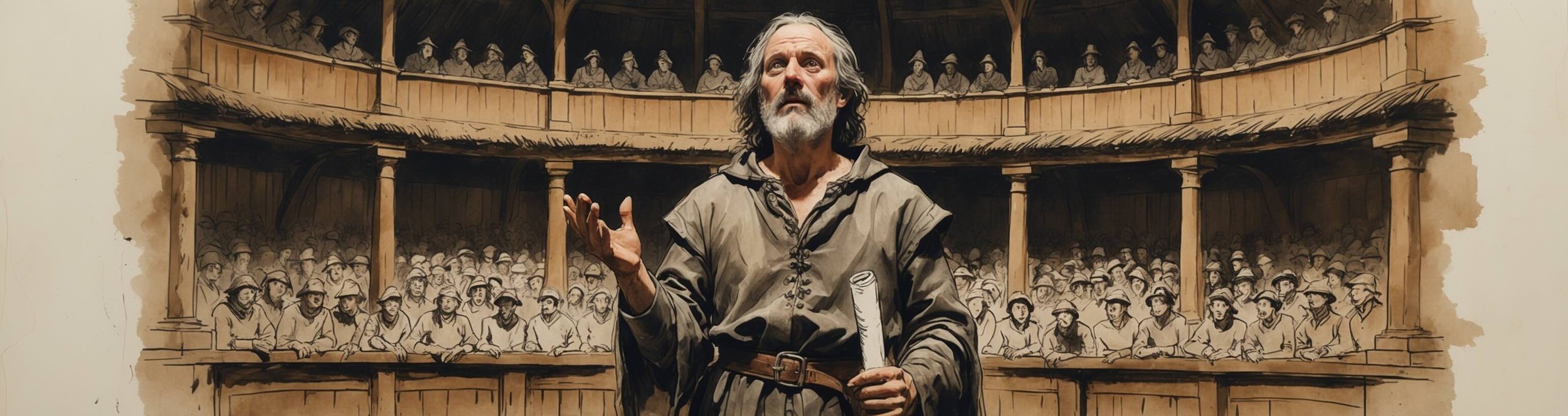
Scene Profile – At a Glance
- Location: The bare stage. The Chorus bridges the years between Agincourt and the peace.
- What Happens: The Chorus carries Henry home in triumph – the beach crowded, London pouring out her citizens like Rome fetching in Caesar – notes the King’s refusal of a victory parade, compares the scene to a living general returning from Ireland, and then hurries us back to France for the treaty.
- Key Characters: The Chorus alone.
- Dramatic Function: A bridge over five years of history – and the play’s most daring moment of topicality, stepping out of 1415 entirely to gesture at the London of 1599.
- Famous Quote:
"How London doth pour out her citizens!"
(the Chorus, Act 5, Prologue) - Why It Matters: The comparison of Henry to “the general of our gracious empress” returning from Ireland is the most direct reference to a living contemporary anywhere in Shakespeare – and the key evidence for dating the play.
Scene Summary
The Chorus opens with its usual apology – those who know the history must forgive the play’s compression of “time, of numbers and due course of things” – and then performs its most sweeping act of stage management yet, moving the King from Agincourt to Calais, across the Channel, through London, and back to France, all in forty-five lines.
The homecoming is the speech’s heart. The English beach is packed with men, wives and boys whose shouts out-voice the sea; London pours out her citizens, the mayor and his brethren “like to the senators of the antique Rome”, fetching in their conquering Caesar. But the conqueror himself refuses the show: he forbids his bruised helmet and bended sword to be carried before him, “being free from vainness and self-glorious pride”, and gives the whole victory – trophy, signal and ostent – to God.
Then, astonishingly, the Chorus steps out of history altogether: just so – “by a lower but loving likelihood” – would London empty itself if the general of our gracious empress were to come back from Ireland with rebellion skewered on his sword. The Holy Roman Emperor’s peace mission is dispatched in two lines, the intervening years are omitted, and the Chorus asks us to brook abridgement and return, eyes after thoughts, to France.
The Conquering Caesar
The Chorus paints the greatest crowd scene in the play – one no stage could hold, which is exactly why the Chorus must paint it.
Original
How London doth pour out her citizens!
The mayor and all his brethren in best sort,
Like to the senators of the antique Rome,
With the plebeians swarming at their heels,
Go forth and fetch their conquering Caesar in...
(the Chorus, Act 5, Prologue)
Shakespeare Retold (Modern Verse)
How London’s citizens all swarm the streets!
The mayor and his colleagues in their finest,
Like senators adorned in ancient Rome,
With commoners amassing all around them,
Go out and carry home the conquering Caesar....
The picture is all energy: London does not welcome Henry, she “pours out” her citizens, and the city becomes Rome, the mayor and aldermen becoming senators, the crowd becoming plebeians, the King becoming Caesar. The classical costume does double work. It magnifies – this is the biggest thing that has ever happened to London – and it quietly complicates, because Caesar returned in triumph to a republic that his triumphs would end. As ever with the Chorus, the official magnificence carries a shadow it never acknowledges; the play has taught us by now to notice what the comparisons let in.
The King Who Refuses a Triumph
Inside the pageant, the Chorus places a refusal – the victor declining his own victory parade.
Original
Where that his lords desire him to have borne
His bruised helmet and his bended sword
Before him through the city: he forbids it...
(the Chorus, Act 5, Prologue)
Shakespeare Retold (Modern Verse)
Where there his lords request that he will carry
His damaged helmet and his twisted sword
With him towards the city: he forbids it...
His lords want the relics of Agincourt – the dented helmet, the bent sword – borne before him like a Roman triumph; Henry forbids it, passing “full trophy, signal and ostent” from himself to God. The humility is consistent with the King we have watched: the man who ordered Non nobis sung on the field now refuses the parade. But the Chorus’s framing deserves the scrutiny the play has trained us in. A refused triumph, publicly refused, is itself a performance – the most sophisticated one available to a king whose brand is piety – and the Chorus reports the modesty in language so admiring that the modesty becomes the spectacle. Whether that is Henry’s calculation or the Chorus’s adoration, the play leaves open: the pattern of announced humility and magnificent effect is simply set before us, one more time.
Language and Technique
- Epic simile: London as Rome, the mayor as senators, Henry as Caesar – the Chorus reaches for the grandest classical comparison in the play, and its shadows (Caesar’s ending) come with it.
- The topical breach: The “general of our gracious empress” drops the fiction of 1415 entirely – a present-tense London hope spoken from the stage, unique in Shakespeare.
- Compression announced: The Chorus names its own method – “the excuse of time, of numbers and due course of things”, “brook abridgment” – five years and an imperial peace mission folded into a sentence.
- Sound as spectacle: The crowd is heard before it is seen: shouts and claps “out-voice the deep mouthed sea” – the Chorus builds the scene from noise, the one thing the theatre could actually supply.
Key Quotes from Act 5, Prologue
Quote 1
Original
Athwart the sea. Behold, the English beach
Pales in the flood with men, with wives and boys,
Whose shouts and claps out-voice the deep mouthed sea...
(the Chorus, Act 5, Prologue)
Shakespeare Retold (Modern Verse)
Across the sea. We see the English beach
Awash with men, with wives and boys at high tide,
Whose shouts and claps drown out the roaring sea...
Quote Analysis: The homecoming begins with sound: a beach “pales in the flood” – fenced in by its own crowds at the tide-line – and the human noise beats the sea’s. The detail of “men, with wives and boys” matters: this is the England the army left behind in Act 2, when all the youth were on fire and the country was selling its pasture to buy horses. The families who paid for the war are given one line of joy – and the play’s next scene of ordinary English life will be Pistol, coming home to nothing.
Original
Were now the general of our gracious empress,
As in good time he may, from Ireland coming,
Bringing rebellion broached on his sword...
(the Chorus, Act 5, Prologue)
Shakespeare Retold (Modern Verse)
If the commanding general of our queen –
One day he might – come back from Ireland
Announcing he’s defeated their rebellion...
Quote Analysis: The most debated three lines in the play. The “general of our gracious empress” is almost universally read as the Earl of Essex, who left London in March 1599 to crush Tyrone’s rebellion in Ireland – making this the clearest reference to a contemporary event in all of Shakespeare, and the anchor for dating the play to 1599. Note the Chorus’s careful hedging: “as in good time he may” – a hope, not a prophecy. The caution proved wise; Essex came home in disgrace within months, and within two years he was executed for rebellion himself.
Original
Then brook abridgment, and your eyes advance,
After your thoughts, straight back again to France.
(the Chorus, Act 5, Prologue)
Shakespeare Retold (Modern Verse)
Forgive this summary, and now advance
Beyond your thoughts, and journey back to France.
Quote Analysis: The Chorus’s exit couplet compresses its whole method into a rhyme: accept the abridgement, and let your eyes chase your thoughts back to France. “After your thoughts” is the play’s theory of theatre in three words – imagination travels first and the staging follows – exactly the contract proposed in the opening Prologue, now so established it can be renewed in a single breath.
Key Takeaways
- Five years in forty lines: Agincourt to the treaty – the return, the triumph, the emperor’s peace mission – all compressed by the play’s most confident stage management.
- The refused parade: Henry declines his triumph and gives the victory to God – genuine piety, perfect politics, or both: the play’s standing question, restated in a single image.
- Shakespeare’s one topical bet: The Essex comparison steps out of the fiction entirely – and dates the play to the spring of 1599, before the Irish campaign failed.
- Rome casts a shadow: The conquering-Caesar simile magnifies Henry – using a hero whose triumphs destroyed his republic and ended in assassination.
Study Questions and Analysis
What does the Act 5 Prologue actually do for the play?
It solves a structural problem no scene could: the story’s climax (Agincourt) and its resolution (the Treaty of Troyes) are five years apart, separated by a return home, a second campaign the play never mentions, and long diplomacy. The Chorus folds all of it – “the excuse of time, of numbers and due course of things” – into one speech, keeping only what the play needs: the hero’s welcome, the King’s humility, and the journey back to France for the wooing.
The choice of what survives the compression is the interpretation. History’s second invasion – the grinding sieges of Normandy that actually forced the treaty – vanishes entirely; what remains is a homecoming pageant and a king refusing praise. The Chorus, as always, is not summarising the history; it is curating it, and the play that follows – where Henry arrives in France as a wooing bridegroom rather than a returning conqueror – depends on the curation. For essays on the Chorus as narrator, this speech is the cleanest example of its editorial power.
Why does Henry refuse to have his helmet and sword carried through London?
Because the victory, in his account of it, belongs to God. The lords want the Roman form – the relics of battle borne before the general – and Henry forbids it:
Original
Being free from vainness and self-glorious pride;
Giving full trophy, signal and ostent
Quite from himself to God.
(the Chorus, Act 5, Prologue)
Shakespeare Retold (Modern Verse)
For he’s devoid of vanity and pride,
Declaring that the victory and emblems
Aren’t his but come from God.
The gesture is entirely consistent: this is the king who cried “Non nobis” and “Te Deum” at Agincourt and threatened death to any who boasted of the victory. But the play has spent four acts teaching us to watch its hero’s humility as technique, and the pattern holds here: the refusal of display, publicly made and admiringly reported, is the most effective display of all. “Being free from vainness and self-glorious pride” is the Chorus’s gloss, not a fact – and a monarch who converts triumph into piety collects both the victory and the virtue. Genuine devotion and perfect image-management are, as ever with Henry, the same visible act; the play declines to open the box.
Who is "the general of our gracious empress", and why does it matter?
Robert Devereux, Earl of Essex – on the overwhelming consensus of scholars – who marched out of London in March 1599, cheered by exactly the crowds the Chorus describes, to put down the Earl of Tyrone’s rebellion in Ireland. The “gracious empress” is Elizabeth I; the hoped-for return, “rebellion broached on his sword”, is the victory everyone expected. It is generally described as the most direct reference to a living contemporary anywhere in Shakespeare’s plays.
It matters twice over. First, for dating: the lines only make sense while Essex was still in Ireland and still expected to triumph – between March and September 1599 – which pins the play’s composition more precisely than any other Shakespeare play. Second, for meaning: Christopher Highley, in Shakespeare, Spenser, and the Crisis in Ireland (1997), reads the whole play through this moment – a drama about a unifying, conquering king written for a nation anxious about an unfinished war and an uncertain succession. The comparison proved a hostage to fortune: Essex returned in failure, and the hope the Chorus voiced curdled within months. The printed line survives as a snapshot of a national mood at its last confident moment.
How does the Chorus handle the gap in time – and what does it leave out?
By owning the gap openly. The Chorus asks pardon for abridging “the full course of things”, personifies itself as the play’s timekeeper, and asks the audience to accept the edit:
Original
There must we bring him; and myself have played
The interim, by remembering you 'tis past.
(the Chorus, Act 5, Prologue)
Shakespeare Retold (Modern Verse)
Let’s all imagine that he’s there; and I
Have been the interval, explaining history.
“Myself have played the interim” – the Chorus literally performs the missing years, standing in for everything the play cannot stage. What the interim contains, history says, is substantial: Henry’s second, far harsher French campaign – years of sieges – plus the Emperor Sigismund’s peace embassy (given two lines) and the long negotiation of the treaty. The play’s Agincourt therefore flows almost directly into the play’s peace, as if the miracle victory settled the war – a compression that makes the story cleaner and the king’s triumph more absolute than the history was. Knowing what the abridgement removes is one of the sharpest cards an essay on the Chorus can play.
Does the humility the Chorus praises match the Henry we have seen?
It matches the Henry we have seen perform – which is the play’s point, and its permanent puzzle. The king who gives “full trophy, signal and ostent” to God here is the same king who ordered the singing of Non nobis on the field, prayed before the battle over his father’s guilt, and told his soldiers that the fewer men, the greater share of honour. The piety is continuous and, as far as the play shows, sincere – no soliloquy ever catches Henry winking.
But Joel B. Altman, in his landmark 1991 essay Vile Participation, showed how carefully the play manages what the audience is invited to feel – and the Chorus is the managing voice. Its Henry is always the official Henry: the sweet touch of Harry in the night, the modest victor, the mirror of all Christian kings. The scenes between the Chorus’s speeches keep supplying the other data – the threats at Harfleur, the order to kill the prisoners, the traitors dispatched without mercy – that the official portrait omits. The humility is real and it is also curated; by Act 5 the play trusts us to hold both, which is precisely why it keeps the Chorus talking to the end.
