Henry V: Act 5, Scene 1 – Analysis
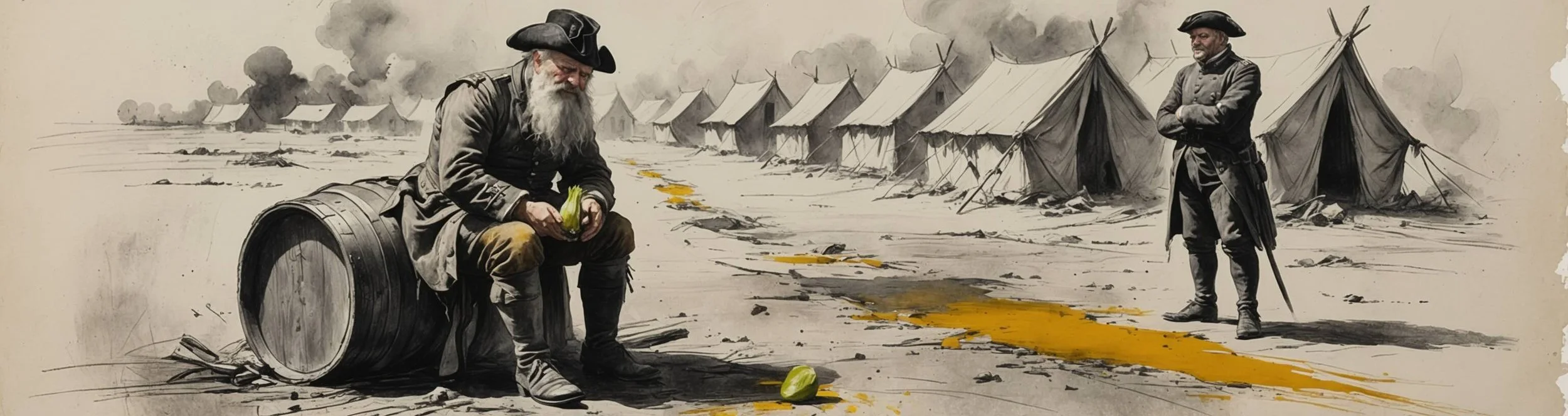
Scene Profile – At a Glance
- Location: The English camp in France, after the victory.
- What Happens: Fluellen, insulted the day before, cudgels Pistol into eating a leek. Gower reads Pistol a lesson in respect – and Pistol, alone, reveals that Nell is dead and resolves to slink home to England as a thief.
- Key Characters: Fluellen, Pistol and Gower.
- Dramatic Function: The comic plot’s ending – and its judgement. The last of the Eastcheap crew is beaten, humiliated and sent home to steal, while the play prepares its royal wedding.
- Famous Quote:
"To England will I steal, and there I'll steal..."
(Pistol, Act 5, Scene 1) - Why It Matters: The play’s low comedy closes in defeat and loss. Whatever the treaty scene celebrates, this scene has already shown the war’s survivors – and what victory left them.
Scene Summary
The war is over, but Fluellen is still wearing his leek – Saint Davy’s day is past, as Gower points out. The Welsh captain explains: yesterday, in a place where he could not make a quarrel, the “rascally, scald, beggarly, lousy, pragging knave” Pistol brought him bread and salt and bade him eat his leek. Fluellen has worn it since, waiting to meet him.
Pistol arrives, swelling “like a turkey-cock”, and gets his meeting. Fluellen beats him with a cudgel until he eats the leek – every mocking protest answered with another blow and another courteous Welsh “I pray you” – then gives him a groat to heal his broken head. When Pistol is alone, Gower adds the verdict: he is a “counterfeit cowardly knave” who mocked an honourable tradition and mistook a Welshman’s accent for a Welshman’s weakness. Let a Welsh correction teach him “a good English condition”.
Then the scene turns. Alone, Pistol drops the bombast: his Nell is dead of disease, he is old, and honour has been “cudgelled” from his limbs. He will go home to England and turn bawd and cutpurse – and pass off his beating scars as wounds from “the Gallia wars”. The last of Falstaff’s world exits the play limping, bereaved, and planning to lie about it.
The Leek
Fluellen’s revenge is served with terrifying politeness.
Original
I peseech you heartily, scurvy, lousy knave, at my desires, and my requests, and my petitions, to eat, look you, this leek...
(Fluellen, Act 5, Scene 1)
Shakespeare Retold (Modern Verse)
I humbly request, you disgusting, lousy rascal, to satisfy my wish, desire and request, to eat, you see, this leek, because, you see, you do not...
The comedy is in the register: every blow of the cudgel is wrapped in the language of petition – desires, requests, petitions, “I pray you” – as if the beating were a formal Welsh courtesy. But the leek itself is serious. It is the emblem of Fluellen’s nation, worn “for a memorable honour” as he told the King on Saint Davy’s day, and Pistol’s mockery of it was mockery of everything Fluellen has fought as: a Welshman in an English king’s army. Making Pistol eat it – skin and all, with sauce of cudgel – converts the insult back into tribute. The scene is farce with a spine: honour, in this play, belongs to the men who serve, not the men who swagger.
A Welsh Correction
Gower – English, measured, and entirely on Fluellen’s side – delivers the scene’s formal sentence.
Original
Go, go; you are a counterfeit cowardly knave. Will you mock at an ancient tradition, begun upon an honourable respect, and worn as a memorable trophy of predeceased valour...
(Gower, Act 5, Scene 1)
Shakespeare Retold (Modern Verse)
Clear off; you are a cheating, cowardly rascal. Will you make fun of an old tradition, born out of honourable respect, and worn to commemorate the bravery of those who died before us, while not daring...
The speech matters because of who gives it. Gower is the play’s steadiest plain soldier, and his rebuke makes the beating a judgement rather than a brawl: Pistol mocked “an ancient tradition, begun upon an honourable respect”, and assumed that a man who “could not speak English in the native garb” could not handle an English cudgel. The line cuts to one of the play’s deepest concerns – the four accents of Henry’s army, and what they are worth. Pistol, the pure-blooded Londoner, has all the English and none of the honour; Fluellen, mocked for his “pribbles and prabbles”, has the valour the accent disguised. Let a Welsh correction, says the Englishman, teach an English condition.
Pistol Alone
With everyone gone, the play’s great survivor takes stock – and for once, the bombast fails.
Original
Old I do wax; and from my weary limbs
Honour is cudgelled. Well, bawd I'll turn,
And something lean to cutpurse of quick hand.
(Pistol, Act 5, Scene 1)
Shakespeare Retold (Modern Verse)
I’m growing old, and from my aching limbs
My reputation’s battered. I’ll run brothels,
And I’ll start picking pockets stealthily.
It is the only moment in the play where Pistol speaks plainly, and what he says is desolate: Nell dead of “malady of France”, his lodging gone, age upon him, honour beaten out. The plan he makes is perfectly in character – steal home, steal at home, and dress the shame as war wounds – but the swagger now reads as what it always was: a poor man’s armour. Falstaff died in Act 2; Bardolph and Nym were hanged; the Boy was killed with the luggage; Nell is dead. Pistol’s exit completes the destruction of the Eastcheap world, and the play lets him leave without punishment or pity – just a plan, a limp, and a lie to sell.
Language and Technique
- Comic register clash: Fluellen’s courteous Welsh formulas (“look you”, “I pray you”) collide with the cudgel blows they accompany – politeness as punchline.
- Mock-heroic bluster: Pistol’s classical bombast – “base Trojan”, Parca’s “fatal web” – inflates a leek quarrel to epic scale, and the gap between register and reality is the joke.
- Dialect spelling: The text spells Fluellen’s accent phonetically – “peseech”, “pless”, “ploody” – keeping his Welshness audible at the exact moment the scene defends its dignity.
- The turn to plain verse: Pistol’s final soliloquy drops the rant for bare statement – “Old I do wax” – and the sudden plainness is more affecting than any of his thunder.
Key Quotes from Act 5, Scene 1
Quote 1
Original
Ha! Art thou bedlam? Dost thou thirst, base Trojan,
To have me fold up Parca's fatal web?
Hence! I am qualmish at the smell of leek.
(Pistol, Act 5, Scene 1)
Shakespeare Retold (Modern Verse)
Ha! Are you mad? Do you desire, weak scumbag,
I kill you, folding up Fates’ fatal blanket?
Clear off! The smell of leeks makes me all queasy.
Quote Analysis: Pistol’s war-cry at the sight of the leek: is Fluellen mad? Does he thirst to have Pistol cut his thread of life – “Parca’s fatal web”? The mythological machinery (the Parcae are the Fates) deployed against a vegetable is Pistol’s essential joke, but there is a real threat in it – and the scene’s comedy comes from watching the threat collapse. He is “qualmish at the smell of leek”; within twenty lines he will be eating it.
Original
You called me yesterday 'mountain-squire'; but I will make you to-day a squire of low degree. I pray you, fall to: if you can mock a leek, you can eat a leek.
(Fluellen, Act 5, Scene 1)
Shakespeare Retold (Modern Verse)
Just yesterday you called me a mountain-man; but I will make you a low-man today. So come on, eat up: if you can make fun of a leek, you can eat a leek too.
Quote Analysis: Fluellen’s logic of correction, delivered mid-beating: yesterday Pistol called him “mountain-squire” – a sneer at Welsh poverty – so today Fluellen makes him “a squire of low degree” by knocking him down. The wordplay turns Pistol’s own insult into the sentence it earns, and the closing rule – if you can mock a leek, you can eat a leek – has the shape of a proverb: mockery of a symbol is answered in the symbol’s own currency.
Original
To England will I steal, and there I'll steal:
And patches will I get unto these cudgelled scars,
And swear I got them in the Gallia wars.
(Pistol, Act 5, Scene 1)
Shakespeare Retold (Modern Verse)
I’ll steal away to England and start stealing:
I’ll plaster clobbered scars, so I’ll enhance
My claim I got them in the wars in France.
Quote Analysis: The comic plot’s last lines, and among the bleakest in the play. Pistol’s double “steal” – sneak home, then thieve at home – compresses his future into a pun, and the final image is of counterfeit honour: patches on cudgel scars, sold as wounds from “the Gallia wars”. The man who survives the play’s every battle leaves it planning to fake his part in them – a quiet, savage commentary on how war stories get made.
Key Takeaways
- The leek is not a joke: Fluellen’s revenge defends a national emblem – the scene punishes contempt for the Welsh identity the army depended on.
- Gower makes it a verdict: The English captain’s rebuke turns the farce into judgement: honour belongs to the men who serve, whatever their accent.
- Eastcheap ends here: Nell’s death completes the toll – Falstaff, Bardolph, Nym, the Boy, now Nell – and Pistol exits as the world’s sole, ruined survivor.
- Victory has an underside: Placed directly before the treaty scene, Pistol’s exit shows what the glorious war leaves its smallest veterans: scars, loss, and a story to fake.
Study Questions and Analysis
Why does Fluellen make Pistol eat the leek?
Because the leek is Wales. Welshmen wore it on Saint Davy’s day as a badge of national honour – in Act 4 Fluellen wears his proudly and the King himself, “for I am Welsh, you know”, honours the custom. Pistol’s bread-and-salt mockery the day before was therefore not teasing but contempt for Fluellen’s nation, delivered when Fluellen could not answer it. The Welsh captain simply waits, wearing the leek past its day, until the answer can be given:
Original
I say, I will make him eat some part of my leek, or I will peat his pate four days. Bite, I pray you; it is good for your green wound and your ploody coxcomb.
(Fluellen, Act 5, Scene 1)
Shakespeare Retold (Modern Verse)
I tell you, I’ll force him to eat some of my leek, else I will beat him in the head for four days. Eat some, I tell you: it is good for your fresh wounds and your bloody head.
The correction is exact: the emblem Pistol mocked becomes the thing he must swallow, blow by blow, down to the skin – “it is good for your green wound and your ploody coxcomb”. And when it is done, Fluellen gives him a groat for his broken head: the gesture of a man who was enforcing respect, not taking revenge. The scene closes the quarrel the way the play likes to close quarrels – with the symbol vindicated and the mocker fed his own words.
What happens to Pistol at the end – and why does it matter?
Alone on stage, Pistol tells us everything in eleven lines. Fortune has turned housewife – fickle and spinning – and the news is a catalogue of loss:
Original
Doth Fortune play the huswife with me now?
News have I, that my Nell is dead i' the spital
Of malady of France...
(Pistol, Act 5, Scene 1)
Shakespeare Retold (Modern Verse)
Is Lady Luck my cheating floozy now?
I’ve heard my wife Nell died in hospital
Of syphilis...
Nell – the Hostess, once Mistress Quickly, whom he married over Nym’s prior claim in Act 2 – has died of the “malady of France” while he was away winning nothing. His “rendezvous”, the tavern that anchored the whole Eastcheap world, is “quite cut off”. What follows is his business plan: bawd, cutpurse, and professional war hero, his cudgel scars patched over and sworn as wounds from the Gallia wars. It matters because Pistol is the last of them – the final walking remnant of Falstaff’s world – and the play sends him off not with a punishment but with a future built on theft and a lie. The glorious war’s most durable veteran is its most fraudulent witness.
What is the point of Gower’s final rebuke?
It converts the beating from slapstick into the play’s considered judgement. Gower is English, sober, and nobody’s partisan – and his verdict is that Pistol is a “counterfeit cowardly knave” who mocked “an ancient tradition, begun upon an honourable respect”, and made the classic scorner’s error: he thought a man who “could not speak English in the native garb” could not handle an English cudgel. Because the Welshman’s English was broken, Pistol assumed the Welshman was.
That assumption is one the play has been dismantling since the four captains first argued in their four accents at Harfleur. Michael Neill, in his 1994 essay Broken English and Broken Irish, reads the play’s medley of Englishes – Welsh, Irish, Scots and English – as its way of testing what the new “British” nation could possibly be; and Gower’s sentence is the test’s answer in miniature: the accent is not the man. “Let a Welsh correction teach you a good English condition” – the Englishman, siding with the Welshman, against the Londoner who confused nationality with worth.
Is this scene comedy or something darker?
It is a comedy that curdles on schedule. The leek business is genuine farce – the bombast, the cudgel, the courteous menu of “desires, and my requests, and my petitions” – and on stage it reliably brings the house down. But Shakespeare places the laughter precisely, and then withdraws it: Gower’s rebuke sobers the scene, and Pistol’s soliloquy empties it. The clown we have been laughing at turns to the audience and reports a dead wife, an old body, and a future of petty crime.
Harold C. Goddard, in The Meaning of Shakespeare (1951), read the play’s comic scenes as its running commentary on the official story – the underplot showing what the pageant costs – and this scene is that method’s last performance. While the court prepares a wedding, the war’s smallest survivor inventories his losses and plans his fraud. Neither cancels the other: the farce is real, and so is the desolation, and the scene’s honesty is in refusing to choose – exactly the double vision the whole play has practised.
How does this scene close the Eastcheap story?
With extinction. Count the crew who set out from London in Act 2: Falstaff died before embarking, his heart “fracted”; Bardolph was hanged for robbing a church; Nym was hanged with him; the Boy – the sharpest of them – was killed guarding the luggage at Agincourt; and now Nell is dead at home. Pistol alone survives, beaten, widowed and headed for the trade of bawd and cutpurse. Of the tavern world that gave the Henry IV plays their warmth, nothing else remains.
A. C. Bradley, in his 1909 essay The Rejection of Falstaff, famously confessed that “our hearts go with Falstaff to the Fleet” – and this scene is where that rejection reaches its terminus: not just Falstaff but his entire world dismantled, person by person, while the king who once drank with them marries a princess two scenes away. For essays on class and brotherhood, the scene is indispensable – the “band of brothers” speech promised that whoever shed his blood with the King would be his brother; Pistol’s exit is the play’s accounting of what that promise was worth to Eastcheap.