Henry V: Act 5, Scene 2 – Analysis
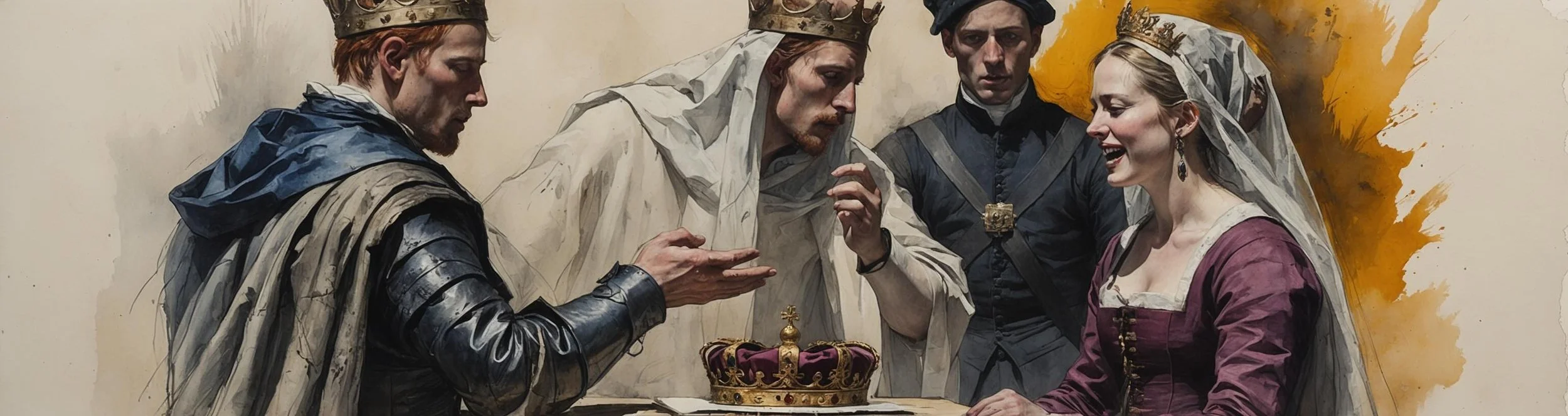
Scene Profile – At a Glance
- Location: A royal palace in France. The two courts meet to make peace.
- What Happens: Burgundy’s plea for peace opens the treaty talks; while the councils negotiate offstage, King Henry woos Princess Katharine in broken English and French. The French King grants every article – his daughter first – and the play ends in betrothal and a prayer for lasting peace.
- Key Characters: King Henry V, Princess Katharine, Alice, the Duke of Burgundy, the King and Queen of France, Exeter and Westmoreland.
- Dramatic Function: The resolution: war becomes marriage, conquest becomes contract. The play’s longest scene converts everything won by the sword into words, articles and a kiss.
- Famous Quote:
"Yet leave our cousin Katharine here with us:
She is our capital demand, comprised
Within the fore-rank of our articles."
(King Henry V, Act 5, Scene 2) - Why It Matters: The wooing of Katharine is the play’s most charming scene and its most debated: a genuine romance, a victor’s demand dressed as courtship, or both at once. How you read this scene decides how you read the play.
Scene Summary
The courts of England and France meet at last in peace. After the formal greetings, the Duke of Burgundy – the broker of the meeting – delivers a long, extraordinary speech describing France as a ruined garden: vines unpruned, hedges wild, fields overrun with weeds, and a generation of children growing up “like savages” because war has driven out every civilising art. Why, he asks, should gentle Peace not be restored? Henry’s answer is brisk: France must buy that peace by accepting every English demand.
The French King takes the articles away to review with his council, and Henry asks that his “capital demand” – Princess Katharine – stay behind. What follows is the famous wooing scene: nearly two hundred lines in which the King of England, conqueror of France, presents himself as a tongue-tied “plain soldier” who cannot flatter, in halting English and worse French, to a princess who speaks little English and gives almost nothing away. He jokes about his plain face, promises a constant heart, proposes they breed a boy to fight the Turk, and finally – overruling the customs of France – kisses her: “nice customs curtsy to great kings”.
The councils return with everything settled. The French King grants every article – his daughter first among them – and hopes aloud that the marriage will plant “Christian-like accord” between the kingdoms, so that war never again advances its bleeding sword between England and France. Queen Isabel blesses the union; the court cries Amen; and the play’s story closes on oaths, a betrothal, and the promise of a peace that – as the Epilogue will immediately remind us – did not hold.
Burgundy’s Garden of France
The scene opens not with the lovers but with the war’s cost, delivered in the play’s most sustained piece of pastoral poetry.
Original
Why that the naked, poor and mangled Peace,
Dear nurse of arts and joyful births,
Should not in this best garden of the world
Our fertile France, put up her lovely visage?
(Burgundy, Act 5, Scene 2)
Shakespeare Retold (Modern Verse)
That broken, damaged peace so far prevented,
A peace that fosters art and happiness,
And why in the best garden of the world,
Our fertile France, we can’t see Peace’s face?
Burgundy’s garden is the play’s conscience. For thirty lines France becomes an estate gone to ruin: the vine dies unpruned, the hedges grow wild “like prisoners”, the meadows conceive nothing but weeds – and, in the speech’s darkest turn, the children of France grow up the same way, learning blood instead of the “sciences”, like soldiers who can only “meditate on blood”. It is the one extended passage in the play spoken for the defeated, and it refuses every glamour the Chorus ever lent the war. Peace here is not a treaty term but “the naked, poor and mangled” nurse of everything that makes life human. Coming minutes before the comedy of the wooing, the speech ensures the play’s happy ending is priced honestly – we know exactly what the garden cost.
Buying the Peace
Henry’s reply to that great speech is four lines of pure transaction.
Original
If, Duke of Burgundy, you would the peace,
Whose want gives growth to the imperfections
Which you have cited, you must buy that peace
With full accord to all our just demands...
(King Henry V, Act 5, Scene 2)
Shakespeare Retold (Modern Verse)
If, Duke of Burgundy, you want this peace
That, lacking now, has caused the things to fail
That you have listed, you must buy that peace by
Agreeing to the fair demands we’ve made...
The contrast in registers is the point. Burgundy speaks elegy; Henry answers in the language of commerce – “buy”, “accord”, “demands”, articles “enscheduled” in writing. There is no gloating and no cruelty, but there is no negotiation either: the imperfections Burgundy mourns will be repaired exactly when France signs. A few lines later Henry names his price with the same frankness – Katharine is “our capital demand”, listed “within the fore-rank of our articles”. Before a word of love is spoken, the scene has shown us the wooing’s legal frame: whatever happens between Henry and Kate in the next two hundred lines, she is already clause one of a surrender.
The Plain Soldier
Left alone with Katharine and her gentlewoman, the most eloquent king in Shakespeare declares himself incapable of eloquence.
Original
The princess is the better Englishwoman. I' faith, Kate, my wooing is fit for thy understanding: I am glad thou canst speak no better English; for, if thou couldst, thou wouldst find me such a plain king that thou wouldst think I had sold my farm to buy my crown.
(King Henry V, Act 5, Scene 2)
Shakespeare Retold (Modern Verse)
Her suspicion of me makes her English already. In truth, Kate, my wooing matches your level of understanding. I am glad you can’t speak better English, for if you did, you would find me to be such a bland king you would think I’ve sold my farm to buy my crown.
The performance is disarming, funny – and impossible to take at face value. Henry claims he has “no cunning in protestation”, cannot “mince it in love”, and would look a “plain king” if only Kate could understand him – a claim delivered in some of the most artful plain-speaking in the language. This is the man whose words took Harfleur without a fight and turned tennis balls into a war. The plain-soldier persona is best read as his final costume: after the general at the breach, the brother at Agincourt and the judge at the traitors’ table, Henry plays the honest wooer with the same total command. And yet the charm is real; the scene works because the audience, like Kate, cannot quite tell where performance ends.
France Is Mine, and You Are Mine
Katharine’s sharpest question – how can she love the enemy of France? – draws the scene’s most revealing answer.
Original
No; it is not possible you should love the enemy of France, Kate: but, in loving me, you should love the friend of France; for I love France so well that I will not part with a village of it; I will have it all mine: and, Kate, when France is mine and I am yours, then yours is France and you are mine.
(King Henry V, Act 5, Scene 2)
Shakespeare Retold (Modern Verse)
No, it is not possible for you to love the enemy of France, Kate, but if you love me, you will be loving the friend of France. For I love France so much that I will not let a single village be taken; it will all be mine. And, Kate, when France is mine and I am yours, then France is yours and you are mine.
The logic is breathtaking: he is not France’s enemy but its lover, because he intends to own all of it – and Kate, in the sentence’s final turn, becomes grammatically interchangeable with the country. “When France is mine and I am yours, then yours is France and you are mine”: the chiasmus fuses woman and territory so completely that possessing one is possessing the other. It is a joke, and it is also the treaty’s exact truth. Everything the wooing dresses in courtship, this sentence states in the language of conquest – which is why it is the single most quoted line in modern criticism of the scene.
Nice Customs Curtsy to Great Kings
The wooing ends with a kiss that French custom forbids – briefly.
Original
O Kate, nice customs curtsy to great kings. Dear Kate, you and I cannot be confined within the weak list of a country's fashion: we are the makers of manners, Kate...
(King Henry V, Act 5, Scene 2)
Shakespeare Retold (Modern Verse)
Oh Kate, sweet customs bow down to great kings. Dear Kate, you and I must not be constrained by the feeble list of customs in a country: we are the ones defining behaviour, Kate...
Katharine’s last defence is decorum: ladies in France do not kiss before marriage. Henry’s answer is the scene in miniature – charming in tone, absolute in content. He and Kate are above custom; they are “the makers of manners”; and the objection is overruled, “therefore, patiently and yielding”. The kiss he takes is delightful – “there is more eloquence in a sugar touch of them than in the tongues of the French council” – and it is also the play’s power structure enacted at the scale of two people: what a great king wants, custom curtsies to. The scene lets both truths stand, which is exactly the balance the whole play has kept since the tennis balls.
Language and Technique
- Extended allegory: Burgundy’s ruined garden is a thirty-line allegory: every weed and rusting plough stands for something war has done to France. It answers the honey-bee speech of Act 1 – the hive was order imagined; the garden is disorder delivered.
- Register shift: The scene moves from high court verse to tumbling prose the moment Henry starts wooing – the same shift he made among the soldiers before Agincourt. Prose is this king’s costume for sincerity.
- Broken English as music: Katharine’s “dat is as it sall please de roi mon pere” and Henry’s deliberately terrible French turn the language barrier into comedy – and into meaning: England and France learning, haltingly, to speak each other.
- Chiasmus: The criss-cross pattern of “France is mine and I am yours… yours is France and you are mine” binds love and conquest into one grammatical knot – worth quoting in any essay on this scene.
- The language of contract: Beneath the courtship runs a steady vocabulary of terms: “demand”, “articles”, “bargain”, “clap hands”. The scene never lets us fully forget that this marriage is clause one of a treaty.
Key Quotes from Act 5, Scene 2
Quote 1
Original
Her vine, the merry cheerer of the heart,
Unpruned dies; her hedges even-pleached,
Like prisoners wildly overgrown with hair...
(Burgundy, Act 5, Scene 2)
Shakespeare Retold (Modern Verse)
Her vineyards, that all cheer us up with wine,
Die out, unpruned. Her unkempt hedges look
Like prisoners with wild and straggly hair...
Quote Analysis: The heart of Burgundy’s garden speech. The vine – wine, joy, “the merry cheerer of the heart” – dies for want of pruning, and the hedges grow wild “like prisoners”: even the imagery of confinement has been infected by war. The speech gives the defeated a voice the play has largely withheld from them, and its picture of a France reverting to wilderness is the exact inverse of the Epilogue’s “world’s best garden” – the estate Henry wins is one his war has already ruined.
Original
Yet leave our cousin Katharine here with us:
She is our capital demand, comprised
Within the fore-rank of our articles.
(King Henry V, Act 5, Scene 2)
Shakespeare Retold (Modern Verse)
But leave my cousin Katharine here with me:
She is my main demand, as is declared
Within the first few pages of our contract.
Quote Analysis: Five words that frame the entire wooing before it begins: “She is our capital demand”. Katharine is the first article of the treaty, listed in its “fore-rank”, and Henry says so in open court with the language of an invoice. Nothing in the wooing scene erases this sentence – whatever affection grows between them grows inside it. Quote it alongside the charm of the wooing to show the scene’s double exposure: courtship and conquest printed on the same page.
Original
O bon Dieu! Les langues des hommes sont pleines de tromperies.
(Katharine, Act 5, Scene 2)
Shakespeare Retold (Modern Verse)
Oh, good God! The tongues of men are full of deceit.
Quote Analysis: Katharine’s response on being told she is like an angel – good God, the tongues of men are full of deceit – is her sharpest moment in the play, and she says it in French, past Henry’s understanding, to her gentlewoman. The princess is not a naive audience for the plain soldier act; she names flattery as flattery the moment she hears it. Her guardedness through the scene – “I cannot tell”, “dat is as it sall please de roi mon pere” – reads less like shyness than like the discretion of someone negotiating from weakness.
Original
You have witchcraft in your lips, Kate: there is more eloquence in a sugar touch of them than in the tongues of the French council; and they should...
(King Henry V, Act 5, Scene 2)
Shakespeare Retold (Modern Verse)
I am bewitched by your lips, Kate. There is more eloquence in their sugary touch than is in the tongues of the entire French council; and they’d...
Quote Analysis: The kiss, and Henry’s verdict on it: her lips are witchcraft, more persuasive than the entire French council. It is the scene’s loveliest compliment and its neatest irony – the king who has conquered France with words declares himself conquered by a touch. For one moment the play’s great instrument, eloquence, is outranked; whether that moment is real surrender or the plain soldier’s finest flourish is exactly the question the scene declines to settle.
Original
God, the best maker of all marriages,
Combine your hearts in one, your realms in one!
(Queen Isabel, Act 5, Scene 2)
Shakespeare Retold (Modern Verse)
God, the best maker of all marriages,
Combine your hearts and kingdoms both together!
Quote Analysis: Queen Isabel’s blessing turns the marriage into the treaty’s sacrament: two hearts in one, two realms in one. The prayer is generous and, as the audience knows, doomed – the “ill office” and “fell jealousy” she prays against will arrive within a generation, and the Epilogue will say so in its next breath. Shakespeare lets the play’s final hope be spoken by the defeated queen, which makes it moving – and lets history, not any character, supply the irony.
Key Takeaways
- The war ends as a contract: Burgundy’s elegy for France meets Henry’s one answer: buy peace by granting every demand – and the first demand is Katharine.
- The wooing is a double exposure: Read straight, it is Shakespeare’s most charming courtship; read against the treaty, it is a conquest performing consent. The scene supports both readings at once.
- Katharine is no fool: Her French aside about the deceitful tongues of men, and her careful non-answers, show a princess who sees the performance clearly and yields to the position, not the flattery.
- Custom curtsies to power: The stolen kiss – “nice customs curtsy to great kings” – is the play’s politics in miniature: charm in the voice, absolutism in the content.
- The happy ending is dated: Isabel’s prayer for perpetual union is answered by the Epilogue moments later: the peace failed, the son lost France. The play ends happily only if you stop it in time.
Study Questions and Analysis
Why does Burgundy describe France as a ruined garden?
Because it lets the play count the cost of the war without accusing anyone. The garden was Renaissance shorthand for the well-governed state – nature improved by care – so a garden gone wild is a country whose government war has driven out. Burgundy’s inventory is precise and terrible:
Original
Put forth disordered twigs; her fallow leas
The darnel, hemlock and rank fumitory
Doth root upon, while that the coulter rusts
That should deracinate such savagery...
(Burgundy, Act 5, Scene 2)
Shakespeare Retold (Modern Verse)
Caused by the untrimmed twigs. Unplanted fields
Awash with poisonous weeds, hemlock and nightshade
Deep-rooted, while the plough-blade rusts away
That should be used, uprooting this destruction....
Weeds with poisoners’ names – darnel, hemlock – root in the fallow fields while the plough rusts, and the speech’s climax moves from land to people: French children now grow “like savages”, learning blood instead of learning. The speech answers Canterbury’s honey-bee vision from Act 1 – there, order was nature’s law; here is what the ordered kingdom of England has actually made of its neighbour. It is the closest the play comes to an anti-war speech, and Shakespeare gives it to a neutral broker at the moment of peace, where no one can dismiss it as enemy propaganda.
Is Henry’s wooing of Katharine romantic or political?
It is both, inseparably – and the scene is engineered so that neither reading can evict the other. The political frame is stated before the wooing begins: Katharine is “our capital demand”, first article of the treaty, and her father’s consent – “dat is as it sall please de roi mon pere” – is the only answer she ever actually gives. Nothing Henry says can change the outcome, because the outcome is being ratified in the next room.
And yet the charm is not fake for being unnecessary. Lance Wilcox, in his 1985 essay Katherine of France as Victim and Bride, reads the scene as the play’s attempt to convert a diplomatic seizure into a love story – the bride of the treaty re-imagined as the bride of choice – while Jean E. Howard and Phyllis Rackin, in Engendering a Nation (1997), place Katharine with the play’s other French women: figures through whom conquest is softened, domesticated and made marriageable. The generous reading says Henry works this hard precisely because he wants what the treaty cannot compel – her actual liking. The sceptical reading says the wooing is the conquest’s last campaign, waged in prose. The scene’s brilliance is that both are fully in the text.
Why does Henry pretend to be a "plain soldier" who cannot speak well?
Because plainness is the one register that makes flattery credible – and Henry, as ever, chooses the register his audience needs. He tells Katharine he cannot gasp out eloquence:
Original
Kate, I cannot look greenly nor gasp out my eloquence, nor I have no cunning in protestation; only downright oaths, which I never use till urged...
(King Henry V, Act 5, Scene 2)
Shakespeare Retold (Modern Verse)
Kate, I cannot make a lovesick gaze nor effusively verbalise love, and I’m clueless with elaborate vows; I only make promises, and only then when encouraged...
The claim is contradicted by everything we have watched for four acts – and by the speech itself, whose “plainness” is built of balanced clauses, comic lists and perfectly placed self-mockery. The persona serves several purposes at once: it flatters Kate by implying she deserves truth rather than performance; it converts his conqueror’s position into the harmlessness of a blunt soldier; and it lets him joke about the very things – his face, his awkwardness – that might otherwise make the scene menacing. The audience has seen this move before: prose among the soldiers at night, ceremony questioned in a borrowed cloak. Plainness is not Henry’s nature; it is his most refined instrument.
What does Katharine herself actually think?
The scene is careful to keep her partly unreadable – but what she does say is consistently sharper than the wooing’s surface. Told she is like an angel, she observes in French that men’s tongues are full of deceits. Asked if she can love him, she answers “I cannot tell”. And her one direct challenge cuts to the heart of the situation:
Original
Is it possible dat I sould love de enemy of France?
(Katharine, Act 5, Scene 2)
Shakespeare Retold (Modern Verse)
Is it possible for me to love the enemy of France?
Her final acceptance – whatever pleases her father – is not a confession of love but a statement of her position, and it is accurate: the choice was never hers. Within that position, though, the text gives her wit, guardedness and poise; she mocks Henry’s French, resists the kiss on grounds of custom, and never once returns a compliment. Some productions play her falling for him; others play her submitting with open eyes. Both are stagings of the same scripted fact: Katharine performs consent gracefully because grace is the only power the treaty leaves her.
What is the "capital demand", and how does the treaty frame the marriage?
The “capital demand” is Katharine herself – Henry’s word, spoken in open court: she is “comprised within the fore-rank of our articles”, the first clause of the peace. The treaty’s other headline article, reported by Exeter, is the title: the French King must name Henry, in French and Latin, his “tres cher fils” and heir of France. Marriage and inheritance together turn conquest into family – France is not seized but married into.
Original
Take her, fair son, and from her blood raise up
Issue to me; that the contending kingdoms
Of France and England, whose very shores look pale
With envy of each other's happiness...
(the King of France, Act 5, Scene 2)
Shakespeare Retold (Modern Verse)
Take her, good son, and with her, go produce
Descendants for me; so the warring kingdoms
Of France and England, whose own shores look pale
In envy at the other’s happiness...
The French King’s surrender speech completes the transformation: he gives his daughter so that her children will make the “contending kingdoms” kin, and war between them unnatural – a civil war within one family rather than a quarrel between strangers. It is the gentlest possible language for a total capitulation, and everyone on stage co-operates in it. For essays on power and language, this is the scene’s deepest lesson: the play’s final conquest is grammatical – enemy becomes son, invasion becomes wedding, and the sword’s work is signed in the vocabulary of love.
Does the play end happily?
On stage, yes: a marriage, a treaty, two kingdoms joined, and a queen’s prayer that they never war again. Shakespeare gives the ending every formal mark of comedy – the play that began with bishops plotting ends with a kiss and an Amen.
But the play refuses to let the ending rest. The Epilogue follows within seconds and states the history: Henry died almost at once, his infant son’s protectors “lost France and made his England bleed”. Norman Rabkin, in his 1977 essay Rabbits, Ducks, and Henry V, argued that the play sustains two irreconcilable readings to its last moment – and the ending is his best evidence: a comedy’s final scene and a tragedy’s final fact, printed on the same page. Whether the wedding or the Epilogue is the “real” ending is not a question the play answers; it is the question the play is.
Why is so much of this scene in French and broken English?
Practically, it is where the play’s long game with language pays off. Katharine’s English lesson in Act 3, Scene 4 – the play’s only all-French scene – taught her the vocabulary of the body from a French gentlewoman; now she deploys her halting English (“me understand vell”) opposite Henry’s deliberately terrible French, and the two languages negotiate as clumsily and consequentially as the two kingdoms.
The broken speech does real work. It makes the wooing funny, which the power imbalance would otherwise make uncomfortable; it dramatises the treaty’s promise – “English may as French, French Englishmen, receive each other” – as an actual, stumbling conversation; and it keeps Katharine partly shielded, since her “I cannot tell” can always be language difficulty rather than refusal. The play has used dialect and accent throughout – Fluellen’s Welsh, the captains’ four Englishes – to ask what one nation under one crown sounds like. The answer, in the final scene, is two people mangling each other’s languages towards a bargain both can live with.
How does this scene connect to the rest of the play – and to the Epilogue?
It is the play’s method performed one last time at the scale of two people. Every earlier victory came the same way: define the terms, transfer the responsibility, perform the register the moment requires – law at Westminster, terror at Harfleur, brotherhood at Agincourt, plainness here. The wooing is Henry’s final performance, and the treaty’s language – demand, article, bargain – keeps the mechanism visible beneath the charm, exactly as the play has always let us see the machinery behind the pageant.
Jonathan Dollimore and Alan Sinfield, in their 1985 essay in Alternative Shakespeares, observed that “even in this play, which is often assumed to be the one where Shakespeare is closest to state propaganda, the construction of ideology is complex” – and the final scene is that complexity at its warmest: a genuinely delightful courtship that is also, visibly, the last article of a surrender. Then the Epilogue opens the frame and dates the whole achievement – the marriage produced the child who lost everything. Read the scene and the Epilogue together and you have the play entire: the triumph fully performed, and fully placed.