Kingship and Leadership
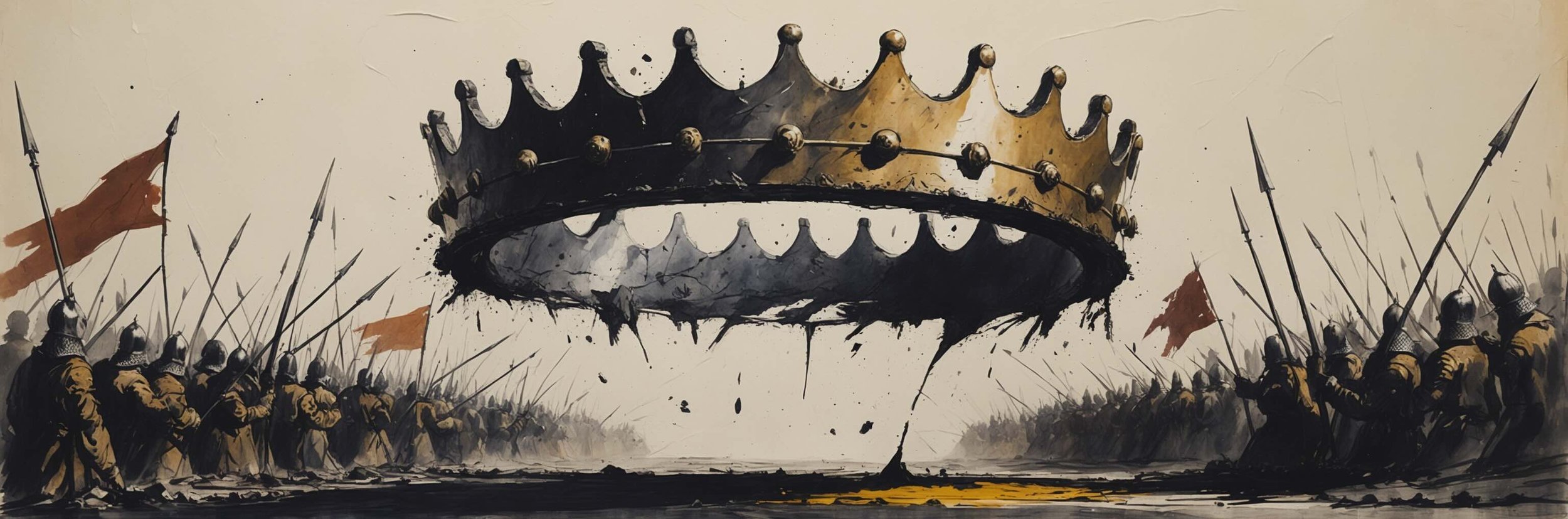
Theme Profile – At a Glance
- Focus: What a crown actually requires of the man wearing it, and what it costs him. The play is less interested in whether Henry is a good man than in what "good king" turns out to mean.
- Key Characters: King Henry V, the Archbishop of Canterbury, Exeter, the Chorus, the Dauphin.
- The Core Tension: A king must look chosen by God while knowing his father stole the crown, and must be loved by the men he is about to spend. Henry does both, and the play keeps showing us the effort.
- Key Manifestations: The bishops’ account of Henry’s transformation in A1S1; the demand for a lawful claim in A1S2; the mercy withdrawn at Southampton; the ceremony soliloquy and the prayer in A4S1; Saint Crispin’s Day; the Epilogue’s report of what the reign came to.
- Famous Quote:
"What infinite heart’s-ease must kings neglect, that private men enjoy!"
(Act 4, Scene 1) - The Outcome: Henry becomes the most successful king in the play’s world and the loneliest man in it. The Epilogue then reports that everything he won was lost within a generation.
The King Who Had to Be Made
Before Henry appears, two bishops explain him. The account they give is not of a man who grew up but of a man who was replaced.
Original
The breath no sooner left his father's body,
But that his wildness, mortified in him,
Seemed to die too; yea, at that very moment
Consideration, like an angel, came
And whipped the offending Adam out of him,
Leaving his body as a paradise,
To envelop and contain celestial spirits.
(Canterbury, Act 1, Scene 1)
Shakespeare Retold (Modern Verse)
But once his father took his final breath,
His youthful folly, once ingrained in him,
Appeared to die as well; yes, at that moment,
Reflection, like an angel sent from heaven,
Consumed him, booting Adam out of Eden,
To leave his body like a paradise
Where holy spirits live in harmony.
The language is the language of religious conversion, and every detail insists on suddenness: the breath leaves the father, the wildness dies, the angel arrives, all in the same instant. Kingship, on this account, is something that descends on a man rather than something he learns.
Two things sit awkwardly under the praise. The first is timing: the transformation coincides exactly with the acquisition of power, which is either a miracle or a promotion. The second is that Canterbury has a reason to be enthusiastic – a bill in Parliament threatens to strip the Church of half its lands, and he has just offered the King a record sum to fund a French campaign. The play’s first statement about good kingship is made by someone who needs it to be true.
The rest of the play never quite lets the account settle. Henry is repeatedly excellent, and we are repeatedly shown the machinery.
Kingship as Paperwork
The first thing this King does is refuse to act until someone else has signed for it. Before Canterbury may deliver the Salic Law argument, Henry places him under an extraordinary charge.
Original
For God doth know how many now in health
Shall drop their blood in approbation
Of what your reverence shall incite us to.
Therefore take heed how you impawn our person,
How you awake our sleeping sword of war:
We charge you, in the name of God, take heed...
(Act 1, Scene 2)
Shakespeare Retold (Modern Verse)
For God knows each and every healthy soldier
Whose blood will spill based on your legal guidance
That’s going to guide the actions that we take.
So, contemplate advice you’re going to give me,
If you invoke a war now we’re at peace.
And, in the name of God, I urge you’re careful...
Read one way this is conscience: a king who understands that men will die on the strength of a legal opinion, and who says so in front of the whole court before hearing it. Read another it is procedure: the responsibility has been formally lodged with someone else, on the record, in the name of God, before a single soldier sails.
Both readings are available and the play does not choose. What is not in doubt is that Henry understands the value of the transaction. Canterbury answers "the sin upon my head", and from that moment the war has an owner who is not the King. Four acts later a private soldier will tell the disguised Henry, without knowing who he is, that the sin does not transfer – and Henry will spend a hundred lines failing to refute him.
The same instinct governs Southampton. Henry traps the three conspirators by inviting them to advise him on mercy for a drunk, then hands them their indictments, and the sentence he passes is framed as theirs.
Thrice-Gorgeous Ceremony
A4S1 is where the play stops arguing about kingship and looks at it. Alone the night before Agincourt, after an argument with three soldiers who do not recognise him, Henry works his way through an inventory of everything a king has that a labourer does not.
Original
I am a king that find thee, and I know
'Tis not the balm, the sceptre and the ball,
The sword, the mace, the crown imperial,
The intertissued robe of gold and pearl,
The farced title running 'fore the king,
The throne he sits on, nor the tide of pomp
That beats upon the high shore of this world,
No, not all these, thrice-gorgeous ceremony...
(Act 4, Scene 1)
Shakespeare Retold (Modern Verse)
I am a king who’s found you out, and know
It’s not the ointment, sceptre nor the orb,
The sword nor club, and nor the royal crown,
And nor the robe that’s made with gold and pearls,
And nor the fancy titles of the king,
The throne he sits on, nor pomposity
That crashes on the world like waves at high tide,
No, none of these things, gorgeous ceremony...
The list is a coronation, itemised and priced. Balm, sceptre, orb, sword, mace, crown, robe, throne: these are the actual objects used in an English coronation service, and Henry runs through them as a man might run through an inventory of things that have failed to work. The conclusion is that none of them can buy a night’s sleep, and that the slave who sweats through the day sleeps better than the king who does not.
It is a genuinely radical thought, and it comes from an unexpected direction. Henry does not say that ceremony is unearned; he says it is ineffective – that it produces fear in other people and insomnia in him. Having spent three acts using ceremony as a weapon, the man who deploys it best is the one who reports that it is hollow.
There is also a convenience in the argument, and it is worth naming. If a king is only a man in a costume, then the deaths tomorrow are not especially his, and the complaint that opens the soliloquy – that everything gets laid on the king – is a complaint about unfairness rather than an acceptance of duty. The most honest speech Henry makes is also the one that lets him off.
Leadership as Storytelling
By morning the doubt is invisible. Outnumbered five to one, Henry does the one thing the situation allows: he changes what the day means.
Original
Then will he strip his sleeve and show his scars,
And say 'These wounds I had on Crispin's day.'
Old men forget: yet all shall be forgot,
But he'll remember with advantages
What feats he did that day: then shall our names,
Familiar in his mouth as household words
Harry the king, Bedford and Exeter,
Warwick and Talbot, Salisbury and Gloucester,
Be in their flowing cups freshly remembered.
(Act 4, Scene 3)
Shakespeare Retold (Modern Verse)
Then he’ll remove his shirt and show his scars,
And say, ‘I got these wounds on Crispin’s day.’
In old age, you’ll become forgetful, yet
You’ll have embellished memories of what
You did that day. Then all our names will be
As common as are household words to people –
Harry the king, Bedford and Exeter,
Warwick and Talbot, Salisbury and Gloucester –
Which they will freely use recalling us.
This is leadership conducted entirely in the future tense. Henry does not tell his men they will win; he tells them what they will be saying about today in forty years’ time, in a pub, with their sleeves rolled up. The soldiers are offered old age, which is the one thing they are afraid they will not get.
The most disarming word in the speech is "advantages" – Henry cheerfully predicts that the veterans will exaggerate. He is not selling them a lie; he is inviting them into the manufacture of one, and telling them the manufacture is part of the reward.
What the play then does with the promise is characteristic. The list of names Henry recites is aristocratic, and when the casualty return arrives in A4S8 he reads the four English nobles by name and disposes of the rest – "but five and twenty" – in half a line. The band of brothers is real for the length of the speech and is a ledger again by the next scene. Neither fact cancels the other, and the play declines to say which one to carry out of the theatre.
"…he fails in the end, as all men great and little fail in Shakespeare."
— W. B. Yeats, Ideas of Good and Evil, 1903
Key Quotes on Kingship and Leadership
Quote 1
We never valued this poor seat of England;
And therefore, living hence, did give ourself
To barbarous licence; as 'tis ever common
That men are merriest when they are from home.
(Act 1, Scene 2)
Shakespeare Retold (Modern Verse)
I never valued being king of England;
So lived away from royal courts, allowing
Myself to live a riotous life; it’s common
For men to frolic when they’re far from home.
Quote Analysis: Part of Henry’s answer to the tennis balls, and the play’s first account of kingship from the King himself. He is explaining the Eastcheap years, and the explanation is remarkable: he did not value the throne, so he lived away from it. That converts the taverns of the Henry IV plays from a scandal into something closer to a decision, and it arrives inside a speech whose next move is to promise that he will now "keep my state" and "be like a king". Kingship, in Henry’s own first definition of it, is a thing you take up and put down – maintained rather than possessed. Whether the account is true or an excellent piece of retrospective editing is a question the play never closes.
The mercy that was quick in us but late,
By your own counsel is suppressed and killed:
You must not dare, for shame, to talk of mercy;
For your own reasons turn into your bosoms,
(Act 2, Scene 2)
Shakespeare Retold (Modern Verse)
The mercy that I recently possessed
Has been suppressed and killed by your advice.
You mustn’t even dare to talk of mercy,
Because your arguments strike through your hearts,
Quote Analysis: The Southampton trap closing. Henry had asked the three conspirators whether he should pardon a drunk who railed against him; all three said no, be severe; and he now uses their own severity to sentence them. The manoeuvre is brilliant, and it is also a piece of stage-management: the King’s mercy has been "killed" by other people, so the executions are the traitors’ doing rather than his. It is the same transfer of responsibility Henry arranges with Canterbury over the war and with the Governor at Harfleur. A pattern this consistent is a policy.
No; nor it is not meet he should. For, though I speak it to you, I think the king is but a man, as I am: the violet smells to him as it doth to me: the element shows to him as it doth to me; all his senses have but human conditions: his ceremonies laid by, in his nakedness he appears but a man; and...
(Act 4, Scene 1)
Shakespeare Retold (Modern Verse)
No, nor would it be appropriate for him to do so. Because, although it might not be appropriate to say so, the king is just a man like me: a violet smells the same to him as it does me; air and water appear the same to him as to me; all his senses are merely human conditions; without his royal pageantry, he’s just a man when seen naked...
Quote Analysis: Henry in a borrowed cloak, telling three soldiers what a king is, while being one. The doubling is the point: the man arguing that kings are ordinary is doing so from inside a disguise that only works because kings are not. The imagery is deliberately small and sensory – a violet, the air, the elements – and it makes the case through the body rather than through politics. What he cannot say, and what the scene is really about, is that a king’s fear must be concealed where a soldier’s may be spoken. He goes on to say exactly that, and then spends the night proving it.
for when lenity and cruelty play for a kingdom, the gentler gamester is the soonest winner.
(Act 3, Scene 6)
Shakespeare Retold (Modern Verse)
for when kindness and cruelty compete to win a country, the kinder player will become the winner.
Quote Analysis: The clearest statement of Henry’s governing doctrine, and one of the most quietly chilling lines in the play. He has just approved the hanging of Bardolph and forbidden his army to take anything from French villages without paying, and this is the reason he gives: mercy wins territory faster than terror. The word "gamester" does the damage. Kindness is not a virtue here but a move, chosen because it works, in a game whose stakes are a kingdom. Everything admirable about Henry’s conduct in France is contained in this line, and so is everything unnerving about it.
Key Takeaways
- Kingship Is Made, Not Born: The play opens with two bishops explaining how Henry became a king. Nobody in it treats royalty as something that simply happens.
- Responsibility Is Always Placed Elsewhere: Canterbury carries the sin of the war; the traitors sentence themselves; the Governor of Harfleur is blamed for the sack. The pattern is consistent enough to be policy.
- Ceremony Is Hollow and Necessary: Henry lists the objects of kingship and finds none of them worth a night’s sleep – then uses all of them the next morning.
- Leadership Works Through Story: The Saint Crispin’s Day speech wins the day by describing a future in which the day has already been won, and admits the memory will be embellished.
Study Questions and Analysis
What does the play say a good king must be able to do?
The play answers this unusually directly, because the bishops spend the whole of A1S1 listing the qualities. Their catalogue is worth taking seriously as the play’s stated specification, even though the men reciting it have an interest in flattery.
Hear him but reason in divinity,
And all-admiring with an inward wish
You would desire the king were made a prelate:
Hear him debate of commonwealth affairs,
You would say it hath been all in all his study:
List his discourse of war, and you shall hear...
(Canterbury, Act 1, Scene 1)
Shakespeare Retold (Modern Verse)
When listening to him talk of religion,
You would be so impressed that secretly
You’d want our king to be ordained a priest;
When hearing him debate on politics,
You’d say that’s all he’s studied all his life;
Hear his account of war and you will hear...
Theology, statecraft, war, and policy: four competences, and the striking thing is that all four are described as kinds of speech. Henry is not praised for courage or piety but for how he sounds when reasoning about them. The passage ends by comparing his talk of war to music and describing the air itself falling silent when he speaks.
E. M. W. Tillyard’s Shakespeare’s History Plays (1944) read the whole second tetralogy as an expression of orthodox Tudor political thought, with Henry as the culminating ideal ruler restoring an order broken by Richard II’s deposition. On that account this passage is straightforwardly the play’s standard, and Henry meets it. John Dover Wilson’s 1947 New Cambridge edition took the same view of the war itself, calling it "a righteous war, and seemed as much so to Shakespeare’s public as the war against the Nazis seems to us".
The difficulty is that the play then demonstrates a fifth competence the bishops do not mention: the ability to arrange matters so that someone else is responsible. That skill is exercised in almost every act, and no one praises Henry for it because no one on stage appears to notice it.
Is Henry a great king or a great actor?
The question is unanswerable as posed, and recognising why is the most useful thing a student can do with it. The play systematically arranges for the evidence to support both.
Consider the pattern. Henry is genuinely brave and takes the same field as his men, and he is also careful to be seen doing it. He is genuinely pious and he times his piety. He refuses ransom for himself in the grandest terms, and the refusal is made in front of a herald who will report it. Almost every admirable act in the play is also an act with an audience, and the play never shows us Henry doing something admirable that nobody sees – with the single exception of the A4S1 soliloquy and prayer, which are the two places he sounds least like a hero.
Norman Rabkin’s "Rabbits, Ducks, and Henry V" (Shakespeare Quarterly, 1977) is the standard treatment. Borrowing the gestalt drawing that can be seen as a rabbit or a duck but never both at once, Rabkin argued that the play "points in two opposite directions, virtually daring us to choose one of the two opposed interpretations it requires of us". The ambiguity is not an accident of four centuries of changing taste; it is designed.
Stephen Greenblatt’s "Invisible Bullets", in Shakespearean Negotiations (1988), sharpened the point differently: the play "deftly registers every nuance of royal hypocrisy, ruthlessness, and bad faith" and then absorbs the registering into the celebration, so that noticing the manipulation becomes part of admiring the manipulator. Jonathan Dollimore and Alan Sinfield, in Alternative Shakespeares (1985), read the same evidence as strain rather than containment: "even in this play, which is often assumed to be the one where Shakespeare is closest to state propaganda, the construction of ideology is complex".
For an essay, the strong move is to refuse the either/or and show why the play forbids it – then argue about what that refusal is for. A play that made Henry simply admirable would be propaganda; one that made him simply a fraud would be a satire. This is neither, and the discomfort is the content.
What does the ceremony soliloquy reveal about the burden of rule?
It reveals a king who has understood his own position with great clarity and drawn a slightly self-serving conclusion from it.
But his own wringing! What infinite heart's-ease
Must kings neglect, that private men enjoy!
And what have kings, that privates have not too,
Save ceremony, save general ceremony?
(Act 4, Scene 1)
Shakespeare Retold (Modern Verse)
Except their own! What endless peace of mind
Can private men enjoy, yet kings can’t have!
And what do kings have that civilians don’t,
Except, of course, for pomp and ceremony?
The observation is exact. A king carries the consequences of decisions taken on behalf of people who will never know they were taken, and receives in exchange a set of props. Henry has arrived, alone and unwatched, at something close to the doctrine later called the king’s two bodies – the mortal man and the undying office – and found that only one of them gets to sleep.
What complicates the speech is its occasion. It comes immediately after Williams has told him that a king with a bad cause carries the deaths he causes, and Henry has spent the exchange arguing that responsibility does not travel that way. The soliloquy is therefore not disinterested reflection but the continuation of an argument he has just lost, and the grievance in it – everything is laid on the king – is a complaint about being blamed rather than an acceptance of blame.
The prayer that follows completes the picture. Henry asks God not to think, today of all days, about how his father took the crown from Richard II, and then itemises the chantries he has endowed and the masses he has paid for. Harold C. Goddard’s The Meaning of Shakespeare (1951) built its ironic reading of the play largely on such moments, tracking the distance between Henry’s "questionable personal motives and his professed devotion to God’s will". Alone, unobserved, the most confident speaker in Shakespeare turns out to be a man managing a title he knows to be flawed.
How does Henry's kingship compare with the French King's?
The comparison is more interesting than the play’s reputation suggests, because Charles VI is not a fool. He is cautious, historically literate and entirely correct about the danger, and he is ignored by his own son.
Witness our too much memorable shame
When Cressy battle fatally was struck,
And all our princes captived by the hand
Of that black name, Edward, Black Prince of Wales;
Whiles that his mountain sire, on mountain standing...
(the King of France, Act 2, Scene 4)
Shakespeare Retold (Modern Verse)
Remember all the shame that fell upon us
When we were fatally attacked at Crécy,
And all our princes then were taken captive
By Edward, Prince of Wales, known as the Black Prince,
While up upon the mountain stood his father...
He remembers Crécy, seventy years earlier, and draws the right conclusion: Henry comes from that stock and should be feared. It is the soundest strategic assessment anyone makes in the play, and the Dauphin has just finished dismissing Henry as a shallow youth.
What the French King lacks is not judgement but authority. He cannot make his heir take the threat seriously, cannot prevent the tennis balls, and cannot hold his nobles to a plan. The historical Charles VI suffered recurring incapacity and France was riven by the Armagnac–Burgundian feud; Shakespeare keeps the effect and drops the explanation, so what we see is simply a wise king whose orders do not carry.
Set against him, Henry’s distinguishing quality is not wisdom but transmission. Everything he decides actually happens: the traitors are arrested within minutes, the army does not loot, the prisoners are killed, the treaty is signed. Alexander Leggatt’s Shakespeare’s Political Drama (1988) studies the histories as accounts of "the ordering and enforcing, the gaining and losing, of public power in the state", and the contrast here is exactly that: two kings with comparable insight and radically different grip.
What is the "king's two bodies" and how does it help with this play?
It is a doctrine of Tudor political and legal thought holding that a monarch has two bodies: the body natural, which is mortal, fallible and can be tired or frightened, and the body politic, which is the undying office and cannot err. The idea was elaborated by Elizabethan lawyers to explain how the crown could pass instantly at a death, and it is genuinely useful for reading Henry V, provided it is used as a tool rather than an answer.
Its usefulness is that the play keeps prising the two apart. In A4S1 Henry removes the outward signs of the body politic by borrowing a cloak, and immediately discovers what the body natural is worth: he loses an argument to a private soldier. The soliloquy that follows is an attempt to work out which of the two is real, and it concludes that ceremony – the visible part of the body politic – cannot heal a knee or buy a night’s sleep.
The doctrine also explains a manoeuvre that otherwise looks like simple evasion. When Henry insists that responsibility for the war lies with Canterbury, or that a soldier’s damnation is his own affair, he is arguing as the office rather than the man. Williams’s reply in A4S1 is powerful precisely because it refuses the distinction: he speaks of the King as a person who will face a reckoning.
Two cautions. First, the doctrine is Elizabethan rather than medieval, so the play is applying its own period’s theory to a fifteenth-century reign. Second, Phyllis Rackin’s Stages of History (1990) warns against treating the histories as illustrations of a settled world-picture; they "occupy various sites of contention, between older and newer conceptions of history", and this play stages the two-bodies idea being tested rather than confirmed. Used carefully, though, it is the sharpest single instrument for A4S1.
Does the Chorus give a reliable account of Henry's leadership?
No, and the gaps are specific enough to build an argument on. The clearest case is the Act 4 prologue, which describes the King moving among his troops the night before Agincourt.
For forth he goes and visits all his host,
Bids them good morrow with a modest smile
And calls them brothers, friends and countrymen.
(the Chorus, Act 4, Prologue)
Shakespeare Retold (Modern Verse)
Because he talks and walks among his soldiers,
And greets them with ‘good morning’ and a smile
And calls them brothers, friends and countrymen.
The prologue goes on to describe every soldier drawing comfort from the King’s face, warmed like ground under the sun – "a little touch of Harry in the night". Then the scene begins and Henry puts on a disguise so that nobody will know who he is, argues bitterly with three men who tell him his cause may be rotten, storms off, and delivers a soliloquy of pure grievance. There is no modest smile, no brotherhood and no comfort.
This is not carelessness. The Chorus supplies the official version of Henry’s leadership and the scenes supply the working version, and the play sets them a few lines apart so that neither can be missed. Joel B. Altman’s "‘Vile Participation’" (Shakespeare Quarterly, 1991) argues that the play is engineered to make its audience "admire the King and nurture hostile feelings toward him" simultaneously; the Chorus is the instrument that produces the first half.
Andrew Gurr’s New Cambridge edition (1992, updated 2005) treats the Chorus as central to how the play manages its divided view of Henry rather than as decorative framing. It is worth knowing, too, that the Chorus does not appear at all in the 1600 Quarto, which produces a leaner and considerably less complicated play.
Why does the play end by reporting the loss of everything Henry won?
Because the Epilogue is where the play settles its accounts, and the accounts do not balance. Fourteen rhymed lines close the play by noting how briefly Henry lived, crediting the victory to Fortune rather than to God or to Henry, and recording that his infant son lost France and left England bleeding.
Three things make this more than a historical footnote. First, nothing compelled it: a triumphal history could simply have ended with the betrothal, and the audience would have gone home satisfied. Second, it reverses the play’s own theology – Henry has spent four acts insisting the victory was God’s, and the Epilogue hands it to luck. Third, it is spoken by the same figure who called Henry "the mirror of all Christian kings", so the play’s most enthusiastic voice is the one delivering the deflation.
For the theme of kingship the implication is sharp. If Henry is the model king, and the model king’s achievement dissolves within a generation, then either the model is insufficient or the achievement was never the kind of thing that lasts. James L. Calderwood, in Metadrama in Shakespeare’s Henriad (1979), argued that the order Henry’s rhetoric creates carries a "built-in obsolescence" – it holds only while the speaking continues – and the Epilogue is the evidence.
The counter-reading deserves its weight. An Elizabethan audience attributed the loss of France to a child king, faction and weak counsel, not to any flaw in Henry. On that view the Epilogue does not diminish him; it measures how much rested on one man, and how fast it went once he was gone. Either way the theme is the same: kingship in this play is a performance that requires a performer, and performances end.