Henry V: Act 4, Scene 1 – Analysis
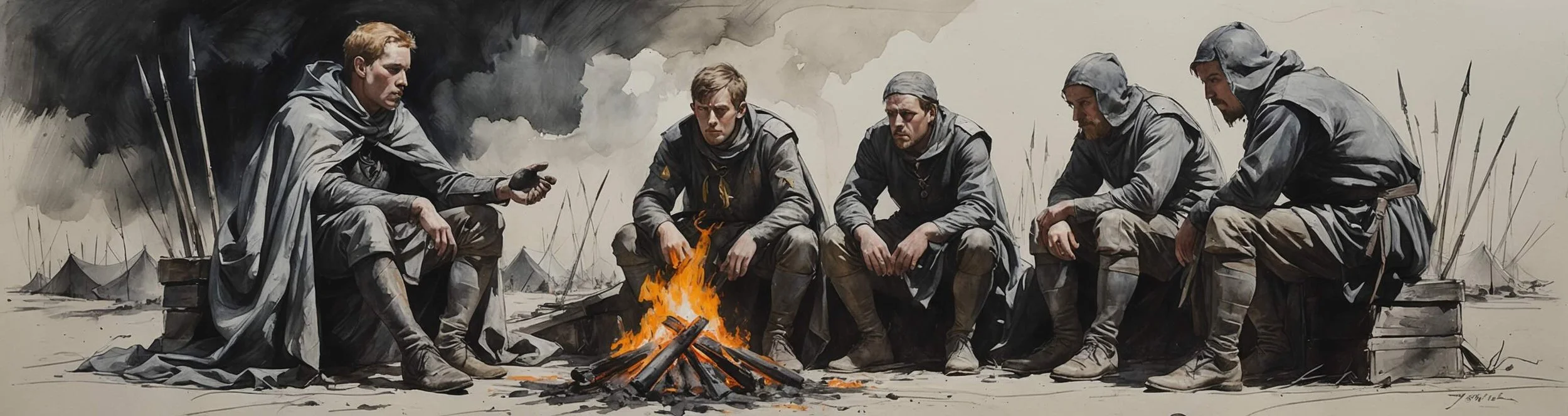
Scene Profile – At a Glance
- Location: The English camp at Agincourt, in the dark hours before the battle.
- What Happens: King Henry, disguised in Erpingham’s cloak, walks his camp by night – meets Pistol, overhears Fluellen, and debates the King’s responsibility with three common soldiers. Left alone, he delivers the ceremony soliloquy, and prays God not to remember his father’s crime.
- Key Characters: King Henry V, Williams, Bates, Court, Pistol, Fluellen, Gower and Sir Thomas Erpingham.
- Dramatic Function: The play’s intellectual centre. For one night the crown argues its case against its subjects – and, alone afterwards, against itself.
- Famous Quote:
"No; nor it is not meet he should. For, though I speak it to you, I think the king is but a man, as I am: the violet smells to him as it doth to me..."
(King Henry V, Act 4, Scene 1) - Why It Matters: Williams’s challenge – who answers for the men who die? – is the hardest question ever put to a Shakespearean king, and the ceremony soliloquy is Henry’s only unguarded self-examination in the play.
Scene Summary
Night, and the King is finding his footing: there is “some soul of goodness in things evil” – the enemy’s nearness makes early risers and ready consciences. He borrows old Sir Thomas Erpingham’s cloak, sends his brothers away, and goes among his army unknown: “I and my bosom must debate awhile.”
The walk is a survey of his kingdom in miniature. Pistol – not recognising him – praises the King as “a bawcock and a heart of gold”, insults him as Fluellen’s kinsman, and swaggers off. Fluellen, overheard, enforces quiet discipline out of Pompey’s wars. Then three common soldiers – Bates, Court and Williams – draw the disguised King into the play’s great debate. Henry argues the King is “but a man”, as they are; that his cause is just; that every subject’s duty is the King’s, but every subject’s soul is his own. Williams answers with the play’s most terrible image – the severed legs and arms and heads that will rise at the latter day and cry “We died at such a place” – and scoffs at the King’s promise not to be ransomed. The quarrel ends in a gentleman’s wager: gloves exchanged, a box on the ear promised if both survive.
Alone, Henry pours out the ceremony soliloquy – everything laid on the King, and what does the King possess but “idle ceremony”, a proud dream that cannot cure a fever or command a beggar’s knee to be healthy? The meanest slave with a full belly sleeps sounder than the crowned head. Interrupted with news that his nobles seek him, he prays: God of battles, steel my soldiers’ hearts – and not today, O Lord, not today, remember the fault his father made in taking the crown. He has reburied Richard, paid five hundred poor to pray, built two chantries – and knows it is all “nothing worth”, since his penitence comes after the crime whose crown he keeps. Gloucester calls; the day, his friends and all things stay for him.
Honey from the Weed
The scene opens with the King rehearsing optimism – for an audience of two brothers, and perhaps for himself.
Original
There is some soul of goodness in things evil,
Would men observingly distil it out.
(King Henry V, Act 4, Scene 1)
Shakespeare Retold (Modern Verse)
There’s something good in everything that’s evil,
If only we would take the time to look.
The philosophy is brisk and useful: danger makes men early risers, enemies are “outward consciences”, and a mind that looks hard enough can “gather honey from the weed”. It is also, noticeably, a performance of cheerfulness – the same service the Chorus just told us his face performs for the whole army. The borrowed cloak that follows is the scene’s hinge: for the only time in the play, Henry puts off the royal “we” and walks as a private man among the men his decisions will spend. What he borrows with the cloak is the thing he has never had on stage: anonymity – and with it, the truth about what his army thinks.
The King in Borrowed Clothes
His first encounter is with the army’s worst soldier – and the King’s most enthusiastic subject.
Original
The king's a bawcock, and a heart of gold,
A lad of life, an imp of fame;
Of parents good, of fist most valiant.
(Pistol, Act 4, Scene 1)
Shakespeare Retold (Modern Verse)
The king’s a fine man with a heart of gold,
A lively chap, a famous child;
Well raised, and brave when fighting with his fists.
Pistol’s praise – delivered to the disguised King’s face – is gloriously worthless: a “bawcock”, a “lad of life”, whose “dirty shoe” Pistol kisses from the heart-string. The comedy is that the play’s emptiest voice loves the King most loudly – and that the King’s incognito survives on the thinnest of aliases, “Harry le Roy”, French for exactly who he is. The encounter also plants the leek quarrel with Fluellen that Act 5 will harvest. Structurally, Pistol is the first of three soundings: the braggart who loves the King blindly, the captain who serves him by the book, and the soldiers who question him – three kinds of subject, met in ascending order of difficulty.
The Reckoning
Then the debate the whole play has been preparing – and the common soldier wins the exchange every reader remembers.
Original
But if the cause be not good, the king himself hath a heavy reckoning to make, when all those legs and arms and heads, chopped off in battle, shall join together at the latter day and cry all 'We died at such a place;'...
(Williams, Act 4, Scene 1)
Shakespeare Retold (Modern Verse)
But if the king’s rationale isn’t good, the king himself has a high price to pay, because all those legs and arms and heads that get chopped off in battle will join together on Judgement Day, shouting, ‘We died at that place;’...
Williams’s vision is the war’s cost rendered as apocalypse: the dismembered dead reassembling at the Last Judgement to testify – wives left poor, debts unpaid, children “rawly left” – and all of it charged, if the cause be not good, to “the king that led them to it”. The argument’s power is its precision: these men do not question obedience – “to disobey were against all proportion of subjection” – they question where the moral bill is sent. Henry’s long reply relocates it: the king is not bound to answer “the particular endings” of his soldiers – the father is not damned for the son lost at sea – for every subject’s duty is the king’s, “but every subject’s soul is his own”. The answer is genuinely clever, and it answers a narrower question than Williams asked: it settles who owns each soldier’s sins, and says nothing about who owns the war. Williams and Bates concede the point they never contested – every man’s ill end on his own head – and the larger charge is left standing, unanswered because unanswerable.
Ceremony
Alone at last, the King takes up the night’s question – and turns it on his own crown.
Original
Upon the king! Let us our lives, our souls,
Our debts, our careful wives,
Our children and our sins lay on the king!
We must bear all. O hard condition...
(King Henry V, Act 4, Scene 1)
Shakespeare Retold (Modern Verse)
Let’s blame the king! Let’s take our lives and souls,
Our debts, our careful wives,
Our children and our sins and blame the king!
A king must bear it all. It’s difficult...
“Upon the king!” – the soliloquy begins as a complaint against the transaction Williams just enforced: lives, souls, debts, wives, children, sins, all laid on one man, who must “bear all”. And then the play’s most searching stretch of thought: what does the king get in exchange? Only ceremony – and Henry interrogates it like a hostile witness. What are its rents, its comings-in? It is “place, degree and form”, creating awe in other men; it cannot cure a fever, cannot buy sleep; its homage is “poisoned flattery”. The catalogue of regalia – balm, sceptre, ball, sword, mace, crown, the intertissued robe, the farced title – is weighed entire against one sleeping labourer, and loses. Coming from the play’s supreme master of ceremony, the speech is either the confession that redeems him or the self-pity that convicts him – the wretched slave he envies has, after all, been sleeping in the mud of his campaign.
The Prayer
Word comes that his nobles are searching for him – and in the minutes left, Henry stops performing altogether.
Original
O God of battles! Steel my soldiers' hearts;
Possess them not with fear; take from them now
The sense of reckoning, if the opposed numbers
Pluck their hearts from them.
(King Henry V, Act 4, Scene 1)
Shakespeare Retold (Modern Verse)
Oh God of war! Give courage to my soldiers;
Don’t make them scared; remove their tendency
To calculate the odds if they’re outnumbered
That plucks their courage from them.
The prayer’s first half is a general’s: steel the soldiers’ hearts, take from them “the sense of reckoning” – the ability to count the odds. Its second half is a son’s, and it is the deepest secret in the Henriad spoken aloud: not to-day, O Lord, think not upon the fault my father made in compassing the crown. Richard II – deposed and murdered so that Henry’s father could reign – is the debt beneath the dynasty, and Henry itemises his instalments: the body reburied, the contrite tears, five hundred poor in yearly pay, two chantries of singing priests. And then the devastating audit: all of it is “nothing worth”, because penitence that comes after – while the penitent keeps the stolen crown – is petition, not repentance. No other speech in the play shows Henry’s conscience without an audience. Whether God accepted the terms, Agincourt’s morning will be taken to answer.
Language and Technique
- Prose for truth, verse for the crown: The debate with the soldiers runs in plain prose; the moment Henry is alone, the verse returns – the play’s registers marking who may be spoken to honestly.
- The disguise convention: The cloaked king among his men is an old ballad motif – but here the tradition’s cosy ending is withheld: no recognition, no reward, just an unsettled wager.
- Apostrophe: The ceremony soliloquy addresses an abstraction directly – “What kind of god art thou?” – putting kingship itself in the dock for cross-examination.
- Catalogue and anticlimax: The regalia list – sceptre, ball, sword, mace, crown – is built high precisely to be toppled by one image: the slave asleep with a full belly.
- Liturgical rhythm: The prayer’s repetitions – “Not to-day, O Lord, / O, not to-day” – carry real desperation: the play’s most controlled speaker, audibly bargaining.
Key Quotes from Act 4, Scene 1
Quote 1
Original
No; nor it is not meet he should. For, though I speak it to you, I think the king is but a man, as I am: the violet smells to him as it doth to me...
(King Henry V, Act 4, Scene 1)
Shakespeare Retold (Modern Verse)
No, nor would it be appropriate for him to do so. Because, although it might not be appropriate to say so, the king is just a man like me: a violet smells the same to him as it does me...
Quote Analysis: The disguised King’s central claim: ceremonies laid by, the king is “but a man”, whose senses share every human condition – the violet smells the same to him. It is both true and tactical: true, as the soliloquy will shortly prove from the inside; tactical, because a king arguing anonymously for the king’s ordinariness is managing morale – fear in the royal face would “dishearten his army”. The line every essay needs on kingship’s two bodies: the man inside the office, testifying – in disguise – that the office is worn over an ordinary skin.
Original
Ay, he said so, to make us fight cheerfully: but when our throats are cut, he may be ransomed, and we ne'er the wiser.
(Williams, Act 4, Scene 1)
Shakespeare Retold (Modern Verse)
Yes, he said that to make us fight enthusiastically. But when our throats are cut, he might pay the ransom and we will never know.
Quote Analysis: Williams’s answer to the King’s guarantee that the King will not be ransomed: he said it “to make us fight cheerfully” – and once our throats are cut, who checks? The cynicism is exact, unanswerable in the dark, and structurally devastating: it treats the King’s word as a morale device, which the audience has watched the King’s words be for three acts. Henry’s huffy reply – he will never trust the King’s word after – earns Williams’s magnificent scorn: a private man’s displeasure against a monarch is “a perilous shot out of an elder-gun”. The play’s power imbalance, priced by the man at the bottom of it.
Original
And what art thou, thou idle ceremony?
What kind of god art thou, that suffer'st more
Of mortal griefs than do thy worshippers?
(King Henry V, Act 4, Scene 1)
Shakespeare Retold (Modern Verse)
And what’s the point of you, then, ceremony?
If ceremony is a god, why suffer
More than your citizens who worship you?
Quote Analysis: The soliloquy’s core question, put directly to the abstraction itself: what art thou, “idle ceremony”? What kind of god suffers more than its worshippers? The interrogation strips kingship to its mechanism – “place, degree and form, / Creating awe and fear in other men” – awe manufactured, fear instilled, nothing real received in exchange but flattery. No speech in Shakespeare goes further in dismantling the mystique of monarchy – and it is spoken by the century’s most successful monarch, at the peak of his powers, the night before his greatest triumph.
Original
I am a king that find thee, and I know
'Tis not the balm, the sceptre and the ball,
The sword, the mace, the crown imperial...
(King Henry V, Act 4, Scene 1)
Shakespeare Retold (Modern Verse)
I am a king who’s found you out, and know
It’s not the ointment, sceptre nor the orb,
The sword nor club, and nor the royal crown...
Quote Analysis: “I am a king that find thee” – the crucial claim of the soliloquy: Henry has seen through ceremony, itemised its props from balm to intertissued robe, and knows the whole “tide of pomp” cannot purchase one labourer’s sleep. The insight is real – and, characteristically, it changes nothing: the man who finds ceremony hollow will wear every piece of the catalogue tomorrow and use its awe to the last rivet. Whether that makes him tragic, hypocritical, or simply a professional doing a job he understands too well is the essay question this speech exists to set.
Original
O, not to-day, think not upon the fault
My father made in compassing the crown!
I Richard's body have interred anew...
(King Henry V, Act 4, Scene 1)
Shakespeare Retold (Modern Verse)
Oh, not today, don’t think about the crime
My father perpetrated for the crown!
I had Richard’s remains reburied nobly...
Quote Analysis: The buried engine of the whole Henriad, exposed for eleven lines: the crown was taken by deposition and murder, the guilt is inherited, and Henry prays – twice over, “not to-day” – that the reckoning be deferred past tomorrow. The reburied body, the paid mourners, the chantries: grace approached through accountancy, and Henry knows it – “all that I can do is nothing worth”. For essays on religion and kingship this is the summit text: the play’s most pious king, confessing that his piety is instalments on a debt he has no intention of repaying in kind.
Key Takeaways
- The crown argues its case – and loses on points: Henry’s theology beats the soldiers’ logic on the soul’s ownership; Williams’s question – who answers for the war? – is never answered at all.
- Ceremony is found hollow by its master: The soliloquy dismantles kingship’s mystique from the inside – and the King wears the whole catalogue again at dawn.
- The debt under the dynasty: The prayer names what the play never otherwise says: the crown is stolen property, and Agincourt is fought under a mortgaged blessing.
- Three subjects, three soundings: Pistol’s empty love, Fluellen’s bookish discipline, Williams’s hard questions – the disguised King meets his kingdom, and only the questions follow him home.
- The glove is a fuse: The wager with Williams seems a night’s bravado – and detonates, twice, in Scenes 7 and 8.
Study Questions and Analysis
Why does Henry disguise himself among his soldiers?
The stated purpose is solitude – “I and my bosom must debate awhile” – but what the cloak actually buys is intelligence: the one commodity no king can gather in his own person, an honest sample of what his army believes. And the tradition Shakespeare is working in made audiences expect something warmer. Anne Barton, in her 1975 essay on the king disguised, showed how popular “comical histories” loved this motif: the monarch incognito meets a plain subject, hears rough truths, reveals himself, and the meeting ends in reward and mutual delight – monarchy and common folk reconciled by a trick.
Shakespeare stages the setup and cancels the payoff. Henry is not recognised, hears more truth than the tradition ever delivered, wins no affection he did not already have, and leaves the encounter with an unsettled quarrel and a glove in his cap. The convention’s warmth is replaced by the play’s most serious argument, and the recognition scene, when it finally comes in Scene 8, is settled with money rather than embrace. For essays on genre, this is the sharpest example of the play raising a popular expectation precisely to withhold it – the fairy-tale king tested against the real weight of the office.
What is the argument with Williams actually about?
Responsibility – specifically, where the moral cost of a war is charged. The soldiers never dispute obedience; Bates states their position with devastating simplicity:
Original
Ay, or more than we should seek after; for we know enough, if we know we are the kings subjects: if his cause be wrong, our obedience to the king wipes the crime of it out of us.
(Bates, Act 4, Scene 1)
Shakespeare Retold (Modern Verse)
Yes, or more than we should try to find out; for all we need to know is that we are under the rule of the king: if the king’s rationale is wrong, our obedience to the king rids us of any guilt.
Obedience transfers the crime upward – “our obedience to the king wipes the crime of it out of us” – and Williams completes the ledger: if the cause be not good, the king’s reckoning at the latter day will be heavy with severed limbs and unprovided souls. The structure of the argument is the same one Henry has used all play – responsibility flows to whoever authorises – now pointed at him. Jonathan Dollimore and Alan Sinfield, in their 1985 essay in Alternative Shakespeares, made this exchange central to their reading: the scene shows ideology under construction and under strain at once – the official doctrine of obedience stated by the men it binds, and its cost queried in the same breath. That a common soldier states the case this well, to the King’s hidden face, is the boldest thing in the play.
Does Henry actually answer Williams?
Half of him. His reply – the father who sends a son on business is not the author of the son’s damnation – is genuinely good theology: the king purposes his soldiers’ service, not their deaths, and since no cause can be tried by “all unspotted soldiers”, war is God’s beadle, punishing in the king’s quarrel the sins men committed before it. “Every subject’s duty is the king’s; but every subject’s soul is his own” – the maxim is clean, and the soldiers accept it because on its own terms it is right: no king can damn you; die well and your death is your own.
But listen to what was asked. Williams’s charge concerned the king’s account – the “heavy reckoning” if the cause is bad – and Henry’s answer concerns each soldier’s account, which no one had disputed. The question “is your war just?” is answered with “your sins are your own”, and the substitution passes in the dark because it is done masterfully. The one thing the King cannot say to his soldiers is the thing the audience saw in Act 1 – that the cause rests on Canterbury’s purchased opinion – and the prayer at the scene’s end shows Henry privately unsure of a deeper title still. The debate is the play in miniature: a brilliant answer, honestly delivered, to a slightly different question.
What is the ceremony soliloquy saying – and does it change how we see Henry?
It is the play’s one unguarded self-audit. Alone, Henry weighs everything kingship gives against everything it takes, and finds the exchange fraudulent: the king receives ceremony – awe, form, degree, “poisoned flattery” – and pays with every night’s sleep:
Original
No, not all these, thrice-gorgeous ceremony,
Not all these, laid in bed majestical,
Can sleep so soundly as the wretched slave,
Who with a body filled and vacant mind
Gets him to rest, crammed with distressful bread...
(King Henry V, Act 4, Scene 1)
Shakespeare Retold (Modern Verse)
No, none of these things, gorgeous ceremony,
If they were laid out on a royal bed
Could help me sleep more soundly than a pauper,
Whose belly’s full and empty mind is free
To let him sleep, full of the bread he worked for...
The whole regalia, “laid in bed majestical”, cannot sleep as soundly as the labouring “wretched slave” – who, the speech adds with real bitterness, little knows “what watch the king keeps” to maintain the peace the peasant enjoys. James L. Calderwood, in Metadrama in Shakespeare’s Henriad (1979), read the soliloquy as the Henriad’s core exposure: kingship revealed as theatre – “place, degree and form” – by its most accomplished actor. How it changes your reading depends on what you do with the sequel: the man who saw through ceremony at three in the morning deploys it, flawlessly and without visible irony, from dawn onwards. Sympathetic readings find here the loneliness that redeems the performance; sceptical ones, the self-pity of a man mourning the price of goods he has no intention of returning. The strongest essays hold the speech against Williams’s sleeping soldiers and let the two keep arguing.
What does Henry’s prayer reveal?
The Henriad’s buried secret, spoken plainly for the only time in this play: the crown Henry wears was taken from Richard II by his father’s usurpation and Richard’s murder, the guilt is live, and tomorrow’s battle will be fought under that unsettled account. The prayer itemises Henry’s reparations:
Original
Five hundred poor I have in yearly pay,
Who twice a-day their withered hands hold up
Toward heaven, to pardon blood; and I have built
Two chantries, where the sad and solemn priests
Sing still for Richard's soul.
(King Henry V, Act 4, Scene 1)
Shakespeare Retold (Modern Verse)
Each year, I pay five hundred lowly paupers
To put their hands together twice a day
And pray to heaven for forgiveness; I’ve made
Two funds that pay for sad and solemn priests
To sing for Richard’s soul.
Reburial, contrite tears, five hundred paid mourners, two chantries – devotion conducted in the vocabulary of accountancy (“in yearly pay”) – and then the merciless self-audit: “all that I can do is nothing worth”, because true repentance would restore what was taken, and the penitent is praying in the stolen crown. Harold C. Goddard, in The Meaning of Shakespeare (1951), built his ironist reading of the King on precisely this junction – Henry’s “questionable personal motives and his professed devotion to God’s will” inhabiting the same prayers. But note what the speech establishes even for generous readings: Henry’s piety is not complacent. He knows the theology cold, knows his instalments cannot clear the principal, and asks only for deferral – “not to-day”. When Agincourt is then won against all odds, the play lets king and audience alike read the verdict as they choose.
What is the glove exchange, and where does it lead?
A quarrel postponed by wager. Stung by Williams’s scorn about the ransom, the disguised King proposes a token:
Original
Give me any gage of thine, and I will wear it in my bonnet: then, if ever thou darest acknowledge it, I will make it my quarrel.
(King Henry V, Act 4, Scene 1)
Shakespeare Retold (Modern Verse)
Give me something of yours, and I will wear it in my hat. Then, if you ever dare to acknowledge that it’s yours, I will continue the argument with you.
They exchange gloves – each to wear the other’s in his cap – and Williams promises a box on the ear if any man alive dares claim his. It is a soldier’s bargain, made in good faith on one side and royal bad faith on the other: Williams wagers with a comrade; Henry knows the challenge can never be honestly redeemed, since the challenger is the one man Williams cannot strike. The fuse burns through Act 4: in Scene 7 Henry plants his glove on Fluellen and sets watchers to contain the explosion; in Scene 8 Williams strikes, is exposed, defends himself – “your majesty came not like yourself” – and is answered with a glove full of crowns. The night’s unanswerable argument, converted first to a joke and then to a payment: the King’s whole method, applied to the one debate he could not win.
Why do Pistol and Fluellen appear in this scene?
They complete the survey. The scene is built as the King’s night-walk through every layer of his army, and each encounter tests a different bond between crown and subject. Pistol offers passionate, worthless loyalty – kisses the King’s “dirty shoe”, insults the King’s friend, and knows the man in front of him not at all: love of the King as pure self-performance. Fluellen, overheard rather than met, enforces quiet in Pompey’s name – loyalty as discipline, service by the book, caring nothing for who hears. Then the soldiers: loyalty with questions attached.
Henry’s one-line verdicts are their own map of his kingship – Pistol’s name “sorts well with your fierceness”; there is “much care and valour in this Welshman”. The King reads his men precisely; what the night tests is whether they can read him – and none of them can, which is the point. The disguise scenes measure the distance between the King’s public legibility (everyone has an opinion of him) and his private opacity (no one knows him in a borrowed cloak) – the same distance the ceremony soliloquy will name from the inside minutes later.
How should I use this scene in an essay?
As the play’s centre of gravity. Whatever the question – kingship, war, religion, class, appearance and reality – the night scene supplies both sides of it in the play’s own words: the official doctrine (the king is but a man; duty is the king’s, the soul the soldier’s own) and the counter-audit (Williams’s reckoning, ceremony’s hollowness, the stolen crown). Nothing else in the play argues so openly, and nothing else shows Henry without an audience.
The high-scoring move is structural: read the scene as the hinge between the two Prologue portraits. The Chorus promised “a little touch of Harry in the night” – comfort radiating from an open royal face; the scene delivers a hidden king collecting doubts he cannot answer and confessing burdens he cannot share; and the next morning delivers Crispin’s Day – the doubts transmuted into the greatest morale speech ever written. Night is where the play keeps Henry’s inwardness; day is where he spends it. An essay that tracks one idea – ransom, brotherhood, responsibility, ceremony – across those three positions will be working exactly where the play does.