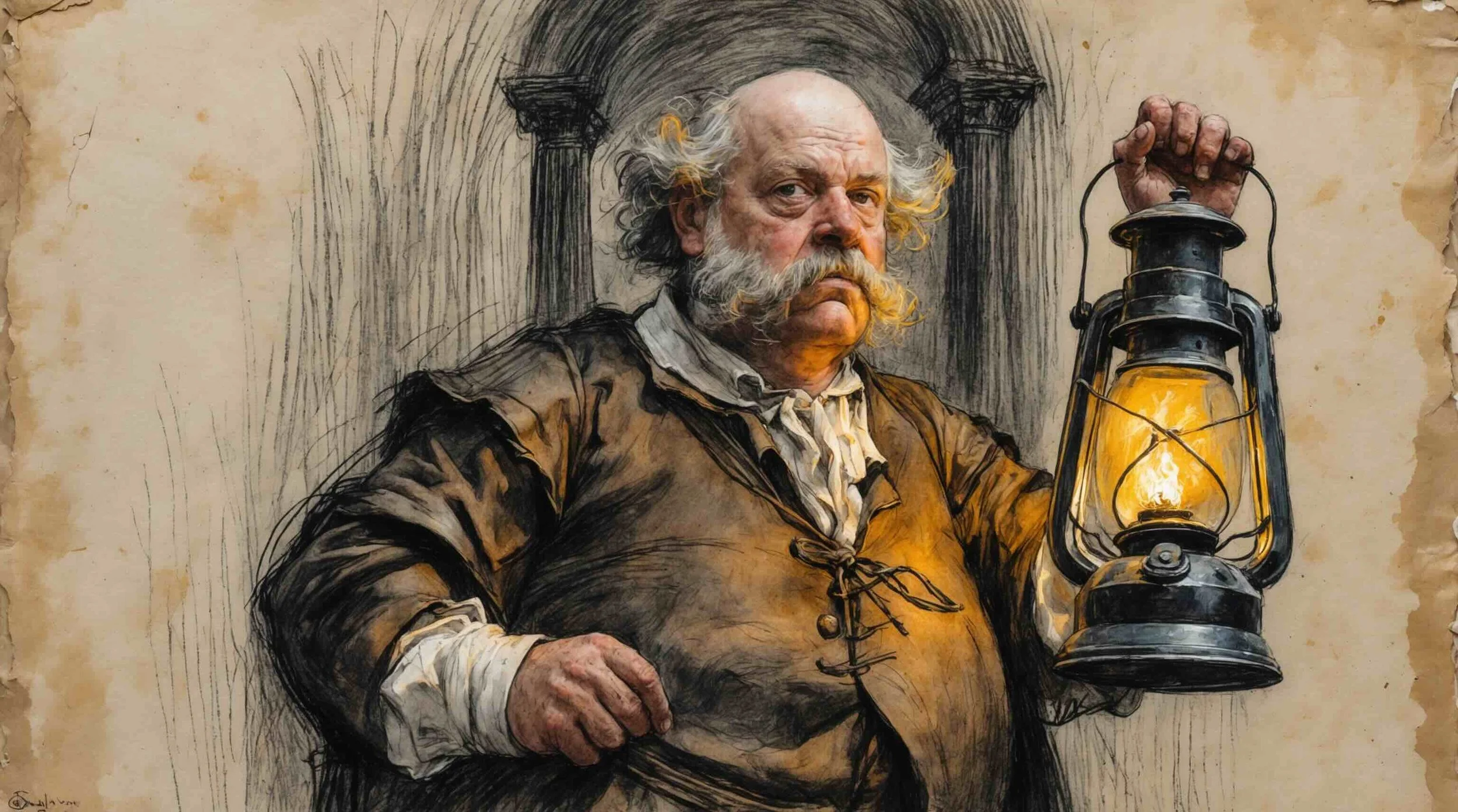
Character Profile – At a Glance
- Role: Constable of the watch in Messina, a self-important official who gets every long word wrong. His sleepy watchmen overhear Borachio and solve the plot that the prince and Claudio could not.
- Key Traits: Pompous, kindly, vain and long-winded. Says the opposite of what he means and never notices. Completely sure of his own importance.
- The Core Conflict: Dogberry holds the truth that would save Hero and cannot get a gentleman to listen to him long enough to hear it.
- Key Actions: Instructs the watch to avoid all trouble (A3S3). Tries to report the arrests to Leonato on the wedding morning and is brushed aside (A3S5). Examines Borachio and Conrade and is called an ass (A4S2). Delivers the prisoners to Don Pedro, and asks that it be remembered that he is an ass (A5S1).
- Famous Quote:
"O that I had been writ down an ass!"
(Act 4, Scene 2) - The Outcome: Paid and thanked by Leonato, who "discharges" him of his prisoner. He leaves hoping that God will "prohibit" a merry meeting.
Are You Good Men and True?
Dogberry enters in the middle of the play with Verges and the watch, and his first job is to choose a constable for the night. He picks George Seacole, because he can read and write, and then tells him why that does not matter.
Original
You are thought here to be the most senseless and fit man for the constable of the watch; therefore bear you the lantern. This is your charge: you shall comprehend all vagrom men; you are to bid any man stand, in the prince's name.
(Act 3, Scene 3)
Shakespeare Retold (Modern Verse)
You are widely considered here to be the most senseless – I mean ‘sensible’ – and suitable man for constable of the watch; so, pick up your lantern. These are your orders: you will comprehend – I mean ‘apprehend’ – all vagrants; you will order any man to stop, in the prince’s name.
"Senseless" for sensible, "comprehend" for apprehend, "vagrom" for vagrant: every word of office comes out bent. The Shakespeare Retold version keeps the blunders and adds the corrections in Dogberry’s own voice, so that a reader who has never met him can hear what he means and what he says at once.
The charge that follows is a masterpiece of avoidance. If a man will not stand, let him go and thank God you are rid of a knave. If the drunk will not go to bed, leave him till he is sober. If you meet a thief, the less you meddle with him the better for your honesty. The watch conclude that they would rather sleep than talk, and Dogberry cannot see how sleeping should offend. It is the funniest briefing in Shakespeare, and it is about to catch two villains. The theme of status and class in this play has its comic face here: the lowest officers in Messina, doing their job as badly as possible, succeed where the highest fail.
Comparisons Are Odorous
On the wedding morning Dogberry and Verges go to Leonato with the news that two "aspicious persons" have been arrested. They have the whole plot in their hands. What they do not have is the ability to say so in under five minutes, and Leonato is in a hurry.
Original
Goodman Verges, sir, speaks a little off the matter: an old man, sir, and his wits are not so blunt as, God help, I would desire they were; but, in faith, honest as the skin between his brows.
(Act 3, Scene 5)
Shakespeare Retold (Modern Verse)
Apologies, sir, my good man Verges tends to veer off topic: he’s an old man, sir, and his mind is not as blunt – I mean ‘sharp’ – as, by God, I wish it was. But I assure you he’s as honest as the skin between his eyebrows.
Dogberry apologises for his partner, which takes longer than letting his partner speak would have done; tells Leonato that his tediousness would be a gift to any worship; and explains that when the age is in, the wit is out. Leonato tells them to examine the prisoners themselves. Dogberry says it shall be "suffigance", and Hero goes to church.
The scene is built for the audience’s agony. We know what the watch heard. We watch the one man who could stop the wedding talk himself out of the room. The theme of wit and communication in this play is mostly a pleasure, and here it is a weapon turned against its owner: Dogberry has too many words and not one that works.
Write Down That I Am an Ass
The examination in the prison is Dogberry at his most magnificent. He asks the prisoners whether they serve God, writes down that they hope they do, and tells them it is already proved they are false knaves before anyone has given evidence. The sexton has to explain how a trial works. Then Conrade calls him an ass, and the sexton has gone.
Original
Dost thou not suspect my place? Dost thou not suspect my years? O that he were here to write me down an ass! But, masters, remember that I am an ass; though it be not written down, yet forget not that I am an ass.
(Act 4, Scene 2)
Shakespeare Retold (Modern Verse)
Don’t you suspect – I mean, ‘respect’ – my role? Don’t you suspect – ‘respect’ – my experience? Oh, if only he was here to write down that he called me an ass! But don’t forget that I am an ass; although it’s not written down, don’t forget that I am an ass.
"Suspect" for respect, and then the glorious collapse: "remember that I am an ass; though it be not written down, yet forget not that I am an ass." He means that the insult should be recorded. He has recorded it himself, three times. The speech that follows, in which he lists his qualifications, a wise fellow, an officer, a householder, "as pretty a piece of flesh as any is in Messina", a man who has had losses and owns two gowns, is the fullest self-portrait in the play, and it is of a man who has no idea what he looks like.
And yet the examination works. The watch give their evidence, the sexton puts it together, and by the end of the scene the plot is on paper and on its way to Leonato. The theme of deception and noting in this play is undone not by cleverness but by a constable too stupid to be deceived.
Sixth and Lastly
Dogberry delivers his prisoners to the prince and Claudio in the street, and the prince asks what they have done.
Original
Marry, sir, they have committed false report; moreover, they have spoken untruths; secondarily, they are slanders; sixth and lastly, they have belied a lady; thirdly, they have verified unjust things; and, to conclude, they are lying knaves.
(Act 5, Scene 1)
Shakespeare Retold (Modern Verse)
Well, sir, they have lied; and what is more, they’ve not told the truth; secondarily, they are slanders; sixth and lastly, they have lied about a lady; thirdly, they have said things are true that are false; and, finally, they are lying scumbags.
Six charges, which are all the same charge, numbered secondarily, sixth and lastly, thirdly and to conclude. The prince repeats the list back to him in the same order, which is the one joke in the play that Dogberry does not understand, and then says that "this learned constable is too cunning to be understood". Borachio has to confess in plain prose before anyone learns what happened.
Dogberry’s last concern, as the prince and Claudio are drinking poison and Leonato is arriving, is that it should be specified, "when time and place shall serve", that he is an ass. Leonato pays him, thanks him and gets rid of him, and Dogberry leaves wishing that God will "prohibit" any future meeting. He has saved Hero’s life and her name, and nobody tells him so. The theme of honour and shame in this play is the gentry’s property, and the man who rescues it never gets a share.
"A drunken constable is not uncommon, nor hard to draw; but see and examine what goes to make up a Dogberry."
— Samuel Taylor Coleridge, Lectures on Shakespeare, 1818
Key Quotes
Quote 1
Why, then, take no note of him, but let him go; and presently call the rest of the watch together and thank God you are rid of a knave.
(Act 3, Scene 3)
Shakespeare Retold (Modern Verse)
Well, then, take no notice of him, but just let him go; and immediately call the rest of the watchmen together and count your blessings you got rid of a villain.
Quote Analysis: Dogberry to the watch, who have asked what to do if a man will not stand when ordered. Let him go, and thank God you are rid of him. The advice is the opposite of a constable’s duty and it is also, in its way, wise: Dogberry wants nobody hurt, least of all his own men. The whole charge is built on this principle of doing nothing, and the joke of the play is that the watch, doing nothing on a church bench at two in the morning, overhear the one conversation that matters.
Truly, I would not hang a dog by my will, much more a man who hath any honesty in him.
(Act 3, Scene 3)
Shakespeare Retold (Modern Verse)
Truly, I would never choose to hang a dog, much more – I mean ‘less’ – a man with any honesty in him.
Quote Analysis: Dogberry, defending his leniency. He means "much less" a man, and says "much more", so that the sentence as spoken offers to hang honest men more readily than dogs. The Retold supplies the correction in Dogberry’s own voice, which is the right way to hear him: the man is kind, and his kindness comes out backwards. Verges calls him merciful, and he is. It is one of the reasons audiences love him rather than merely laughing at him.
Comparisons are odorous: palabras, neighbour Verges.
(Act 3, Scene 5)
Shakespeare Retold (Modern Verse)
Comparisons are odorous – I mean ‘odious’ – less chat, Verges.
Quote Analysis: Dogberry to Verges, who has just said he is as honest as any old man alive. "Odorous" for odious is the most famous of his blunders, so famous that the mistaken word has nearly replaced the right one in the saying. "Palabras" is Spanish for words, borrowed to mean "fewer words", and used by the most wordy man in Messina. The line is a small masterpiece because it is pompous, wrong and affectionate all at once, and because Dogberry is telling someone else to be brief.
O villain! Thou wilt be condemned into everlasting redemption for this.
(Act 4, Scene 2)
Shakespeare Retold (Modern Verse)
Oh, you villain! You will be condemned into everlasting redemption – I mean ‘damnation’ – for this.
Quote Analysis: Dogberry, on hearing that Borachio took a thousand ducats to slander Hero. Everlasting redemption is heaven, and he means hell. It is the one moment in the play where Dogberry is morally right at the top of his voice, and the language fails him completely. The blunder is also the play in miniature. Messina is full of people who say one thing and mean another; Dogberry is the only one who does it by accident, and the only one whose heart is in the right place every time.
Key Takeaways
- The Malapropist: Dogberry says the opposite of what he means in almost every speech, and never once notices; the Retold keeps the blunders and supplies the sense.
- Do Nothing, Catch Everything: His advice to the watch is to avoid all trouble, and the watch, avoiding trouble on a bench, overhear the plot.
- The Man Nobody Hears: He carries the truth to Leonato on the wedding morning and is sent away as tedious; the gentry's inattention is the play's real villain.
- Writ Down an Ass: His demand that the insult be recorded is the funniest speech in the play, and the fullest portrait of a man with no idea how he looks.
Study Questions and Analysis
What are Dogberry’s malapropisms, and why are they funny?
A malapropism is the use of a wrong word that sounds like the right one, and the term comes from a character in Sheridan’s The Rivals who was invented nearly two centuries after Dogberry; he is the thing before it had a name. His report to Leonato packs three into one sentence.
One word, sir: our watch, sir, have indeed comprehended two aspicious persons, and we would have them this morning examined before your worship.
(Act 3, Scene 5)
Shakespeare Retold (Modern Verse)
A final word, sir: on our watch, sir, we did indeed comprehend – I mean ‘apprehend’ – two auspicious – I mean ‘suspicious’ – people who we’d like you to interrogate this morning.
Comprehended for apprehended; aspicious for suspicious; and the whole sentence delivered with the gravity of a man reading a warrant. The joke is not simply that he gets words wrong. It is that he gets the long, official words wrong, the words of his office, and that the wrong word so often says something truer than the right one. His watchmen are to be "senseless" and "vigitant"; the prisoners are full of "piety"; and Dogberry himself is an "aspicious" person in both senses.
William Hazlitt, in Characters of Shakespear’s Plays (1817), called Dogberry and Verges "inimitable specimens of quaint blundering and misprisions of meaning", and went on to a sharper point: they are "a standing record of that formal gravity of pretension and total want of common understanding, which Shakespeare no doubt copied from real life, and which in the course of two hundred years appear to have ascended from the lowest to the highest offices in the state." The joke, for Hazlitt, was political as well as verbal. Samuel Taylor Coleridge (1818) refused to treat him as a mere clown: "Take Dogberry: are no important truths there conveyed, no admirable lessons taught, and no valuable allusions made to reigning follies, which the poet saw must for ever reign?" George Bernard Shaw (1898) gave the actor’s rule: "Dogberry’s first qualification must be a complete unconsciousness of himself as he appeals to others." The comedy depends on his never knowing. The Shakespeare Retold version handles the problem a modern reader faces, which is that half the blunders no longer sound like anything, by keeping the wrong word and letting Dogberry correct himself in the next breath. The theme of wit and communication in this play has Beatrice at one end and Dogberry at the other: she means more than she says, and he says more than he means.
What is Shakespeare satirising in Dogberry’s charge to the watch?
Petty office, and the people who hold it. Every instruction Dogberry gives is designed to keep the watch out of harm’s way, and he is most eloquent on the subject of thieves.
Truly, by your office, you may; but I think they that touch pitch will be defiled: the most peaceable way for you, if you do take a thief, is to let him show himself what he is and steal out of your company.
(Act 3, Scene 3)
Shakespeare Retold (Modern Verse)
In truth, it is your job to do so; but I believe that those who touch black tar will become unclean: the most peaceful way for you, if you do catch a thief, is to let him show his true colours by stealing away from you.
They may arrest a thief, but pitch defiles those who touch it, so the peaceable course is to let him show what he is "and steal out of your company". The pun is accidental and perfect. The watch are to be officers of the peace in the most literal sense: they are to keep it by never disturbing anyone, including criminals.
Samuel Johnson (1765), annotating the scene with Leonato, noticed how exactly Shakespeare had caught the voice of a man in a small office: "Dogberry, in his vanity of superiour parts, apologizing for his neighbour, observes, that of two men on an horse, one must ride behind." Vanity of parts, in a man with none, is the whole character. August Wilhelm Schlegel (1808) summed up the watch as "the blundering simplicity of a couple of constables and watchmen" and saw no more in them than comic relief, which is roughly how the eighteenth century had played them. Hazlitt (1817) saw the satire reaching upward, to the "formal gravity of pretension" of every official who has ever hidden an empty head behind a long word. The charge also contains the play’s one piece of genuine wisdom about policing: "the watch ought to offend no man". Dogberry means it as an excuse for doing nothing. It is also, in a play about honourable men destroying an innocent woman, not the worst principle on offer. The theme of status and class in this play lets the gentlemen do the damage and the constables repair it, and the charge to the watch is where the repair begins.
How does Dogberry’s watch solve the plot?
By accident, and the play says so through the villain. Borachio, confessing to the prince, gives the watch their due.
I have deceived even your very eyes: what your wisdoms could not discover, these shallow fools have brought to light...
(Borachio, Act 5, Scene 1)
Shakespeare Retold (Modern Verse)
I have even tricked your eyes: what your wise heads could not uncover, these silly fools have got to the bottom of...
"What your wisdoms could not discover, these shallow fools have brought to light." The watch were sitting on a church bench, under orders to go to bed at two, when Borachio came by drunk and boastful and told Conrade everything. They did not investigate; they overheard. The arrest that follows is as inept as everything else they do, with one watchman convinced that a thief called Deformed is at large because Borachio used the word.
Samuel Taylor Coleridge (1818) made the famous objection that the watch are "forced into the service, when any other less ingeniously absurd watchmen and night-constables would have answered the mere necessities of the action". A. C. Swinburne (1880) answered him directly: "if Dogberry had been other than Dogberry, or if Verges had been other than Verges, the action and catastrophe of the whole play could never have taken place at all." Swinburne’s point is the better one. A competent constable would have reported to Leonato in two sentences and stopped the wedding; only Dogberry could hold the truth and fail to deliver it, so that Hero must be shamed, "die" and be restored. The incompetence is the plot. Bertrand Evans (1960) added the structural observation that the audience knows the plot is solved from the moment of the arrest, so that the church scene is played against our knowledge that the cure already exists; the pain of Act 4 is the pain of watching Dogberry fail to say "suffigance" fast enough. The theme of deception and noting in this play is defeated by the one group of people in Messina too simple to practise it.
Why does nobody listen to Dogberry?
Because he is a constable talking to a governor on a busy morning, and because he cannot say anything briefly. His response to being called tedious is the play’s best illustration of why he is.
It pleases your worship to say so, but we are the poor duke's officers; but truly, for mine own part, if I were as tedious as a king, I could find it in my heart to bestow it all of your worship.
(Act 3, Scene 5)
Shakespeare Retold (Modern Verse)
It may please you to say so, my lord, but we are merely officers of the duke; but truthfully on my part, if I was as boring as a king, I would find it in my heart to give all my tediousness to you, my lord.
He takes "tedious" as a compliment, something like wealthy, and offers to give Leonato all of it. Leonato, who has a wedding to attend, says he would fain know what they have to say, and Verges finally manages a sentence with the arrest in it, which Dogberry immediately buries under an apology for Verges. The news never arrives.
Jean E. Howard (1987) read the play as a contest over who gets to control what is seen and believed, a contest the "better sort" win, and the scene with Leonato is its sharpest case: the truth is in the possession of a man whose class makes him inaudible. George Bernard Shaw (1898) saw the scene’s importance when Henry Irving cut it, and called the cut "the most audacious" of Irving’s "manifold treasons against Shakespeare"; without the scene, he said, Verges "is almost annihilated", and the play loses the moment where the gentry fail to hear. The Folger editors Mowat and Werstine call him "the bumbling, officious Dogberry", and both adjectives matter: the bumbling makes him slow, the officiousness makes him long, and Leonato has time for neither. There is a kinder reading too. Leonato offers him wine and asks him to conduct the examination himself, which is a courtesy to a man of Dogberry’s rank, and the examination is in fact what breaks the case. Nobody listens to Dogberry, but the play does, and it gives him the result. The theme of status and class in Messina is not that the poor are despised; it is that they are not heard until it is nearly too late.
Is Dogberry just a fool, or is there more to him?
He is a fool with a character, which is rarer. The speech in which he lists his qualifications is comic from end to end, and it is also the portrait of a particular man.
I am a wise fellow, and, which is more, an officer, and, which is more, a householder, and, which is more, as pretty a piece of flesh as any is in Messina, and one that knows the law, go to; and a rich fellow enough, go to; and a fellow that hath had losses, and one that hath two gowns and every thing handsome about him.
(Act 4, Scene 2)
Shakespeare Retold (Modern Verse)
I am a wise man, and, what’s more, an officer, and, what’s more, a householder, and, what’s more, as attractive as any person here in Messina, and I understand the laws, so there; and I’m a rich enough man, so there; and I’m a man who has known hardship, and I have two gowns and I own lots of lovely things.
An officer, a householder, a handsome man, a man who knows the law, a rich enough man, a man who "hath had losses", a man with two gowns. The list is in no order of importance because, to Dogberry, it is all importance, and "hath had losses" is a small, sad, respectable touch: he has been richer than he is, and wants it known. He is vain, and he is kind, and the two live in the same sentence.
Samuel Taylor Coleridge (1818) insisted on the difference between a type and a character: "A drunken constable is not uncommon, nor hard to draw; but see and examine what goes to make up a Dogberry." Dogberry, for Coleridge, is "not the creature of the day, to disappear with the day, but the representative and abstract of truth which must ever be true, and of humour which must ever be humorous." Shaw (1898) agreed from the stalls: "Dogberry is a capital study of parochial character. Sincerely played, he always comes out as a very real and highly entertaining person." The word "sincerely" is the key. Played as a clown he is tiresome; played as a man who believes every word he says, he is one of the most lovable parts in Shakespeare, and the actors who have made him famous, from Will Kemp in the first company to Michael Keaton in Branagh’s 1993 film, have all found the belief first. Hazlitt (1817) thought the pair "inimitable", and the word is right. The theme of status and class in this play gives Dogberry the lowest office on stage and the clearest conscience. He is the only man in Messina who never wrongs anyone.
Who first played Dogberry?
Will Kemp, the leading clown of Shakespeare’s company, and we know it from a slip in the printing. In the 1600 quarto the speech headings for the examination scene give the actors’ names instead of the characters’, "Kemp" for Dogberry and "Cowley" for Verges, as if the printer had set the play from a manuscript in which Shakespeare was already thinking of who would speak the lines. Dogberry’s last instruction in the play is one of the speeches so labelled.
Come, bring away the plaintiffs: by this time our sexton hath reformed Signior Leonato of the matter: and, masters, do not forget to specify, when time and place shall serve, that I am an ass.
(Act 5, Scene 1)
Shakespeare Retold (Modern Verse)
Take the plaintiffs – I mean ‘defendants’ – away; by now, our sexton will have reformed – I mean ‘informed’ – Leonato of this: and, masters, do not forget to specify, when the time and place is right, that I am an ass.
Plaintiffs for defendants, reformed for informed, and the one thing he wants specified when time and place shall serve. It is a speech written for a particular comedian, and it ends with the catchphrase the comedian would have made his own.
Samuel Johnson (1765) noticed the evidence and recorded it plainly: in the quarto "the names of two actors, Kempe and Cowley, are placed at the beginning of the speeches, instead of the proper words". The Folger editors Mowat and Werstine describe the same text as "remarkable among early printed texts of Shakespeare’s plays for the contrast it presents between the superb correctness of its dialogue and the many obvious errors and ambiguities in its stage directions and speech prefixes", and note that those prefixes "contain the names of two quite well-known actors from Shakespeare’s company—the clowns Will Kemp and Richard Cowley". The Royal Shakespeare Company’s own history of the play states that Kemp "is known to have played Dogberry" and that he left the company during 1599, which is one reason the play is usually dated to late 1598 or early 1599. Kemp was a physical comedian famous for his jigs, and the part is built for one: Dogberry’s dignity is a thing of the body as well as the voice, and every actor since has had to decide how fat, how slow and how grand to make him. The theme of status and class in this play was written, in the first instance, for a star, and the star played the man at the bottom.
What happens to Dogberry at the end?
He is paid, thanked and dismissed, and he never finds out what he has done. Leonato gives him money for his pains and relieves him of his prisoner, and Dogberry’s farewell is as muddled as his greeting.
I leave an arrant knave with your worship; which I beseech your worship to correct yourself, for the example of others.
(Act 5, Scene 1)
Shakespeare Retold (Modern Verse)
I’ll leave an utter rogue with your worship; and I ask your worship to fix this man yourself, as an example to others.
He asks Leonato to "correct yourself", meaning the prisoner; wishes his worship health and gives him leave to depart from his own house; and prays God to "prohibit" a merry meeting. Then he goes, and the play has no more use for him. The dance at the end is for the gentry.
Samuel Taylor Coleridge (1818) thought this exactly right, since Dogberry is "forced into the service" of a plot that could have been served by any fool, and once the service is done the play may drop him. A. C. Swinburne (1880) thought Coleridge wrong about the plot but did not quarrel with the exit. Northrop Frye, in A Natural Perspective (1965), described comedy’s habit of absorbing or dismissing its outsiders before the final celebration, and Dogberry, who was never part of Messina’s society, is dismissed with a tip. What the audience carries away is something the characters never see. Borachio told the prince that "these shallow fools" brought to light what wisdom could not, and the prince, a moment earlier, had called the constable "too cunning to be understood". Both are jokes at Dogberry’s expense and both are true. Hazlitt’s reading of him as a type of officialdom that "ascended from the lowest to the highest offices in the state" gives the exit its edge: the man of no understanding goes home with his fee, and the men of understanding go dancing, and the play has made very clear which of them did the harm. The theme of status and class in this comedy is settled in the last scene with everyone back in place, and Dogberry’s place is outside.