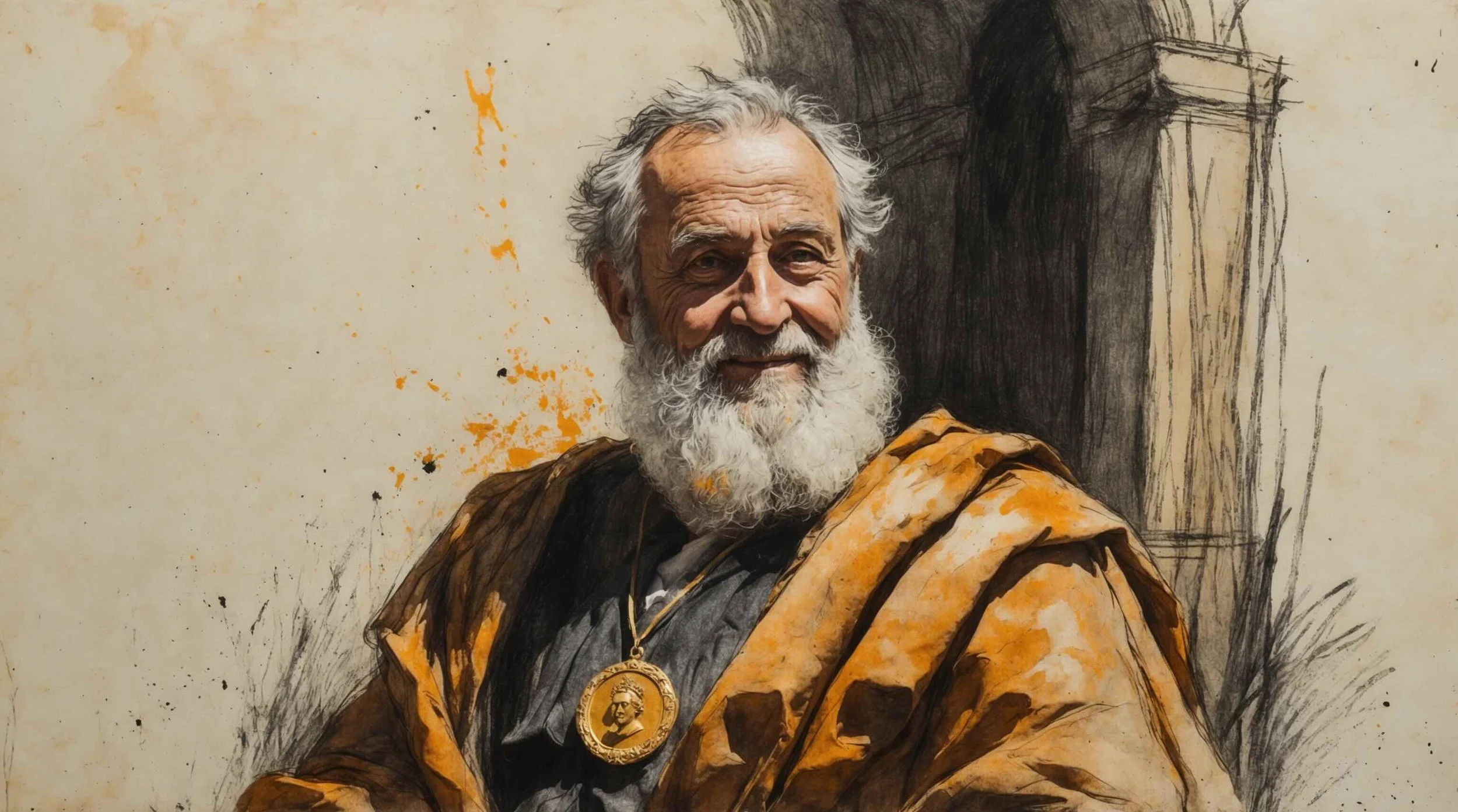
Character Profile – At a Glance
- Role: Governor of Messina, Hero’s father and Beatrice’s uncle. Host to Don Pedro and his officers, maker of the match with Claudio, and the man who wishes his own daughter dead when she is accused.
- Key Traits: Genial, hospitable, proud of his daughter and of his standing. Quick to grief and quick to rage. Old enough to challenge a young man to a duel and mean it.
- The Core Conflict: Leonato’s honour lives in his daughter’s. When the prince calls her unchaste, he believes the prince over his own child, and the play makes him pay for it with a grief that turns to fury.
- Key Actions: Welcomes the prince and hears that he means to woo Hero (A1S1, A1S2). Gives Hero to Claudio "and with her my fortunes" (A2S1). Plays the grave old man in the gulling of Benedick (A2S3). Wishes Hero dead in the church, then accepts the friar’s plan (A4S1). Challenges Claudio, learns the truth and sets the terms of his penance (A5S1). Stage-manages the second wedding (A5S4).
- Famous Quote:
"Being that I flow in grief,
The smallest twine may lead me."
(Act 4, Scene 1) - The Outcome: His daughter restored and married, his niece matched, his revenge dissolved: "And so dies my revenge."
The Host of Messina
Leonato opens the play with a letter and a guest list. The prince is coming; the war is won; a young Florentine called Claudio has covered himself in honour. Leonato is the kind of man who weeps at good news and says so, and when the prince arrives he greets him with a speech that is all courtesy.
Original
Never came trouble to my house in the likeness of your grace: for trouble being gone, comfort should remain; but when you depart from me, sorrow abides and happiness takes his leave.
(Act 1, Scene 1)
Shakespeare Retold (Modern Verse)
Trouble has never come to my house in the shape of you, your grace: when those who cause trouble leave, it’s comforting; but when you leave, only sorrow remains and all the happiness is gone.
It is a graceful welcome from a man whose whole position depends on being gracious. Leonato governs Messina, but a prince outranks him, and for the next month his house, his table and his daughter are at the prince’s disposal. He knows it, and he makes the best of it. His joke about Hero’s mother, "Her mother hath many times told me so", is the first of the play’s hundred cuckold jokes, and it comes from the father of the bride.
Within a scene his brother tells him that the prince means to woo Hero, and Leonato’s response is to prepare her answer. The theme of courtship and marriage in Messina begins as a conversation between older men about a girl who is not in the room, and Leonato is comfortable with that.
Take of Me My Daughter
At the ball Leonato learns that the prince was wooing for Claudio, and he hands his daughter over on the spot.
Original
Count, take of me my daughter, and with her my fortunes: his grace hath made the match, and all grace say Amen to it.
(Act 2, Scene 1)
Shakespeare Retold (Modern Verse)
Count Claudio, take my daughter from me, and with her also comes my fortune. The prince has made the match, and may God say Amen to that.
"And with her my fortunes": Hero is his only heir, and the sentence gives away the girl and the estate in one breath. She is standing beside him and says nothing we can hear. It is not cruelty. It is simply how a governor of Messina marries off a daughter, and Leonato does it with pleasure, adding a week’s delay for the preparations and a promise to help the prince trick Benedick into loving Beatrice.
In the orchard he plays his part so well that Benedick cannot believe it is a part: "knavery cannot, sure, hide himself in such reverence." The white beard is the trick’s guarantee. Leonato is a respectable old man, and respectability, in this play, is what people believe. The theme of deception and noting in Messina depends on who is doing the deceiving, and nobody suspects the governor.
Hath No Man's Dagger Here a Point for Me?
In the church Leonato hears the prince, the prince’s brother and his future son-in-law swear that Hero is a wanton, and he believes them. His first instinct is suicide; his second, when Hero faints, is that she had better die. The friar asks why she should not look up.
Original
Wherefore! Why, doth not every earthly thing
Cry shame upon her? Could she here deny
The story that is printed in her blood?
(Act 4, Scene 1)
Shakespeare Retold (Modern Verse)
Why shouldn’t she! Well, does the evidence
Not cover her in shame? Can she deny
The story that her blushing face reveals?
"The story that is printed in her blood" is her blush, and Claudio has already taught him how to read it. What follows is the most terrible speech a father makes in the comedies: he wishes he had never had her, wishes he had taken a beggar’s child instead, and says that if he thought she would live he would strike at her life himself. The grief is real and so is the self-pity. The word that repeats is "mine".
And then, within a hundred lines, the friar talks him out of it. Leonato’s own explanation is the play’s kindest line about him: "Being that I flow in grief, / The smallest twine may lead me." He is a man who believes whoever spoke last, and the play knows it. The theme of honour and shame has no more vivid victim than a father who would kill his daughter to save his name, and no more honest confession of weakness.
Thou Hast Killed My Child
By Act 5 the twine has pulled the other way. Leonato has convinced himself that Hero was slandered, and when the prince and Claudio try to hurry past him he stops them.
Original
Know, Claudio, to thy head,
Thou hast so wronged mine innocent child and me
That I am forced to lay my reverence by
And, with grey hairs and bruise of many days,
Do challenge thee to trial of a man.
(Act 5, Scene 1)
Shakespeare Retold (Modern Verse)
Claudio, to your face:
You’ve wronged my child, who’s innocent, and me,
So much I’m forced to put aside respect
And, with grey hair and creaking older bones,
I challenge you to fight me like a man.
An old man challenging a young soldier to a duel is a comic situation, and Shakespeare lets it be comic: Antonio joins in, calls them "boys, apes, braggarts, Jacks, milksops", and has to be restrained by the brother he is defending. But Leonato’s own lines are not funny. "Thou hast killed my child: / If thou kill’st me, boy, thou shalt kill a man" is the speech of a father who has nothing left to lose, and Claudio, who tried to laugh it off, puts his hand on his sword.
The scene is also the first time anyone has told Claudio and the prince what they did. Leonato says it plainly: Hero is buried, slandered to death, "framed by thy villany". They do not believe him, and they will within the hour. The theme of gender and patriarchy in this play gives a woman’s honour to her father to defend, and Leonato, having failed her in the church, tries to make it up with a sword.
And So Dies My Revenge
When Borachio confesses, Leonato has the two most powerful men in Messina in his debt, and the penance he sets is not a punishment but a repair.
Original
Possess the people in Messina here
How innocent she died; and if your love
Can labour ought in sad invention,
Hang her an epitaph upon her tomb
And sing it to her bones, sing it to-night...
(Act 5, Scene 1)
Shakespeare Retold (Modern Verse)
To make sure people in Messina know
That she died innocent; and if your love
Is able to create something in sadness,
Then write a tribute to her on her tomb
And sing it to her body there tonight.
Clear her name in public; mourn her in public; and in the morning marry the cousin who is "almost the copy of my child that’s dead". The first two undo the shame; the third restores the match. Leonato is thinking like a governor, not like a father, and the plan works because it gives Claudio a way to be forgiven that costs him nothing he values.
In the last scene he directs the whole business, sends the women off to be masked, tells his brother to play the father, and watches Claudio swear to marry a woman he cannot see. The play never asks him to say sorry to Hero. It asks him to be clever, and he is. The theme of status and class in this play is a matter of who arranges things, and Leonato, having lost control of his house for an afternoon, ends the play firmly back in charge of it.
"This is one of our author’s observations upon life. Men overpowered with distress, eagerly listen to the first offers of relief, close with every scheme, and believe every promise."
— Samuel Johnson, Notes on Much Ado About Nothing, 1765
Key Quotes
Quote 1
A victory is twice itself when the achiever brings home full numbers.
(Act 1, Scene 1)
Shakespeare Retold (Modern Verse)
A victory is twice as good when the victor brings back a full army.
Quote Analysis: Leonato to the messenger, on hearing that few men were lost. It is the first judgement he makes in the play and it is a generous one: the measure of a victory is how many come home. The line also tells us what kind of man he is, a civilian who thinks about soldiers as people with houses to return to. His own house is about to receive them, and the war he is about to host is the one that takes casualties.
But mine and mine I loved and mine I praised
And mine that I was proud on, mine so much
That I myself was to myself not mine,
Valuing of her...
(Act 4, Scene 1)
Shakespeare Retold (Modern Verse)
But you were mine; I loved that you were mine,
And proudly praised that you were mine; so much so
That my life was no longer mine to live
Because I valued her so much.
Quote Analysis: Leonato over his unconscious daughter, explaining why her disgrace has destroyed him. "Mine" comes six times in three lines. He loved her as his, praised her as his, was proud of her as his, so much that he was no longer his own. It is love, and it is ownership, and the speech cannot tell them apart. Hero’s fall into "a pit of ink" is his fall, and that is why he would rather she died than survived it.
I pray thee, peace. I will be flesh and blood;
For there was never yet philosopher
That could endure the toothache patiently...
(Act 5, Scene 1)
Shakespeare Retold (Modern Verse)
Oh, please be quiet. I’m only flesh and blood;
As yet, there’s no philosopher who’s lived
Who could endure a toothache patiently...
Quote Analysis: Leonato to his brother, who has been offering him comfort. Nobody has ever borne a toothache patiently, however grandly they wrote about suffering; and Leonato refuses to be a philosopher. The speech that leads to this, about grief that "cries louder than advertisement", is the play’s one sustained passage of pain, and it comes from the comic old man. He has earned it. The toothache is also Benedick’s excuse for lovesickness two acts earlier, and the echo is not kind to Benedick.
I thank you, princes, for my daughter's death:
Record it with your high and worthy deeds:
'Twas bravely done, if you bethink you of it.
(Act 5, Scene 1)
Shakespeare Retold (Modern Verse)
I thank you, princes, for my daughter’s death:
Let’s list it with your other worthy acts.
It was so bravely done, upon reflection.
Quote Analysis: Leonato to the prince and Claudio, after Borachio has confessed. The irony is as heavy as he can make it: thank you, record it with your worthy deeds, it was bravely done. Borachio has just tried to take all the blame on himself, and Leonato will not let him: "Here stand a pair of honourable men". The phrase is Mark Antony’s, and Leonato uses it the same way. For the only time in the play he has the moral advantage over a prince, and he spends it in three lines of sarcasm.
Key Takeaways
- The Gracious Host: Leonato runs Messina and defers to the prince; his daughter, his house and his fortune are all at the prince's disposal, and he gives them gladly.
- Mine and Mine: In the church he wishes Hero dead because her shame is his; the speech cannot separate love from ownership.
- The Smallest Twine: He believes whoever spoke last, the prince, then the friar, then his own grief; the play calls it weakness and forgives it.
- The Old Man's Challenge: His duel with Claudio is comic and not comic at once: the first time anyone names what the young men have done.
Study Questions and Analysis
Why does Leonato believe the accusation against his own daughter?
Because of who makes it. Three men of rank, one of them a prince, swear they saw her at her window, and against that Hero has only a denial. Leonato’s reasoning is spoken aloud.
Would the two princes lie, and Claudio lie,
Who loved her so, that, speaking of her foulness,
Washed it with tears? Hence from her! Let her die.
(Act 4, Scene 1)
Shakespeare Retold (Modern Verse)
Would the two princes lie? Would Claudio lie,
Who loved her so much, speaking of her filth,
He sobbed with tears? Let’s leave her here to die!
Would princes lie? Would a man who loved her lie, and weep while he did it? It does not occur to him that they could be honestly mistaken, and it does not occur to him to ask his daughter. The Friar’s evidence, which is the same blush read the other way, convinces him within minutes, and that is the point: Leonato believes the last authoritative voice.
The Folger editors Barbara Mowat and Paul Werstine name it precisely, "Leonato’s too credulous paternal fury", and set it beside Claudio’s weak jealousy and the prince’s touchy honour as the three failings inside Messina that let an outsider’s malice work. Carol Cook, in her 1986 essay in PMLA, read the speech as the plainest statement in the play that a daughter’s chastity is her father’s property, so that he experiences her disgrace as theft and responds like a man robbed; in Cook’s terms "masculine privilege is contingent on the legibility of women", and Hero has suddenly become illegible to him. Gail Kern Paster, in her "Modern Perspective" essay for the Folger edition, sets Leonato in a wider pattern: "anxiety about sexual betrayal in marriage seems endemic in Messina, sparing neither the old nor the young, neither male nor female", and the father who joked about his wife’s fidelity in the first scene is the father who believes the worst of his daughter in the fourth. Samuel Johnson (1765) put it more gently, and more generally, in his note on "the smallest twine may lead me": "Men overpowered with distress, eagerly listen to the first offers of relief, close with every scheme, and believe every promise." The theme of honour and shame in this play is held by men on women’s behalf, and Leonato shows what happens when the holder panics.
What is the point of Leonato’s long speech on grief in Act 5?
It is the play’s one extended passage of real pain, and it is given to a man we have so far seen as a genial host and a comic dupe. His brother tells him to be patient; Leonato tells him what patience is worth.
Patch grief with proverbs, make misfortune drunk
With candle-wasters; bring him yet to me,
And I of him will gather patience.
(Act 5, Scene 1)
Shakespeare Retold (Modern Verse)
Obscure his pain with platitudes, avoid grief
By reading books by candlelight, then bring him
To me and I will learn patience from him.
Find a father who has lost what I have lost, he says, and if that man can smile and stroke his beard and patch his grief with proverbs, I will learn patience from him. "But there is no such man." The speech goes on to say that everyone can counsel grief they do not feel, and nobody can counsel their own, and that there was never yet a philosopher who could bear a toothache.
William Hazlitt (1817) made the general point that in this play "the serious part is still the most prominent", and the speech is the strongest evidence for it: for forty lines the comedy stops and an old man talks about losing a child. Harry Berger Jr. (1982) read it more coldly, as the grief of a member of "the Men’s Club of Messina" for his own standing as much as for his daughter, and it is true that Leonato’s "woe" is still partly the woe of the man whose "mine" has been taken. But the speech also prepares the challenge. Antonio’s advice is that he should not bend all the harm upon himself but make those who offended him suffer too, and Leonato answers, "There thou speak’st reason." Within a minute the prince and Claudio arrive, and the man who could not be comforted has found something to do. August Wilhelm Schlegel (1808) observed that the church scene would have been "too tragical" had Shakespeare not softened it, and this scene is where the softening is tested: it holds, but only just. The theme of love and romance in this play is mostly about couples. Leonato’s speech is its one account of what a parent’s love feels like when it is broken.
Is Leonato’s challenge to Claudio comic or serious?
Both, and the play is careful to keep it both. An old man offering to fight a young officer, with his older brother shouting insults beside him, is a stock comic picture. Then Leonato speaks.
Canst thou so daff me? Thou hast killed my child:
If thou kill'st me, boy, thou shalt kill a man.
(Act 5, Scene 1)
Shakespeare Retold (Modern Verse)
You think you’ll fob me off? You killed my child:
If you can kill me, boy, you’ll kill a man.
"If thou kill’st me, boy, thou shalt kill a man" is not a line anyone laughs at. Claudio has just tried to wave him away, and the prince calls him "good old man"; the two of them are embarrassed rather than frightened. But Claudio’s hand goes to his sword, and the prince has to end the scene by refusing to listen. Benedick arrives a moment later and says the thing that frames it: "In a false quarrel there is no true valour."
The Folger editors Mowat and Werstine list Leonato’s fury among the play’s causes of disaster, and the challenge is the fury pointed in the right direction at last: at the men who were wrong rather than at the daughter who was not. John Barton’s 1976 production for the RSC, set in British India, found a whole world in the scene; Michael Billington in the Guardian called the setting "an ideal background for the play about the practical jokes of a bored officer class", and against that background two old civilians challenging the officers is exactly as absurd and as brave as it should be. Bertrand Evans (1960) noted that the audience, which knows the truth, watches the scene from a position of "discrepant awareness": we know Leonato is right and Claudio does not, so that the young men’s jokes about "two old men without teeth" fall on us as evidence against them. The challenge is never fought. Borachio is brought in before it can be, and Leonato’s valour, like Benedick’s, is tested only by the offer. The theme of honour and shame in this play is usually about a man defending his own name. For one scene it is a father defending his daughter’s, and the play lets him be ridiculous and right at the same time.
Why does Leonato dismiss Dogberry?
Because he is busy, because Dogberry is tedious, and because the play needs him to. The constable arrives on the wedding morning with news that would stop the whole catastrophe, and cannot get it out.
Take their examination yourself and bring it me: I am now in great haste, as it may appear unto you.
(Act 3, Scene 5)
Shakespeare Retold (Modern Verse)
Interrogate them yourself and let me know the outcome: I am now in a great hurry, which should appear obvious to you.
Leonato has already called the two of them tedious and been told that if Dogberry were as tedious as a king he would bestow it all on his worship. He is polite, he offers them wine, and he goes to give his daughter away without hearing that two villains have been arrested outside his door. The audience, which knows what the watch overheard, watches him leave with something close to pain.
Samuel Johnson (1765) was one of the few early critics to take the scene seriously, and his note on Dogberry’s remark that of two men on a horse one must ride behind catches the social texture exactly: "The first place of rank or understanding can belong but to one, and that happy one ought not to despise his inferiour." Leonato does not despise Dogberry; he simply cannot afford the time. George Bernard Shaw, reviewing the play in 1898, complained that Henry Irving had virtually cut Dogberry from his production, and that "Verges, even more dependent than Dogberry on that cut-out scene with Leonato, is almost annihilated by its excision": the scene matters because it shows the gentry failing to listen. Jean E. Howard (1987) read the whole plot as a question of rank, in which the "better sort" control what is seen and believed, and the dismissal of Dogberry is the clearest case: the truth is in the hands of a man nobody of Leonato’s class will hear. The dramatic irony is heavy and deliberate. Leonato is hurrying to the church to be destroyed by a lie, and the cure is standing in his hall, saying "it shall be suffigance". The theme of status and class in this play is not a matter of villainy but of attention, and the governor’s attention is elsewhere.
What is Leonato’s role in the gulling of Benedick?
He is the guarantee. The prince and Claudio could be suspected of a joke; the old governor could not, and Benedick says so. Leonato plays his part with relish.
O, my lord, wisdom and blood combating in so tender a body, we have ten proofs to one that blood hath the victory. I am sorry for her, as I have just cause, being her uncle and her guardian.
(Act 2, Scene 3)
Shakespeare Retold (Modern Verse)
Oh, my lord, when wisdom and passion fight each other in a young person, we have overwhelming proof that passion will win. I feel sorry for her, as I should be, because I’m her uncle and guardian.
The phrasing is beautifully judged: "wisdom and blood combating in so tender a body", "I am sorry for her, as I have just cause". It is exactly how a worried guardian would talk, and it is a lie from beginning to end. Benedick, listening, decides that "knavery cannot, sure, hide himself in such reverence", and is caught.
William Hazlitt (1817) thought the two gulling scenes the best in the play and could not choose between them; he singled out "the grey-beard, Leonato" as the voice that makes Benedick’s conversion credible. Samuel Taylor Coleridge (1818) explained why the trick needs an authority figure: it works on "the vanity in each" of the lovers, and vanity believes a respectable witness. There is an uncomfortable echo later. The same reverence that makes Leonato’s lie believable in the orchard makes the prince’s lie believable to Leonato in the church; the governor who used his white beard to deceive Benedick is deceived in turn by rank. Gail Kern Paster notes that in this play "the actions to make and to break nuptials employ the same kinds of theatrical means", and Leonato is an actor in both productions, once as author and once as audience. The theme of deception and noting in Messina is not confined to villains. Its most respectable practitioner is the man who will shortly be its most pitiable victim.
Why does Leonato make Claudio marry his "niece"?
Because it restores the match, and the match is what Leonato wanted all along. The penance he sets has three parts, and the third is the one that matters.
To-morrow morning come you to my house,
And since you could not be my son-in-law,
Be yet my nephew: my brother hath a daughter,
Almost the copy of my child that's dead,
And she alone is heir to both of us...
(Act 5, Scene 1)
Shakespeare Retold (Modern Verse)
And then come to my house tomorrow morning,
And since you could not be my son-in-law,
Then be my nephew: my brother has a daughter,
Almost the image of my child that’s dead,
And she’s the only heir to both of us.
A daughter of his brother’s, "almost the copy of my child that’s dead", and the heir to both their estates: Leonato is offering Claudio the same bargain as before, with the shame removed. Claudio accepts without asking her name. The revenge dies because the business is back on track.
Carol Cook (1986) saw the second wedding as the system repairing itself: Hero is handed over again by one man to another, masked and silent, and "remains dead in her resurrection, as she is reappropriated to the mode of perception that killed her". Gail Kern Paster reads the masks the same way, as a sign that "the old cultural categories that produce suspicion and slander remain largely untouched". The traditional defence is that the device is a rite of forgiveness rather than a transaction, and William Hazlitt (1817) accepted it as "one of those temporary consignments to the grave of which Shakespeare seems to have been fond". A. C. Swinburne (1880) was franker, calling the marriage "a doubtfully desirable consummation" that the play nonetheless could not have ended without. What is striking about Leonato’s part is how little it changes. He gave Hero to Claudio with his fortune in Act 2; he gives her again, with both fortunes, in Act 5; and the only difference is that this time Claudio has to say thank you. The theme of courtship and marriage in this play is arranged by fathers, and Leonato arranges it twice.
What does Leonato think of Beatrice?
He is fond of her, teases her, and does not expect her to marry. His prediction in the second act is the one everybody remembers.
By my troth, niece, thou wilt never get thee a husband, if thou be so shrewd of thy tongue.
(Act 2, Scene 1)
Shakespeare Retold (Modern Verse)
I assure you, niece, you will never get yourself a husband if you remain so sharp-tongued.
Too shrewd of tongue to get a husband; and when the prince later suggests Benedick, Leonato’s view is that a week married they would "talk themselves mad". But he is also the one who describes her best, as a woman who is "never sad but when she sleeps", and who wakes herself with laughing. He knows her, and he lets her talk.
Anna Jameson (1832) called Beatrice "a spirited and faithful portrait of the fine lady of his own time", and the fine lady’s uncle is written as an indulgent one: he warns, he predicts, he never once orders her to do anything, which is a marked contrast with the way he handles Hero. The reason is in the play’s structure. Beatrice is an orphan with no fortune mentioned, and so, as Harry Berger Jr. (1982) observed of the women of Messina generally, her value in the marriage market is lower and her freedom correspondingly greater; Leonato has less invested in her and so interferes less. That is why she can refuse a prince and he can laugh. It also explains his part in the trick: he joins the plot to marry her to Benedick not as a father arranging an alliance but as an uncle enjoying a game. In the last scene it is Leonato who says "Come, cousin, I am sure you love the gentleman", and he is right. The theme of wit and communication in this play is tolerated in a niece and would not be in a daughter, and Leonato is the man who shows the difference.