Othello: Act 4, Scene 1 – Analysis
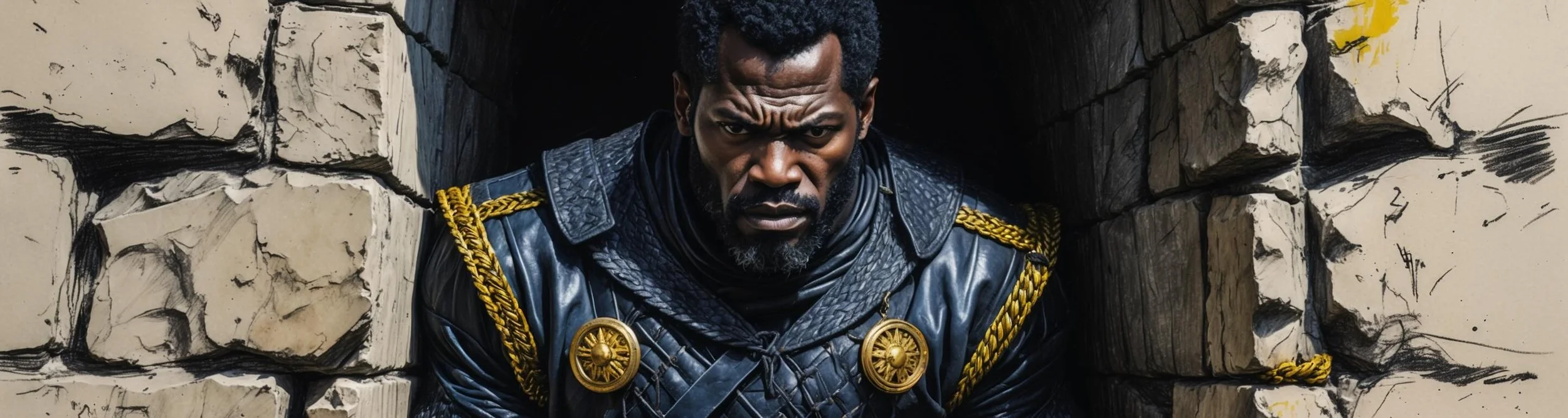
Scene Profile – At a Glance
- Location: Cyprus, before the castle.
- What Happens: Iago's lurid hints drive Othello into a fit. Iago then stages an eavesdropping trick so that Cassio's talk of his mistress Bianca looks to the hidden Othello like a boast about Desdemona. Othello resolves to kill her, and in public strikes her before the visiting Lodovico.
- Key Characters: Othello, Iago, Cassio, Bianca, and Desdemona.
- Dramatic Function: The point of no return – Othello commits to murder, the handkerchief becomes false "proof", and his collapse is exposed to a Venetian witness.
- Famous Quote:
"It is not words
that shake me thus."
(Othello, Act 4, Scene 1) - Why It Matters: Othello's language disintegrates, his body fails him, and he chooses death for Desdemona. The noble Moor of Act 1 is gone, and Venice begins to see it.
Scene Summary
The scene opens with Iago still working on Othello, dangling images of Desdemona and Cassio naked together and returning, again and again, to the handkerchief. The pressure becomes unbearable: Othello's speech breaks into fragments and he falls to the floor in an epileptic fit. Iago gloats over his fallen general before Cassio enters; Iago sends Cassio away and tells him to come back shortly.
When Othello recovers, Iago sets up his cruellest trick. He hides Othello where he can watch but only half hear, then questions Cassio about his mistress Bianca. Cassio laughs about Bianca's infatuation with him, and the concealed Othello, who cannot hear her name, believes every smile and boast is about his wife.
Bianca herself then storms in and flings the handkerchief back at Cassio, accusing him of taking it from some other woman. To Othello this is the "ocular proof" he has been demanding – his own handkerchief, in Cassio's keeping, thrown about by another mistress. Once Cassio and Bianca leave, Othello comes out resolved to kill Desdemona. He wants poison, but Iago steers him to strangle her in the bed she has supposedly defiled.
A trumpet announces Lodovico, arrived from Venice with letters recalling Othello home and naming Cassio governor of Cyprus in his place. Desdemona's relief at the news, and her open warmth towards Cassio, tip Othello over the edge: in front of the astonished Lodovico he strikes her. Left alone with Iago, Lodovico can hardly believe this raving man is the same Moor the Venetian Senate trusts.
The Fit: Language and Body Collapse
The scene's first movement is a study in disintegration. Iago feeds Othello fragments – a kiss, a naked bed, a confession – and refuses to complete them, letting Othello's imagination do the worst work. By the time he reaches the word "lie", Othello's verse has broken down into a jumble of repetitions and broken phrases, the handkerchief and the confession colliding until grammar itself gives way.
Original
Lie with her! Lie on her! We say lie on her, when they belie her. Lie with her! that's fulsome.
(Othello, Act 4, Scene 1)
Shakespeare Retold (Modern Verse)
Lie with her! Lie on her! We say lie ‘on’ her, when they have lied to her. Lie ‘with’ her! That’s offensive.
The collapse of Othello's language mirrors the collapse of his self-command. The man who once spoke in the grand, rolling music of Act 1 now stammers in prose, snatching at single words. His insistence that "It is not words that shake me thus" is poignantly untrue: words are exactly what have shaken him, Iago's words, and the fit that follows is the body finally registering the damage the mind can no longer contain. Then he falls, and Iago stands over him, savouring the success of his "medicine".
The Eavesdropping Trick
Recovered, Othello is handed the scene's central piece of stagecraft. Iago hides him – "encave yourself" – and promises that Cassio, prompted to retell his story, will betray himself in every gesture. The trick depends entirely on what Othello cannot hear: Iago will ask about Bianca, but Othello, straining at a distance, will fit the laughter to Desdemona.
Original
As he shall smile, Othello shall go mad;
And his unbookish jealousy must construe...
(Iago, Act 4, Scene 1)
Shakespeare Retold (Modern Verse)
His smiling’s going to make Othello mad;
And his flawed jealousy must then interpret...
Iago tells us his method in advance, and the cruelty is in the precision. He knows Othello's "unbookish jealousy" – untutored, raw, ready to misread – will "construe / Poor Cassio's smiles" entirely wrong. The scene becomes a play within the play, with Iago as director, Cassio as an unwitting actor, and Othello as an audience of one who has been told exactly how to misunderstand what he sees. When Bianca arrives and throws the handkerchief back, the staged illusion is complete: appearance has wholly replaced reality.
"Strangle Her in Her Bed"
The eavesdropping done, Othello emerges transformed. His grief keeps breaking through – he cannot stop praising Desdemona even as he condemns her – but Iago closes off every retreat, and the talk turns to method. Othello reaches first for poison; Iago corrects him, choosing a death that fits his obscene logic of contamination.
Original
Do it not with poison, strangle her in her bed, even the bed she hath contaminated.
(Iago, Act 4, Scene 1)
Shakespeare Retold (Modern Verse)
Don’t do it with poison; strangle her in her bed, the one that she cheated on you in.
Iago's choice of the bed is deliberate and grotesque. Poison would be distant and clean; strangling in the marriage bed makes the killing intimate, a punishment shaped to the imagined crime. Othello accepts at once – "the justice of it pleases" – the word "justice" showing how completely Iago has rebuilt murder as righteousness in his mind. From this point the ending of the play is fixed: Desdemona will die where she has been accused, and the bed that should mean love will mean death.
The Public Blow
Lodovico's arrival from Venice drops the private nightmare into a public arena. He brings letters recalling Othello and promoting Cassio, and Desdemona, knowing nothing of her husband's state, speaks warmly of mending the breach with Cassio. To Othello, every kind word is fresh proof. In front of a senior Venetian envoy, he strikes her.
Original
Is this the noble Moor whom our full senate
Call all in all sufficient?
(Lodovico, Act 4, Scene 1)
Shakespeare Retold (Modern Verse)
Is this the Moor our senators deem noble
And think him competent?
Lodovico's stunned question measures the whole arc of Othello's fall. To Venice he is "all in all sufficient" – the steady, indispensable commander – and what Lodovico now sees flatly contradicts that reputation. The blow is a public shaming for Desdemona and a public unmasking for Othello, who has lost the self-control that defined him. Iago, characteristically, refuses to defend him outright yet damns him by implication, telling Lodovico only to watch and judge for himself.
Language and Technique
- Broken syntax: Othello's fragmented prose – "Lie with her! Lie on her!" – enacts a mind coming apart, the verse of the noble general dissolving into stammered repetition.
- Stichomythia: The clipped, single-line exchanges ("Lie –" / "With her?") quicken the pace and show Iago feeding Othello pieces he is desperate to complete.
- Dramatic irony: The eavesdropping scene runs on it – the audience knows Cassio is laughing about Bianca while Othello hears it as Desdemona.
- Animal imagery: Othello's "A horned man's a monster and a beast" and the parting "Goats and monkeys!" reduce humanity to bestial lust, echoing Iago's earlier language.
- The handkerchief as prop: Bianca flinging it back turns a stage property into false "ocular proof", the visible object that overrides the truth.
Key Quotes from Act 4, Scene 1
Quote 1My medicine, work! Thus credulous fools are caught;
And many worthy and chaste dames even thus,
(Iago, Act 4, Scene 1)
Shakespeare Retold (Modern Verse)
My poisons, work! Gullible fools are caught like this;
And this is how so many moral women
And mark the fleers, the gibes, and notable scorns,
That dwell in every region of his face;
(Iago, Act 4, Scene 1)
Shakespeare Retold (Modern Verse)
And watch his sneers, his jokes, and disrespect
All written in each feature of his face;
By heaven, that should be my handkerchief!
(Othello, Act 4, Scene 1)
Shakespeare Retold (Modern Verse)
Oh my goodness, I think that’s my handkerchief!
I will chop her into messes: cuckold me!
(Othello, Act 4, Scene 1)
Shakespeare Retold (Modern Verse)
I will chop her into chunks of meat. She can’t cheat on me!
My lord, this would not be believed in Venice,
Though I should swear I saw't: 'tis very much:
(Lodovico, Act 4, Scene 1)
Shakespeare Retold (Modern Verse)
My lord, no one in Venice would believe this,
But I’ve seen it myself. That’s far too much:
Key Takeaways
- Othello breaks down: His language fractures into broken prose and he collapses in an epileptic fit, the noble general visibly coming apart.
- The eavesdropping trick: Iago hides Othello and questions Cassio about Bianca, so laughter about a mistress is misheard as a boast about Desdemona.
- False proof: Bianca throws the handkerchief back at Cassio in front of Othello, giving him the "ocular proof" he craved – an object that lies.
- The murder decided: Othello resolves to kill Desdemona, and Iago steers him to strangle her in their marriage bed.
- Public exposure: Othello strikes Desdemona before Lodovico, and Venice begins to see that its "noble Moor" is no longer himself.
Study Questions and Analysis
Why does Othello have a fit in this scene?
Othello collapses under the sheer pressure of Iago's suggestions. Iago has reduced his insinuations to their crudest physical form – a kiss, a naked bed, the word "lie" – and refuses to finish the thought, so Othello's imagination supplies the rest. His speech disintegrates into broken fragments before his body gives way entirely and he falls into what the text calls an epilepsy.
Nature would not invest herself in such shadowing passion without some instruction. It is not words that shake me thus.
(Othello, Act 4, Scene 1)
Shakespeare Retold (Modern Verse)
My instinct wouldn’t make me be so angry unless there was some truth in it. It’s not just the hearsay that’s making me shake with anger.
The fit is both physical and symbolic. Othello insists it is "not words" that shake him, yet words are precisely the cause; his own claim is part of the self-deception. The collapse dramatises how completely Iago has invaded his victim, reaching past the mind into the body. G. Wilson Knight, in The Wheel of Fire (1930), described the grand, separate "Othello music" of his early speech; here that music breaks down into stammered prose, and the fit is its physical equivalent – the noble style and the noble man failing together.
How does the eavesdropping trick work?
It is one of Iago's most theatrical manoeuvres. He hides Othello where he can see Cassio but cannot clearly hear him, then changes the subject without Othello's knowledge: he questions Cassio not about Desdemona but about Bianca, the mistress who dotes on him. Cassio laughs at the idea of marrying Bianca, and the concealed Othello, unable to catch her name, takes every smirk and gesture as proof of an affair with his wife.
The trick is a play within the play, with Iago as director and Othello as a deliberately misinformed audience. Its power lies in the gap between sight and sound: Othello can see laughter but not its cause, so Iago supplies the cause for him. W. H. Auden, in The Dyer's Hand (1962), saw Iago as a kind of practical joker and experimenter, staging situations to watch human beings destroy themselves; the eavesdropping scene is exactly such an experiment, with Othello's jealousy as the variable Iago is testing.
What is the role of Bianca and the handkerchief here?
Bianca's arrival converts Iago's spoken trap into visible "proof". She storms in to return the handkerchief Cassio had given her, suspecting it is a love-token from another woman – not knowing Cassio found it in his lodging, where Iago had planted it. To the watching Othello, the object he gave Desdemona is now being flung about by Cassio's mistress.
This is some minx's token, and I must take out the work?
(Bianca, Act 4, Scene 1)
Shakespeare Retold (Modern Verse)
This is a gift from some slapper, and you want me to make a copy of it?
Bianca's jealousy unwittingly serves Iago's, and the handkerchief becomes the false centre of the tragedy. Thomas Rymer, in A Short View of Tragedy (1693), notoriously dismissed the play as "the tragedy of the handkerchief", mocking the idea that so much catastrophe could hang on a scrap of cloth. Yet that is partly the point: Othello has been led to trust a visible object over a person, and the scene shows appearance triumphing over reality at the worst possible moment.
Why does Othello decide to strangle rather than poison Desdemona?
Othello's first instinct is poison – a distant, almost merciful death – and he asks Iago to get him some. Iago overrides him, and the change of method is significant. He proposes strangling her in the marriage bed, the very place he claims she has betrayed Othello.
Do it not with poison, strangle her in her bed, even the bed she hath contaminated.
(Iago, Act 4, Scene 1)
Shakespeare Retold (Modern Verse)
Don’t do it with poison; strangle her in her bed, the one that she cheated on you in.
The choice reframes the murder as a kind of poetic justice, punishment fitted to the supposed crime, and Othello seizes on it precisely because "the justice of it pleases". Iago understands that Othello needs to feel he is administering justice rather than committing murder, and the bed turns the killing into a symbolic act of purification. It is a measure of how thoroughly Iago now controls not just Othello's beliefs but the very shape of what he intends to do.
What is the significance of Othello striking Desdemona in public?
The blow is the scene's most shocking moment and a turning point in Othello's public standing. Lodovico has just arrived from Venice with official letters; Desdemona, ignorant of her husband's jealousy, speaks affectionately of healing the rift with Cassio. To Othello this is unbearable, and he strikes her in front of the envoy.
The act is doubly devastating. For Desdemona it is a public humiliation from the husband she has done nothing to wrong; for Othello it is the loss of the dignity and self-command that have defined him since Act 1. F. R. Leavis, in The Common Pursuit (1952), argued that the flaw lies in Othello himself – in a self-dramatising egotism that collapses into violence – and the public blow gives his reading its sharpest evidence. A. C. Bradley, in Shakespearean Tragedy (1904), held instead that this is a fundamentally noble man poisoned past recognition; on either view, the blow marks the point where the private corruption becomes visible to the world.
How does this scene develop the theme of appearance versus reality?
Act 4, Scene 1 is built almost entirely around the gap between what seems and what is. The eavesdropping trick lets Othello see one thing – Cassio laughing – while the reality is another, and Iago supplies the false meaning. The handkerchief, a real object, "proves" a betrayal that never happened. Even Othello's own claim about himself, that "it is not words" that move him, is a misreading of his own state.
The scene shows how appearance versus reality becomes lethal once a trusted interpreter controls the gap between them. Iago never needs to fabricate events; he only manages how they are seen. Stephen Greenblatt, in Renaissance Self-Fashioning (1980), described Iago as a brilliant improviser who fashions Othello by feeding him a story he comes to inhabit; this scene is that improvisation at its peak, with reality staged, narrated, and misread to order.
What does Othello's language reveal about his state of mind?
Othello's speech in this scene is a barometer of his disintegration. The expansive, ceremonious verse of the early acts has gone; in its place are broken exclamations, animal images, and lurching swings between adoration and disgust. He calls Desdemona "a fine woman! a fair woman! a sweet woman!" one moment and resolves to chop her "into messes" the next.
A horned man's a monster and a beast.
(Othello, Act 4, Scene 1)
Shakespeare Retold (Modern Verse)
A cheated man with horns is just a monster!
The "horned man" image – the cuckold's traditional horns – shows how Othello has absorbed Iago's bestial vocabulary, now seeing himself as a "monster and a beast". His parting line, "Goats and monkeys!", flings Iago's earlier animal imagery back into the world at large. G. Wilson Knight, in The Wheel of Fire (1930), traced how the "Othello music" of the opening acts decays under jealousy; by this scene the grand style has curdled into the broken, bestial speech of a man no longer in command of himself.
How does Iago handle Lodovico at the end of the scene?
Iago's treatment of Lodovico is a small masterpiece of insinuation. Asked directly whether Othello is sane, Iago refuses either to defend or to condemn him outright. Instead he hints that the truth is worse than he dares say and tells Lodovico simply to watch and judge for himself.
This is Iago's signature move, the same technique he used on Brabantio and Othello: he plants suspicion while keeping his own hands clean, letting others draw the damning conclusion. By declining to "breathe his censure" he appears honest and reluctant, even as he steers Lodovico towards the worst possible view. Harold Bloom, in Shakespeare: The Invention of the Human (1998), described Iago as an artist of evil who relishes his own craft; the closing exchange shows that artistry working on a fresh audience, extending his web of suggestion to the newly arrived Venetian even as his plot against Desdemona moves towards its end.