Othello: Act 4, Scene 3 – Analysis
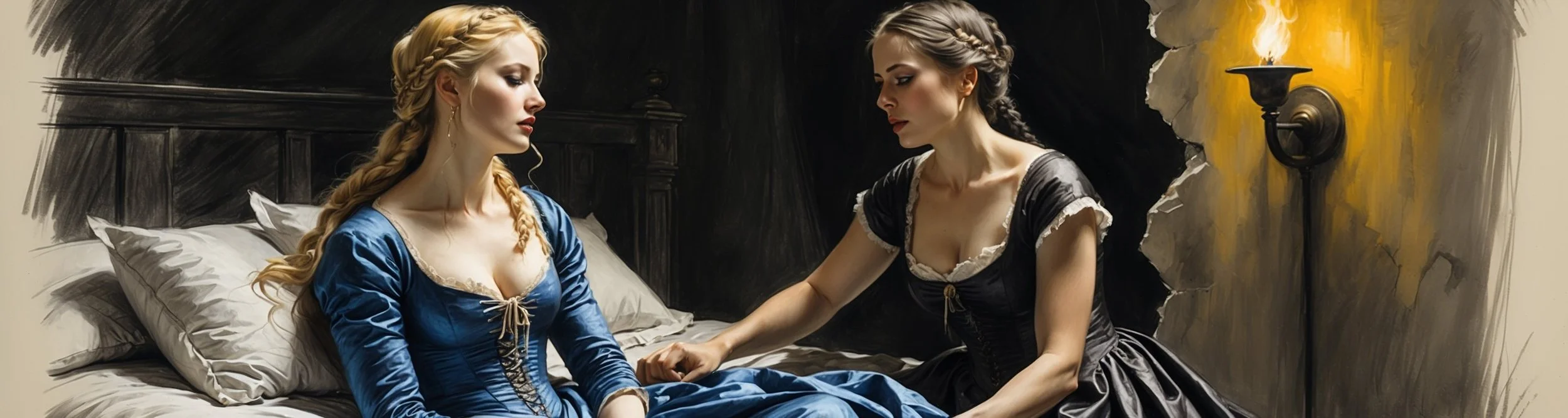
Scene Profile – At a Glance
- Location: A bedchamber in the citadel in Cyprus, at night.
- What Happens: Desdemona prepares for bed on Othello's orders, attended by Emilia. She sings the Willow Song and asks whether wives ever betray their husbands; Emilia answers with a worldly defence of women.
- Key Characters: Desdemona and Emilia.
- Dramatic Function: A still, tender lull before the murder – it deepens our sense of Desdemona's innocence and gives Emilia the play's frankest defence of women.
- Famous Quote:
"Let husbands know
Their wives have sense like them..."
(Emilia, Act 4, Scene 3) - Why It Matters: The quiet before the killing. Desdemona's innocence and Emilia's clear-eyed honesty make the coming violence feel even more unbearable.
Scene Summary
After supper with the Venetian envoy Lodovico, Othello sends Desdemona to bed and orders her to dismiss her attendant. Obedient as ever, she tells Emilia to make her ready for the night, even though Emilia wishes aloud that her mistress had never met Othello. Desdemona will not hear a word against him: she loves him still, frowns and all.
As Emilia unpins her, Desdemona is overtaken by a strange foreboding. She remembers Barbary, a maid of her mother's who was abandoned by the man she loved and died singing a song called "Willow". The song will not leave Desdemona's mind, and she begins to sing it herself, breaking off to wonder at a knock and to send Emilia for her things.
The talk turns to faithfulness. Desdemona, almost disbelieving, asks whether there really are women who betray their husbands. Emilia replies that of course there are, and that she herself might do it for a great enough prize. This opens into Emilia's long, frank defence of women: wives have the same desires and feelings as their husbands, and when they stray it is usually their husbands' fault. Desdemona, unconvinced and innocent to the last, bids her good night, praying she may learn only good from others' wrongs.
The Willow Song and Desdemona's Foreboding
The scene's quietness is its terror. Desdemona is doing something utterly ordinary – getting ready for bed – and yet the air is thick with death. She cannot say why, but her mind keeps circling a memory: Barbary, a servant her mother once had, who loved a man who went mad and left her, and who sang herself to death with an old song. The detail is unbearable because we know what Desdemona does not, that she too will die tonight at the hands of the man she loves.
Original
And did forsake her: she had a song of 'willow;'
An old thing 'twas, but it expressed her fortune,
(Desdemona, Act 4, Scene 3)
Shakespeare Retold (Modern Verse)
Who left her: then she sang a song called ‘Willow’;
An old song, it was, about her life,
Shakespeare lets the song do what argument cannot. Desdemona does not accuse Othello or plead her innocence; she simply sings, and the borrowed grief of a long-dead maid becomes her own. The song's refrain of "willow" – the tree of forsaken love – gathers up every betrayed and dying woman into one image, and Desdemona slips quietly into their company. That she sings someone else's song, half-forgetting the words, makes her seem already half-gone, a presence fading even as she sits there.
Emilia's Defence of Women
If Desdemona is the scene's innocence, Emilia is its honesty. When Desdemona asks, almost incredulous, whether any wife would really betray her husband, Emilia refuses to pretend. She admits she might do it herself for a great enough reward, and then goes much further, mounting a defence of women that is startling for its directness about female desire and its anger at male double standards.
Original
Yet have we some revenge. Let husbands know
Their wives have sense like them: they see and smell...
(Emilia, Act 4, Scene 3)
Shakespeare Retold (Modern Verse)
We still can get revenge. Our husbands must know
Their wives have senses like them: sight and smell,
Emilia's argument is plain and radical: wives have the same senses, appetites and frailties as men, and so deserve the same understanding. When women fall, she says, it is usually because their husbands taught them how – through neglect, jealousy, or cruelty. Coming from the mouth of a servant, in the half-light before a murder, it is one of the boldest things any woman says in Shakespeare. It also lays the moral ground for the play's ending, where Emilia will refuse to stay silent and pay for her honesty with her life.
Language and Technique
- The embedded song: The Willow Song is a real ballad woven into the scene, its refrain breaking up Desdemona's speech so grief seems to surface through her without her choosing it.
- Dramatic irony: Desdemona's talk of dying and her request to be shrouded in her wedding sheets land far harder on us than on her, because we know the murder is coming.
- Prose and verse: Emilia's worldly defence shifts between brisk prose and rolling verse, the verse lifting her argument from gossip into something like a manifesto.
- Symbolism of the willow: The willow is the traditional emblem of forsaken love, so the song aligns Desdemona with every abandoned, dying woman before her.
- Antithesis: Emilia builds her case on balanced opposites – sweet and sour, husbands and wives – to insist that women are made of exactly the same stuff as men.
Key Quotes from Act 4, Scene 3
Quote 1If I do die before thee prithee, shroud me
In one of those same sheets.
(Desdemona, Act 4, Scene 3)
Shakespeare Retold (Modern Verse)
If I’m to die before you, wrap me up
In one of those sheets on the bed.
My mother had a maid called Barbary:
She was in love, and he she loved proved mad...
(Desdemona, Act 4, Scene 3)
Shakespeare Retold (Modern Verse)
My mother had a maid called Barbary:
The man she loved turned out to be a madman
But I do think it is their husbands' faults
If wives do fall: say that they slack their duties,
(Emilia, Act 4, Scene 3)
Shakespeare Retold (Modern Verse)
But I believe it is their husbands’ faults
If wives cheat: say they stop sleeping with us
And have their palates both for sweet and sour,
As husbands have. What is it that they do...
(Emilia, Act 4, Scene 3)
Shakespeare Retold (Modern Verse)
And palates that discern both sweet and sour,
Just like their husbands have. What is their motive
Key Takeaways
- The calm before the storm: The scene is deliberately quiet and domestic, which makes the murder waiting beyond it feel even more terrible.
- The Willow Song: Desdemona's borrowed song of forsaken love foreshadows her death and links her to a long line of betrayed women.
- Emilia's defence of women: Emilia argues that wives have the same desires and feelings as men, and that husbands are usually to blame when wives stray.
- Innocence and irony: Desdemona's talk of dying and her wedding sheets is unbearable precisely because she half-senses what the audience already knows.
Study Questions and Analysis
What is the Willow Song and why does Desdemona sing it?
The Willow Song is an old ballad about a woman forsaken by her lover, with a refrain that returns again and again to the willow, the traditional tree of grief and abandoned love. Desdemona did not invent it; she remembers it from Barbary, a maid in her mother's household who was deserted by the man she loved and "died singing it". On this night the song simply will not leave her mind.
And she died singing it: that song to-night
Will not go from my mind; I have much to do,
(Desdemona, Act 4, Scene 3)
Shakespeare Retold (Modern Verse)
And she died singing it. Tonight, that song
Is stuck within my mind; it’s all I can do...
The song works on the audience as pure foreboding. Desdemona cannot name the dread that has settled on her, so it comes out as a borrowed tune, and the act of singing a dead woman's song makes her seem already half-claimed by death. It also tells us something about her character: faced with a husband who has begun to frighten her, she reaches not for anger or self-defence but for sorrow and song. Her grief is gentle, inward, and entirely without blame – which is exactly what makes the coming murder so monstrous.
What is the significance of Emilia's speech about women and husbands?
Emilia's long speech is one of the most outspoken defences of women in all of Shakespeare. Prompted by Desdemona's innocent question about whether wives ever betray their husbands, Emilia refuses the easy, pious answer. She argues that women have the same senses, appetites and weaknesses as men, and that when wives stray the cause usually lies in how their husbands have treated them – through neglect, jealousy, restriction or violence.
And have not we affections,
Desires for sport, and frailty, as men have?
(Emilia, Act 4, Scene 3)
Shakespeare Retold (Modern Verse)
And don’t we feel attraction,
Desire our fun, with weaknesses, like men do?
The speech matters because it gives the play a counter-voice to its own misogyny. Where Iago and Othello speak of women as objects to be owned, valued, and discarded, Emilia speaks of them as full human beings with their own desires and their own claim to fair treatment. Many critics read the moment as proto-feminist, though it is voiced not as triumphant theory but as the weary realism of a servant who has seen how marriages actually work. Its placement is pointed: this clear-eyed defence of women comes minutes before a wife is murdered for a fault she never committed.
How does the scene create dramatic irony and foreboding?
Almost everything Desdemona says in this scene means more to us than to her. She talks of dying, asks to be wrapped in her wedding sheets if she should die first, and sings a song about a woman who died of love – and we know that within the hour Othello will smother her on that very bed. The gap between her dim foreboding and our certain knowledge is the engine of the scene's almost unbearable tension.
Shakespeare builds the irony from ordinary, domestic detail rather than grand speeches. The unpinning of a dress, the laying of sheets, a half-remembered song, a question about faithfulness – these are the textures of a quiet evening, and it is precisely their gentleness that hurts. The scene asks the audience to watch a kind, loving woman prepare for a death she does not see coming, and to be unable to do anything but wait. By slowing the action almost to stillness here, the play makes the violence that follows feel like a desecration of something tender and ordinary.
What does the scene reveal about Desdemona's character?
The scene shows Desdemona at her most sympathetic and, to some readers, her most frustrating. She is loving, loyal and entirely without guile: even as Othello frightens her, she will not hear Emilia criticise him, insisting that she loves him so much that "even his stubbornness, his cheques, his frowns" have grace in her eyes. Her obedience is total; she goes to bed because he has told her to.
So would not I. My love doth so approve him,
That even his stubbornness, his cheques, his frowns –...
(Desdemona, Act 4, Scene 3)
Shakespeare Retold (Modern Verse)
I don’t, for I have so much love for him,
That even his stubbornness, rebukes and frowns –...
For some audiences this passivity is part of her tragedy: she is so good and so trusting that she cannot conceive of the evil being done to her. For others it raises difficult questions about how the play idealises a woman who submits without protest. Either way, the scene deepens her, setting her innocence beside Emilia's worldliness so that the two women illuminate each other. Desdemona's refusal to imagine that any wife could betray her husband measures the distance between her purity and the world's suspicion of it.
How does Emilia contrast with Desdemona in this scene?
The scene works by pairing two very different women. Desdemona is young, high-born, idealistic and innocent; Emilia is older, a servant, and shaped by the hard knowledge of how the world treats wives. Where Desdemona cannot believe any woman would betray her husband, Emilia coolly admits she might do it herself for a great enough prize – not because she is wicked, but because she sees marriage clearly.
The contrast is dramatic rather than moral: Shakespeare is not asking us to choose between them. Desdemona's innocence and Emilia's experience are two true ways of being a woman in this world, and the scene lets them sit side by side, talking honestly in the dark. The pairing also prepares the ending. Emilia's clear sight about men and her refusal to flatter them foreshadow the moment in the final scene when she will see through Iago's plot and denounce it, even knowing it may cost her life. The frank, generous woman of this quiet scene becomes the play's truth-teller.
Is Emilia's speech feminist, and how should we read it today?
Modern readers often hear Emilia's speech as strikingly feminist, and there is good reason. She insists on the equality of male and female desire, attacks the double standard that condemns unfaithful wives while excusing unfaithful husbands, and locates the cause of women's "faults" in men's mistreatment. Few characters in Renaissance drama make the case for women so plainly.
Then let them use us well: else let them know,
The ills we do, their ills instruct us so.
(Emilia, Act 4, Scene 3)
Shakespeare Retold (Modern Verse)
So, let them treat us well, else let them know
We misbehave because they taught us so.
It is worth being careful, though. Emilia argues for fair treatment and shared appetite, not for women's independence or equality in any modern political sense; her frame is still the marriage and the household. The speech is best read as a powerful counter-voice within a deeply patriarchal world rather than as a manifesto from outside it. Its force comes partly from its placement, voiced by a servant, in private, to another woman, on the night one of them will be killed for an imagined infidelity. The play gives Emilia the argument and then shows, horrifically, the cost of a world that will not listen to it.
Why does Shakespeare place this quiet scene just before the murder?
Structurally, the scene is a deliberate hush before catastrophe. The previous acts have built relentlessly towards violence; here the play almost stops, holding the audience in a small, candlelit room with two women talking and one of them singing. The pause is not a relief but a tightening: we know what is coming, and the stillness only makes us dread it more.
The placement also sharpens the tragedy's meaning. By showing Desdemona so gentle, so loving and so innocent in the moments before her death, Shakespeare makes the murder feel like the destruction of goodness itself, not the punishment of a guilty woman. And by giving Emilia her defence of women here, he sets a clear moral truth ringing in our ears just as Othello prepares to act on a monstrous lie. The scene is the play's tenderness and its conscience gathered into one quiet space, so that everything Othello is about to destroy is fully present to us before he destroys it.