Othello: Act 5, Scene 1 – Analysis
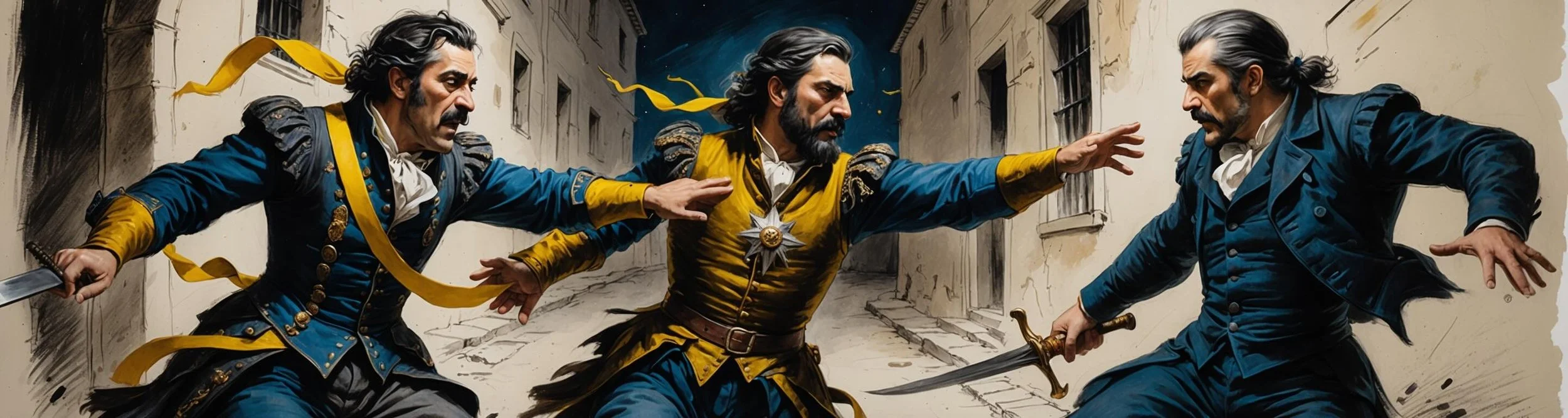
Scene Profile – At a Glance
- Location: A dark street in Cyprus, at night.
- What Happens: Iago sets Roderigo to ambush Cassio. In the chaos both dupes are wounded; Iago stabs Cassio's leg from the shadows, then returns with a light, plays the rescuer, and silently murders Roderigo.
- Key Characters: Iago, Roderigo, Cassio, Othello, and Bianca.
- Dramatic Function: The penultimate scene springs Iago's trap – it disposes of the one man who could expose him and pushes Othello off to kill Desdemona.
- Famous Quote:
"This is the night
That either makes me or fordoes me quite."
(Iago, Act 5, Scene 1) - Why It Matters: Iago's web finally turns lethal in person. He kills with his own hand for the first time and still walks away wearing the mask of the honest, helpful friend.
Scene Summary
The scene opens in a dark Cyprus street, where Iago has positioned Roderigo behind a wall to ambush Cassio as he passes. Iago urges him to keep his nerve and stay focused, then withdraws into the shadows. Alone, Iago reveals his real calculation: he profits whichever man dies, because a living Roderigo will demand back the money and jewels Iago has swindled from him, and a living Cassio is a daily reproach to his own failure.
Cassio enters and Roderigo lunges at him, but Cassio's hidden armour saves him and he wounds Roderigo instead. From behind, the unseen Iago slashes Cassio in the leg and slips away. Cassio falls, crying out that he is maimed and shouting for help and a surgeon. Othello arrives, hears Cassio's cries, and concludes that "honest" Iago has kept his promise to kill him. Spurred on, Othello hurries off to murder Desdemona in her bed.
Lodovico and Gratiano, two Venetian noblemen newly arrived in Cyprus, hear the groans but hold back, fearing a trap. Iago returns carrying a light, dressed in his shirt, and stages the role of the shocked rescuer. He pretends to discover Cassio, bandages his leg, and then, in the dark, stabs the wounded Roderigo to death – silencing for ever the one accomplice who could betray him.
When Bianca rushes in, distraught at the sight of her wounded Cassio, Iago seizes on her at once, hinting she is somehow behind the attack. Emilia arrives and Iago sends her to the citadel with the news, ordering Bianca held for questioning. As the bodies are carried off, Iago pauses to acknowledge that this night will either make him or destroy him completely.
Every Way Makes My Gain
Left alone after planting Roderigo, Iago lays bare the cold arithmetic behind the ambush. He does not much care who dies, because every outcome serves him. If Roderigo survives he will demand restitution for the gifts Iago has pocketed; if Cassio survives he remains a living rebuke and might one day expose the plot. The cleanest result is that both men die in the dark and the trail goes cold.
Original
And he grows angry. Now, whether he kill Cassio,
Or Cassio him, or each do kill the other,
Every way makes my gain: live Roderigo,
(Iago, Act 5, Scene 1)
Shakespeare Retold (Modern Verse)
And now he’s angry. Now, if he kills Cassio,
Or Cassio kills him, or kill each other,
Each way I win. But if Roderigo lives,
The speech is pure logic stripped of feeling, and that is what makes it chilling. Iago weighs human lives the way a merchant weighs a ledger, balancing risks and profits with no flicker of conscience. The repeated either-or structure – "whether he kill Cassio, / Or Cassio him, or each do kill the other" – lets every branch lead to the same conclusion, so that the men he has set against one another are reduced to interchangeable pieces. This is the engine of the whole tragedy laid bare: Iago does not destroy people for what they are but for what they are worth to his scheme.
Othello Mistakes the Cries for Justice
The ambush has a second target who never lifts a sword. When Othello hears Cassio's screams from the dark street, he reads them exactly as Iago intended: as proof that his trusted ensign has carried out the murder he was promised. The moment is the play's dramatic irony at its bleakest – Othello praising the man who has ruined him, while a wounded innocent cries for help nearby.
Original
’Tis he: – O brave Iago, honest and just,
That hast such noble sense of thy friend’s wrong!
(Othello, Act 5, Scene 1)
Shakespeare Retold (Modern Verse)
It’s him. – Oh, brave Iago, decent man,
You’ve shown integrity when your friend’s wronged.
The words "honest and just" land like a wound on a second reading. Othello has been so thoroughly remade by Iago's story that he hears murder as friendship and treats a botched assassination as a lesson in loyalty – "Thou teachest me." From here he turns the same lethal resolve on Desdemona, sweeping off to kill her with the language of vengeance already on his lips. The scene splits its violence: Iago's blade cuts Cassio in the street while Othello, fired by the same lie, goes to cut down his innocent wife.
The Honest Rescuer Returns
Iago's most audacious stroke is to come back to the scene of his own crime carrying a light. Having wounded Cassio from behind and vanished, he reappears in his shirt as the alarmed neighbour roused by the noise, full of shocked questions and offers of help. Under cover of rescuing Cassio he finishes the job he started, stabbing the helpless Roderigo to death before the man can name him.
Original
O murderous slave! O villain!
(Iago, Act 5, Scene 1)
Shakespeare Retold (Modern Verse)
You murderous slave! You villain!
The cry is grotesquely double. To the watching noblemen Iago appears to be cutting down one of the attackers in righteous fury; in truth he is murdering his own accomplice to seal his lips, and the insult he hurls – "murderous slave" – describes himself more aptly than his victim. Roderigo's dying words, "O damned Iago! O inhuman dog!", come too late and to no witness. With Roderigo silenced, Iago at once begins building his next fiction, turning on Bianca and inviting the gentlemen to read guilt in her frightened face.
Language and Technique
- Dramatic irony: Othello calls Iago "honest and just" at the very moment Iago is butchering people in the dark, so the audience hears the praise as condemnation.
- Darkness and confusion: The scene is staged in near-total darkness, with characters crying out blindly – the physical murk mirrors the moral blindness Iago exploits.
- Soliloquy as exposure: Iago's aside lays out his cost-benefit reasoning in plain calculation, letting the audience see the machinery while the other characters see only a helpful friend.
- Role-playing: Iago literally re-enters "with a light" and plays the rescuer, dramatising the gap between his false face and his murderous hand.
- Repetition and antithesis: "Whether he kill Cassio, / Or Cassio him, or each do kill the other" piles up alternatives that all collapse into Iago's single profit.
Key Quotes from Act 5, Scene 1
Quote 1I have rubbed this young quat almost to the sense,
And he grows angry.
(Iago, Act 5, Scene 1)
Shakespeare Retold (Modern Verse)
I’ve wound this little pimple up enough,
And now he’s angry.
If Cassio do remain,
He hath a daily beauty in his life
That makes me ugly;...
(Iago, Act 5, Scene 1)
Shakespeare Retold (Modern Verse)
And if Cassio lives,
He gets the job that I aspire to have
And makes me look weak;...
The voice of Cassio: Iago keeps his word.
(Othello, Act 5, Scene 1)
Shakespeare Retold (Modern Verse)
That’s Cassio’s voice; Iago’s kept his promise.
This is the night
That either makes me or fordoes me quite.
(Iago, Act 5, Scene 1)
Shakespeare Retold (Modern Verse)
Tonight’s the night
That either makes me or destroys my plight.
Key Takeaways
- Iago turns killer: For the first time Iago sheds blood with his own hand, wounding Cassio and murdering Roderigo in the dark.
- Win either way: His soliloquy shows the trap is designed so that whichever dupe dies, Iago profits and stays safe.
- Deadly irony: Othello hears Cassio's screams as proof of Iago's loyalty and goes off to kill Desdemona, trusting a murderer.
- The mask holds: Iago returns "with a light" as the shocked rescuer and at once begins pinning the attack on the innocent Bianca.
Study Questions and Analysis
Why does Iago want both Cassio and Roderigo dead?
Iago has reached the stage where his accomplices have become liabilities. Roderigo, the gullible Venetian he has been bleeding for money, will eventually demand back the gold and jewels Iago claimed to be passing to Desdemona – gifts that never arrived. Cassio, meanwhile, is the living proof of Iago's failure and the one man whose survival might one day unravel the plot. In his soliloquy Iago weighs the outcomes coldly and concludes that Cassio cannot be allowed to live.
No, he must die. But so: I hear him coming.
(Iago, Act 5, Scene 1)
Shakespeare Retold (Modern Verse)
No, he must die. But, wait: I hear him coming.
The logic is that of a man tidying away evidence. With both men dead, no one survives who can connect Iago to the conspiracy, and the murders can be blamed on anonymous thieves in the night. W. H. Auden, in The Dyer's Hand (1962), read Iago as a kind of practical joker and experimenter who treats other people as material for his schemes; here the experiment turns lethal, and the human cost means nothing to him beyond the risk it removes.
What does the ambush reveal about Iago's methods?
Until this scene Iago has worked almost entirely through words – insinuation, rumour, the careful planting of suspicion. The street ambush shows what happens when that long campaign finally requires action. Even so, Iago tries to keep his own hands clean: he sets Roderigo to do the killing and only strikes himself, from behind and unseen, when the plan begins to fail.
What is striking is how seamlessly he switches between roles. One moment he is the murderer slashing at Cassio's leg in the dark; the next he has fetched a light and returned as the horrified neighbour, asking who could have done such a thing. The scene dramatises his defining trick – doing the damage himself while arranging for someone else, or no one, to take the blame. It is the same method he has used on Othello throughout, now compressed into a few violent minutes and exposed to the audience in full.
How does dramatic irony work in this scene?
The scene is built on the gap between what Othello believes and what the audience knows. Othello hears Cassio crying out in the dark and reads the sound as proof that Iago has murdered his rival as promised. He treats his deceiver as a teacher at the exact moment Iago is committing and concealing crimes a few feet away.
Thou teachest me. Minion, your dear lies dead,
And your unblest fate hies: strumpet, I come.
(Othello, Act 5, Scene 1)
Shakespeare Retold (Modern Verse)
I’ve learnt from you. Slapper, your lover’s dead,
And your doom is approaching: whore, I’m coming.
The words "Thou teachest me" are unbearable because the audience hears them as the precise opposite of the truth: Othello takes a lesson in honour from the man destroying him. A. C. Bradley, in Shakespearean Tragedy (1904), stressed how far Othello has been remade by Iago's poison; by this point his judgement is so corrupted that he greets a botched assassination as a model of loyalty and turns the same lethal resolve on his innocent wife – "strumpet, I come". The irony is not merely clever but tragic, measuring exactly how completely Iago has reversed Othello's grasp of who is friend and who is enemy.
Why does Iago kill Roderigo himself?
Roderigo has outlived his usefulness and become Iago's single most dangerous loose end. He is the one accomplice who knows that Iago took his money on false pretences and who has just been told to murder Cassio. A wounded, frightened Roderigo, questioned by the authorities, could expose the entire scheme. When Iago returns with the light and hears Roderigo calling for help, he settles the matter at once, and Roderigo dies naming the man who has betrayed him.
O damned Iago! O inhuman dog!
(Roderigo, Act 5, Scene 1)
Shakespeare Retold (Modern Verse)
Damn you, Iago! You inhuman dog!
The brilliance and the horror of the killing lie in its disguise. To Lodovico and Gratiano, Iago appears to be striking down one of the attackers in defence of the wounded Cassio; in fact he is silencing his own agent. Roderigo's dying cry finally names his killer – "O damned Iago!" – but it comes too late and to no witness who can understand it, taken for nothing more than a victim's confusion. The accusation that should destroy Iago dissolves into the dark.
How does Iago begin to frame Bianca?
The moment Bianca arrives, weeping over the wounded Cassio, Iago recognises a fresh opportunity. She is a courtesan, an easy figure to blacken, and her open distress makes her conspicuous. Rather than let suspicion drift toward himself, he steers it onto her, hinting to the gentlemen that her agitation is really guilt and inviting them to study her face for proof.
The tactic is pure Iago: he manufactures evidence out of an innocent person's emotion, reading fear as a confession. He calls her a "notable strumpet", declares he suspects "this trash / To be a party in this injury", and points to "the gastness of her eye" as though terror were the same as wrongdoing. It is the handkerchief trick in miniature – taking a neutral or sympathetic detail and reframing it as damning – and it shows that even with two bodies on the ground, Iago is already improvising the next layer of his cover story.
What is the significance of the scene being set in darkness?
The darkness is both literal and symbolic. On the practical level it allows the confusion the plot needs: Roderigo cannot see clearly enough to kill Cassio, Iago can wound from behind unseen, and Lodovico and Gratiano hang back precisely because they cannot tell friend from foe. The night turns the street into a place where nobody can trust their eyes.
These may be counterfeits: let’s think’t unsafe
To come in to the cry without more help.
(Lodovico, Act 5, Scene 1)
Shakespeare Retold (Modern Verse)
They might be faking it; let’s think it unsafe
To go where men are wailing without more help.
Symbolically, the blackness is the perfect setting for Iago's work, which has always depended on others' inability to see clearly. The play's recurring contrast between appearance and reality becomes physical here: in the dark, Iago the murderer can pass for Iago the rescuer simply by carrying a light. Lodovico's caution – the fear that the cries "may be counterfeits" – even gestures at the scene's deeper theme, a world where nothing can be taken at face value and the truth is exactly what Iago says it is.
How does this scene prepare for the play's final scene?
Act 5, Scene 1 is the trigger for the catastrophe. Othello leaves it convinced that Cassio is dead and that justice is being done, and walks directly to Desdemona's bedchamber with murder in his heart. The street violence and the murder of Desdemona are deliberately staged back to back, so that Iago's plot and Othello's tragedy converge in a single terrible night.
At the same time the scene begins to sow the seeds of Iago's undoing. By killing Roderigo he removes one witness, but he leaves Cassio alive and Bianca falsely accused, and the loose ends he creates here will help unravel everything in the final scene. Iago's own closing couplet acknowledges the precariousness of his position – this is the night that will "either make me or fordoes me quite". The audience, knowing the tragedy is almost complete, hears in those words a foreboding the speaker cannot yet feel: the machine he has built is now running faster than he can control it.