The Merchant of Venice: Act 1, Scene 3 – Analysis
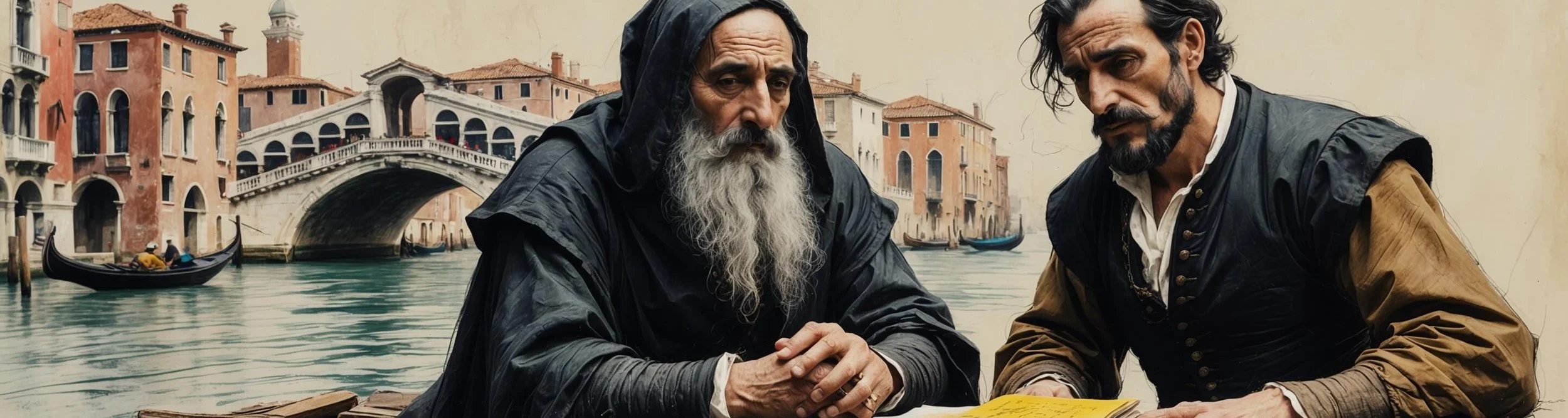
Scene Profile – At a Glance
- Location: A public place in Venice, the heart of its money-lending world.
- What Happens: Bassanio asks Shylock for a loan of three thousand ducats, guaranteed by Antonio. Shylock reveals his hatred of Antonio, who insults him to his face. Shylock then offers to lend interest-free, on one condition: if the debt is unpaid, he may cut a pound of Antonio's flesh.
- Key Characters: Shylock, Antonio, Bassanio.
- Dramatic Function: The scene seals the deadly bond and brings Shylock and Antonio face to face, exposing the hatred between them that will drive the play to its courtroom climax.
- Famous Quote:
"let the forfeit
Be nominated for an equal pound
Of your fair flesh, to be cut off and taken"
(Shylock, Act 1, Scene 3) - Why It Matters: The pound-of-flesh bond is the engine of the whole tragedy, and the scene first reveals the mutual hatred between Shylock and Antonio that makes it so dangerous.
Scene Summary
In a public place in Venice, Bassanio negotiates with Shylock, a Jewish moneylender, for a loan of three thousand ducats for three months, to be guaranteed by Antonio. Shylock weighs the risk, noting that Antonio's wealth is all at sea and therefore uncertain, but concludes that Antonio is "sufficient" and that he may accept the bond.
When Bassanio invites him to dinner, Shylock refuses to eat with Christians. As Antonio approaches, Shylock reveals in an aside the depth of his hatred: he loathes Antonio both as a Christian and because Antonio lends money without charging interest, undercutting Shylock's trade, and he longs to feed the "ancient grudge" he bears him.
Antonio and Shylock then spar openly. Shylock defends the charging of interest with a story from the Bible about Jacob, which Antonio dismisses, warning that "the devil can cite Scripture for his purpose". Shylock reminds Antonio of how he has insulted and spat on him in the past, yet now comes asking for help – and Antonio coldly replies that he is likely to do the same again.
Shylock then makes a surprising offer: he will lend the money without interest, in a spirit of "friendship". The only condition is a "merry" one – that if Antonio fails to repay on time, Shylock may cut a pound of flesh from his body. Antonio, confident his ships will return in time, accepts despite Bassanio's misgivings, and the two men leave to seal the bond.
The Negotiation and the Hidden Grudge
The scene opens in clipped, businesslike prose as Shylock turns over the terms of the loan. His repeated "well" and his careful weighing of Antonio's "sufficiency" show a shrewd professional assessing a risk. But the surface calm hides something darker, which Shakespeare reveals the moment Antonio appears, in an aside that lets the audience hear Shylock's true feelings.
Original
I hate him for he is a Christian,
But more for that in low simplicity
He lends out money gratis and brings down
The rate of usance here with us in Venice.
(Shylock, Act 1, Scene 3)
Shakespeare Retold (Modern Verse)
I hate this man because he is a Christian,
But more than that, he idiotically
Lends money interest-free, thereby reducing
Inflated rates that we can charge in Venice.
The aside is crucial to how we read everything that follows. Shylock's hatred has two roots: religious difference and wounded commercial interest. Antonio lends "gratis" – without interest – which both undercuts Shylock's livelihood and embodies a Christian contempt for the trade Shylock depends on. The honesty of the aside is striking: Shylock does not pretend to himself that this is friendship. He intends to "feed fat the ancient grudge" he bears Antonio, and his offer of a loan, when it comes, must be read in that light.
The Argument over Interest
When the two men confront each other, their quarrel turns on the morality of lending money at interest. Shylock defends the practice with a biblical story about Jacob, who increased his flock by cunning. Antonio rejects the comparison with contempt, drawing a sharp distinction between honest profit and what he sees as Shylock's unnatural breeding of money from money.
Original
Mark you this, Bassanio,
The devil can cite Scripture for his purpose.
An evil soul producing holy witness
Is like a villain with a smiling cheek,
(Antonio, Act 1, Scene 3)
Shakespeare Retold (Modern Verse)
Hear this, Bassanio:
To help himself, the devil quotes the bible.
An evil person who's reciting scripture
Is like a villain with a phoney smile,
The clash exposes the gulf between the two men. To Antonio, lending at interest is barren and immoral – metal "breeding" from metal – and Shylock's use of Scripture only proves the devil can quote holy texts. To Shylock, interest is simply the legitimate use of his own property, and Antonio's scorn is hypocrisy. The audience is left to weigh two incompatible moral worlds. Antonio's "smiling cheek" image is, with bitter irony, a warning the play turns back on him: it is Shylock who will shortly wear a smile while planning Antonio's ruin.
Insult, Patience and the Pound of Flesh
Before any deal is struck, Shylock forces Antonio to confront how he has treated him. In one of the play's most powerful speeches, he catalogues the abuse he has borne – called a dog, spat upon, kicked – and asks how a man so insulted should now be expected to lend. Antonio's answer is chillingly unrepentant.
Original
I am as like to call thee so again,
To spit on thee again, to spurn thee too.
If thou wilt lend this money, lend it not
As to thy friends;...
(Antonio, Act 1, Scene 3)
Shakespeare Retold (Modern Verse)
I'll likely call you all those things again,
And spit on you again, and fob you off.
If you will lend the money, do not lend it
Out to your friends,...
Antonio's refusal to soften is remarkable. Rather than flatter the man whose help he needs, he openly promises more of the same cruelty and tells Shylock to lend to him as an "enemy". It is into this poisoned atmosphere that Shylock drops his "merry" proposal: an interest-free loan secured against a pound of Antonio's flesh. Presented as a joke and a gesture of friendship, the bond is in fact the trap the whole aside has prepared. Antonio, sure his ships will return a month early, accepts at once, while Bassanio – more clear-eyed – senses the danger and protests in vain.
Language and Technique
- Aside: Shylock's aside lets the audience hear his true hatred of Antonio while the other characters cannot, creating dramatic irony around the "friendly" bond.
- Prose and verse: The haggling opens in dry, transactional prose, then rises into verse for the charged confrontation, marking the shift from business to deep feeling.
- Biblical allusion: Shylock's tale of Jacob and Laban's sheep turns Scripture into an argument for interest, which Antonio counters with his own scriptural image of the quoting devil.
- Animal imagery: Antonio is called a "fawning publican" and Shylock a "dog" and "cur" – dehumanising language that shows how each man reduces the other.
- Irony of the "merry bond": Shylock dresses a deadly condition as a joke, so that the most dangerous moment of the scene wears the mask of friendship.
Key Quotes from Act 1, Scene 3
Quote 1If I can catch him once upon the hip,
I will feed fat the ancient grudge I bear him.
(Shylock, Act 1, Scene 3)
Shakespeare Retold (Modern Verse)
If I can catch him out and trip him up,
I'll cure the long-held grudge I hold against him.
You call me misbeliever, cut-throat dog,
And spit upon my Jewish gaberdine,
And all for use of that which is mine own.
(Shylock, Act 1, Scene 3)
Shakespeare Retold (Modern Verse)
You call me non-believer, and a mad dog
And spit upon my Jewish overcoat,
And just because I use the gold I own.
let the forfeit
Be nominated for an equal pound
Of your fair flesh, to be cut off and taken
In what part of your body pleaseth me.
(Shylock, Act 1, Scene 3)
Shakespeare Retold (Modern Verse)
let the forfeit
Be written out to be a pound exactly
Of your fine flesh, to be cut off and taken
From which part of your body I decide.
Come on: in this there can be no dismay;
My ships come home a month before the day.
(Antonio, Act 1, Scene 3)
Shakespeare Retold (Modern Verse)
Come on, there's nothing here to cause concern;
A month before it's due, my ships return.
Key Takeaways
- The deadly bond is sealed: Shylock lends three thousand ducats interest-free, secured against a pound of Antonio's flesh.
- Mutual hatred is exposed: Shylock's aside reveals his grudge, while Antonio openly admits he will go on insulting and spitting on him.
- Shylock has real grievances: He has been abused for his religion and his trade, which complicates any simple view of him as a villain.
- The "merry bond" is a trap: Shylock disguises a deadly condition as a friendly joke, and Antonio accepts it without fear.
- Antonio's confidence is his flaw: Sure his ships will return in time, he ignores the danger that Bassanio rightly senses.
Study Questions and Analysis
Why does Shylock hate Antonio?
Shylock states his reasons plainly in the aside he speaks as Antonio approaches, and they are twofold. First, he hates Antonio because he is a Christian, the dominant group that has long despised and persecuted him. Second, and he says "more" for this reason, Antonio lends money "gratis" – without interest – which lowers the going rate in Venice and damages Shylock's business. Religious hatred and commercial injury are fused together. Walter Cohen, in his 1982 essay The Merchant of Venice and the Possibilities of Historical Criticism, stresses how the play sets the honoured merchant against the reviled usurer: Antonio's free lending is not just generosity but a way of asserting the Christian merchant's superiority over the Jewish moneylender whose trade he undercuts. The economic rivalry, on this reading, carries the prejudice inside it.
But the scene also gives Shylock a third, more personal grievance that he voices openly to Antonio's face: he has been publicly insulted, called a dog, and physically spat upon, all for practising his lawful trade. This matters for how we judge him. Shylock's hatred is not motiveless malice; it is the product of years of contempt and abuse, much of it from Antonio himself. The play deliberately makes his loathing comprehensible, even as it shows that loathing curdling into a desire for revenge. When Antonio responds to Shylock's catalogue of injuries not with apology but with a promise to repeat them, the audience can see how the hatred is sustained on both sides, and why the bond Shylock proposes is so menacing.
Is Shylock a villain or a victim in this scene?
This scene is where the famous difficulty of Shylock's character first becomes acute, and it deliberately supports both readings. On one hand, his aside reveals a man nursing an "ancient grudge" and waiting to "catch" his enemy "upon the hip", and the bond he devises – a pound of flesh – is monstrous. From this angle he is the play's villain, plotting murder behind a mask of friendship.
On the other hand, Shakespeare gives him grievances that are entirely justified. He has been abused, spat upon and called a dog simply for being Jewish and for lending money, and Antonio, far from repenting, vows to do it all again. His great speech listing these injuries makes it impossible to see him only as a stock villain; he is a human being responding, however terribly, to systematic cruelty.
Critics divide sharply over how far this sympathy can be pressed. Harold Bloom, in his 1998 study Shakespeare: The Invention of the Human, insists that the play is, as a comedy, profoundly antisemitic and warns against reading Shakespeare as a critic of that prejudice, even while he judges Shylock one of Shakespeare's most magnificent creations. A. D. Moody, in his 1964 study Shakespeare: The Merchant of Venice, presses an ironic reading in the other direction, arguing that the Christians are no better than Shylock and that the play quietly exposes their cruelty rather than endorsing it. The most persuasive view is that the scene itself refuses to settle the question: one reading emphasises Shylock's coming cruelty and the genuine menace of the bond, another the prejudice that has shaped him and made his hatred understandable. Shakespeare holds both in tension, and it is this ambiguity that has made the role so contested, especially in the wake of the persecutions of later history.
What is the significance of the pound of flesh bond?
The pound-of-flesh bond is the central device of the entire play, and its significance is both dramatic and symbolic. Dramatically, it is the time-bomb that powers the plot: from the moment Antonio signs, the audience waits to see whether his ships will return before the debt falls due, and the bond drives the story towards the courtroom climax of Act 4.
If he will take it, so; if not, adieu;
And, for my love, I pray you wrong me not.
(Shylock, Act 1, Scene 3)
Shakespeare Retold (Modern Verse)
If he accepts it, great; if not, goodbye.
And hopefully you won't think badly of me.
Symbolically, the bond crystallises the play's great themes. It sets the cold letter of the law against the value of human life, preparing the way for the later contest between justice and mercy. It exposes the dangerous logic of a commercial world in which everything, even a man's body, can be priced and contracted for. W. H. Auden, in his 1962 essay collection The Dyer's Hand, sees Venice as a world where the binding written contract has replaced the older, unwritten bond of lifelong loyalty between people, and the pound-of-flesh agreement is the grim extreme of that shift: human obligation reduced to an enforceable clause. The bond also turns the prejudice running through Venice into something lethal: it is Shylock's means of revenge for years of Christian contempt. By disguising this deadly instrument as a "merry sport", Shakespeare makes it more sinister still, and ensures that the bargain struck so lightly here will hang over every scene that follows.
How does Shakespeare use prose and verse in this scene?
The scene's shifts between prose and verse track its changing emotional temperature. The opening negotiation is conducted largely in prose: Shylock turns over the terms of the loan in a dry, repetitive, businesslike manner, his "well" and his calculations conveying the cool surface of a financial transaction. Prose suits this haggling, keeping the tone mundane and transactional.
The mood lifts into verse for the scene's charged confrontations. Shylock's aside of hatred, the argument over Jacob's sheep, the great speech recalling his mistreatment, and the proposal of the bond are all in blank verse, which gives them weight, rhythm and intensity. The move from prose to verse marks the move from business to passion, from the visible deal to the buried grudge that drives it. The scene's final couplets, Antonio's confident "dismay" and "day", round things off with the polished finality of rhyme. By controlling the texture of the language so precisely, Shakespeare lets us feel the difference between what the characters are openly doing – arranging a loan – and what is really happening beneath: the setting of a deadly trap.
How does Antonio behave towards Shylock, and what does it reveal?
Antonio's behaviour in this scene is, by modern standards, startling. He comes to ask Shylock for a substantial favour, yet he treats him with open contempt throughout. He dismisses Shylock's biblical argument as the devil quoting Scripture, and when Shylock recalls the insults and the spitting he has endured, Antonio does not apologise but promises to do exactly the same again, telling Shylock to lend to him as an "enemy" rather than a friend.
This reveals a hard, even ugly, side to a character the first scene presented sympathetically. The generous, melancholy friend of Act 1, Scene 1 is here capable of casual, unrepentant cruelty towards a Jew, and he seems to regard such contempt as entirely normal. The effect is to complicate the play's moral picture. Antonio is not a simple hero, and Shylock not a simple villain; both are shaped by, and contribute to, the prejudice of their society. Some readers argue that Antonio's confidence in mistreating Shylock reflects the security of belonging to the powerful group, and that his later helplessness in Shylock's grip is a kind of reversal. At the very least, the scene insists that the hatred is mutual and that Antonio bears real responsibility for the enmity that will nearly destroy him.
How does this scene develop the theme of prejudice and intolerance?
This scene is the play's most concentrated study of prejudice, showing it operating on both sides and woven into the everyday workings of Venice. The Christian characters treat Shylock's Jewishness as grounds for contempt: he is marked out by his "gaberdine", called a "dog" and a "cur", and spat upon in public, and Antonio plainly considers this normal behaviour. Shylock, in turn, refuses to eat or pray with Christians and harbours a hatred rooted partly in religious difference. Intolerance here is not the failing of one wicked person but the atmosphere the whole society breathes.
Crucially, Shakespeare links prejudice to the plot's central danger. Shylock's bond is not merely a business arrangement; it is a vehicle for revenge against the contempt he has suffered, and Antonio's careless cruelty is precisely what makes Shylock willing to set such a trap. The scene thus dramatises how intolerance feeds on itself, each insult breeding the next, until it produces something murderous. How far Shakespeare endorses, exposes or simply reflects the prejudice of his society remains debated: some find the play complicit in the antisemitism of its time, others see it laying that antisemitism bare for examination. What is not in doubt is that this scene makes hatred between communities the soil in which the tragedy grows.