The Merchant of Venice: Act 2, Scene 1 – Analysis
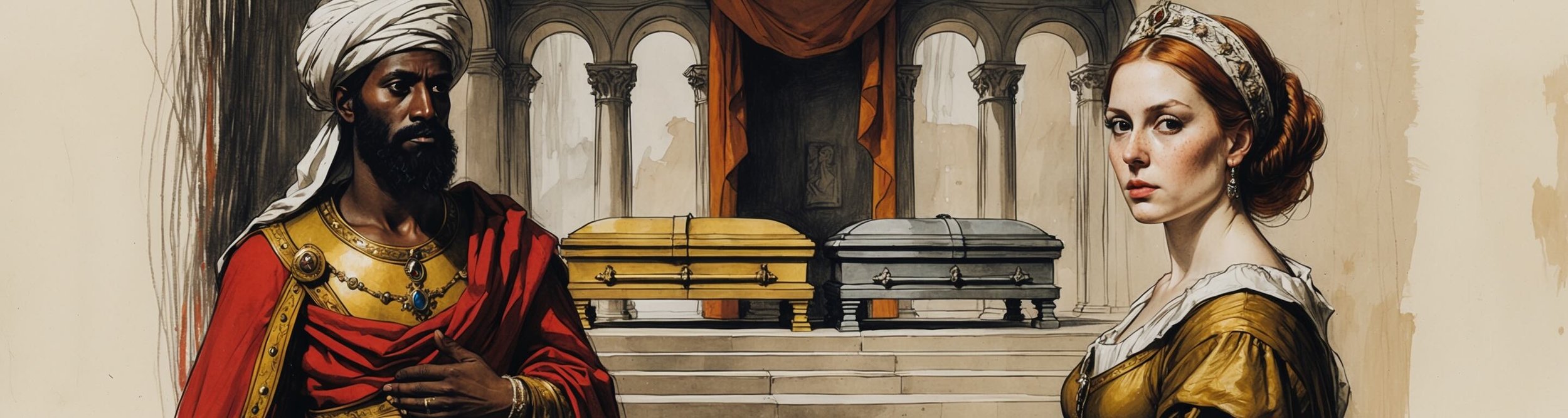
Scene Profile – At a Glance
- Location: A room in Portia's house at Belmont, where her suitors must take the casket test set by her dead father.
- What Happens: The Prince of Morocco arrives to woo Portia. He asks her not to judge him by his dark skin, boasts of his courage, and is led off to attempt the choice of caskets that will decide whether he can marry her.
- Key Characters: The Prince of Morocco (a proud suitor), Portia.
- Dramatic Function: A short scene that opens the casket plot in person, introducing the first onstage suitor and raising the question of how Portia must be won.
- Famous Quote:
"Mislike me not for my complexion,
The shadowed livery of the burnished sun,"
(Morocco, Act 2, Scene 1) - Why It Matters: It puts the play's interest in prejudice and outward appearance on stage in a new key, and starts the suspense of the casket lottery that will eventually bring Bassanio to Belmont.
Scene Summary
At Belmont, the Prince of Morocco arrives to try for Portia's hand. His first words ask her not to hold his dark skin against him, and he insists that the blood beneath it is as red as any pale northerner's. He swears that brave men have feared his looks and that the loveliest women of his own country have loved them.
Portia answers courteously that the choice is not hers to make freely: her father's will has bound her to marry whoever solves the riddle of the three caskets. Were she free, she says, Morocco would stand as fair a chance as any man she has seen. Morocco thanks her, boasts of his courage with sword in hand, yet admits that blind fortune may let a lesser man win. Portia warns him of the test's hard terms, and leads him off to the temple, with the casket choice to follow after dinner.
"Mislike Me Not for My Complexion"
Morocco's opening speech is one of the play's most direct treatments of race. He begins not by praising Portia but by defending himself, anticipating that his dark skin will count against him before he has said a word. The defence is proud rather than apologetic: he reframes his colour as the mark of the hot sun he was born under, and challenges any pale rival to cut his skin and see whose blood runs redder.
Original
Mislike me not for my complexion,
The shadowed livery of the burnished sun,
To whom I am a neighbour and near bred.
(Morocco, Act 2, Scene 1)
Shakespeare Retold (Modern Verse)
Don't hold the colour of my skin against me,
For it is darkened by the scorching sun
That I have lived under since I was born.
The plea is dignified, and it lands awkwardly on a modern ear because it reveals how routinely a dark-skinned man expected to be judged. Morocco assumes he must argue his way past his appearance just to be considered, and that assumption tells us a good deal about the world of the play. His image of common blood – the idea that an incision would prove every man's blood "reddest" alike – is a quiet claim to a shared humanity, made by a character the play will nonetheless treat as an outsider.
The Boast and the Caveat
Having defended his looks, Morocco turns to his courage. He calls on his scimitar and the great deeds it has done to prove his worth, picturing himself outstaring fierce eyes and mocking lions to win Portia. Yet his bravado is undercut by an honest admission: for all his prowess, the casket test is a lottery, and luck may hand victory to a weaker man.
Original
And so may I, blind fortune leading me,
Miss that which one unworthier may attain,
And die with grieving.
(Morocco, Act 2, Scene 1)
Shakespeare Retold (Modern Verse)
And so might I be subject to misfortune
And miss out marrying you by one inferior,
And then I'd die in grief.
The shift from boasting to anxiety makes Morocco more sympathetic than a simple braggart. He knows the test is no contest of valour: it rewards the right guess, not the bravest heart, and so all his battlefield triumphs count for nothing here. The "blind fortune" he fears is the same chance that governs the whole casket plot, where worth and luck are pointedly separated. It is a neat irony that the man most certain of his own merit must submit to a game that ignores it entirely.
Language and Technique
- Self-defence as opening: Morocco begins by defending his appearance rather than wooing, which immediately foregrounds the theme of prejudice.
- Imagery of blood and sun: The "burnished sun" and the talk of whose blood is "reddest" turn skin colour into a debate about shared humanity.
- Hyperbole: Morocco's boasts – outstaring fierce eyes, mocking lions, plucking cubs from the she-bear – inflate his courage to heroic, almost mythic size.
- Classical allusion: References to Phoebus, Hercules and Alcides lend his speech grandeur while hinting at his taste for self-dramatising.
Key Quotes from Act 2, Scene 1
Quote 1And let us make incision for your love,
To prove whose blood is reddest, his or mine.
(Morocco, Act 2, Scene 1)
Shakespeare Retold (Modern Verse)
And let us cut our skin, in love of you,
To prove whose blood is reddest, his or mine.
Besides, the lottery of my destiny
Bars me the right of voluntary choosing:
(Portia, Act 2, Scene 1)
Shakespeare Retold (Modern Verse)
Besides, the lottery of my chosen husband
Prevents me picking someone for myself.
Key Takeaways
- The casket test goes live: The scene puts Portia's lottery of suitors on stage for the first time, with Morocco as the first onstage contender.
- Prejudice in the open: Morocco's plea not to be judged by his colour brings the play's interest in race and outward appearance to the surface.
- Worth versus luck: Morocco's boasts collide with his fear that "blind fortune" may let a lesser man win, exposing how the test ignores merit.
- Portia is not free: She is bound by her father's will and cannot choose her own husband, a constraint that shapes her whole story.
Study Questions and Analysis
How does Shakespeare present the Prince of Morocco?
Morocco is presented as proud, courageous and acutely aware that his dark skin will be held against him. His very first words ask Portia not to "mislike" him for his "complexion", which tells us he expects prejudice before he has done anything to earn it. Rather than apologise, he defends himself with real dignity, reframing his colour as the badge of the hot sun he was born under and insisting that his blood is as red as any pale rival's.
At the same time, Shakespeare gives him a streak of self-dramatising bombast. He boasts of his scimitar, of outstaring fierce eyes and mocking lions, inflating his valour to heroic size. The mixture is deliberately complex: he is sympathetic in his plea for fair judgement, yet vain enough that his later failure at the caskets will carry a touch of comeuppance. The result is a suitor we are invited to respect and smile at by turns, and whose treatment exposes the casual prejudice of the play's world.
What does the scene reveal about prejudice and appearance?
The scene brings the play's interest in outward appearance into sharp focus. Morocco assumes from the start that he will be judged by his skin, and the assumption is telling: in the world of the play, a dark-skinned man expects to argue his way past his looks simply to be considered. His image of cutting two men's skins to prove their blood equally red is a quiet but powerful claim that surface difference is only skin deep.
Yet the play does not fully endorse the equality he pleads for. Portia, courteous to his face, will later be relieved when he chooses wrongly and leaves. Janet Adelman, in Blood Relations (2008), reads the play as defining its Christians against the outsiders they reject, and Morocco's anxious plea is an early instance of that othering: he must argue for his common humanity precisely because Venice has already marked him as alien. The scene therefore sits within a larger pattern in the play, which repeatedly judges people by exteriors – gold and silver caskets, fine clothes, skin colour – and repeatedly suggests that the true measure of worth lies elsewhere. Morocco's speech states the ideal of common humanity that the casket test, choosing inner worth over show, is meant to honour, even as the characters around him fall short of it.
Why is the casket test important to the play?
The casket test is the device that governs Portia's marriage, and this scene is where it first plays out before us. By her father's will, each suitor must choose between caskets of gold, silver and lead; the one who picks correctly wins her hand, while a wrong choice carries a heavy forfeit. Portia is bound by the test absolutely, unable to choose for herself, which is why she explains to Morocco that the "lottery" of her destiny bars her "voluntary choosing".
The test matters thematically because it stages the play's central concern with appearance against reality. Suitors are tempted by the showy gold and silver and must learn to value the unpromising lead. Sigmund Freud, in The Theme of the Three Caskets (1913), reads the lead casket as the right choice precisely because it is the humblest and least alluring, the unshowy thing a wiser instinct learns to prefer over glitter. Morocco's arrival sets the pattern: a confident man, sure of his own worth, must submit to a game that rewards insight rather than valour or wealth. The suspense the scene begins – who will choose rightly? – runs through the Belmont plot until Bassanio finally wins Portia by reading past the surface.