The Merchant of Venice: Act 2, Scene 2 – Analysis
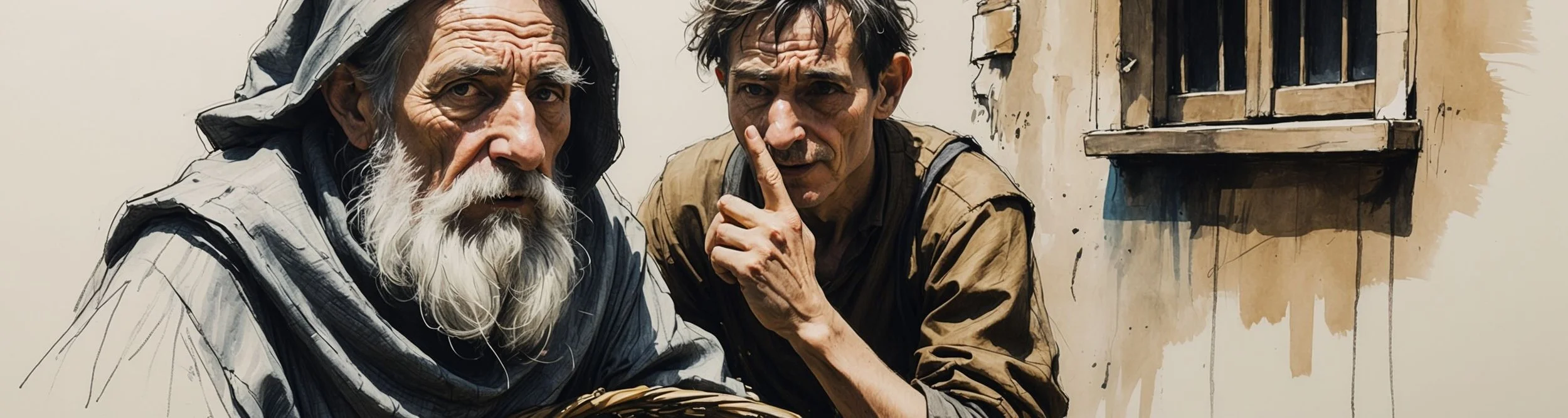
Scene Profile – At a Glance
- Location: A street in Venice, outside the world of Belmont and the casket test.
- What Happens: Launcelot Gobbo debates whether to run away from his master Shylock, then teases his half-blind father before securing a new place with Bassanio. Bassanio takes him on and agrees that Gratiano may travel with him to Belmont.
- Key Characters: Launcelot Gobbo (Shylock's servant), Old Gobbo (his father), Bassanio, Gratiano.
- Dramatic Function: The play's first sustained comic scene. It moves a servant from Shylock to the Christian household, and arranges for Gratiano to join the voyage to Belmont.
- Famous Quote:
"it is a wise father that knows his own child."
(Launcelot, Act 2, Scene 2) - Why It Matters: The comedy carries real weight: a Christian household tempting away Shylock's servant prefigures the loss of his daughter, and the talk of devils and "the very Jew" reinforces the play's casual prejudice.
Scene Summary
The scene opens with Launcelot Gobbo alone in a Venice street, locked in a comic argument with himself. His conscience tells him to stay loyal to his master Shylock; a "fiend" at his elbow urges him to run away. He weighs the two voices at length and concludes, with mock solemnity, that since Shylock is "the very devil incarnal", he had better follow the fiend's friendlier advice and flee.
At that moment his father, the sand-blind Old Gobbo, arrives carrying a basket and asking the way to the Jew's house. Launcelot recognises his father, who does not know him, and cannot resist teasing the old man – first misdirecting him, then solemnly announcing that "young Master Launcelot" is dead. When the grief becomes too much, he reveals himself and asks his father's blessing, though Gobbo can hardly believe this bearded young man is his boy.
Father and son then turn to business. Old Gobbo has brought a present meant to smooth Launcelot's way, and Launcelot decides it should go instead to Bassanio, who is known to dress his servants well. When Bassanio enters, the two Gobbos talk over each other in a tangle of malapropisms until Bassanio cuts through and grants Launcelot the post – Shylock, it turns out, has already recommended the move.
With Launcelot dispatched to take his leave of Shylock, Gratiano arrives and presses Bassanio to let him come to Belmont. Bassanio agrees, but only on condition that Gratiano curb his wild, loud manner, which might embarrass him among strangers. Gratiano promises to behave with comic exaggeration – though not tonight, when there is a party – and the two part to prepare for the evening's feast.
The Comic Conscience
Launcelot's opening monologue is the scene's set-piece: a clown staging a full morality-play debate between conscience and the devil entirely inside his own head. The joke is that he gets the moral logic backwards. His conscience tells him to stay with Shylock, the devil tells him to run – and Launcelot reasons that since his master is himself a kind of devil, fleeing him is the more sensible, "friendly" course.
Original
to be ruled by my conscience, I should stay with the Jew my master, who, God bless the mark, is a kind of devil; and, to run away from the Jew, I should be ruled by the fiend, who, saving your reverence, is the devil himself.
(Launcelot, Act 2, Scene 2)
Shakespeare Retold (Modern Verse)
If I'm ruled by my conscience, I should stay with the Jew, my master, who, if I'm being honest, is rather like the devil; but if I run away from the Jew, then I'd be ruled by the devil, who, in all humility, is actually the devil.
The speech is funny, but it does the play's prejudicial work too. The casual equation of Shylock with the devil is exactly the slander the Christians repeat throughout, and here it is put in the mouth of a clown for laughs. Launcelot's tangled reasoning – that a servant should flee a "Jew" who is the devil even if conscience says stay – lets the audience enjoy the comedy while quietly absorbing the assumption that to serve Shylock is to serve evil. The morality-play frame gives a low joke a surprisingly large theological reach.
Fooling the Father
The arrival of Old Gobbo turns the scene into broad physical comedy. Launcelot, recognising the half-blind father who cannot recognise him, decides to "try confusions" – misdirecting the old man and then, with straight-faced cruelty, reporting his own death. Only when Gobbo's grief becomes real does Launcelot relent and claim his blessing, insisting on his identity even as his father struggles to believe it.
Original
Nay, indeed, if you had your eyes, you might fail of the knowing me: it is a wise father that knows his own child.
(Launcelot, Act 2, Scene 2)
Shakespeare Retold (Modern Verse)
No, even if you could see, you'd probably fail to recognise me: it is a wise father who can recognise his own child.
The line inverts a proverb – usually "it is a wise child that knows his own father" – and the joke lands because Old Gobbo cannot know his own son. Beneath the clowning, the scene plays lightly with one of the comedy's recurring concerns: fathers and children who fail to recognise one another. Shylock will shortly lose his daughter Jessica, and Portia is governed by a dead father's will. Launcelot's reunion is warm and farcical, but it sits inside a play where the bond between parent and child is repeatedly strained or broken.
Changing Masters
The middle of the scene moves Launcelot from Shylock's service to Bassanio's. When Bassanio enters, the two Gobbos botch their appeal in a flurry of contradictions and malapropisms, each interrupting the other, until Bassanio cuts through the noise. Crucially, he reveals that Shylock has already spoken to him and recommended the change – so the comedy resolves into a small migration from the Jewish household to the Christian one.
Original
Shylock thy master spoke with me this day,
And hath preferred thee, if it be preferment
To leave a rich Jew's service, to become
The follower of so poor a gentleman.
(Bassanio, Act 2, Scene 2)
Shakespeare Retold (Modern Verse)
Your master, Shylock, spoke with me today,
And told me that he likes you. If you want
To leave a rich Jew's service to become
A worker for a poor man such as me.
Bassanio's lines carry a sly economic irony. He is "so poor a gentleman" precisely because he has borrowed heavily – Shylock's own money, secured against Antonio's bond – to fund his suit at Belmont, yet he takes on another servant and lavishes fine liveries on him. The scene thus shows the careless Christian spending that the play sets against Shylock's thrift. Launcelot's wry observation that Bassanio has "the grace of God" while Shylock has "enough" sharpens the contrast between Christian show and Jewish wealth.
Gratiano Asks to Come Along
The scene closes by setting up the voyage to Belmont. Gratiano arrives and demands to join Bassanio's trip. Bassanio agrees, but his consent comes with a warning: Gratiano is "too wild, too rude and bold of voice", and such behaviour, harmless among friends, might damage Bassanio's standing where he is not known. The exchange is light, but it shows Bassanio anxious to present a respectable face at Belmont.
Original
Thou art too wild, too rude and bold of voice;
Parts that become thee happily enough
And in such eyes as ours appear not faults;
(Bassanio, Act 2, Scene 2)
Shakespeare Retold (Modern Verse)
You are too wild, too rude and over boisterous,
Traits that are fine enough and funny to us,
And in our eyes, we don't see them as faults;
The request matters to the plot – Gratiano's presence at Belmont will lead to his match with Nerissa – but the exchange also touches the play's interest in appearance against reality. Bassanio, about to gamble everything on choosing the right casket by looking past surface show, is here busy managing surfaces himself, coaching Gratiano to "put on" sober modesty so that strangers will form the right impression. Gratiano's mock-pious promise to wear prayer-books and sigh "amen" turns the whole idea of self-presentation into a joke.
Language and Technique
- Comic prose: Launcelot and the Gobbos speak in loose, tumbling prose, marking them as low-status clowns against the verse of Bassanio and Gratiano.
- Morality-play debate: The conscience-versus-fiend monologue borrows the structure of medieval morality drama and plays it for laughs.
- Malapropism: The Gobbos muddle their words – "infection" for affection, "frutify" for certify – so that meaning collapses into comic nonsense.
- Inverted proverb: "It is a wise father that knows his own child" flips a familiar saying to fit the blind father who cannot know his son.
- Dramatic prefiguring: A servant slipping from Shylock's house to a Christian one quietly anticipates Jessica's flight in the scenes to come.
Key Quotes from Act 2, Scene 2
Quote 1Certainly the Jew is the very devil incarnal;
(Launcelot, Act 2, Scene 2)
Shakespeare Retold (Modern Verse)
Certainly the Jew is the devil incarnate,
My master's a very Jew: give him a present! Give him a halter: I am famished in his service; you may tell every finger I have with my ribs.
(Launcelot, Act 2, Scene 2)
Shakespeare Retold (Modern Verse)
My master is a proper Jew: you're giving him a present! So give him a harness! I'm starving working for him; my ribs protrude like fingers I'm so thin.
If I do not put on a sober habit,
Talk with respect and swear but now and then,
Wear prayer-books in my pocket, look demurely,
(Gratiano, Act 2, Scene 2)
Shakespeare Retold (Modern Verse)
If I'm not sensible, remaining sober,
And speak respectfully, with little swearing,
Have prayer-books in my pocket, look polite –
Key Takeaways
- The play's first big comic scene: Launcelot's clowning and the muddled Gobbos provide broad humour after the tense bond plot of Act 1.
- A servant changes sides: Launcelot leaves Shylock for Bassanio, with Shylock's own blessing, moving from the Jewish household to the Christian one.
- Prejudice runs through the jokes: The casual talk of Shylock as "the very devil" shows how deeply contempt for him is woven into everyday Venetian speech.
- Foreshadowing of Jessica's flight: A servant slipping away from Shylock prefigures the far more wounding loss of his daughter.
- Gratiano joins the voyage: Bassanio agrees to take Gratiano to Belmont, setting up the second pair of lovers.
Study Questions and Analysis
What is the purpose of Launcelot's opening monologue?
Launcelot's monologue stages a comic battle between his conscience, which urges him to stay loyal to Shylock, and a tempting "fiend", which urges him to run away. The form is borrowed from medieval morality plays, where a soul is pulled between good and evil voices, but Shakespeare plays it for laughs by having Launcelot get the moral arithmetic upside down. He decides that because Shylock is himself "a kind of devil", obeying the fiend and fleeing is the more sensible choice.
The speech does more than raise a laugh. It introduces the play's clown and establishes the loose, tumbling prose that marks him out from the verse-speaking gentry. C. L. Barber, in Shakespeare's Festive Comedy (1959), sees the clown as the figure who licenses release into festivity, and Launcelot's mock-debate is exactly that kind of holiday misrule, a low parody of moral seriousness that frees the audience to laugh its way out of the bond plot's tension. More importantly, the monologue plants the prejudicial assumption that to serve Shylock is to serve evil – an idea the audience absorbs through comedy rather than confrontation. By the end of the speech Launcelot has talked himself into leaving, and the scene's larger movement, from the Jewish household to the Christian one, is set in motion.
Why does Launcelot tease his father about being dead?
When Old Gobbo arrives half-blind and fails to recognise his own son, Launcelot seizes the chance to "try confusions" with him – first misdirecting the old man, then gravely announcing that "young Master Launcelot" has died and gone to heaven. The cruelty is purely comic: Launcelot watches his father grieve, then relents and reveals himself, demanding a blessing as proof of their reunion.
The teasing is broad clowning, but it touches a theme that runs quietly through the play. This is a scene about a father who cannot know his own child, and it sits beside Shylock's coming loss of Jessica and Portia's bondage to a dead father's will. Launcelot's inverted proverb – "it is a wise father that knows his own child" – makes the joke explicit, since here it is the father who cannot know the son.
When Launcelot finally claims his blessing, he insists he is his father's boy "that was, your son that is, your child that shall be" – a little parade of tenses that asserts the unbroken bond between them even as the joke has just played on its failure. The reunion is warm and ends happily, which throws into relief the more painful father-child relationships the play is about to develop.
What does the scene tell us about Shylock as a master?
Almost everything we hear about Shylock here comes from Launcelot, who is hardly an impartial witness. The servant calls him "the very devil incarnal" and "a very Jew", complains of being starved in his service until his ribs show, and treats leaving him as an escape from evil. Taken at face value, this paints Shylock as a cruel, miserly employer.
But the play is careful not to confirm the picture. We never see Shylock mistreat Launcelot, and it is Shylock himself who recommends the servant to Bassanio – hardly the act of a tyrant. What the scene really shows is how readily those around Shylock assume the worst of him, recycling the same anti-Jewish slanders whether or not the facts support them. W. H. Auden, in The Dyer's Hand (1962), reads the play's Venice as a world organised around money-making, where older bonds of loyalty and service are quietly displaced by contract and advantage; Launcelot's easy desertion of one master for a more lavish one is a small symptom of that world. His complaints are funny, but they are also an instance of the prejudice that isolates Shylock throughout the play, and the audience is left to weigh the clown's word against the absence of any real evidence.
How does this scene fit into the play's structure?
Structurally the scene does several quiet jobs while seeming merely to entertain. It provides the play's first sustained comic relief after the heavy business of the bond in Act 1, lightening the tone before the action returns to Belmont and the caskets. It also advances the plot in practical ways: Launcelot is settled in Bassanio's service, and Gratiano secures his place on the voyage to Belmont, which will eventually pair him with Nerissa.
More subtly, the scene prepares the ground for what is coming. A servant slipping away from Shylock's house to a Christian master prefigures the far more serious flight of Jessica, Shylock's daughter, in the scenes that follow. The comic talk of fathers and children, devils and Jews, rehearses in a low key the themes the play is about to treat in earnest. So a scene that looks like a digression is in fact threading the Venice and Belmont plots together and tuning the audience's ear to the prejudice and the broken bonds ahead.
Why does Bassanio warn Gratiano about his behaviour?
Bassanio agrees to take Gratiano to Belmont but insists on one condition: Gratiano must rein in his wild, loud manner. Among friends in Venice, Bassanio says, Gratiano's boldness is no fault and even a pleasure, but in a place where he is not known it would look like coarseness and might damage Bassanio's reputation just when he most needs to impress. He is, after all, about to court the wealthy and discerning Portia.
The exchange is comic – Gratiano promises to wear prayer-books and sigh "amen" like a model of piety, before adding that the reform need not start tonight – but it touches the play's serious interest in surfaces. Bassanio, who will shortly win Portia by choosing the casket that warns against trusting appearances, is here busy stage-managing appearances himself. The scene gently exposes the tension at the heart of his story: a man who must learn to value substance over show is also a man very concerned with how things look.
How does the comedy of the scene carry serious meaning?
The scene is built almost entirely from broad comedy – a clown arguing with himself, a blind father gulled by his son, two men talking over each other in a muddle of wrong words – yet it does substantial thematic work beneath the laughter. The running joke that Shylock is a devil normalises the play's anti-Jewish prejudice, slipping it past the audience as entertainment rather than argument. The misrecognition of father by son lightly anticipates the play's larger failures of recognition between parents and children.
This is characteristic of how Shakespearean comedy works: the funniest material often carries the heaviest freight. Barber's account of festive comedy is useful here, since for him the holiday mood of release is never purely innocent – the licence to laugh also smuggles in the assumptions and exclusions the play will later test in earnest. The laughter eases the audience from the tense bond plot into the romance of Belmont, while quietly planting the prejudices and anxieties the rest of the play will develop. The migration of a servant from a Jewish to a Christian house, played for farce, foreshadows the wounding loss of Jessica; the talk of devils prepares the courtroom's harsher contempt. A study of the scene that stops at the jokes misses how much serious groundwork the comedy lays.