The Merchant of Venice: Act 2, Scene 5 – Analysis
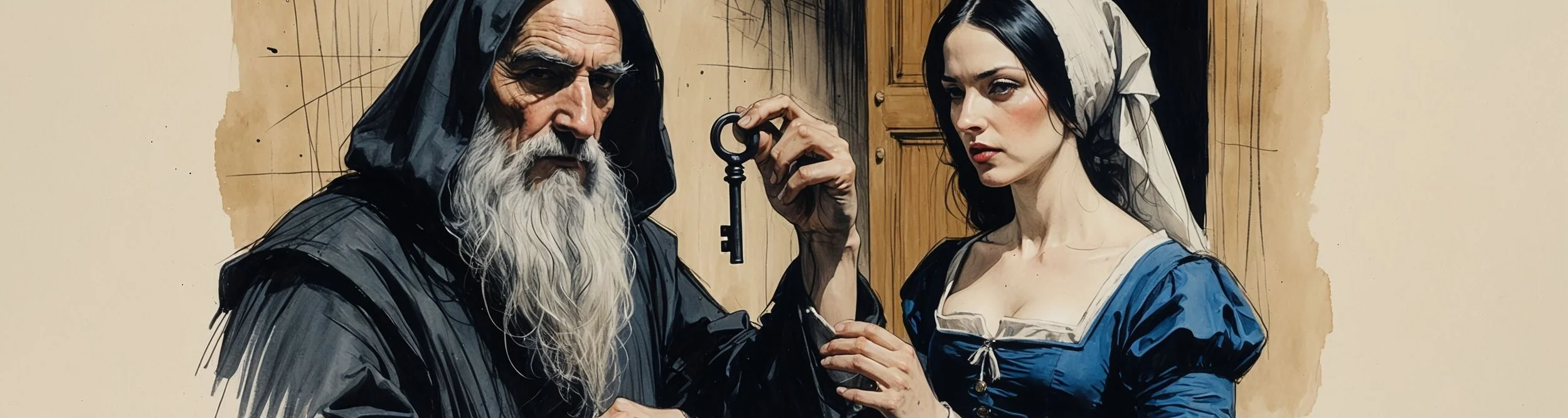
Scene Profile – At a Glance
- Location: Outside Shylock's house in Venice, in the early evening, as he prepares to leave for dinner.
- What Happens: Shylock, invited to supper by Bassanio, hands his daughter Jessica the keys and orders her to lock up the house and shut out the masquers' revelry. He leaves uneasy, troubled by a dream of money-bags. Alone, Jessica reveals she means to flee.
- Key Characters: Shylock, Jessica, Launcelot Gobbo (his departing servant).
- Dramatic Function: A short domestic scene that sets the elopement in motion, showing Shylock as an anxious householder while Jessica quietly counts the hours until her escape.
- Famous Quote:
"Fast bind, fast find;
A proverb never stale in thrifty mind."
(Shylock, Act 2, Scene 5) - Why It Matters: It gives us Shylock at home, guarding his doors and his ducats, just as his daughter prepares to carry both away – the private wound that will harden him in the trial to come.
Scene Summary
Outside his house, Shylock warns Launcelot Gobbo that he will soon learn the difference between serving him and serving Bassanio, his new master. He calls repeatedly for his daughter Jessica, and when she appears he gives her his keys: he has been invited out to supper and means to go, though grudgingly, "in hate" rather than friendship, and unsettled by a bad dream of money-bags.
Launcelot hints that there may be a masque that night. Alarmed, Shylock orders Jessica to lock the doors and stop her ears against the music and the "Christian fools with varnished faces", refusing to let such frivolity into his "sober house". He repeats his thrifty motto and goes. Left alone, Jessica says a quiet farewell: if her luck holds, her father will lose a daughter and she will lose a father this very night.
The House Locked Against the World
The heart of the scene is Shylock as householder. Hearing that masquers may pass, he does not delight in the spectacle but recoils from it. He commands Jessica to seal the house like a body shutting its senses, keeping out the noise of Christian Venice. The imagery is defensive and almost claustrophobic: a man trying to wall his home against a world he distrusts, never guessing that the danger is already inside it.
Original
Lock up my doors; and when you hear the drum
And the vile squealing of the wry-necked fife,
Clamber not you up to the casements then,
Nor thrust your head into the public street...
(Shylock, Act 2, Scene 5)
Shakespeare Retold (Modern Verse)
Lock up my doors, and when you hear the drum
And awful screeching from the bent-necked flute,
Don't climb up to the swinging double windows
Nor stick your head outside to see the streets...
Shylock's instinct is to shut out, to bind fast. The "vile squealing" of the fife and the "Christian fools with varnished faces" are everything he wants kept beyond his threshold. There is something painfully ironic in the care he takes: he is sealing the windows against the very escape route his daughter will use, and the more tightly he locks the house, the more completely he is shutting himself in with his own coming loss. His watchfulness is real, but it is aimed in entirely the wrong direction.
A Daughter's Farewell
The scene ends on Jessica, alone, and the mood changes completely. Throughout her father's instructions she has said almost nothing; only when he has gone does she speak her mind, and what she reveals is the secret that powers the whole sequence of scenes. Her closing couplet is quiet, even tender, but its meaning is a clean break.
Original
Farewell; and if my fortune be not crost,
I have a father, you a daughter, lost.
(Jessica, Act 2, Scene 5)
Shakespeare Retold (Modern Verse)
Goodbye, and if good luck is to be had,
You'll lose your daughter, and I'll lose my dad.
The neat rhyme makes the parting sound almost casual, but the substance is a child resolving to abandon her father and his faith in one night. Jessica frames her flight as good fortune, not betrayal, and the audience is left to weigh those two readings against each other. To her, the locked house is a prison; to Shylock, it is protection. The same doors mean opposite things to father and daughter, and that gulf of feeling, drawn so economically here, is what makes Shylock's later grief so raw.
Language and Technique
- Repetition as anxiety: Shylock's broken, repeated calls of "Jessica!" make him sound restless and uneasy, a man who cannot quite settle before he goes.
- Imagery of sealing: The house is told to "stop its ears" and shut its "casements" – the building is imagined as a body closing itself against the outside world.
- Dramatic irony: Every order Shylock gives to protect his home in fact clears the way for Jessica's escape, and the audience knows it while he does not.
- Rhyming couplet: Jessica's closing rhyme of "crost" and "lost" snaps the scene shut on her secret resolve, turning a tender farewell into a declaration of departure.
Key Quotes from Act 2, Scene 5
Quote 1Look to my house. I am right loath to go:
There is some ill a-brewing towards my rest,
For I did dream of money-bags to-night.
(Shylock, Act 2, Scene 5)
Shakespeare Retold (Modern Verse)
Take good care of my house. I'd rather stay here.
Bad omens are occurring to upset me:
I dreamt of cash last night, and that's unlucky.
Do as I bid you; shut doors after you:
Fast bind, fast find;
A proverb never stale in thrifty mind.
(Shylock, Act 2, Scene 5)
Shakespeare Retold (Modern Verse)
Do as I tell you; shut the doors behind you:
And quickly lock the things you want to keep;
A worthy saying to a mind that's cheap.
Key Takeaways
- Shylock at home: The scene shows him as an anxious householder, guarding his doors, his keys and his ducats against a world he distrusts.
- The elopement is set: By handing Jessica the keys and going out, Shylock unknowingly clears the path for her escape that very night.
- Dramatic irony throughout: Every precaution Shylock takes to protect his house in fact helps his daughter to rob and leave it.
- Jessica's secret resolve: Her closing couplet reveals a daughter ready to lose father and faith in one night, framing it as good fortune rather than betrayal.
Study Questions and Analysis
How does Shakespeare present Shylock in this domestic scene?
This is one of the few times we see Shylock at home rather than in the marketplace or the law court, and the effect is to make him more human and more isolated at once. He is fussy, anxious and controlling: he calls repeatedly for Jessica, frets about the masque, and insists on locking the house against the noise of Venice. There is meanness in him – he is glad to be rid of his "huge feeder" of a servant – but also a real unease, a sense that he is happier behind closed doors than out among the Christians who have invited him.
What makes the portrait sympathetic, even as it stays critical, is how alone he is. He guards his "sober house" against a hostile world, never suspecting that the person he trusts with his keys is the one preparing to betray him. C. L. Barber, in Shakespeare's Festive Comedy (1959), reads the play as a contest between Shylock's instinct to hoard and bind fast and the Christian world's impulse to give and spend freely; his motto "fast bind, fast find" is the very emblem of that hoarding temper, and it is precisely his locking and keeping that the comedy is built to defeat. The scene lets us see the private man behind the public moneylender: watchful, house-proud, and about to be wounded in the place he thought most secure.
Why does Shylock want the house "locked up" against the masque?
On the surface, Shylock simply dislikes noise and frivolity. He calls the masquers "Christian fools with varnished faces" and their music a "vile squealing", and he wants none of it entering his "sober house". His instinct is to seal the building like a body shutting its senses – to "stop my house's ears" against the revelry outside.
Beneath that, the order reflects his whole relationship with Venice. The masque stands for the Christian world that mocks and excludes him, and his response is to wall himself off from it. Walter Cohen, writing in ELH (1982), reads Shylock's thrift and watchfulness as the marks of the usurer set against the merchant's freer spending, a clash bound up with the economic anxieties of an emerging commercial world; the locked house is the usurer's instinct made visible. The scene also draws on the theme of prejudice and intolerance: Shylock's withdrawal is partly self-protection, the defensive crouch of a man used to hostility. The cruel irony is that, by sealing the house, he is locking away the very daughter who longs to join that Christian world – and handing her the means to escape into it.
What does Jessica's final couplet reveal about her feelings?
Jessica is almost silent while her father gives his orders, so her closing couplet carries real weight: it is the first time we hear what she actually thinks. "If my fortune be not crost, / I have a father, you a daughter, lost" frames her planned elopement not as betrayal but as good luck – the escape she has been waiting for.
Farewell; and if my fortune be not crost,
I have a father, you a daughter, lost.
(Jessica, Act 2, Scene 5)
Shakespeare Retold (Modern Verse)
Goodbye, and if good luck is to be had,
You'll lose your daughter, and I'll lose my dad.
The lines are deliberately double-edged. The neat rhyme and the soft word "farewell" make the parting sound gentle, almost loving, yet the substance is a clean and permanent break: she will lose a father and he a daughter in a single night. Readers disagree about how to judge her – whether she is a brave young woman escaping a joyless home, or a child abandoning her father and her faith for money and a Christian lover. Shakespeare gives us both possibilities here and refuses to settle them, which is part of what keeps Jessica such a debated figure.
How does this short scene prepare for Shylock's later grief?
The scene works as quiet groundwork for the explosion of feeling we hear reported in Act 2, Scene 8, where Shylock runs through the streets crying for his daughter and his ducats. Here we see exactly what he is about to lose and how much it means to him: the house he guards so carefully, the keys he trusts to Jessica, the wealth he dreams about, and the daughter he assumes is safely under his roof.
By showing Shylock as a careful, anxious householder before the robbery, Shakespeare makes the loss land harder. We understand that for Shylock security and possession are deeply entangled – his money, his house and his child are all things to be "bound fast" and kept – so that losing them at once strikes at his whole sense of himself. The scene also sows the resentment that will surface at the trial: the private betrayal here helps explain, without excusing, the public cruelty later. A man this wounded in his own home does not forgive easily.