The Merchant of Venice: Act 2, Scene 6 – Analysis
Scene Profile – At a Glance
- Location: Outside Shylock's house in Venice, at night, during the masque.
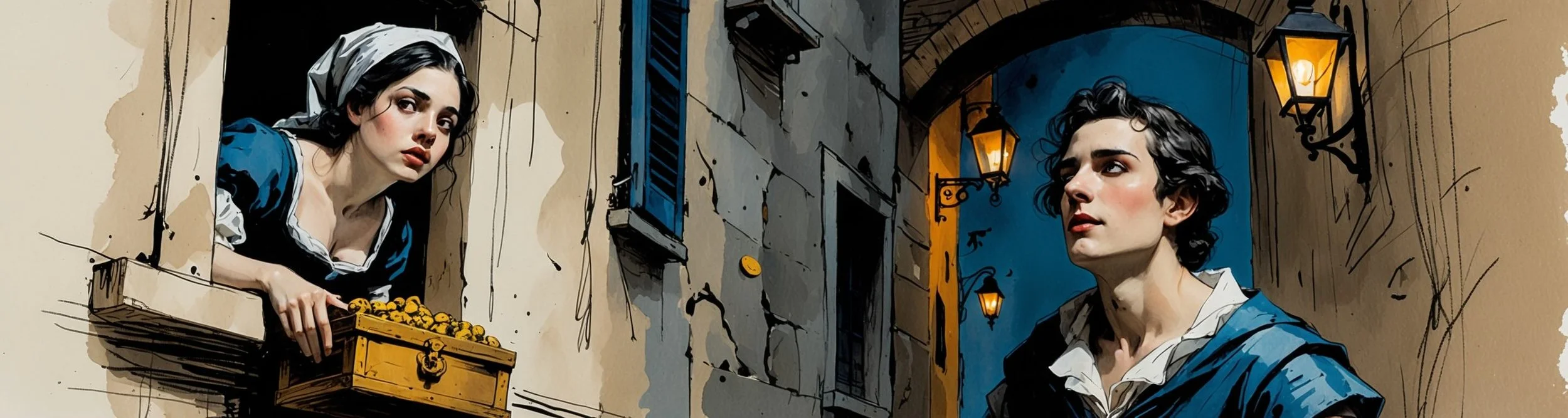
- What Happens: Gratiano and Salarino wait in disguise for Lorenzo, musing on how desire cools once won. Lorenzo arrives and calls up to Jessica, who appears dressed as a boy. She throws down a casket of her father's treasure and slips out to elope with him. Antonio enters to report the masque is cancelled and Bassanio is sailing.
- Key Characters: Lorenzo, Jessica, Gratiano, Antonio, Salarino.
- Dramatic Function: The elopement itself – the romance that runs alongside the bond plot – staged as a moonlit escape complete with disguise, stolen treasure and a lover's serenade.
- Famous Quote:
"But love is blind and lovers cannot see
The pretty follies that themselves commit;"
(Jessica, Act 2, Scene 6) - Why It Matters: It completes Shylock's domestic ruin in the most pointed way – his daughter robs him and runs to a Christian – while raising quiet doubts about a love built on disguise and stolen gold.
Scene Summary
At night, outside Shylock's house, Gratiano and Salarino wait in their masquing costumes for Lorenzo, who is late. They pass the time reflecting that lovers usually arrive early, and that all things – feasts, voyages, desire itself – are chased more eagerly than they are enjoyed once won.
Lorenzo hurries in and calls up to the house. Jessica appears above, disguised as a boy, and after a brief exchange to make sure of him she throws down a casket of her father's gold and jewels. Ashamed of her disguise but committed to her escape, she gathers more ducats and comes down to join them. The masquers leave with Jessica, and Antonio arrives to tell Gratiano the masque is off – the wind has changed and Bassanio is about to sail for Belmont.
"All Things... Are with More Spirit Chased Than Enjoyed"
Before Lorenzo arrives, Gratiano offers a worldly little meditation on desire. Waiting in the dark, he reflects that everything is wanted more keenly in the pursuit than in the having – a thought that hangs faintly over the elopement to come, as though questioning whether this passionately chased love will survive being won.
Original
All things that are,
Are with more spirit chased than enjoyed.
(Gratiano, Act 2, Scene 6)
Shakespeare Retold (Modern Verse)
Everything
Has more zeal in pursuit than satiated.
Gratiano illustrates the idea with images of cooling appetite: the diner who rises from the table less hungry, the horse that retraces its path without the fire it had the first time, the ship that sets out proud and returns battered. The speech is light in tone but its placement is pointed. Just as Jessica is about to be won, Gratiano wonders aloud whether anything keeps its lustre once possessed. Shakespeare lets the romance go ahead while planting a small seed of doubt about its durability – a doubt the play never quite resolves.
The Escape in Disguise
The centre of the scene is Jessica's appearance "above", dressed as a boy and embarrassed by it. Her disguise is both practical – it lets her move through the streets unnoticed – and symbolic, marking how completely she is shedding one identity for another. She is uneasy about being seen, but she is not uncertain about leaving.
Original
But love is blind and lovers cannot see
The pretty follies that themselves commit;
For if they could, Cupid himself would blush
To see me thus transformed to a boy.
(Jessica, Act 2, Scene 6)
Shakespeare Retold (Modern Verse)
But love is blind and lovers do not see
The silly actions love makes them commit,
For if they could, the God of Love would blush
To see me now transformed into a boy.
Jessica's shame is half playful, half real. The "pretty follies" of love excuse the indignity of her costume, and the proverb "love is blind" lets her laugh at herself even as she does something momentous. But the disguise carries weight beyond the joke: a daughter dressed as a boy, throwing her father's wealth out of the window to a waiting Christian, is enacting a total break from home and faith. The theme of gender and disguise first surfaces here, in a minor key, before Portia takes it up far more boldly in the trial scene. Jessica's blush is the small, human cost of a very large step.
Language and Technique
- Extended simile: Gratiano compares cooling desire to a sated diner, a tired horse and a storm-battered ship – a chain of images that makes his point vivid and slightly cynical.
- Disguise as symbol: Jessica's boy's costume is staged business that also signals her change of identity, faith and family in one stroke.
- Proverbial wit: "Love is blind" lets Jessica acknowledge the folly of her situation while still embracing it, softening the audacity of the elopement.
- Night setting: The darkness covers the escape and lends the romance a secretive, fairy-tale glamour, while also hiding the theft at its heart.
Key Quotes from Act 2, Scene 6
Quote 1Here, catch this casket; it is worth the pains.
I am glad 'tis night, you do not look on me,
For I am much ashamed of my exchange:
(Jessica, Act 2, Scene 6)
Shakespeare Retold (Modern Verse)
Here, catch this box: it will be worth your while.
I'm glad it's night so that you cannot see me,
For I'm ashamed how different I appear:
For she is wise, if I can judge of her,
And fair she is, if that mine eyes be true,
And true she is, as she hath proved herself,
(Lorenzo, Act 2, Scene 6)
Shakespeare Retold (Modern Verse)
For she is wise, if I can be her judge,
And she's attractive, if I'm seeing right,
And she is truthful, as she's proved to herself,
Key Takeaways
- The elopement is staged: Jessica escapes by night in a boy's disguise, throwing down a casket of her father's gold to Lorenzo and the waiting masquers.
- Romance shadowed by theft: The love match is genuine, but it is built on robbing Shylock, and Shakespeare keeps both truths in view at once.
- Disguise enters the play: Jessica's boy's costume introduces the gender-and-disguise theme that Portia will later take much further.
- Gratiano's doubt: His musing that all things are "chased" more keenly than "enjoyed" hangs a faint question over how this love will fare once won.
- The plot turns outward: Antonio's arrival, announcing the cancelled masque and Bassanio's sailing, links the elopement back to the main voyage to Belmont.
Study Questions and Analysis
What is the significance of Jessica's disguise as a boy?
On the simplest level, the disguise is practical: dressed as a boy and acting as Lorenzo's "torchbearer", Jessica can move through the night streets of Venice without being recognised. But Shakespeare makes it carry far more than plot convenience. The costume marks the completeness of her transformation – she is leaving behind her father, her religion and her name, and the change of dress stands for all of it at once.
Her embarrassment is telling. She is "much ashamed" of her "exchange" and grateful for the darkness, which suggests she feels the strangeness of what she is doing even as she does it. The moment also opens the play's interest in gender and disguise, a theme that will return with much greater force when Portia dresses as a male lawyer to save Antonio. Jessica's nervous, half-comic cross-dressing is the quieter first instance, a small rehearsal for the bolder disguises to come.
Janet Adelman, in Blood Relations: Christian and Jew in The Merchant of Venice (2008), pushes the symbolism further, reading Jessica's male disguise as a kind of symbolic circumcision – the bodily mark of the Jewish father stamped on the very moment she tries to convert and escape into Christian Venice. For Adelman, the disguise does not free Jessica from her origins so much as inscribe them: even as she flees Shylock, she remains, troublingly, bound to her father. That reading sharpens the unease of the scene, suggesting that the transformation Jessica longs for may be less complete than her change of costume implies.
How does the scene balance romance against the theft of Shylock's wealth?
This is the central tension of the scene, and Shakespeare refuses to resolve it neatly. On one hand, the elopement is staged as romance: a moonlit serenade, a lover calling up to a window, a girl slipping away to her beloved. Lorenzo's praise of Jessica as "wise, fair and true" sounds entirely sincere, and the language gives the escape a glow of fairy-tale glamour.
On the other hand, the romance is funded by robbery. Jessica throws down a "casket" of her father's gold and stops to gather "more ducats" before she leaves, so the love match is literally bankrolled by Shylock's stolen wealth. The play lets both things be true at once: this is a real love, and it is a daughter looting her father's house. How sympathetic we find Jessica depends partly on how we weigh those facts, and the scene is carefully built to keep the question open rather than to settle it for us.
What does Gratiano's speech about desire add to the scene?
Gratiano's reflection – that "all things... are with more spirit chased than enjoyed" – can look like idle banter to fill the time while the men wait. But its placement just before the elopement gives it a quiet thematic charge. He is saying that desire cools once satisfied: the diner rises less hungry, the ship returns battered, the chase is always keener than the prize.
Set against Lorenzo's eager pursuit of Jessica, the speech plants a small doubt about whether this passionately wanted love will hold its value once it is safely won. The play never tells us outright whether Jessica and Lorenzo are happy in the long run, and some readers find their later scenes faintly melancholy. Gratiano's worldly little sermon is the moment Shakespeare quietly raises that possibility, letting the romance go forward while reminding us that wanting and having are not the same thing.
Why does Antonio's entrance matter at the end of the scene?
Antonio's brief appearance does important practical work: it tells us the masque has been called off because the wind has changed, and that Bassanio is about to set sail for Belmont. This pulls the scene's private romance back into the larger machinery of the plot, reminding the audience that while Lorenzo elopes, the central voyage – Bassanio's quest for Portia, funded by Antonio's dangerous bond – is getting underway.
The timing also creates a neat structural hinge. The elopement closes off the Venice household story for now, and Antonio's news points us towards Belmont and the casket plot. By having Antonio himself bring the message, Shakespeare keeps the man whose life is mortgaged to Shylock present at the edge of the scene, a quiet reminder of the risk hanging over everything as the lovers and adventurers scatter into the night. W. H. Auden, in The Dyer's Hand (1962), reads the play as an uneasy one in which the romance of Belmont is never quite free of the money-making world of Venice that funds it; Antonio's entrance here, breaking into the lovers' moonlit escape with practical news of ships and sailings, is a small instance of that intrusion, the commercial city quietly reasserting itself just as the romance seems to take flight.