The Merchant of Venice: Act 2, Scene 7 – Analysis
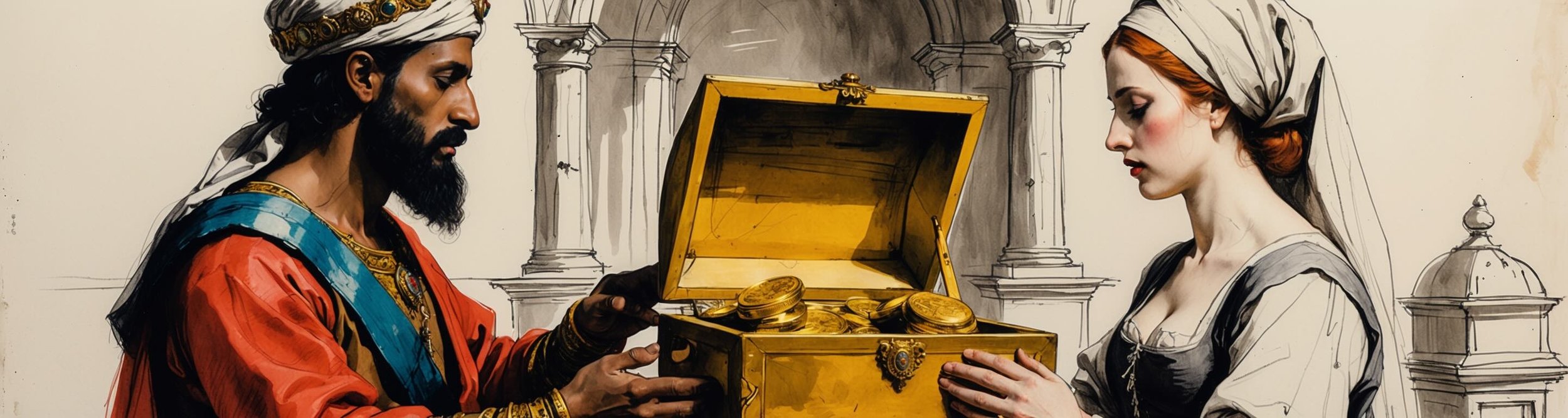
Scene Profile – At a Glance
- Location: A room in Portia's house at Belmont, where the three caskets are displayed.
- What Happens: The Prince of Morocco studies the gold, silver and lead caskets and their inscriptions. Reasoning that a jewel as precious as Portia must lie in gold, he chooses the golden casket – and finds a skull and a scroll telling him "All that glitters is not gold". He departs, having failed.
- Key Characters: The Prince of Morocco (a confident suitor), Portia.
- Dramatic Function: The first of the three casket trials, dramatising Portia's father's test and the play's interest in how surface and substance can come apart.
- Famous Quote:
"All that glitters is not gold;
Often have you heard that told:"
(Morocco, reading, Act 2, Scene 7) - Why It Matters: It launches the casket test as a moral lesson in appearance versus reality, punishing the suitor who trusts the dazzle of gold over the humility of lead.
Scene Summary
At Belmont, Portia has the curtains drawn back to reveal the three caskets – one gold, one silver, one lead – and invites the Prince of Morocco to make his choice. By her dead father's law, the suitor who picks the casket containing her portrait wins her hand; the others must leave at once and never marry.
Morocco reads the three inscriptions carefully. The lead casket warns that the chooser "must give and hazard all he hath", which he rejects as unworthy of so dull a metal. The silver promises "as much as he deserves", and he weighs whether he is worthy of Portia, deciding that he is. But it is the gold – "what many men desire" – that wins him, for surely the whole world desires Portia, and so precious a lady can only be housed in the most precious metal.
He demands the key, unlocks the gold casket, and recoils in horror: inside is a "carrion Death", a skull, holding a scroll. The verses mock his choice – all that glitters is not gold, and many a man has sold his life for mere show. Crushed, Morocco takes a hasty leave. Portia, relieved, hopes that every suitor of his "complexion" will choose as badly, and orders the curtains drawn.
Reading the Caskets
The heart of the scene is Morocco's long deliberation. Shakespeare lets us watch a confident, intelligent man reason his way carefully – and wrongly – through the puzzle. Morocco is no fool; he reads each inscription closely and rejects the lead and silver for plausible reasons. His error is not stupidity but a particular kind of value-judgement: he cannot believe that anything so common as lead could house anything so precious as Portia.
Original
A golden mind stoops not to shows of dross;
I'll then nor give nor hazard aught for lead.
(Morocco, Act 2, Scene 7)
Shakespeare Retold (Modern Verse)
A golden mind won't pick up something worthless;
So I won't give nor risk my all for lead.
This is the thinking that dooms him. Morocco assumes that worth must look like worth – that a "golden mind" naturally reaches for gold and despises base metal as "dross". The casket test is designed precisely to punish that assumption. The lead casket alone asks the chooser to "give and hazard all", to risk everything for love rather than expect a reward equal to his own estimation. Morocco's instinct to match precious to precious is exactly the surface-reading the test is built to expose, and the audience, sensing the trap, watches him walk into it.
The Worship of Gold
Having dismissed lead and weighed silver, Morocco fixes on gold, and his reasoning rises into rapturous praise of Portia. The whole world, he argues, desires her; suitors cross deserts and seas to reach her; so precious a "saint" can only be enshrined in the most precious metal. The speech is genuinely beautiful, which is part of its danger: eloquence in the service of a mistake.
Original
Never so rich a gem
Was set in worse than gold.
(Morocco, Act 2, Scene 7)
Shakespeare Retold (Modern Verse)
A gem like her has never
Been set in less than gold.
Morocco's logic seems unanswerable: a jewel as rich as Portia must be set in gold, never in "worse". Yet the scene turns this confident reasoning into the very proof of his failure. He treats Portia as a precious object to be correctly priced and housed, applying the logic of the marketplace to love, and the test rewards no such calculation. The error connects the scene to the play's interest in wealth and greed: Morocco judges by value and show, and in doing so reveals that he has misread what Portia – and the casket riddle – truly require.
"All That Glitters Is Not Gold"
The casket opens on a skull and a scroll, and the scene's whole argument is delivered in the mocking verses Morocco reads aloud. The "carrion Death" inside the gleaming gold is the bluntest possible image of appearance betraying substance: behind the dazzle lies not Portia but a memento mori, a reminder of death.
Original
All that glitters is not gold;
Often have you heard that told:
Many a man his life hath sold
But my outside to behold:
(Morocco, reading, Act 2, Scene 7)
Shakespeare Retold (Modern Verse)
'All that glitters is not gold;
You've often heard that story told:
Many a man his life has sold
To see my outside made of gold:
The scroll states the play's lesson outright: glittering surfaces deceive, and men ruin themselves chasing show. The proverb has become so familiar that it is easy to forget how exactly it fits Morocco's error – he literally chose the casket for its golden "outside" and found death within. The verses also reach beyond him to the audience, framing the casket test as a parable about judgement: those who choose by appearance, who trust the eye over deeper discernment, are punished. Morocco's dignified, grieving exit makes him more sympathetic than foolish, but the lesson stands clear.
Language and Technique
- Dramatic irony: The audience suspects gold is the wrong choice well before Morocco does, so his confident reasoning builds tension as he heads for the trap.
- Religious imagery: Morocco calls Portia a "saint" and her suitors pilgrims who come "to kiss this shrine", elevating his desire into something like worship.
- The skull (memento mori): The "carrion Death" inside the gold casket is a stark visual emblem, the surface promising riches and the inside delivering death.
- Rhyming scroll: The chiming verses ("gold... told... sold... behold") give the lesson a sing-song, proverbial finality, as if fate itself is rhyming his defeat.
- Inscriptions as riddle: The three mottoes ("desire", "deserve", "give and hazard") work as a moral test, each tempting a different flaw in the chooser.
Key Quotes from Act 2, Scene 7
Quote 1Why, that's the lady; all the world desires her;
From the four corners of the earth they come,
To kiss this shrine, this mortal-breathing saint:
(Morocco, Act 2, Scene 7)
Shakespeare Retold (Modern Verse)
Well, that's the lady; everyone desires her.
They come from every corner of the world
To kiss this precious, living human saint:
O hell! What have we here?
A carrion Death, within whose empty eye
There is a written scroll! I'll read the writing.
(Morocco, Act 2, Scene 7)
Shakespeare Retold (Modern Verse)
Oh hell! What have we here?
A dead man's skull, and in his empty eye,
There is a written note! I'll read the writing.
A gentle riddance. Draw the curtains, go.
Let all of his complexion choose me so.
(Portia, Act 2, Scene 7)
Shakespeare Retold (Modern Verse)
A fond farewell. Now draw the curtains, go.
Let everyone who looks like him choose so.
Key Takeaways
- The first casket trial: Morocco chooses the gold casket and fails, opening the three-part test set by Portia's dead father.
- Appearance versus reality: The scene dramatises the play's central lesson – "all that glitters is not gold" – punishing the man who trusts surface over substance.
- Morocco is reasoned, not foolish: He thinks carefully but wrongly, undone by the assumption that the most precious lady must lie in the most precious metal.
- The skull as emblem: Inside the gleaming gold is a "carrion Death", the bluntest possible image of a deceiving surface.
- Portia's prejudice: Her relieved hope that "all of his complexion" choose so reveals a streak of bigotry, linking Belmont to the intolerance of Venice.
Study Questions and Analysis
Why does Morocco choose the gold casket, and why is he wrong?
Morocco chooses gold through a chain of reasoning that feels logical but rests on a false premise. He rejects the lead casket because he cannot believe so base a metal could house anything precious, and dismisses its demand to "give and hazard all" as unworthy. He weighs the silver, which promises "as much as he deserves", and judges himself deserving of Portia. But it is the gold – "what many men desire" – that wins him, because surely the whole world desires Portia, and so precious a lady can only be set in the most precious metal.
His error is to assume that worth must look like worth. He matches precious to precious, treating Portia as a jewel that belongs in gold. The casket test is designed to punish exactly this surface-reading. Only the lead casket asks the chooser to risk everything for love without expecting a reward equal to his own estimation, and that humility is what the riddle rewards. Morocco's confident, materialist logic – the very thing that makes him eloquent – is what leads him straight to the skull.
Sigmund Freud, in his essay The Theme of the Three Caskets (1913), reads the riddle as one in which the humblest casket is always the right one, and gold as nothing but surface dazzle. On this reading Morocco's failure is structurally inevitable: the man who reaches for the most glittering metal is precisely the man the fable is designed to reject, because the truth it guards lies always in the least showy choice. Freud's account explains why Morocco's intelligence cannot save him – the test is not a puzzle to be out-thought but a moral pattern in which gold, by its very brilliance, is the wrong answer.
What does the casket test reveal about the theme of appearance versus reality?
The casket test is the play's clearest dramatisation of appearance versus reality. Each suitor must look past the surface of the metals to the truth they conceal, and the metals are deliberately misleading: the dazzling gold hides death, while the dull, unpromising lead holds the prize. The scroll spells the lesson out – "all that glitters is not gold" – and Morocco's fate proves it.
What makes the scene rich is that Morocco is not punished for being stupid but for trusting his eyes. He chooses by what looks valuable and what the crowd desires, and finds only a "carrion Death". The test insists that true worth cannot be read off a surface, an idea that echoes across the whole play: in Shylock, who is judged by his outward difference; in Portia, who will disguise herself to reveal a truth the court cannot otherwise see; and in Antonio's wealth, which looks secure but rests on ships that may sink. The caskets turn that recurring concern into a single, vivid stage emblem.
C. L. Barber, in Shakespeare's Festive Comedy (1959), treats the casket choice as a kind of moral fable woven into the comedy, a ritual ordeal that sorts suitors by their inner disposition rather than their cleverness. On this view the test is less a riddle than a parable: it rewards the giving, self-hazarding spirit that the festive world prizes and exposes the calculating one. Barber's reading helps explain why the scene feels patterned and almost ceremonial – Morocco is not merely guessing wrong but enacting a fault the fable exists to dramatise, so that his defeat carries the satisfying inevitability of a story teaching its lesson.
How sympathetic a figure is the Prince of Morocco?
Morocco is treated with more dignity than his failure might suggest. He reasons intelligently, speaks with real grandeur, and his praise of Portia, though mistaken in its logic, is genuinely beautiful. When he loses, he does not rage but grieves and departs with quiet self-possession: "thus losers part". Shakespeare gives him enough nobility that his defeat feels touching rather than ridiculous.
At the same time, the scene is shadowed by the prejudice around him. In his opening appearance Morocco is conscious of being judged by his "complexion", and Portia's closing wish that "all of his complexion" should fail so seals the discomfort. Many readers find that the play uses Morocco both as a genuine character and as a casualty of the casual racism of his world. He chooses wrongly, but the relief with which Belmont waves him off says something unflattering about the society judging him, not only about the suitor himself.
What is the significance of the skull and the scroll inside the gold casket?
The "carrion Death" – a skull – is a memento mori, a traditional emblem reminding the viewer that all earthly riches end in death. Placing it inside the gold casket gives the scene its sharpest irony: the metal that promises the greatest reward delivers the image of mortality and decay. Morocco chose by the golden surface, and the surface turns out to be a death's head.
Gilded tombs do worms enfold.
Had you been as wise as bold,
Young in limbs, in judgment old,...
(Morocco, reading, Act 2, Scene 7)
Shakespeare Retold (Modern Verse)
But gold tombs only worms enfold.
If you'd have been as wise as bold,
With youthful body, judgment old,...
The scroll's verses turn the lesson into a chiming, almost taunting rhyme. "Gilded tombs do worms enfold" makes the point with grim economy: gold may cover a grave as easily as a treasure. The wish that Morocco had been "young in limbs, in judgment old" diagnoses his failing precisely – he had boldness and vigour but not the seasoned discernment to see past the glitter. The skull and scroll together transform the casket test from a fairy-tale guessing game into a moral parable about the cost of choosing by appearances.
How does the gold casket connect to the play's treatment of wealth?
The casket scenes sit at the heart of the play's argument about wealth and greed. Morocco's mistake is essentially to apply the logic of the marketplace to love: he prices Portia as the richest prize and reasons that the richest prize must be housed in the richest metal. He treats her as a "gem" to be correctly valued, and the test rejects that whole way of thinking.
This matters because the play is everywhere concerned with how money distorts judgement. Bassanio needs Antonio's loan to win Portia; Shylock's love of ducats is set against his love of his daughter; Jessica funds her elopement with stolen gold. Against all this, the lead casket quietly insists on a different value – the willingness to "give and hazard all" rather than to calculate a return. Morocco, dazzled by gold, fails to grasp it. His defeat suggests that the truest worth, in love as elsewhere, is precisely what cannot be measured in the glitter of metal.
Why does Shakespeare place this scene between the elopement and Shylock's grief?
The scene's placement is a deliberate piece of contrast and pacing. It comes immediately after Jessica's night-time elopement in Venice and just before the report of Shylock's anguish in the streets. By cutting from the dark, theft-shadowed romance of Venice to the bright, formal ritual of Belmont, Shakespeare sets his two worlds side by side – the harsh commercial city and the fairy-tale estate where love is decided by a casket riddle.
The juxtaposition also lets the casket plot breathe without losing the thread of the main story. While the audience waits to learn how Shylock will react to losing his daughter, the Belmont scenes keep the romance moving and develop the appearance-versus-reality theme that runs through the whole play. Structurally, the alternation between Venice and Belmont keeps both plots alive and lets each comment on the other: Morocco's failure to see past gold quietly rhymes with a world in Venice where gold, ships and bonds drive everything, and where surfaces, as Shylock will discover, deceive.