The Merchant of Venice: Act 2, Scene 8 – Analysis
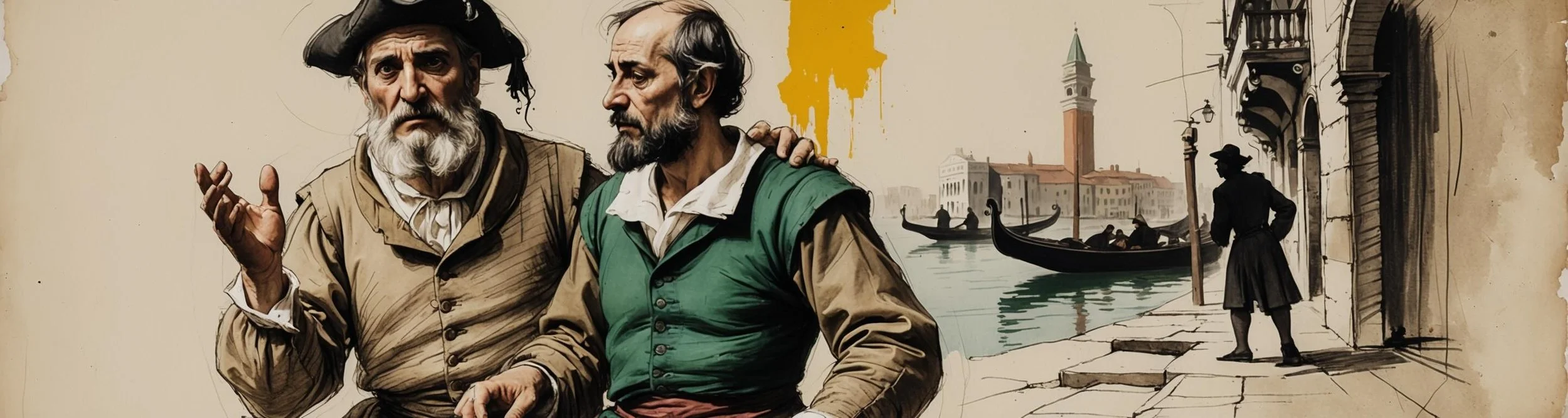
Scene Profile – At a Glance
- Location: A street in Venice, the morning after Jessica's elopement.
- What Happens: Salarino and Salanio describe Shylock's frantic grief at losing his daughter and his ducats, mocked through the streets by Venice's boys. They recall the tender parting of Antonio and Bassanio, and worry about a report of a wrecked ship that might be Antonio's – with the bond now hanging over him.
- Key Characters: Salarino and Salanio (Venetian gossips), with Shylock, Antonio and Bassanio reported but not present.
- Dramatic Function: A reporting scene that conveys Shylock's offstage anguish, deepens our sense of Antonio's devotion, and sows the first dread that Antonio's ships may fail.
- Famous Quote:
"My daughter! O my ducats! O my daughter!
Fled with a Christian! O my Christian ducats!"
(Shylock, reported by Salanio, Act 2, Scene 8) - Why It Matters: It shapes how we judge Shylock – as either a grieving father or a miser counting coins – and quietly tightens the noose of the bond around Antonio.
Scene Summary
On a Venice street the morning after the elopement, Salarino and Salanio compare news. Bassanio has sailed, Gratiano with him, but Lorenzo was not aboard. Shylock, they report, roused the Duke himself to search Bassanio's ship, only to find it already gone; the Duke then learned that Lorenzo and Jessica had been seen together in a gondola.
Salanio recounts Shylock's wild outcry through the streets – a confused passion crying for his daughter and his ducats at once – with the boys of Venice trailing him in mockery. The two then turn to Antonio, warning that he had better repay his debt on time or he will suffer for it. Salarino mentions a French rumour of a richly laden ship wrecked in the Channel, and silently fears it may be Antonio's. He describes the loving parting of Antonio and Bassanio, and the two friends resolve to go and cheer Antonio up.
"My Daughter! O My Ducats!"
The scene's most famous moment is not staged but reported: Salanio mimics Shylock's frantic run through Venice, his grief and his greed tangled hopelessly together. We never see Shylock here; we see him through the mocking eyes of his enemies, which makes the report as much a portrait of Venetian cruelty as of Shylock's pain.
Original
My daughter! O my ducats! O my daughter!
Fled with a Christian! O my Christian ducats!
Justice! The law! My ducats, and my daughter!
(Shylock, reported by Salanio, Act 2, Scene 8)
Shakespeare Retold (Modern Verse)
'My daughter! Oh, my gold coins! Oh, my daughter!
Fled with a Christian! Oh, my Christian gold coins!
I must have justice! My gold coins, and daughter!
The lines are deliberately double-edged, and how we read them shapes our whole view of Shylock. Heard one way, they are comic and damning: a miser who muddles his child with his cash, equally distressed by both, crying "ducats" in the same breath as "daughter". Heard another, they are the broken speech of a man whose entire world – family, faith and fortune – has been torn away in a single night, his grief too raw to come out in any order. Crucially, we hear them only at second hand, sneered by Salanio and laughed at by the Venice boys. The mockery invites us to despise Shylock, but a thoughtful audience may feel the pull of pity underneath the ridicule.
The Shadow Over Antonio
From Shylock's grief the talk slides towards Antonio, and the tone darkens. Salarino reports a French rumour of a wrecked ship and confesses he thought at once of Antonio. He then recalls the parting of the two friends, painting Antonio as a man whose love for Bassanio is so complete that he seems to live only for him.
Original
And even there, his eye being big with tears,
Turning his face, he put his hand behind him,
And with affection wondrous sensible
He wrung Bassanio's hand; and so they parted.
(Salarino, Act 2, Scene 8)
Shakespeare Retold (Modern Verse)
And even then, his eyes welling with tears,
He turned away, and put his hand behind him,
And with a quite remarkable affection,
He shook Bassanio's hand. That's how they parted.
The detail is tender and a little melancholy. Antonio hides his tears and turns away, gripping Bassanio's hand "with affection wondrous sensible" – remarkably deep feeling. Salanio's verdict, that Antonio "only loves the world for him", crystallises the play's central friendship, and the depth of that love is exactly what makes the bond so dangerous: Antonio has pledged his own flesh out of devotion to a friend now sailing away from him. The scene's structure is pointed – Shylock's loss of a child is followed at once by a portrait of Antonio's love – setting the wounded father and the loving merchant on a collision course we can already feel coming.
Language and Technique
- Reported action: Shylock's grief and the friends' parting both reach us second-hand, filtered through the speakers – we see Shylock only as his enemies choose to show him.
- Juxtaposition of daughter and ducats: The famous outcry pairs "daughter" and "ducats" again and again, fusing grief and greed in a way that can read as comic or as agonised.
- Dramatic irony and foreshadowing: The casual rumour of a wrecked ship plants the dread of Antonio's ruin long before it is confirmed.
- Mob mockery: The boys of Venice trailing Shylock turn his private grief into public spectacle, exposing the cruelty of the Christian crowd.
Key Quotes from Act 2, Scene 8
Quote 1Why, all the boys in Venice follow him,
Crying, his stones, his daughter, and his ducats.
(Salarino, Act 2, Scene 8)
Shakespeare Retold (Modern Verse)
Why, everyone in Venice followed him,
Crying, 'His gems, his daughter, and his gold coins!'
Let good Antonio look he keep his day,
Or he shall pay for this.
(Salanio, Act 2, Scene 8)
Shakespeare Retold (Modern Verse)
Let's make sure good Antonio pays his debt,
Else he will pay for this.
Key Takeaways
- Shylock's grief is reported, not shown: We hear his frantic "daughter and ducats" outcry only through his mocking enemies, which colours how we judge him.
- Grief or greed: The famous outcry can be read as a miser muddling child and cash, or as a broken man whose whole world has collapsed at once.
- Venetian cruelty exposed: The boys jeering at Shylock in the streets reveal the casual prejudice of Christian Venice.
- Antonio's devotion: The tender parting from Bassanio shows a man who "only loves the world for him", deepening the friendship at the play's heart.
- The bond darkens: A rumour of a wrecked ship and a warning that Antonio must "keep his day" plant the dread of his ruin.
Study Questions and Analysis
Why does Shakespeare report Shylock's grief rather than show it on stage?
The choice to report Shylock's anguish, rather than stage it directly, has a powerful effect on how we receive it. We do not watch Shylock weep; we hear Salanio impersonate him, sneering at the way he cried for his daughter and his ducats in the same breath, with the boys of Venice trailing behind in mockery. The grief reaches us already framed as a joke, filtered through enemies who find his pain funny.
This filtering is the point. By denying us direct access to Shylock, Shakespeare makes us aware of how his society sees him – as a ridiculous outsider rather than a suffering human being. A more sentimental playwright might have given Shylock a moving soliloquy of loss; instead we get his pain at second hand, sneered and chanted. The technique keeps Shylock partly comic and partly pitiable at once, and forces the audience to decide for themselves whether to laugh with the Venetians or to feel the grief their mockery is trying to drown out.
Is Shylock's outcry about his daughter or his money?
This is the question the scene is built to provoke, and it has divided audiences for centuries. The outcry – "My daughter! O my ducats! O my daughter!" – deliberately yokes the two losses together, and the reading we choose shapes our whole sense of Shylock. Taken as comedy, the line damns him: a miser so warped that he cannot tell his child from his coins, mourning both equally and perhaps the money more.
Taken seriously, the same words become the broken speech of a man in shock. Everything he had – his daughter, his wealth, his faith, his standing – has been stripped from him in a single night, and his grief tumbles out in no coherent order, daughter and ducats jumbled because his whole world has been jumbled. The play does not settle the question, and the fact that we hear the words only as his enemies mimic them makes it harder still to be sure. That uncertainty is exactly what makes Shylock one of Shakespeare's most debated figures: the scene gives us both a stock comic miser and a wounded father, and refuses to tell us which is the real man.
John Gross, in Shylock: A Legend and Its Legacy (1992), traces how this very moment – the daughter-and-ducats caricature – has been received and performed across four centuries. Gross shows that the line has been played both ways many times over: as broad anti-Jewish farce, the grasping miser of stage tradition, and, especially since the nineteenth century, as the cry of a genuinely broken man. His history makes clear that the ambiguity is not a modern invention but something the report itself licenses, and that how a given age chooses to stage these words tends to reveal as much about that age's attitudes to Shylock as about the character on the page.
How does the scene present the friendship between Antonio and Bassanio?
The scene gives us one of the play's most intimate glimpses of love and friendship. Salarino describes the parting of the two men in tender, almost tearful detail: Antonio, eyes "big with tears", turns his face away to hide his feeling and grips Bassanio's hand "with affection wondrous sensible". Salanio sums it up by saying Antonio "only loves the world for him" – that Bassanio is the reason Antonio cares about life at all.
The depth of this devotion is dramatically vital. Antonio has pledged a pound of his own flesh to Shylock purely so that Bassanio could afford to woo Portia, and this scene makes the emotional logic of that reckless act vivid. His love is so complete that he will risk his body for his friend's happiness. Readers have long debated the exact nature of Antonio's feeling – whether it is friendship, fatherly affection, or something more – but the scene leaves no doubt about its intensity. That intensity is what gives the bond plot its emotional weight: the danger Antonio faces is the direct cost of how much he loves.
How does the scene build suspense about Antonio's fate?
The scene plants the first real seeds of dread about Antonio's ships. Salarino mentions, almost in passing, a Frenchman's report of a richly laden ship wrecked in the narrow seas between France and England, and admits that he "thought upon Antonio" and "wished in silence that it were not his". Nothing is confirmed, but the rumour hangs in the air, and the audience, who know Antonio's whole fortune is at sea, feels the threat sharpen.
Shakespeare layers this against Salanio's earlier warning that Antonio must "keep his day" or "pay for this". Together the two moments fuse the scene's strands into a single rising tension: Shylock has just been robbed and humiliated by Christians, and if a Christian merchant should default on his bond, the wounded moneylender will have both motive and legal right to demand his pound of flesh. The wrecked-ship rumour is the trigger that makes that nightmare suddenly plausible. By the scene's end, the comic report of Shylock's grief has darkened into genuine foreboding for Antonio's life.
Walter Cohen, in his essay The Merchant of Venice and the Possibilities of Historical Criticism (1982), reads the play through its economic anxieties, setting the trading merchant against the lending usurer and tracking how money pervades every relationship in Venice. The scene bears that reading out: a wrecked cargo and an unpaid bond are not background detail but the very machinery that turns a private grief into a threat of bloodshed. Cohen's emphasis on the world of commerce helps explain why the suspense here feels so material – Antonio's life hangs on the fate of ships and the calendar of a debt, the romance of the merchant world shadowed at every turn by the hard arithmetic that funds it.