The Merchant of Venice: Act 2, Scene 9 – Analysis
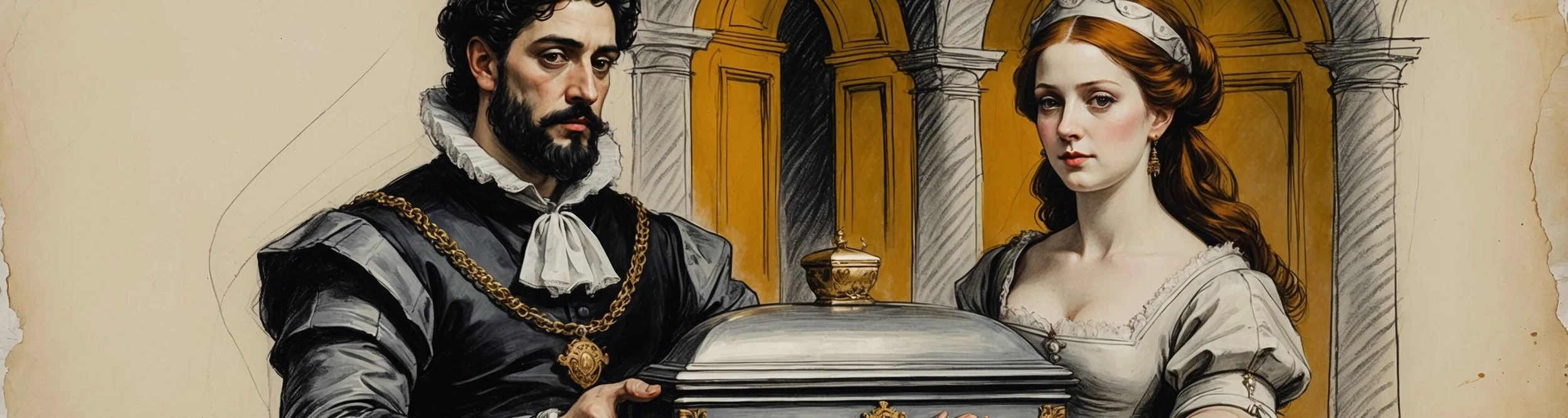
Scene Profile – At a Glance
- Location: A room in Portia's house at Belmont, where the three caskets are displayed.
- What Happens: The Prince of Arragon takes the casket test. Scorning the gold "many men desire" and the crowd's poor judgement, he reasons that he deserves Portia and chooses the silver casket, which promises "as much as he deserves". Inside he finds a portrait of a fool. As he leaves, a messenger announces the arrival of a promising young Venetian – Bassanio.
- Key Characters: The Prince of Arragon (a proud suitor), Portia, Nerissa.
- Dramatic Function: The second casket trial, contrasting Arragon's arrogant self-regard with Morocco's dazzled greed, and clearing the way for Bassanio's arrival.
- Famous Quote:
"O, these deliberate fools! When they do choose,
They have the wisdom by their wit to lose."
(Portia, Act 2, Scene 9) - Why It Matters: It completes the lesson of the caskets – pride fails as surely as greed – and ushers in Bassanio, the suitor Portia actually wants.
Scene Summary
At Belmont, Nerissa hurries to draw back the curtain: the Prince of Arragon has sworn the casket oath and is ready to choose. Portia reminds him of the terms – choose her portrait and win her hand, fail and leave at once, never to woo another woman.
Arragon studies the three caskets. He rejects the lead with a sneer, unwilling to risk all for so base a metal. He scorns the gold too: "what many men desire" must mean the choice of the foolish "multitude" who judge only by appearance, and he refuses to rank himself with them. The silver tempts him, for it promises "as much as he deserves", and Arragon is sure he deserves much. He chooses silver, only to find inside the portrait of a "blinking idiot" and a mocking scroll. He leaves in bitter dignity, carrying away, as he puts it, two fools' heads instead of one.
Portia mocks the "deliberate fools" who outwit themselves, and Nerissa quotes the old saying that marriage is governed by destiny. A messenger then arrives to announce a young Venetian come ahead of his lord, bearing rich gifts and the loveliest manners the servant has ever seen. Portia is wary of his extravagant praise, but Nerissa voices the hope in both their hearts: that the approaching lord may be Bassanio.
The Pride That Scorns the Crowd
Where Morocco was dazzled by gold, Arragon is undone by self-regard. His whole approach to the caskets is governed by a wish to set himself above the common herd. He rejects the gold not because he sees through it but because he despises the "multitude" who would choose it, refusing to share their taste.
Original
I will not choose what many men desire,
Because I will not jump with common spirits
And rank me with the barbarous multitudes.
(Arragon, Act 2, Scene 9)
Shakespeare Retold (Modern Verse)
I won't select like most men tend to do,
Because I don't agree with common folk,
Belittling myself with uncouth people.
Arragon's contempt for the "barbarous multitudes" is the key to his character and his failure. He is not really thinking about Portia at all; he is thinking about his own superiority. His reasoning is snobbish rather than wise: he avoids gold to avoid being common, not because he has seen through its false promise. The casket test exposes this self-absorption. A suitor so busy distinguishing himself from the crowd has no humility left to "give and hazard all", and his pride steers him straight towards the casket that flatters his sense of his own merit.
"As Much As He Deserves"
The silver casket's promise – "as much as he deserves" – is irresistible to a man as sure of his own worth as Arragon. He launches into a grand speech about merit, wishing that honours and offices went only to those who truly earned them, never guessing that the test is about to measure his own deserving and find it wanting.
Original
O, that estates, degrees and offices
Were not derived corruptly, and that clear honour
Were purchased by the merit of the wearer!
(Arragon, Act 2, Scene 9)
Shakespeare Retold (Modern Verse)
If only land, credentials and employment
Were not achieved corruptly, and the honour
Were won by merit by the one who won them!
There is real substance to Arragon's complaint – the wish that honour went by merit rather than corruption is a noble one, and the speech briefly sounds like sober wisdom. But it is undercut by the man delivering it. Arragon condemns those who "cover" honours they have not earned while assuming, without a flicker of doubt, that he himself fully deserves Portia. He claims merit as his birthright, the very presumption the silver casket is designed to punish. His thoughtful-sounding meditation is in fact one long act of self-flattery, and the "blinking idiot" inside the casket is its perfect answer.
The Fool's Head
Arragon opens the silver and finds not Portia but a "blinking idiot" – a portrait of a fool – staring back at him. The image is cruelly exact: the man who was so sure of his own worth is shown the face of folly, and the scroll drives the lesson home with a taunting rhyme.
Original
With one fool's head I came to woo,
But I go away with two.
(Arragon, Act 2, Scene 9)
Shakespeare Retold (Modern Verse)
I came with one fool's head to woo,
But, with this painting, I've got two.
The grim joke lands neatly. Arragon arrived with one fool's head – his own – and leaves with two, taking the painted idiot away as proof of his misjudgement. Unlike Morocco, who grieved with dignity, Arragon's exit is sourer, his self-image punctured rather than merely disappointed. The casket has given him exactly what he asked for: "as much as he deserves" turns out to be the portrait of a fool. The test has measured his self-estimation against the truth and found a yawning gap, and the wit of the riddle is that Arragon's own logic convicted him.
Language and Technique
- Contrast with Morocco: Arragon's pride is set against Morocco's greed, so the two failed suitors define each other – one dazzled by gold, one blinded by self-regard.
- Irony of the speech on merit: Arragon's fine words about deserving honour are undercut by his blind assumption that he deserves Portia, turning wisdom into self-flattery.
- The fool's portrait: The "blinking idiot" is a stark visual punchline – the proud prince literally shown the face of folly.
- Mocking rhyme: The scroll's chiming couplets ("woo... two", "bed... head") give Arragon's defeat a jeering, sing-song finality.
- Structural hinge: The messenger's arrival at the close pivots the play towards Bassanio, the suitor we have been waiting for.
Key Quotes from Act 2, Scene 9
Quote 1Who shall go about
To cozen fortune and be honourable
Without the stamp of merit?
(Arragon, Act 2, Scene 9)
Shakespeare Retold (Modern Verse)
Who is able to
Deceive their luck, remaining honourable
Unless they do deserve it?
O, these deliberate fools! When they do choose,
They have the wisdom by their wit to lose.
(Portia, Act 2, Scene 9)
Shakespeare Retold (Modern Verse)
These overthinking fools! When they do choose,
They're smart, but common sense they seem to lose.
Come, come, Nerissa; for I long to see
Quick Cupid's post that comes so mannerly.
(Portia, Act 2, Scene 9)
Shakespeare Retold (Modern Verse)
Let's go Nerissa. I can't wait to see
This lovely man that Cupid's sent to me.
Key Takeaways
- The second casket trial: Arragon chooses the silver casket and fails, finding the portrait of a fool where he expected Portia.
- Pride, not greed: Where Morocco was dazzled by gold, Arragon is undone by arrogance, sure he deserves "as much as he deserves".
- Wisdom turned to self-flattery: His fine speech on merit is hollowed out by his blind assumption that he himself deserves the prize.
- The fool's head: The "blinking idiot" inside the silver is a cruelly exact answer to a man so certain of his own worth.
- Bassanio approaches: The scene ends by ushering in a promising young Venetian, pivoting the play towards the suitor Portia truly wants.
Study Questions and Analysis
How does Arragon's failure differ from Morocco's?
The two failed suitors are carefully contrasted, each undone by a different vice. Morocco fails through a kind of dazzled materialism: he reasons that the most precious lady must lie in the most precious metal, and chooses gold because it looks the part. His error is to trust appearances and the world's desires – he picks "what many men desire".
Arragon fails through pride. He scorns the gold precisely because the crowd would choose it, refusing to "rank himself with the barbarous multitudes", and selects the silver because it promises "as much as he deserves" – and he is certain he deserves a great deal. Where Morocco is blinded by the glitter of gold, Arragon is blinded by his own self-image. Together they map out two ways of misreading the test: valuing surface, and overvaluing oneself. Both leave humility out of the reckoning, and only the lead casket, which asks the chooser to "give and hazard all", rewards that. The pairing lets Shakespeare show that the casket riddle is not really about cleverness at all, but about the spirit in which a person chooses.
Why is the portrait of a fool the right punishment for Arragon?
The "blinking idiot" inside the silver casket is a perfectly judged answer to Arragon's particular failing. He chose the casket that promised him "as much as he deserves", confident that his deserving was great. The portrait of a fool tells him exactly what he deserves, in the test's eyes: it holds a mirror up to his self-regard and shows him folly instead of merit.
What's here? The portrait of a blinking idiot,
Presenting me a schedule! I will read it.
How much unlike art thou to Portia!
(Arragon, Act 2, Scene 9)
Shakespeare Retold (Modern Verse)
What's this? A portrait of a silly fool
Who's handing me a note! Here, let me read it.
You look completely different to Portia!
The punishment fits because it is self-inflicted. Arragon's whole reasoning was an exercise in measuring his own worth, and the casket simply gives him the verdict he asked for. The scroll's mockery – that he came to woo with one fool's head and leaves with two – turns his pride into the joke. It is a more humiliating defeat than Morocco's, because Morocco at least misjudged the metal, while Arragon misjudged himself. The fool's head is the test's way of saying that the man most sure he is no fool is exactly the fool the riddle was waiting for.
Sigmund Freud, in his essay The Theme of the Three Caskets (1913), reads silver as the metal of self-regard and the humblest casket as the only right one, so that anything chosen for what it flatters in the chooser must betray him. Arragon fits the pattern exactly: drawn to the silver because it promises him his deserts, he is choosing a mirror of his own vanity, and the fool's head is what that mirror honestly returns. Freud's account clarifies why the silver casket is the natural trap for pride – it answers self-love with self-knowledge, giving the proud man not the prize but the portrait of his folly.
What does the casket test as a whole suggest about choosing well?
Taken with Morocco's scene, Arragon's failure completes a clear pattern. The gold casket tempts those who value show and what the world desires; the silver tempts those who overvalue themselves; only the lead, which demands that the chooser "give and hazard all", rewards the right spirit. The lesson is that choosing well is not a matter of cleverness but of humility and self-giving – a readiness to risk everything for love without calculating a return.
This connects the casket plot to the play's deeper values. The suitors who fail both treat winning Portia as a transaction: Morocco prices her, Arragon claims her as his due. The test rejects that whole commercial way of thinking, which links it to the play's running concern with wealth and greed. When Bassanio later chooses the lead, he succeeds precisely because he embraces risk and self-surrender rather than calculation. The two failed suitors exist to define, by contrast, the kind of love the casket test is built to find – and the kind it is built to reject.
C. L. Barber, in Shakespeare's Festive Comedy (1959), reads the casket choice as a moral fable folded into the comedy, an ordeal that measures the spirit in which a suitor comes rather than his cleverness. On that view the three caskets form a single parable about giving rather than getting: the festive world rewards the chooser who will hazard all and exposes the one who calculates his return. Barber's reading explains why the pattern of failure feels designed rather than accidental – Morocco and Arragon are not unlucky but instructive, each enacting precisely the grasping or self-serving disposition the fable exists to rule out, so that the test as a whole teaches what loving well requires.
How does the scene present Portia and Nerissa?
The scene gives Portia and Nerissa some of their sharpest, most companionable moments before the main action engulfs them. Portia watches the failed suitor with cool, witty detachment, dismissing Arragon and Morocco alike as "deliberate fools" who reason their way to ruin. There is real intelligence and a touch of impatience in her – she is bound by her dead father's will to marry whoever solves the riddle, and her dry mockery is the response of a clever woman with little control over her own fate.
Nerissa, her waiting-woman and confidante, supplies the warmer note, quoting the old saying that "hanging and wiving goes by destiny" – that marriage, like death, is decided by fate. The easy back-and-forth between them establishes a partnership that will matter later, when both women disguise themselves to intervene in Venice. Here, though, the scene's purpose is gentler: to show Portia's wit, to voice the women's shared hope that the next suitor will be Bassanio, and to remind us that beneath the formal ritual of the caskets, Portia has feelings and preferences of her own.
Why does the scene end with the arrival of a messenger?
The messenger's arrival is a piece of expert dramatic timing. Just as the casket test has eliminated its second wrong suitor, a servant enters to announce a young Venetian who has ridden ahead of his lord, bearing rich gifts and the finest manners he has ever seen. He praises the newcomer so extravagantly that Portia teases him for it, but the message does its work: it points unmistakably towards Bassanio.
Structurally, this turns the scene's ending into a hinge. The procession of unwanted suitors is over, and the play now pivots towards the man Portia actually wants and the one the audience has been waiting for. The messenger's glowing description – comparing the newcomer to a sweet day in April heralding summer – lifts the mood from the cold ritual of failure into genuine anticipation. By closing on Nerissa's prayer that the approaching lord be Bassanio, Shakespeare leaves us poised on the edge of the scene that will decide Portia's marriage and set the rest of the plot in motion.