The Tempest: Epilogue – Analysis
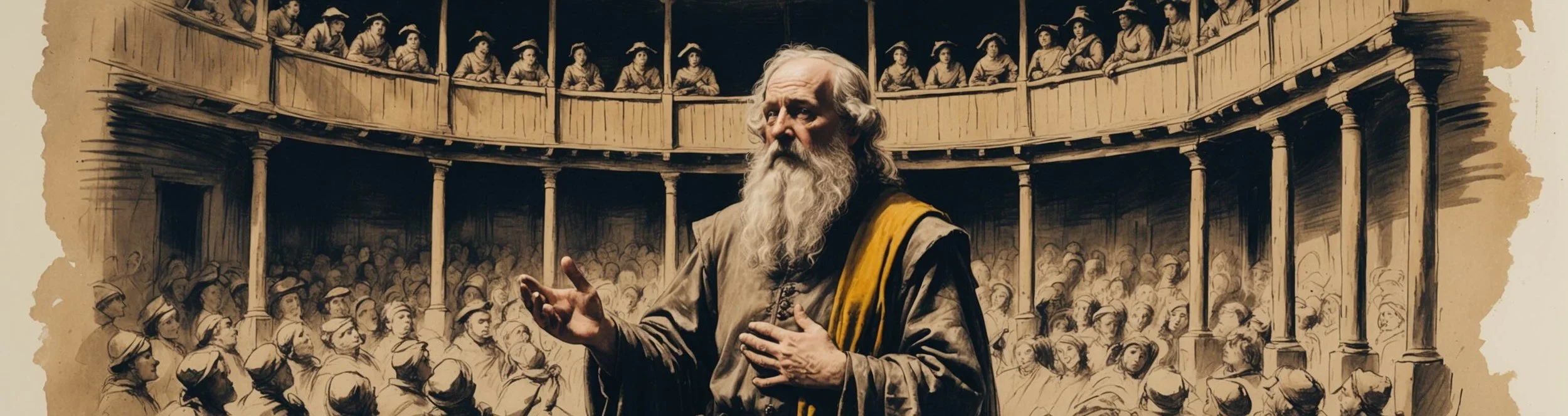
Scene Profile – At a Glance
- Location: The bare stage, after the play has ended; Prospero alone, without his magic.
- What Happens: Prospero steps forward to tell the audience that his charms are gone and his strength is his own. Unless their applause releases him he must stay on the island; he asks for their indulgence as they would ask for pardon themselves.
- Key Characters: Prospero, speaking to the audience.
- Dramatic Function: The play’s last reversal: the magician who held everyone captive hands his release to the spectators, and the theatre’s convention of applause becomes the plot’s final act.
- Famous Quote:
"As you from crimes would pardoned be,
Let your indulgence set me free."
(Prospero, Epilogue) - Why It Matters: Twenty lines of rhymed tetrameter that turn the whole play inside out, and the source of the four-hundred-year-old idea that Prospero’s farewell is Shakespeare’s.
Scene Summary
The play is over. Prospero comes forward alone and speaks to the audience in his own voice. His charms are all overthrown, and the strength he has left is his own, which is very little. Now, he says, it is true that he must be confined here by the audience, or sent to Naples. Since he has his dukedom back and has pardoned the man who deceived him, they should not leave him to dwell on this bare island by their spell; they should release him from his bonds with the help of their good hands.
Their gentle breath must fill his sails, or his project fails, and the project was to please. He now lacks spirits to enforce his will and art to enchant, and his ending will be despair unless prayer relieves him – prayer that pierces so far that it assaults mercy itself and frees all faults. As they would wish to be pardoned for their own crimes, he asks, let their indulgence set him free.
The Prisoner Changes Places
For three hours Prospero has held everyone on the island by his spell. The Epilogue’s first move is to reverse the arrangement, and it does so in eight lines.
Original
Now my charms are all o'erthrown,
And what strength I have's mine own,
Which is most faint: now, 'tis true,
I must be here confined by you,
Or sent to Naples. Let me not,
Since I have my dukedom got
And pardoned the deceiver, dwell
In this bare island by your spell...
(Prospero, Epilogue)
Shakespeare Retold (Modern Verse)
My magic powers are on the shelf,
And all my strength I make myself,
And I’m not strong. So now it’s true,
I must be locked up here by you,
Or sent to Naples. Let me not –
For since I have my dukedom got
And forgave all my foes – remain
By magic in this sparse domain...
The charms are gone; the strength that remains is faint and his own; and the man who confined a king in a lime grove is now the one confined, by the audience’s spell, on a bare island. The reversal is exact and the vocabulary is the play’s: bands, release, spell, confined are the words that have been used of Ariel, of Caliban, of the courtiers, and they are now used of Prospero by Prospero. The argument about imprisonment and freedom that began with Ariel’s my liberty in Act 1 ends with the master asking for his. The speech also names, in passing, the two things the play has just done, the dukedom got and the deceiver pardoned, so that the request for release rests on the play’s own ending: a man who has forgiven should not be left in prison. The rhymed tetrameter, shorter than the blank verse of the play, is the sound of a man speaking without his art.
The Project Was to Please
The second half of the speech makes the request explicit and gives it a theology. What Prospero asks for is applause, and what he calls it is mercy.
Original
Gentle breath of yours my sails
Must fill, or else my project fails,
Which was to please.
(Prospero, Epilogue)
Shakespeare Retold (Modern Verse)
Blow gentle winds upon my sails
To fill them, else my project fails,
Which was to please you.
Gentle breath is applause, and it must fill his sails or the project fails. The project, he says, was to please, which is a strange thing for Prospero to say of a plot to recover his dukedom and a stranger thing for a play to say of itself, and the doubleness is the point. Without spirits to enforce or art to enchant, the magician is an actor, and an actor’s ending is despair unless the audience relieves him. The last six lines turn applause into prayer and prayer into pardon: as the spectators would want to be forgiven their own crimes, they should let their indulgence set him free. The word indulgence carries its religious sense, a remission of punishment, and the couplet asks the audience to do for Prospero what Prospero has just done for Antonio. It is the play’s argument about revenge and forgiveness handed to the people who have been watching it, and the theatre’s convention of clapping at the end becomes the last act of the plot. Whether it is also Shakespeare’s own farewell is a question the speech invites; what it certainly is, is a magician giving up the last thing he has, the power to end his own play.
Language and Technique
- Rhymed tetrameter: Four-beat rhyming couplets replace the play’s blank verse: a plainer, smaller music for a man who has given up his art.
- The play’s vocabulary reversed: Confined, spell, bands, release, free: the words used of Prospero’s prisoners are now used by Prospero of himself.
- Applause as breath: “Gentle breath of yours my sails / Must fill” – clapping becomes the wind that will carry the ship to Naples, so the audience is asked to finish the voyage.
- Prayer and pardon: The last six lines move from despair to prayer to mercy to indulgence, a religious sequence that turns a curtain call into an absolution.
- Direct address: Prospero speaks to the audience as an audience, the only time in the play the fiction admits that it is one.
Key Quotes from the Epilogue
Quote 1
Now my charms are all o'erthrown,
And what strength I have's mine own,
Which is most faint...
(Prospero, Epilogue)
Shakespeare Retold (Modern Verse)
My magic powers are on the shelf,
And all my strength I make myself,
And I’m not strong.
Quote Analysis: The first three lines say what the play has just shown: the magic is gone and what is left is a man. The modern verse keeps the admission of weakness. Prospero has said nothing like it in five acts, and he says it in the first breath of the Epilogue.
And my ending is despair,
Unless I be relieved by prayer,
Which pierces so that it assaults
Mercy itself and frees all faults.
(Prospero, Epilogue)
Shakespeare Retold (Modern Verse)
And so I’ll end up in despair,
Unless I am helped out by prayer,
Which you receive when I pray strong
And pardon all that I’ve done wrong.
Quote Analysis: The turn from the theatre to the church. Despair unless prayer relieves him, and prayer that assaults mercy itself: the modern verse keeps the strength of the verb. Prospero has just told Alonso not to burden the moment with a heaviness that is gone, and here he takes the heaviness on himself.
Key Takeaways
- The captor asks to be released: The Epilogue reverses the play: the man who held everyone by his spell is now held by the audience’s, and asks for freedom in the words his prisoners used.
- Applause is the plot’s last act: The clapping that ends any play is written into this one as the breath that fills Prospero’s sails and the mercy that pardons him.
- Forgiveness passed to the audience: As you would be pardoned, pardon me: the spectators are asked to do for Prospero what Prospero did for Antonio.
- A smaller music: The rhymed tetrameter, after five acts of blank verse, is the sound of a magician without his art.
Study Questions and Analysis
What is Prospero asking for in the Epilogue?
Applause, and something more than applause. He tells the audience that his charms are gone, that he has only his own faint strength, and that unless they release him he must stay confined on the island by their spell. The release he asks for is the help of their good hands, the gentle breath that will fill his sails and carry him to Naples; the convention of clapping at the end of a play is written into the play as the last thing that has to happen for its story to finish.
But release me from my bands
With the help of your good hands:
Gentle breath of yours my sails
Must fill, or else my project fails...
(Prospero, Epilogue)
Shakespeare Retold (Modern Verse)
But free me from the ties that be
And with your help, grant liberty.
Blow gentle winds upon my sails
To fill them, else my project fails...
The last six lines ask for more. Without spirits to enforce or art to enchant, his ending is despair unless prayer relieves him, and the prayer he describes assaults mercy itself and frees all faults; so, as the audience would wish to be pardoned their own crimes, they should let their indulgence set him free. Indulgence is a word with a religious history, a remission of punishment granted by the church, and the couplet asks the spectators to grant it. The request completes the play’s argument about revenge and forgiveness. Prospero forgave Antonio without being asked; now he asks, and the audience decides. Every performance of the play ends with the audience saying yes.
Is the Epilogue Shakespeare’s farewell to the theatre?
It has been read that way since the nineteenth century, and the reading has obvious attractions. The Tempest is probably the last play Shakespeare wrote alone; its hero is an artist who stages illusions for an audience, gives up his art, and asks to be released; and the Epilogue’s speaker is a man without spirits or charms, which is what a playwright is when the play is over. Put the facts together and Prospero’s farewell to magic becomes Shakespeare’s farewell to the stage, with the great globe of Act 4 as the Globe theatre.
The play does not confirm it, and the facts are less tidy than the reading. Shakespeare went on to collaborate on Henry VIII, The Two Noble Kinsmen and the lost Cardenio, and there is no evidence that he thought of The Tempest as a last work. G. Wilson Knight, in The Crown of Life (1947), argued that Prospero automatically reflects Shakespeare himself, and the argument has never gone away; W. H. Auden’s The Sea and the Mirror (1944), subtitled a commentary on the play, gives Prospero a verse farewell to Ariel that takes the identification for granted. A student can use the reading as long as it is dated and labelled. What the Epilogue certainly does, whoever is speaking, is end the play’s study of magic and art with an artist confessing that his art was for pleasing people and that he cannot end the show without them.
Why does the Epilogue reverse the play’s language of imprisonment?
Because the play has been about who holds whom, and the Epilogue settles the question by handing the power to the audience. Ariel asked for its liberty in Act 1 and was freed in Act 5; Caliban sang of freedom and was acknowledged as a thing of darkness; Ferdinand called his captivity space enough; the courtiers stood spell-stopped in a grove. Now Prospero uses the same words – confined, spell, bands, release, free – of himself, and the people he asks for release are the ones who have been watching him confine everyone else.
I must be here confined by you,
Or sent to Naples.
(Prospero, Epilogue)
Shakespeare Retold (Modern Verse)
I must be locked up here by you,
Or sent to Naples.
The reversal has been read as humility and as one last manipulation, since a request for applause is also a way of getting it. The text allows both, and the play’s treatment of imprisonment and freedom has never been simple: every servant on the island is also, in some sense, a captor, and Ariel’s five words about being human held Prospero more surely than any chain. What the Epilogue adds is the admission that the magician was always dependent. No audience, no play; no applause, no release. Aimé Césaire’s Une Tempête (1969) ends instead with Prospero still on the island and Caliban’s cry of freedom, which is one measure of how much the original’s ending depends on this speech.
What does the form of the Epilogue tell us?
The play is in blank verse and prose; the Epilogue is twenty lines of rhymed couplets, mostly in four beats rather than five. The shorter line and the rhymes are the form of songs, spells and jingles – Ariel’s songs use it, and so does the masque – and Prospero has spoken nothing like it until now. The change of music is the change of status: a man who has given up his art speaks in the simplest verse the play has.
Epilogues were conventional on the Jacobean stage, and most of them are jokes or compliments that ask for applause in the actor’s own voice. This one keeps the character. Prospero does not step out of the play to become an actor; he stays Prospero and makes the actor’s request in the play’s own terms, so that the audience’s applause frees a magician rather than rewarding a performer. The effect is that the fiction and the theatre end at the same moment. Samuel Johnson, in his 1765 notes, remarked that the play’s plan is regular, and the Epilogue is the last proof of it: a plot that began with a storm raised by art ends with the art surrendered and the storm’s survivor waiting for a wind that only the audience can give.