The Tempest: Act 5, Scene 1 – Analysis
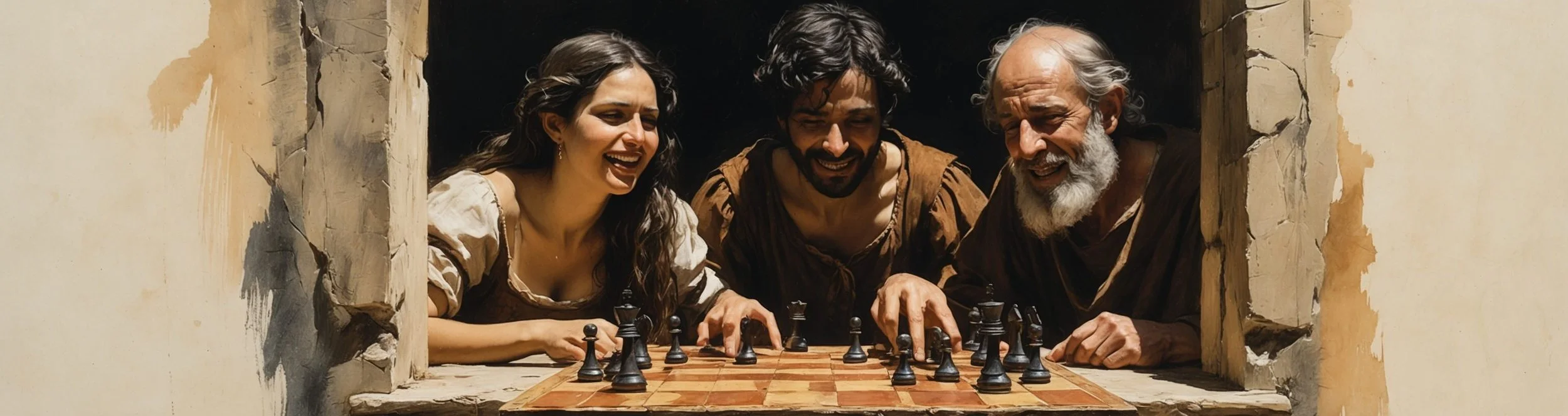
Scene Profile – At a Glance
- Location: Before Prospero’s cell, at six in the evening, three hours after the storm.
- What Happens: Prospero chooses forgiveness over vengeance, renounces his magic, releases the charmed court, forgives his enemies and reclaims Milan. He reveals Ferdinand and Miranda at chess, the ship is found whole, the conspirators are pardoned, and Ariel is set free.
- Key Characters: Prospero and Ariel; Alonso, Gonzalo, Antonio, Sebastian, Adrian and Francisco; Ferdinand and Miranda; the Master and Boatswain; Caliban, Stephano and Trinculo.
- Dramatic Function: The resolution of every plot on the island in one continuous scene: the decision, the renunciation, the recognitions, the reunions, and the release.
- Famous Quote:
"Though with their high wrongs I am struck to the quick,
Yet with my nobler reason 'gainst my fury
Do I take part: the rarer action is
In virtue than in vengeance..."
(Prospero, Act 5, Scene 1) - Why It Matters: The play’s whole argument turns on Ariel’s five words and Prospero’s answer to them; everything after is the working-out of a choice made in the first thirty lines.
Scene Summary
Prospero, in his magic robes, notes that his project is coming to a head and that it is six o’clock, the hour he set for the end of his work. Ariel reports that the king and his followers are held spellbound in the lime grove by the cell: Alonso, Sebastian and Antonio distracted, the rest mourning over them, and old Gonzalo weeping into his beard. If Prospero saw them, Ariel says, his affections would become tender; its own would, if it were human. Prospero answers that his shall. Struck to the quick as he is by their wrongs, he takes the part of his nobler reason against his fury: the rarer action is in virtue than in vengeance, and since they are penitent his purpose extends not a frown further. He sends Ariel to release them.
Alone, Prospero calls on the elves of hills, brooks and groves and the spirits by whose aid he has dimmed the sun, raised winds, split oaks with lightning and opened graves. But this rough magic he now abjures. Once heavenly music has done its last work on the courtiers’ senses he will break his staff, bury it in the earth, and drown his book deeper than any sounding line has reached. To solemn music Ariel leads in the court party, who stand charmed in a circle. Prospero speaks to each in turn as the spell dissolves: to good Gonzalo, his true preserver; to Alonso, who used him cruelly; to Sebastian, pinched for his part; and to Antonio, his brother, who expelled remorse and nature and would have killed his king, and whom he nonetheless forgives. None of them yet knows him. He sends Ariel for his hat and rapier so that he can appear as he was in Milan, and Ariel, dressing him, sings of the freedom to come. Prospero says he will miss the spirit, and sends it to fetch the Master and Boatswain from the ship.
Gonzalo prays for a heavenly power to lead them out of the fearful country. Prospero presents himself to the king as the wronged Duke of Milan and embraces him. Alonso, not sure whether this is the man or another enchantment, feels his pulse, finds it human, and, his madness lifting, resigns the dukedom and asks pardon for his wrongs. Prospero embraces Gonzalo, tells Antonio and Sebastian that he could prove them traitors to the king but will tell no tales, and forgives Antonio his rankest fault, requiring only the return of his dukedom. Alonso asks how Prospero survived, and speaks of the loss of his son. Prospero replies that he has had a like loss in this last tempest: he has lost his daughter. Alonso wishes both children were alive and reigning in Naples. Prospero says he will tell the whole story later, welcomes the king to his cell, and, since his dukedom has been returned, offers a wonder in exchange: he draws back a curtain to reveal Ferdinand and Miranda playing chess.
Miranda accuses Ferdinand of cheating and forgives him in advance. Alonso fears the sight is another vision; Sebastian calls it a miracle; Ferdinand kneels to his father, who blesses him. Miranda, seeing the crowd, cries out at how many goodly creatures there are and at the brave new world that has such people in it; Prospero says it is new to her. Ferdinand explains that he chose Miranda when he thought he had no father to ask, and that she is the daughter of the Duke of Milan, who has given him a second life. Alonso says he must ask his child’s forgiveness; Prospero stops him from burdening the moment with a heaviness that is gone. Gonzalo blesses the couple and sums up the voyage: Claribel found a husband, Ferdinand a wife, Prospero his dukedom, and all of them themselves when no man was his own. Alonso joins their hands.
Ariel brings in the Master and the Boatswain, dazed. The Boatswain reports that the ship, given up for split three hours ago, is as tight and well rigged as when it sailed; the crew woke from a dead sleep under hatches to strange noises and found her whole. Alonso says these are not natural events; Prospero promises to explain everything at leisure. He has Ariel release Caliban, Stephano and Trinculo, who are driven in wearing their stolen clothes. Sebastian and Antonio wonder whether the creatures can be bought. Prospero identifies the two Neapolitans as the king’s servants and the third, the witch’s son who plotted his death, as his own: this thing of darkness he acknowledges his. Alonso recognises his drunken butler and reeling jester; Stephano, asked whether he would be king of the isle, says he would have been a sore one. Prospero sends Caliban to trim his cell if he hopes for pardon, and Caliban promises to be wise hereafter and seek for grace, cursing himself for taking a drunkard for a god. Prospero invites the company to spend the night in his cell and hear his story; in the morning he will take them to Naples for the wedding, and then retire to Milan, where every third thought shall be his grave. He promises calm seas, gives Ariel one last charge, and sets it free.
Mine Would, Sir, Were I Human
The scene’s first thirty lines decide the play. Prospero has his enemies charmed in a grove and three hours of work behind him, and the question of what to do with them is answered before the audience has settled.
Original
ARIEL: Your charm so strongly works 'em
That if you now beheld them, your affections
Would become tender.
PROSPERO: Dost thou think so, spirit?
ARIEL: Mine would, sir, were I human.
PROSPERO: And mine shall.
(Act 5, Scene 1)
Shakespeare Retold (Modern Verse)
ARIEL: All your spells are so effective,
That if you saw them, all your feelings would
Become considerate.
PROSPERO: You really think so?
ARIEL: Mine would, if I were human.
PROSPERO: Then mine will.
Ariel reports and then, unprompted, judges: the prisoners are so wrought upon that if Prospero saw them his affections would become tender, and Ariel’s would too, were it human. The line is a rebuke disguised as a conditional, and Prospero hears it as one. His answer reasons from the spirit’s remark to a principle: if a thing of air can imagine pity, a man of their kind must do better, and since the rarer action is in virtue than in vengeance and the men are penitent, his purpose need not extend a frown further. The speech is often quoted as the play’s moral, and it is, but the play is careful about how the moral arrives. It is prompted by a servant, it rests on a claim – they are penitent – that is true of only one of the three, and it is delivered by a man who admits in the same breath that he is struck to the quick. The theme of revenge and forgiveness is resolved here not by a change of heart but by a decision of the reason against the heart, which is a harder and more interesting thing.
This Rough Magic
Alone, Prospero renounces his art in a speech borrowed from a witch. The borrowing is the point, and so is the timing: he gives up his magic before he has used it for the last time.
Original
But this rough magic
I here abjure, and, when I have required
Some heavenly music, which even now I do,
To work mine end upon their senses that
This airy charm is for, I'll break my staff,
Bury it certain fathoms in the earth,
And deeper than did ever plummet sound
I'll drown my book.
(Prospero, Act 5, Scene 1)
Shakespeare Retold (Modern Verse)
But all this magic
I now reject, and when I get to hear
Some heavenly music, like I’m starting to now,
To work my plan upon the senses of those
For whom my magic is, I’ll break my wand,
And bury it deep down within the earth,
And deeper than an anchor ever dropped to,
I’ll throw my book of spells.
The invocation that precedes these lines is adapted almost line for line from Medea’s speech in Ovid’s Metamorphoses, in Golding’s translation, and what Prospero lists is Medea’s list: the sun dimmed, the winds called, oaks split, graves opened and their sleepers let forth. The play never says that Prospero has raised the dead, and the claim sits oddly beside everything the audience has seen him do; it is there because the source put it there, and its effect is to make his art sound, for the first time, like hers. Rough is his own word for it, and it concedes what the harpy scene showed. Then the renunciation, in two verbs the play has been waiting for. The staff will be broken and buried, the book drowned deeper than any plummet sounded, and the promise is made with the music already playing for the last charm. The argument about magic and art ends with its practitioner calling it by a harsher name and putting it away, and the reasons are left to the audience: because the plot is finished, because a duke cannot rule by sorcery, because Ariel must be freed, or because a man who has just chosen virtue over vengeance no longer trusts himself with the instrument of vengeance.
The Charm Dissolves
The courtiers are led in and stand spellbound while Prospero, still unrecognised, addresses each of them. The speech is a private settling of accounts before the public one, and it contains the play’s most difficult forgiveness.
Original
Flesh and blood,
You, brother mine, that entertained ambition,
Expelled remorse and nature; who, with Sebastian,
Whose inward pinches therefore are most strong,
Would here have killed your king; I do forgive thee,
Unnatural though thou art.
(Prospero, Act 5, Scene 1)
Shakespeare Retold (Modern Verse)
My kinsman,
My brother, driven by your wild ambition,
You spurned remorse and kinship; with Sebastian –
Whose bruises are the worst because of this –
You would have killed your king; I do forgive you,
Despite your evilness.
Gonzalo is thanked, Alonso is charged with cruelty, Sebastian is told he is pinched for his part, and Antonio is forgiven in a sentence that names everything it forgives: ambition entertained, remorse and nature expelled, a king almost killed. The forgiveness is granted to a man who cannot yet hear it, and when Prospero repeats it aloud a few minutes later – most wicked sir, whom to call brother would infect my mouth, I do forgive thy rankest fault – Antonio says nothing, then or ever. The play’s argument about revenge and forgiveness has to accommodate this. Prospero forgives a brother who does not repent, and requires only the return of his dukedom, which Antonio must restore in any case. It is forgiveness as policy rather than reconciliation, and the scene does not pretend otherwise. What it does is let the audience hear the cost, in a man who cannot say the word brother without disgust and says it anyway. Between the two speeches Ariel dresses him as Duke of Milan and sings of the cowslip and the bat, and Prospero says he will miss the spirit. The tenderness is real, and it is given to the servant rather than the brother.
A Game of Chess
Prospero’s answer to the return of his dukedom is a wonder of his own, and it is the play’s quietest coup de theatre: the drowned prince and the magician’s daughter, playing a board game.
Original
Was Milan thrust from Milan, that his issue
Should become kings of Naples? O, rejoice
Beyond a common joy, and set it down
With gold on lasting pillars: In one voyage
Did Claribel her husband find at Tunis,
And Ferdinand, her brother, found a wife
Where he himself was lost, Prospero his dukedom
In a poor isle and all of us ourselves
When no man was his own.
(Gonzalo, Act 5, Scene 1)
Shakespeare Retold (Modern Verse)
Now was the Duke of Milan thrust from Milan
So that his heirs be kings of Naples? Oh, joy,
Let’s celebrate this happy time and write it
In gold on marble pillars. In this journey,
In Tunis, Claribel courted a husband;
And Ferdinand, her brother, found a wife
Where he was shipwrecked; Prospero got his dukedom
Upon a desert isle, and all of us found
Ourselves when we were mesmerised.
The discovery works on two audiences. Alonso gets his son back and fears it is another vision; Miranda sees a crowd of human beings for the first time and calls them a brave new world, which her father corrects in three words. Chess is a game of kings and captures, and Miranda’s accusation that Ferdinand plays her false, forgiven before he can answer, is the play’s marriage plot in miniature: she has already decided to lose him a score of kingdoms. Gonzalo’s speech is the scene’s official summary and the play’s, and it is worth noticing what it claims. In one voyage Claribel found a husband, Ferdinand a wife, Prospero his dukedom, and all of them found themselves when no man was his own. The last clause is the large one. The three hours on the island have been a period in which nobody was his own, charmed, lost, drowned or mad, and the recovery of self is what Gonzalo counts as the voyage’s profit. It is the play’s argument about illusion and reality stated as a blessing, and Alonso’s amen, from the man who has lost most and recovered most, is the scene’s true reconciliation; Antonio, who has found nothing, is silent.
This Thing of Darkness
The scene’s last movement brings in the ship’s officers and the conspirators, and Prospero has one more acknowledgement to make. It is the play’s most argued-over sentence, and it is spoken about the character with the least to say for himself.
Original
These three have robbed me; and this demi-devil –
For he's a bastard one – had plotted with them
To take my life. Two of these fellows you
Must know and own; this thing of darkness I
Acknowledge mine.
(Prospero, Act 5, Scene 1)
Shakespeare Retold (Modern Verse)
These three have robbed from me; and this half-devil –
For he’s a proper bastard – plotted with them
To kill me. Two of these chaps you must know
For they report to you; this thing of darkness,
I must admit is mine.
Stephano and Trinculo are returned to the king who owns them; Caliban, the witch’s son who plotted the murder, is claimed by the man who has ruled him. Acknowledge mine can be read three ways and the play supports all of them: a master owning a servant, a father owning a foster-child, a man owning the darkness in himself. Sebastian and Antonio, true to form, wonder whether the creatures can be sold. Caliban’s own response is the scene’s surprise. Sent to trim the cell if he hopes for pardon, he promises to be wise hereafter and seek for grace, and calls himself a thrice-double ass for taking a drunkard for a god. Whether this is conversion or capitulation the play does not say; what it shows is that the last speech of repentance in The Tempest belongs to Caliban, and that Antonio never makes one. The theme of nature and nurture gets its final evidence here, and it cuts both ways. Then Prospero closes the play’s business: a night of stories, a voyage to Naples, a wedding, and retirement to Milan where every third thought shall be his grave. The last order is to Ariel, and it is the one order the whole play has been waiting for. Be free.
Language and Technique
- A conditional that decides the play: “Mine would, sir, were I human” – five words in the subjunctive, from a spirit, and the plot turns on them.
- Borrowed invocation: The elves of hills speech is Medea’s from Ovid, so the white magician renounces his art in the words of a black one: the allusion is the argument.
- The dissolving charm as weather: “As the morning steals upon the night, / Melting the darkness”: the return of the courtiers’ reason is described as dawn, an image of natural recovery for a supernatural cure.
- Discovery scene: The curtain drawn on a game of chess is a stage trick with no magic in it, placed exactly where the audience expects one – the play’s last illusion is real.
- Summaries within the scene: Gonzalo’s “In one voyage” and the Boatswain’s report are the play recounting itself, so that the audience hears the afternoon’s events turned into story before the story ends.
- Silence: Antonio speaks once after his forgiveness, and only to price Caliban: the scene makes his silence audible.
Key Quotes from Act 5, Scene 1
Quote 1
Now does my project gather to a head:
My charms crack not; my spirits obey; and time
Goes upright with his carriage.
(Prospero, Act 5, Scene 1)
Shakespeare Retold (Modern Verse)
So now my plans are reaching their fruition:
My spells are holding; spirits still obey; and
It’s all going to plan.
Quote Analysis: The scene’s first lines, and the last time Prospero speaks as the man in control. Charms holding, spirits obeying, time on schedule: the modern verse keeps the project manager’s satisfaction, and the next thirty lines will end the project.
Whether thou best he or no,
Or some enchanted trifle to abuse me,
As late I have been, I not know: thy pulse
Beats as of flesh and blood; and, since I saw thee,
The affliction of my mind amends, with which,
I fear, a madness held me: this must crave,
An if this be at all, a most strange story.
Thy dukedom I resign and do entreat
Thou pardon me my wrongs.
(Alonso, Act 5, Scene 1)
Shakespeare Retold (Modern Verse)
If you’re him or not,
Or just another magic spell to trick me,
Which happened recently, I don’t know. Your pulse
Beats as a human heart; and since I’ve seen you,
My woolly-mindedness has healed, which was,
I think, caused by insanity, suggesting
That something very strange is going on.
I do resign my dukedom and I ask
That you forgive me for my wrongs.
Quote Analysis: Alonso’s recognition of Prospero, by pulse. He cannot be sure this is not another enchantment, but the beat of flesh and blood and the lifting of his madness persuade him, and he resigns the dukedom before he has finished the sentence. The modern verse keeps the doubt and the surrender; this is the play’s one wholehearted repentance.
For you, most wicked sir, whom to call brother
Would even infect my mouth, I do forgive
Thy rankest fault; all of them; and require
My dukedom of thee, which perforce, I know,
Thou must restore.
(Prospero, Act 5, Scene 1)
Shakespeare Retold (Modern Verse)
And you, most wicked man, whom calling brother
Would make me sick, I do forgive all of
The awful things you’ve done; but now I need
My dukedom back from you, which you’re compelled
To give to me.
Quote Analysis: Prospero’s forgiveness of Antonio, spoken aloud. The word brother would infect his mouth; the rankest fault is forgiven, all of them; and the dukedom is required back. The modern verse keeps the disgust inside the pardon. Antonio does not reply.
Sir, she is mortal;
But by immortal Providence she's mine...
(Ferdinand, Act 5, Scene 1)
Shakespeare Retold (Modern Verse)
She is human;
But by the grace of God, she is my wife...
Quote Analysis: Ferdinand’s answer to his father’s question whether Miranda is the goddess who separated and reunited them. She is mortal, and providence gave her to him; the modern verse keeps the two claims. The word goddess has followed Miranda since the beach in Act 1, and Ferdinand finally sets it aside.
Mark but the badges of these men, my lords,
Then say if they be true.
(Prospero, Act 5, Scene 1)
Shakespeare Retold (Modern Verse)
Look at the badges on these men, my lords,
Then say who they belong to.
Quote Analysis: Prospero presents the conspirators by their livery. The badges are the king’s, and the stolen finery is over them; the modern verse keeps the invitation to identify servants by their masters. The line prepares the acknowledgement of Caliban that follows.
My Ariel, chick,
That is thy charge: then to the elements
Be free, and fare thou well! Please you, draw near.
(Prospero, Act 5, Scene 1)
Shakespeare Retold (Modern Verse)
My Ariel,
Go make that happen, then fly on the wind
In freedom! So, farewell! Please, gather round.
Quote Analysis: The last words of the scene. One more charge, then to the elements be free, and fare thou well; the modern verse keeps the release and the farewell. Prospero’s next words are the Epilogue, spoken alone, with no spirit left to command.
Key Takeaways
- The decision comes first: Prospero chooses virtue over vengeance in the scene’s opening lines, prompted by Ariel, and everything after is the consequence.
- The book is drowned before the last trick: The renunciation of magic is spoken while the final charm is still working: Prospero gives up his art as an act of will, not of exhaustion.
- Forgiveness without repentance: Antonio is forgiven twice and never answers; Alonso repents fully; Caliban promises to seek grace. The scene grades its sinners and forgives them all.
- The wonder is a chess game: Prospero’s reply to getting his dukedom back is to reveal the lovers at play: the play’s last discovery uses no magic at all.
- Ariel is freed, Caliban is acknowledged: The two servants end the play differently – one released to the elements, one claimed as a thing of darkness – and the play lets both endings stand.
Study Questions and Analysis
Why does Prospero decide to forgive his enemies?
Because Ariel prompts him, and because his reason tells him to. Ariel describes the charmed courtiers, Gonzalo weeping into his beard, and says that if Prospero saw them his affections would become tender; Ariel’s own would, if it were human. Prospero takes the point at once. If a spirit made of air can feel for their afflictions, a man of their own kind must feel more; and since the rarer action is in virtue than in vengeance and they are penitent, his purpose need go no further than it has.
Though with their high wrongs I am struck to the quick,
Yet with my nobler reason 'gainst my fury
Do I take part: the rarer action is
In virtue than in vengeance: they being penitent,
The sole drift of my purpose doth extend
Not a frown further.
(Prospero, Act 5, Scene 1)
Shakespeare Retold (Modern Verse)
Although their evil actions wound me up,
But, with my better judgement, not through anger,
I will engage: it is rarer behaviour
To act with kindness than revenge. They’re sorry,
And hence the only thing I need to do
Is not be angry.
The decision has been read in different ways. For Frank Kermode (1954) it is the triumph of Prospero’s art and reason over passion, the play’s central opposition resolved in the hero. For Jan Kott (1964) it is the end of an experiment in power that has already failed once in Milan, with Prospero giving up because there is nothing left to do with what he has won. The text supports a reading between them. The forgiveness is an act of reason against fury, Prospero says so, and the fury is still there; the claim that his enemies are penitent is true of Alonso and false of Antonio, and Prospero knows it. What the play insists on is that the choice is made, and made before the courtiers appear, so that everything that follows is forgiveness rather than a trial. A student writing on revenge and forgiveness should notice that the play’s most famous moral line is prompted by a servant’s conditional.
What does the “Ye elves of hills” speech mean, and why does Prospero give up his magic?
The speech is Prospero’s renunciation of magic, and it comes in two parts. First he calls the roll of the spirits he has commanded – elves of hills and brooks, the sprites who chase the ebbing tide, the makers of fairy rings and midnight mushrooms – and lists what he has done with their help: dimmed the sun, raised winds, made war between sea and sky, split oaks with lightning, shaken headlands, and opened graves. Then he abjures this rough magic. When the last charm has done its work he will break his staff, bury it, and drown his book deeper than any sounding line has reached.
The first part is adapted from Medea’s speech in the seventh book of Ovid’s Metamorphoses, in Arthur Golding’s translation of 1567, and the borrowing gives the play’s white magician the voice of its most famous witch. Why he gives the art up the play leaves to inference. The practical reasons are strong: his plot is complete, Ariel has been promised freedom, and a duke returning to Milan under a king who had written against witchcraft could hardly keep a wizard’s staff. The moral reason is in the word rough, which admits what the storm, the harpy and the hounds have shown. And there is the reading, current since the nineteenth century and pressed by G. Wilson Knight in The Crown of Life (1947), that Prospero’s farewell to his art is Shakespeare’s farewell to the stage. The speech does not need that reading to work, and it does not exclude it. What it certainly does is end the argument about magic and art by having its master call it by a harsher name and put it down.
Does Antonio repent?
No. Prospero forgives him twice, once while he is still charmed and once to his face, naming the crimes each time: ambition, the expulsion of remorse and nature, the plot to kill the king. Antonio’s only words after the second forgiveness are a joke with Sebastian about whether Caliban is marketable. He does not ask pardon, he does not thank his brother, and he does not speak of Milan, which he must restore whether he likes it or not.
The silence is the play’s most deliberate omission, and it shapes how the ending should be read. Alonso repents completely, Caliban promises to seek grace, even Stephano admits he would have been a sore king; the one man who committed the original crime is the one man on whom nothing works. Prospero’s forgiveness of him is therefore not a reconciliation but a decision to stop, and the play makes the cost audible in the line about the word brother infecting his mouth. Critics have divided over whether this weakens the ending or strengthens it. Anne Barton, in her New Penguin edition (1968), remarked that the play will lend itself to almost any interpretation; on the question of Antonio it lends itself to two, a comedy in which forgiveness is complete and a harder play in which it is offered to a man who will not take it. The text gives the second reading the last word, since Antonio’s silence is the last thing the audience knows about him.
What does Miranda mean by “O brave new world”?
She is looking at a crowd of human beings for the first time – the King of Naples and his court, crowding round the chess game – and she is amazed at how many goodly creatures there are and how beautiful mankind is. Brave meant splendid or fine in 1611, not courageous, and the world is new because she has never seen it. Her father’s reply is three words: it is new to her.
O, wonder!
How many goodly creatures are there here!
How beauteous mankind is! O brave new world,
That has such people in't!
(Miranda, Act 5, Scene 1)
Shakespeare Retold (Modern Verse)
Oh, wow!
How many gorgeous men are standing here!
How beautiful mankind is! Luscious world,
That has such men in it!
The exchange holds the play’s two views of humanity in four lines. Miranda’s wonder is real and the play does not mock it; the people she admires include the man who usurped her father and the man who plotted to murder a sleeping king, and Prospero’s reply says so without spoiling her joy. Aldous Huxley borrowed the phrase for the title of his 1932 novel about a future that is neither brave nor new, and the irony has stuck to the line ever since, but in the theatre the moment depends on how Prospero says his three words. Gently, and the scene is a father watching his daughter grow up; coldly, and it is the play’s judgement on the men she is admiring. Either way the line completes the play’s argument about nature and nurture: Miranda’s goodness needed no teaching, and her innocence is about to meet a court.
What does “this thing of darkness I acknowledge mine” mean?
Prospero is presenting the three conspirators to the court. Two of them, Stephano and Trinculo, are Alonso’s servants, and Prospero says the king must know and own them; the third is Caliban, the witch’s son, whom Prospero claims as his own. In the plainest reading he is identifying a servant by his master, as he has just identified the other two by their badges. Everything else in the line is what a reader brings to it.
To take my life. Two of these fellows you
Must know and own; this thing of darkness I
Acknowledge mine.
(Prospero, Act 5, Scene 1)
Shakespeare Retold (Modern Verse)
To kill me. Two of these chaps you must know
For they report to you; this thing of darkness,
I must admit is mine.
What readers have brought is considerable. Caliban is the creature Prospero raised and taught, so the acknowledgement can be a parent’s; he is the plotter of Prospero’s murder, so it can be a master’s; and he is the play’s figure of appetite and rebellion, so it can be a man’s admission of what is dark in himself. Paul Brown made the line the title of his 1985 essay on the play and colonial discourse, reading it as the coloniser’s confession of his entanglement with the colonised, and it has served as the play’s shorthand for colonialism and empire ever since. The word darkness is the one to weigh. It is the vocabulary the play has used for Sycorax and her devil, and Prospero applies it, at the end, to something that is his. The modern verse keeps the delayed admission, with mine as the last word.
Why does Prospero say that every third thought shall be his grave?
He has just laid out the future: a night of stories in the cell, the voyage to Naples in the morning, the wedding of Ferdinand and Miranda, and then retirement to Milan. In Milan, he says, every third thought shall be his grave. It is the last thing he says about himself before the Epilogue, and it turns the restoration of his dukedom into something quieter than a triumph.
The line has been played as serenity and as sadness, and the text allows both. A man of Prospero’s age in 1611 might reasonably give a third of his thoughts to death, and the tone can be one of a duke who has settled his affairs. But the play has spent five acts showing Prospero as the most active mind on the island, and a Milan in which one thought in three is of the grave is not the dukedom he lost. The arithmetic is exact and the modern verse drops it – I’ll contemplate my death – which keeps the sense and loses the fraction. Readers who take the renunciation of magic as Shakespeare’s own farewell have found this line the most personal in the play; readers who do not still hear in it the cost of the choice made in the scene’s first thirty lines. Prospero has won, and he is describing the rest of his life as a waiting room.
Why is Ariel freed and Caliban not?
Because their bargains were different. Ariel serves Prospero for a fixed term in return for its release from the pine, and the term is up: Prospero promised freedom within two days in Act 1, promised it again in Act 4, and keeps the promise with the last words of this scene, after one final errand. Caliban has no term. He is Prospero’s slave by conquest and, in Prospero’s account, by desert, and at the end of the play he is sent to trim the cell in the hope of pardon. The play does not say what happens to him when the ship sails.
The difference has been read as the play’s judgement on the two kinds of servant, the spirit who serves gently and the monster who plots murder, and that reading is available; it has also been read as the play’s blind spot, the point at which Prospero’s generosity runs out. Ania Loomba, in Gender, Race, Renaissance Drama (1989), argued that Prospero’s takeover of the island is both racial plunder and a transfer to patriarchy, and on that reading Caliban’s ending is the play’s unfinished business. What the text gives is Caliban’s last speech, which is a promise to seek grace, and Prospero’s acknowledgement, which is a claim of ownership. The question of imprisonment and freedom that the play has been asking since Ariel first said my liberty is answered for one servant and left open for the other, and a student should resist the temptation to close it.
How does the scene tie up the play’s three plots?
In order, and in one place. The court plot ends first: Alonso repents and resigns the dukedom, Antonio and Sebastian are forgiven and warned that their treason is known, and Prospero is Duke of Milan again. The love plot ends with the chess game, Alonso’s blessing, and Gonzalo’s summary of the voyage. The comic plot ends last, with the conspirators driven in wearing their stolen clothes, pardoned as fools, and sent to tidy the cell. Between them the Boatswain reports that the ship is whole, which undoes the first scene, and Ariel is freed, which fulfils the promise of the second.
The order matters because it is the order of seriousness. Samuel Johnson, in his 1765 notes, observed that the play’s plan is regular, and this scene is where the regularity shows: every strand is picked up in the sequence it was laid down, and nothing is left dangling except what the play chooses to leave, Antonio’s silence and Caliban’s future. E. M. W. Tillyard, in Shakespeare’s Last Plays (1938), described the pattern of the late plays as prosperity, destruction and regeneration, with the destruction in The Tempest compressed into Prospero’s narration; this scene is the regeneration, and it takes place, as Alonso keeps noticing, within three hours of the wreck. The play observes the unity of time so strictly that the Boatswain can measure it in glasses, and the scene’s last line is an invitation to draw near and hear the story that the audience has just watched.