The Tempest: Act 4, Scene 1 – Analysis
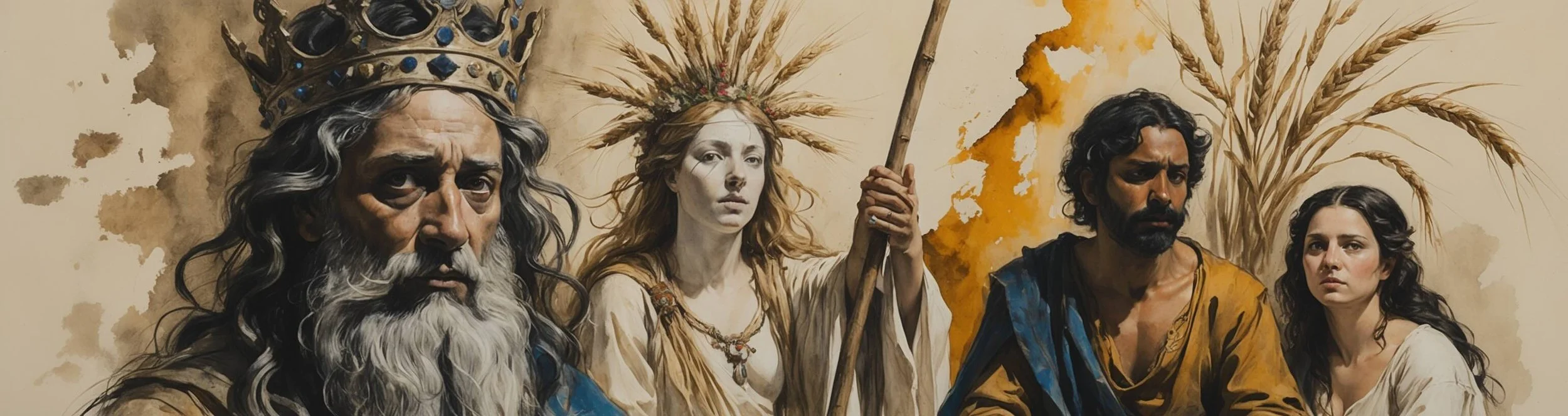
Scene Profile – At a Glance
- Location: Before Prospero’s cell.
- What Happens: Prospero gives Miranda to Ferdinand with a warning against lust before marriage, and stages a masque of goddesses to bless the betrothal. He breaks it off when he remembers Caliban’s plot, calms Ferdinand with the revels speech, then traps the conspirators with gaudy clothes and spirit hounds.
- Key Characters: Prospero, Ferdinand, Miranda; Ariel; the spirits as Iris, Ceres and Juno; Caliban, Stephano and Trinculo.
- Dramatic Function: The play’s celebration and its second most famous speech: a wedding masque that dissolves, and the comic plot run to ground.
- Famous Quote:
"We are such stuff
As dreams are made on, and our little life
Is rounded with a sleep."
(Prospero, Act 4, Scene 1) - Why It Matters: The masque and the speech that ends it turn a wedding celebration into the play’s meditation on illusion, and Prospero’s sudden anger shows the cost of running everything.
Scene Summary
Prospero tells Ferdinand that his trials were a test of his love, which he has passed, and gives him Miranda, a third of his own life. He adds a warning: if Ferdinand takes her virginity before the marriage rites are performed, the heavens will curse the union with hatred and discord. Ferdinand swears that nothing will melt his honour into lust. Prospero calls Ariel, praises the harpy performance, and orders the spirits brought to present some vanity of his art for the young couple; Ariel asks whether its master loves it, and is told dearly. Prospero warns Ferdinand a second time to keep his oath, and Ferdinand answers that the cold snow on his heart cools his blood.
To soft music the masque begins. Iris, the rainbow and messenger of Juno, summons Ceres, goddess of harvest, from her fields to celebrate a contract of true love. Ceres asks whether Venus and Cupid will be present, since she has forsworn their company after they helped Pluto steal her daughter; Iris says Venus has gone back to Paphos and Cupid has broken his arrows, their plan to work a wanton charm on the couple having failed. Juno descends and the two goddesses sing blessings on the lovers: honour, riches, long life, full barns and endless harvest. Ferdinand calls it a majestic vision and asks whether these are spirits; Prospero says they are, called from their confines by his art, and Ferdinand wishes to live on the island for ever. Iris summons nymphs and sunburnt reapers, who dance together.
In the middle of the dance Prospero starts up. He has forgotten the conspiracy of Caliban and his confederates against his life, and the minute of their plot has nearly come. He dismisses the spirits, who vanish with a strange hollow noise. Ferdinand and Miranda have never seen him so angry. Prospero tells them to be cheerful: the revels are ended, the actors were spirits and have melted into thin air, and everything in the world, the towers, palaces, temples and the great globe itself, will dissolve in the same way and leave nothing behind; we are such stuff as dreams are made on, and our little life is rounded with a sleep. He asks them to bear with his troubled old brain, sends them into his cell, and walks to still his beating mind.
Ariel reports that it left the three conspirators, drunk and full of valour, following its drum through thorns and briars into the filthy pool beyond the cell, where they stand up to their chins. Prospero calls Caliban a born devil on whom nurture will never stick, and has Ariel hang gaudy clothes on a line as bait. Caliban, Stephano and Trinculo creep in, wet and stinking, the two Neapolitans mourning their lost bottles. Caliban urges them to the cell to do the murder; Trinculo sees the wardrobe and cries out for King Stephano; and the two of them load themselves with gowns and jerkins, joking about stealing by line and level, while Caliban begs them to leave the trash alone and kill Prospero first. Prospero and Ariel set spirits in the shape of hounds on them and drive them out roaring. Prospero orders his goblins to torment them with cramps, notes that all his enemies now lie at his mercy, and promises Ariel its freedom shortly.
The Gift and the Warning
The scene opens with a father handing over his daughter, and the handing-over is done in the language of property and testing. What follows the gift is a warning that occupies more lines than the gift did.
Original
Then, as my gift and thine own acquisition
Worthily purchased take my daughter: but
If thou dost break her virgin-knot before
All sanctimonious ceremonies may
With full and holy rite be ministered,
No sweet aspersion shall the heavens let fall
To make this contract grow: but barren hate,
Sour-eyed disdain and discord shall bestrew
The union of your bed with weeds so loathly
That you shall hate it both: therefore take heed,
As Hymen's lamps shall light you.
(Prospero, Act 4, Scene 1)
Shakespeare Retold (Modern Verse)
Then, as my gift to you, and your reward
You’ve earned with merit, wed my daughter: but
If you take her virginity before
All of our solemn ceremonies have been
Presided over in a holy ritual,
The heavens will not shower you in blessings
To make your marriage flourish, but with hatred,
Bitter disgust and conflict; and they’ll spread
Revolting weeds upon your marriage bed
So that you both despise it. So, take heed
So Hymen’s torch shines for you.
Prospero’s terms are worth reading twice. Miranda is his gift and Ferdinand’s acquisition, worthily purchased by carrying logs; she is a third of his own life; and the marriage is a contract whose growth depends on the heavens’ blessing, which will be withheld if the virgin-knot is broken early. The threat is graphic – barren hate, sour-eyed disdain, a bed strewn with loathly weeds – and it is repeated a few lines later, after Ferdinand has already sworn. Some readers have found the insistence ugly, and it is certainly the voice of a man who cannot stop controlling. But the play gives Prospero reasons. He has one afternoon to marry his daughter to the heir of Naples and has just watched two men plan a murder over a sleeping king; the power and control he holds over everyone on the island ends the moment they sail, and the marriage is the only arrangement that will outlast his magic. The warning is the sound of a man trying to make his plan permanent.
The Masque
The masque is a show within the show, and the play lets the audience watch it as one. Three goddesses, two songs of blessing, and a dance of nymphs and reapers: it is the entertainment a Jacobean court would have recognised, staged by a magician for two people.
Original
Honour, riches, marriage-blessing,
Long continuance, and increasing,
Hourly joys be still upon you!
Juno sings her blessings upon you.
(Juno, Act 4, Scene 1)
Shakespeare Retold (Modern Verse)
Honour, wealth, and wedding blessing,
Endless love keeps coalescing,
And hourly brings happiness!
Juno sings you words that bless.
The masque’s subject is fertility without lust. Ceres refuses to appear if Venus and Cupid are present, because they helped Pluto carry off her daughter; Iris reports that the pair have given up their plan to work a wanton charm on the couple, and Cupid has broken his arrows. The goddesses who remain, marriage and harvest, bless the lovers with honour, riches, long life and barns that are never empty. It is Prospero’s warning about chastity turned into a pageant, and Ferdinand, who takes it for a vision of paradise, has understood it correctly: this is what the island can be when the right people rule it. The masque is also the play’s most explicit exercise of magic and art as art rather than force, spirits called from their confines to enact Prospero’s present fancies, and the fancies are all of order, plenty and blessing. That is why its interruption is so violent.
Our Revels Now Are Ended
Prospero stops the dance because he has remembered Caliban, and the speech he then makes to a frightened Ferdinand is the most quoted passage in the play. It is spoken by a man who is, by his own account, vexed.
Original
I had forgot that foul conspiracy
Of the beast Caliban and his confederates
Against my life: the minute of their plot
Is almost come.
(Prospero, Act 4, Scene 1)
Shakespeare Retold (Modern Verse)
I did forget about that evil plan
That Caliban, the monster, and his friends
Intend to kill me: and the time he plans it
Is almost here.
The interruption comes first and explains everything after it. The masque was meant to end in a dance; instead it ends because its author forgot an appointment with his murderers, and the spirits vanish with a hollow noise. The revels speech is Prospero’s recovery, and it is beautiful and not calm. The actors were spirits and have melted into air; the towers, the palaces, the temples, the great globe itself will dissolve as the pageant did; we are the stuff dreams are made on, and our lives are rounded with a sleep. Read as consolation it is strange consolation: a young man alarmed by his father-in-law’s anger is told that everything, himself included, will vanish. Read as what it is, the speech of a man whose control has just slipped, it makes sense. Prospero has staged a vision of permanence and had it interrupted by the one plot he forgot, and his answer is to say that nothing was ever permanent anyway. The play’s argument about illusion and reality reaches its peak here, and the man making it admits in the next breath that his old brain is troubled.
Trash and Hounds
The scene’s last movement drops from the great globe to a clothes-line. The conspirators are caught not by force but by their own greed, and Caliban, who alone remembers the point, is the one who suffers for it.
Original
The dropsy drown this fool! What do you mean
To dote thus on such luggage? Let's alone
And do the murder first: if he awake,
From toe to crown he'll fill our skins with pinches,
Make us strange stuff.
(Caliban, Act 4, Scene 1)
Shakespeare Retold (Modern Verse)
May illness kill this fool! What are you thinking
To value all this junk? Leave it alone
And do the murder first. If he awakens,
He’s going to punish us from head to toe
And make us look atrocious.
The trap works because Prospero knows his enemies. Stephano and Trinculo cannot pass a wardrobe; Caliban, who has spent three scenes planning the murder, watches them try on gowns and joke about stealing by line and level, and begs them to leave the luggage and do the murder first. His fear is exact – pinches from toe to crown, transformation into barnacles or low-browed apes – and it is the fear of a creature who knows what Prospero does to people. Then the hounds come, with names, and the three are driven out roaring. The episode is comic and it is also the play’s cruellest scene, since the punishment that follows, dry convulsions and aged cramps, is ordered by a man who has just described his own old brain as troubled. Prospero’s closing lines note that all his enemies now lie at his mercy, and promise Ariel the air at freedom. The word mercy is the play’s next subject, and the scene ends with Prospero using it to mean the opposite: revenge and forgiveness is complete, and the choice between them has not yet been made.
Language and Technique
- The masque form: Rhymed couplets, classical goddesses, a descent from the heavens and a country dance: the masque copies the court entertainments of James I’s reign, so the audience of 1611 saw its own fashionable spectacle staged inside a play.
- Blank verse resumed: After the masque’s couplets, Prospero’s revels speech returns to blank verse, and the change of sound is the change from show to thought.
- Dissolving images: Melted into air, baseless fabric, insubstantial pageant, leave not a rack behind: the speech is built from words for vanishing, so that its form enacts what it describes.
- The great globe: A pun on the theatre the play may have been written for: the Globe, like the world, is a building that will not last.
- Prose for thieves: Stephano and Trinculo’s wardrobe jokes are in prose, Caliban’s pleas in verse: even in the play’s lowest comedy, the monster keeps the higher register.
- Named hounds: Mountain, Silver, Fury, Tyrant: the spirit-dogs have the kind of names real hounds were given, which makes the supernatural punishment sound like a country sport.
Key Quotes from Act 4, Scene 1
Quote 1
ARIEL: Do you love me, master? No?
PROSPERO: Dearly my delicate Ariel.
(Act 4, Scene 1)
Shakespeare Retold (Modern Verse)
ARIEL: Do you love me, master? No?
PROSPERO: I love you dearly, Ariel.
Quote Analysis: The only time Ariel asks for anything but freedom. The question comes in the middle of a rhyming errand-list, and Prospero answers it at once; the modern verse keeps the exchange. It is the tenderest moment between master and servant in the play, and it comes two scenes before the servant is released.
Let me live here ever;
So rare a wondered father and a wife
Makes this place Paradise.
(Ferdinand, Act 4, Scene 1)
Shakespeare Retold (Modern Verse)
Let me live here forever;
A father and wife so rare and lovely
Makes this place Paradise.
Quote Analysis: Ferdinand’s response to the masque: with such a father-in-law and such a wife, the island is Paradise, and he would stay for ever. The modern verse keeps the wish. It is the play’s happiest line, and Prospero interrupts the show a few lines later.
Sir, I am vexed;
Bear with my weakness; my old brain is troubled:
Be not disturbed with my infirmity:
If you be pleased, retire into my cell
And there repose: a turn or two I'll walk,
To still my beating mind.
(Prospero, Act 4, Scene 1)
Shakespeare Retold (Modern Verse)
I’m upset;
Bear with me in my weakness, for I’m troubled.
Don’t be upset by my infirmity.
If you would like to, go into my room
And rest yourself. I’ll take a gentle stroll
To calm my active mind.
Quote Analysis: The lines that follow the famous ones and are rarely quoted with them. Prospero asks the lovers to bear with his weakness and his troubled old brain, sends them inside, and goes for a walk to calm himself. The modern verse keeps the admission of infirmity, which is what the revels speech was written to cover.
A devil, a born devil, on whose nature
Nurture can never stick; on whom my pains,
Humanely taken, all, all lost, quite lost;
And as with age his body uglier grows,
So his mind cankers.
(Prospero, Act 4, Scene 1)
Shakespeare Retold (Modern Verse)
He is a devil, born and bred, whose nature
Cannot be changed; the kindness that I showed him,
All done sincerely is completely lost;
And as he’s looking uglier with age,
His mind gets uglier as well.
Quote Analysis: Prospero’s verdict on Caliban, spoken alone. Nature and nurture are named together here, and the conclusion is that nothing taught him has stuck; the modern verse keeps both words. The audience has just heard Caliban describe the island’s music, and knows the verdict is incomplete.
Let them be hunted soundly. At this hour
Lie at my mercy all mine enemies:
Shortly shall all my labours end, and thou
Shalt have the air at freedom: for a little
Follow, and do me service.
(Prospero, Act 4, Scene 1)
Shakespeare Retold (Modern Verse)
Make sure they’re hunted down. And at this time,
Let all my enemies lie at my mercy:
Soon all my work is over, and then you
Will have your liberty; but for a short while,
Do some more work for me.
Quote Analysis: The scene’s last speech. All Prospero’s enemies lie at his mercy, his labours are almost over, and Ariel will soon have the air at freedom; the modern verse keeps the promise. The word mercy is used to mean power, and the next scene will make Prospero choose which he means.
Key Takeaways
- A wedding on conditions: Prospero gives Miranda away as a gift and a purchase, and warns twice against lust before the ceremony: the marriage is his plan’s one permanent achievement.
- The masque is the play’s ideal: Goddesses of marriage and harvest bless the couple with plenty, and Venus is excluded: order without desire, which is what Prospero’s art is for.
- Interruption, then the famous speech: The revels speech is a recovery from lost control – Prospero forgot the murder plot – and its calm covers a troubled old brain.
- Greed defeats the conspiracy: Stephano and Trinculo are caught by a clothes-line, not a sword, while Caliban, who alone remembers the murder, is punished with them.
- Mercy means power, for now: The scene ends with all Prospero’s enemies at his mercy and his revenge complete; the decision to forgive is still to come.
Study Questions and Analysis
What does “We are such stuff as dreams are made on” mean?
That human beings are made of the same material as dreams, and that a life is a short waking with sleep on either side of it. The line is the climax of Prospero’s speech dismissing the masque: the spirit-actors have melted into air, and so, he says, will the cloud-capped towers, the palaces, the temples and the great globe itself, leaving not a wisp of cloud behind. The vision he has just staged was insubstantial; the world is no more substantial than the vision.
We are such stuff
As dreams are made on, and our little life
Is rounded with a sleep.
(Prospero, Act 4, Scene 1)
Shakespeare Retold (Modern Verse)
For we are only
Made up of dreams, and our lives are bookended
With sleep pre-birth and post-death.
Two points of context change how the speech reads. First, its occasion: Prospero says it because he has just remembered Caliban’s plot and stopped the masque in anger, and Ferdinand is alarmed; the speech is a father-in-law recovering his composure, and it ends with him admitting that he is vexed and his old brain is troubled. Second, its afterlife: since the nineteenth century the speech has been read as Shakespeare’s farewell to his art, with the great globe as the Globe theatre and Prospero as the playwright, a reading G. Wilson Knight pressed in The Crown of Life (1947). The play neither confirms nor forbids it. What the speech certainly does is state the play’s argument about illusion and reality at its most extreme, and then undercut it, since the man who says all things dissolve immediately goes off to deal with three very solid conspirators. The word is made on, not made of; the misquotation is almost universal.
What is the masque, and why does Prospero stage it?
A masque was the court entertainment of Shakespeare’s day: an allegorical show with music, dancing, elaborate costumes and machinery, in which classical gods descended to compliment the monarch and bless an occasion, usually a royal wedding. Ben Jonson wrote them for James I’s court from 1605 onwards. Prospero’s masque follows the form exactly, with Iris as messenger, Ceres and Juno as the goddesses of harvest and marriage, songs of blessing, and a concluding dance of nymphs and reapers. He stages it because he has promised the couple some vanity of his art, and because a betrothal deserves a celebration.
The masque also says what Prospero wants the marriage to be. Ceres will not come if Venus and Cupid are there, and Iris confirms that their wanton charm has failed; the goddesses who bless the lovers promise honour, riches, long life and full barns, fertility with the passion removed. It is Prospero’s warning about chastity turned into a pageant. The play was performed at court during the celebrations for Princess Elizabeth’s wedding in the winter of 1612 to 1613, and some scholars have suggested the masque was added or expanded for the occasion; the evidence is inconclusive. Whether or not it was, the scene lets the audience watch a court spectacle from the inside and then watch it vanish, which no real masque could do. Ferdinand’s wish to live here for ever is the response the form was designed to produce, and Prospero’s interruption is the play’s comment on it.
Why does Prospero suddenly stop the masque?
Because he has remembered that Caliban, Stephano and Trinculo are coming to murder him, and the minute of their plot has almost arrived. He starts up in the middle of the dance, dismisses the spirits, and they vanish with a strange hollow noise. Ferdinand notes that he is in some passion that works him strongly; Miranda says she has never seen him so angry. The revels speech follows, and then Prospero sends the lovers away and calls Ariel to prepare for the conspirators.
The interruption is the scene’s turning point and one of the play’s most discussed moments. A plot by three drunkards, which Ariel has already told Prospero about and which Ariel has already led into a bog, is hardly a threat to a magician who has just made goddesses descend; yet it breaks his concentration and produces the play’s only description of Prospero losing his temper. Readers have offered different explanations: that the plot reminds him of Antonio’s, the original betrayal by someone he had trusted; that Caliban’s ingratitude wounds him more than the courtiers’ because he tried to raise Caliban; or simply that a man running four plots at once on a three-hour clock has too much to hold in his head. Jan Kott (1964) read the island as Prospero’s failed experiment in government, and the interruption as the moment the failure shows. Whatever the cause, the effect is that the play’s vision of illusion and reality is delivered by a man who has just been reminded that reality has a knife in it.
Why does Prospero say nurture can never stick on Caliban?
Because he is angry, and because the plot against his life seems to him proof that everything he tried to teach Caliban has failed. Alone for a moment after Ariel goes to fetch the bait, he calls Caliban a devil, a born devil, on whose nature nurture will never stick, whose body grows uglier with age and whose mind rots with it. It is the play’s most explicit statement of the nature-and-nurture argument, and the position it takes is that some natures cannot be improved.
A devil, a born devil, on whose nature
Nurture can never stick; on whom my pains,
Humanely taken, all, all lost, quite lost;
And as with age his body uglier grows,
So his mind cankers.
(Prospero, Act 4, Scene 1)
Shakespeare Retold (Modern Verse)
He is a devil, born and bred, whose nature
Cannot be changed; the kindness that I showed him,
All done sincerely is completely lost;
And as he’s looking uglier with age,
His mind gets uglier as well.
The play does not endorse the verdict. In the previous act Caliban described the island’s music in the finest verse the play contains, and in this scene he is the only conspirator who keeps his mind on the plan while the civilised men loot a wardrobe; whatever nurture failed to give him, it was not intelligence. Samuel Taylor Coleridge, lecturing in 1811, called Caliban a noble being raised by the poet far above contempt, and Frank Kermode (1954) made the opposition of art and nature the play’s organising idea, with Caliban as the natural man on whom art cannot work. The scene supports both readings and complicates them, since the speech is delivered by a man who admits a few lines earlier that his own old brain is troubled. The question of nature and nurture is not settled here; it is reopened in Act 5, when Caliban resolves to seek for grace.
How are the conspirators defeated?
By a clothes-line and a pack of dogs. Ariel has already led the three through briars and thorns into a stinking pool, following a drum they could not see; they arrive at the cell wet, filthy and without their bottles. Prospero has Ariel hang gaudy garments on a line by the entrance, and Stephano and Trinculo cannot resist them. While they dress up and joke, Caliban pleads with them to do the murder first. Then spirits in the shape of hounds are set on all three, with Prospero and Ariel calling the dogs by name, and the conspirators are driven out roaring. Prospero orders his goblins to torment them with cramps and convulsions.
The defeat is designed to humiliate rather than to harm, and the design tells the audience how seriously to take the threat. The trumpery on the line is Prospero’s own word for it; he knows that the two Neapolitans are thieves before they are murderers, and the trap is a test of character that they fail at once. Caliban’s exasperation, watching his kings dote on luggage, is the scene’s sharpest comedy and its saddest moment, since he alone understands what is at stake and he is punished with the fools. The hounds’ names, Mountain, Silver, Fury and Tyrant, make the punishment a hunt, and a hunt is a gentleman’s sport; the question of masters and servants, which the comic plot has been asking since Act 2, is answered here by the master setting his dogs on the servants.
What is the significance of Ariel asking “Do you love me, master?”
It is the only moment in the play when Ariel asks Prospero for anything other than freedom, and it comes in the middle of a rhyming promise to fetch the spirits in a twinkling. Prospero answers at once: dearly, my delicate Ariel. The exchange is brief, and productions play it many ways – as a child’s question, a servant’s, a lover’s – but the text gives it no explanation and moves straight on to business.
The question matters because of what the play has already shown. In Act 1 Prospero called Ariel a malignant thing and threatened to peg it in an oak; in this scene he calls it his industrious servant and his bird, and confesses love. The relationship between masters and servants on this island is coercive from the start, and the play keeps asking whether it is anything else. Ariel’s question, and the answer, suggest that it is, without pretending that the coercion has gone: Prospero’s next line is an order not to approach until called. William Hazlitt (1817) called Ariel imaginary power, the swiftness of thought personified, and a thought that asks whether it is loved is a strange thing. The play lets it stay strange. Two scenes later Ariel is freed, and Prospero says he will miss it.
Why is Prospero so insistent about chastity before marriage?
He warns Ferdinand twice, in graphic terms, that if he breaks Miranda’s virgin-knot before the ceremony the marriage will be cursed with barren hate and discord, and Ferdinand swears twice that nothing will melt his honour into lust. The masque then repeats the message in allegory, with Venus and Cupid excluded from the blessing. The insistence has struck many readers as excessive, and it is certainly a father’s anxiety spoken by a man who cannot stop giving instructions.
But the anxiety has a source in the play. Miranda is the object of the play’s one attempted rape, by Caliban, and Prospero has just spent an afternoon using her as the prize in his plot; he needs the marriage to be lawful and lasting because it is the only part of his design that will survive his loss of power and control. Lorie Jerrell Leininger’s essay “The Miranda Trap” (1980) argued that Prospero needs Miranda as bait and then needs to protect her from the consequences, and the double warning is exactly that protection. Stephen Orgel, in “Prospero’s Wife” (1984), noted that the play’s mothers are absent and its father does the work of both; the chastity speeches are the mother’s talk given to the magician. Ferdinand’s answer, that the cold snow on his heart cools his blood, is the response of a young man who wants to get through the lecture, and the play lets him.