The Tempest: Act 3, Scene 3 – Analysis
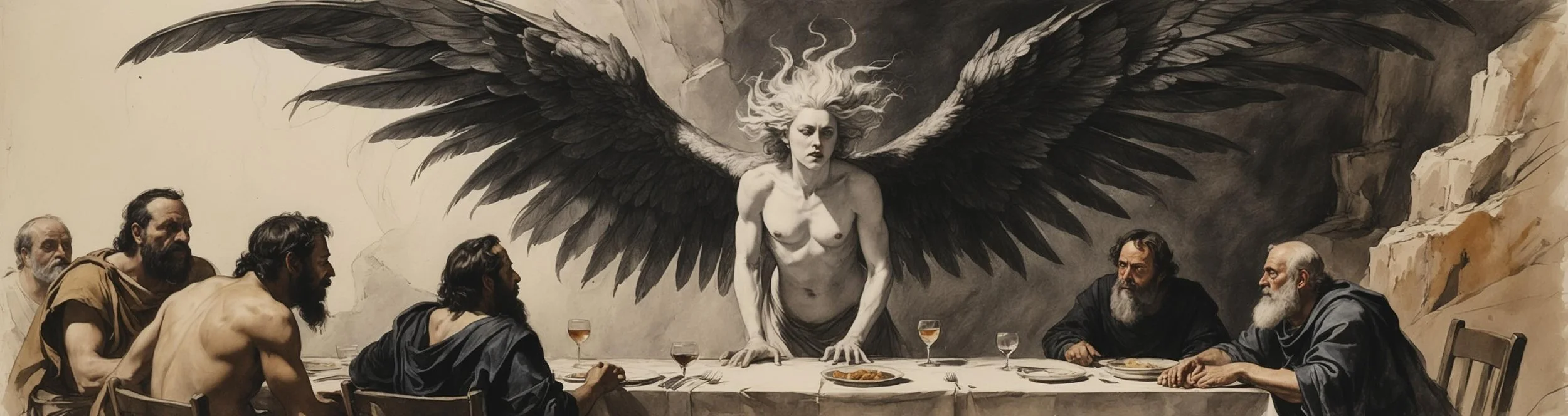
Scene Profile – At a Glance
- Location: Another part of the island; the court party, exhausted, gives up the search for Ferdinand.
- What Happens: Strange shapes bring in a banquet and vanish. As the courtiers go to eat, Ariel appears as a harpy, makes the table disappear, and names Alonso, Antonio and Sebastian as three men of sin. Alonso, hearing his guilt in the thunder, goes to drown himself.
- Key Characters: Alonso, Gonzalo, Antonio, Sebastian, Adrian and Francisco; Ariel as a harpy; Prospero, above and invisible.
- Dramatic Function: The play’s judgement scene: Prospero’s revenge shown at full strength, with his enemies named, accused and driven mad before he decides to forgive them.
- Famous Quote:
"You are three men of sin, whom Destiny,
That hath to instrument this lower world
And what is in't, the never-surfeited sea
Hath caused to belch up you..."
(Ariel, Act 3, Scene 3) - Why It Matters: The harpy’s speech is the first time the crime against Prospero is spoken aloud to the men who committed it, and Alonso’s breakdown makes the forgiveness of Act 5 possible.
Scene Summary
The court party has been searching the island for Ferdinand and can go no further. Gonzalo’s old bones ache; Alonso sits down and gives up hope, saying his son is drowned and the sea mocks their search on land. Antonio and Sebastian, aside, are glad the king has despaired and agree to make their second attempt on his life that night, when the others are too tired to keep watch.
Solemn music sounds. Prospero enters above, invisible, and strange shapes bring in a banquet, dance around it with gestures of welcome, invite the courtiers to eat, and depart. The courtiers are astonished. Sebastian is now ready to believe in unicorns and the phoenix; Antonio says travellers never lie; Gonzalo remarks that though the islanders are monstrous in shape their manners are gentler than most men’s, and Prospero, aside, agrees that some of the men present are worse than devils. Alonso hesitates, then resolves to eat, since he feels the best of his life is past, and calls his brother and the duke to the table.
Thunder and lightning. Ariel descends in the shape of a harpy, claps its wings on the table, and the banquet vanishes. Ariel addresses Alonso, Sebastian and Antonio as three men of sin whom the sea has spat out onto an uninhabited island because they are unfit to live among men, and says it has driven them mad. They draw their swords; Ariel tells them they might as well stab the wind or the water, and that their swords are now too heavy to lift. Then it delivers its message: the three of them drove Prospero from Milan and exposed him and his child to the sea; the powers have not forgotten; Alonso has been robbed of his son for it; and lingering ruin will follow all three unless they repent and live clean lives. The harpy vanishes and the shapes return to carry the table away.
Prospero, above, praises Ariel’s performance and the spirits’ dancing, notes that his enemies are now in his power and out of their wits, and goes to visit Ferdinand and Miranda. Gonzalo asks the king why he stands staring. Alonso says the thunder pronounced the name of Prospero and told him his crime; his son is drowned for it, and he will go and find him on the seabed. He rushes out. Sebastian and Antonio, vowing to fight fiends one at a time, follow. Gonzalo says all three are desperate, their guilt working on them like a slow poison, and sends the younger lords after them to prevent what their madness may drive them to.
Giving Up
The scene begins at the low point of the courtiers’ afternoon. They have walked in a maze of paths to nowhere, and the king, who has held out hope for two scenes, lets it go.
Original
Even here I will put off my hope and keep it
No longer for my flatterer: he is drowned
Whom thus we stray to find, and the sea mocks
Our frustrate search on land. Well, let him go.
(Alonso, Act 3, Scene 3)
Shakespeare Retold (Modern Verse)
Just here I’ll give up hope and won’t continue
To kid myself no longer: he has drowned
Whom we are looking for; the sea is laughing
At us for searching on the land. He’s gone.
Alonso’s surrender is the first thing the harpy needs. A man who still hoped could not be broken by the news of his son’s death, since he would not believe it; a man who has just said let him go is ready to hear that the loss was his own fault. Antonio and Sebastian, watching the king despair, see only opportunity, and fix the murder for that night. The two responses to the same moment – the king’s grief and the conspirators’ glee – are set side by side without comment, and they measure the moral distance across which Prospero’s forgiveness will later have to reach. The scene’s argument about revenge and forgiveness begins here, before the spectacle, with a victim at his weakest and his enemies at their most confident.
The Banquet
Prospero’s show is in two parts, and the first is hospitality. Strange shapes bring in a feast, dance around it in welcome, and leave it for hungry men to eat.
Original
GONZALO: If in Naples
I should report this now, would they believe me?
If I should say, I saw such islanders –
For, certes, these are people of the island –
Who, though they are of monstrous shape, yet, note,
Their manners are more gentle-kind than of
Our human generation you shall find
Many, nay, almost any.
PROSPERO: Honest lord,
Thou hast said well; for some of you there present
Are worse than devils.
(Act 3, Scene 3)
Shakespeare Retold (Modern Verse)
GONZALO: If in Naples
I told them what I’d seen, would they believe me?
If I said, I saw people from the island –
For I am sure they’re people from the island –
Who, though they look like monsters, we have noted
Their manners are more kind and gentle than
The humans of our age who you might meet
Most times, no, almost every time.
PROSPERO: Good lord,
You spoke the truth; for some within your group
Are worse than devils.
The courtiers’ reaction is a small study in how Europeans meet the unknown. Sebastian is ready to believe in unicorns; Antonio, the play’s sceptic, says he will swear to anything travellers report; and Gonzalo, kindest and most credulous, draws the moral that these monstrous-shaped islanders have gentler manners than most men. Prospero’s aside agrees, and turns the observation against its audience: some of the men watching are worse than devils. The exchange is the play’s argument about colonialism and empire conducted from the other side, with the courtiers as the wondering visitors and the island’s creatures as the hospitable natives, and the play’s judgement is already given before the harpy speaks. The banquet is also a trap in the plainest sense. It is offered so that it can be taken away, and Alonso, resolving to eat because the best is past, walks into it with the resignation of a man who no longer cares.
Three Men of Sin
The harpy is Prospero’s accusation given wings. Ariel’s speech is the first time in the play that the crime against Milan is stated to the criminals, and it is delivered as a sentence from a court they cannot appeal to.
Original
But remember –
For that's my business to you – that you three
From Milan did supplant good Prospero;
Exposed unto the sea, which hath requit it,
Him and his innocent child: for which foul deed
The powers, delaying, not forgetting, have
Incensed the seas and shores, yea, all the creatures,
Against your peace. Thee of thy son, Alonso,
They have bereft; and do pronounce by me:
Lingering perdition, worse than any death
Can be at once, shall step by step attend
You and your ways; whose wraths to guard you from –
Which here, in this most desolate isle, else falls
Upon your heads – is nothing but heart-sorrow
And a clear life ensuing.
(Ariel, Act 3, Scene 3)
Shakespeare Retold (Modern Verse)
But you must remember –
And that’s the reason that I’m here – that you three
In Milan overthrew good Prospero,
And left him to the oceans – much like you’ve been –
Along with his defenceless child. For that crime,
The powers that be – who’d waited, not forgetting –
Fired up an angry sea and all its creatures
To break your peace. That son of yours, Alonso,
The sea has taken; and it’s ordered me to
Inflict a drawn-out ruin, worse than death
Can ever be, and every step will happen
To you. The only way that you can stop them –
Which here, upon this isolated island,
Will come to you – is no less than remorse
And living kind and morally from now on.
The speech has three parts, and each does something the plot needs. First the charge: the three supplanted good Prospero and exposed him and his child to the sea. Then the claim of agency: the powers, delaying but not forgetting, have raised the sea and shore against them, and taken Alonso’s son. Then the sentence and the condition: lingering perdition, step by step, unless heart-sorrow and a clear life follow. It is Prospero’s own view of events, spoken by his spirit in the costume of a classical avenger, and the audience should notice what it claims. Ferdinand is not dead, and Prospero knows it; the sea did not requite anything, since Prospero raised it. The harpy’s theology is a fiction designed to produce repentance, and it works on exactly one of the three. Alonso hears the thunder speak his trespass and goes to drown himself; Antonio and Sebastian draw their swords on the air. The scene’s demonstration of magic and art at full power is also a demonstration of its limit, since the two men who most need to feel guilt feel nothing but rage.
Language and Technique
- Spectacle in two movements: A banquet offered, then snatched away: the scene’s structure is a trick, and the trick is the argument – hospitality withdrawn from men who do not deserve it.
- The harpy: Ariel’s costume comes from Virgil, where harpies foul the Trojans’ feast and prophesy; the classical allusion makes Prospero’s revenge look like fate rather than a man’s grudge.
- The sea’s vocabulary: “The never-surfeited sea / Hath caused to belch up you” – the sea as a stomach that has vomited the guilty onto the shore, an image of disgust dressed as destiny.
- Delayed accusation: “But remember”: the harpy’s speech holds back its real business until the swords have failed, so that the charge lands on men already helpless.
- Sound as conscience: Alonso hears the crime in the billows, the wind and the thunder’s organ-pipe: the island’s noises, which delight Caliban, become an accusation for the guilty.
- Asides from above: Prospero’s commentary – honest lord, praise in departing, bravely performed – keeps the audience aware that the terror is theatre with a director.
Key Quotes from Act 3, Scene 3
Quote 1
You fools! I and my fellows
Are ministers of Fate: the elements,
Of whom your swords are tempered, may as well
Wound the loud winds, or with bemocked-at stabs
Kill the still-closing waters, as diminish
One dowle that's in my plume...
(Ariel, Act 3, Scene 3)
Shakespeare Retold (Modern Verse)
You fools! I and my fellow beings
Enact what Fate decrees: the elements
Your swords have swiped at might as well attempt
To hurt the winds, or your pathetic stabs
Might try to kill encasing water, as you
Might chop a feather from my plume...
Quote Analysis: The harpy’s answer to drawn swords. The elements the swords are made of might as well wound the wind or stab the closing water as harm a feather of its plumage; the modern verse keeps the scorn. It is the play’s clearest statement that on this island force is useless against art.
Their several kinds have done. My high charms work
And these mine enemies are all knit up
In their distractions; they now are in my power;
And in these fits I leave them, while I visit
Young Ferdinand, whom they suppose is drowned,
And his and mine loved darling.
(Prospero, Act 3, Scene 3)
Shakespeare Retold (Modern Verse)
Performed their roles. Now, all my spells are working
And all my enemies are self-consumed
And mystified; they’re under my control now;
I’ll leave them in confusion while I visit
Young Ferdinand, whom they believe has drowned,
And his girl whom both he and I do love.
Quote Analysis: Prospero’s satisfaction, spoken from above: his enemies are knit up in their distractions and in his power, and he leaves them in their fits to visit the lovers. The modern verse keeps the coldness. This is revenge as Prospero wants it, and the play will ask in Act 5 whether he can want something else.
O, it is monstrous, monstrous:
Methought the billows spoke and told me of it;
The winds did sing it to me, and the thunder,
That deep and dreadful organ-pipe, pronounced
The name of Prosper: it did bass my trespass.
(Alonso, Act 3, Scene 3)
Shakespeare Retold (Modern Verse)
Oh, it is awful.
I thought I heard the waves tell me about it;
The winds sang it to me, and then the thunder –
That sounds like dreadful organ music – spoke
Of Prospero: a bass-note boomed my sins.
Quote Analysis: Alonso’s breakdown. The billows, the winds and the thunder have all told him the name of Prospero and the nature of his crime, and the organ-pipe image gives his guilt a sound. The modern verse keeps the bass note. He is the one man on whom the harpy’s sermon works.
All three of them are desperate: their great guilt,
Like poison given to work a great time after,
Now 'gins to bite the spirits.
(Gonzalo, Act 3, Scene 3)
Shakespeare Retold (Modern Verse)
All three of them are desperate: their guilt,
Has, like a poison taking time to work,
Begins to gnaw their conscience.
Quote Analysis: Gonzalo’s diagnosis, and the play’s own: guilt like a poison given long ago, now beginning to bite. The modern verse keeps the slow poison. Gonzalo, who has no guilt to feel, is the only one who can see what is happening to the other three.
Key Takeaways
- Prospero’s revenge at full strength: The banquet and the harpy are the closest the play comes to punishment, and Prospero watches from above with satisfaction.
- The crime spoken aloud: The harpy’s speech is the first time Antonio, Sebastian and Alonso hear their crime against Milan named, and the sentence is repentance or ruin.
- One repents, two draw swords: Alonso hears his guilt in the thunder and goes to drown himself; Antonio and Sebastian answer the accusation with steel, and the difference decides Act 5.
- Hospitality withdrawn: The island offers its visitors a feast and takes it back: the scene’s shape is the play’s judgement on men who would have been worse than devils as guests.
Study Questions and Analysis
What does the harpy’s speech mean, and why is it a harpy?
Ariel, in the shape of a harpy, tells Alonso, Sebastian and Antonio that they are three men of sin whom the sea has vomited onto an island where no man lives, because they are unfit to live among men; that their swords are useless against ministers of fate; that they drove Prospero and his child from Milan and left them to the sea; that the powers have taken Alonso’s son in return; and that lingering ruin will follow them unless they repent and live clean lives thereafter. It is an accusation, a sentence and an offer of mercy in one speech.
You are three men of sin, whom Destiny,
That hath to instrument this lower world
And what is in't, the never-surfeited sea
Hath caused to belch up you; and on this island
Where man doth not inhabit; you 'mongst men
Being most unfit to live.
(Ariel, Act 3, Scene 3)
Shakespeare Retold (Modern Verse)
You three are sinners, men whom Destiny –
Which has control of everything on earth
And all that’s in it – made the quenchless sea
Spit out again, to live upon this island
Where no man lives; and you amongst all men
Do not deserve to live.
The harpy comes from the third book of Virgil’s Aeneid, where the harpies, monstrous birds with women’s faces, foul the Trojans’ feast and one of them, Celaeno, prophesies hunger before they reach their promised land. Shakespeare’s audience would have known the episode, and the costume tells them how to read the scene: the vanishing banquet is a classical omen, and the speech that follows is prophecy. But the prophet is Prospero’s servant, speaking Prospero’s words, and the theology of sin and fate is a script. Frank Kermode’s Arden edition (1954) treated the scene as the play’s clearest demonstration of Prospero’s art used for correction rather than harm; readers less sympathetic to Prospero have noticed that the speech lies about Ferdinand and claims for the powers a storm Prospero raised himself. Both readings are available, and the question they raise, whether magic and art used to produce repentance is different from revenge, is the question Act 5 answers.
Why does the banquet vanish?
Because it was never meant to be eaten. The strange shapes bring in the feast, dance around it with every gesture of welcome, and leave; the courtiers, hungry and exhausted, resolve to eat; and as they approach the table Ariel claps its wings on it and the food is gone. The banquet exists so that it can be withdrawn, and the withdrawal is the first act of the harpy’s judgement, before a word is spoken.
The stagecraft is the meaning. Hospitality offered and snatched away is the island’s verdict on its guests, and Gonzalo’s remark that the monstrous islanders are gentler than most men is the audience’s cue: these men would have been worse hosts than the shapes are, and worse guests. The device also belongs to the play’s larger argument about illusion and reality. Nothing the courtiers see on the island is what it seems – the storm, the sleep, the music, the feast – and the banquet is the point at which appearance turns hostile. The King’s Men had by 1611 an indoor theatre at the Blackfriars, where a table could be made to vanish by a trap or a turning top, and the Folio’s stage direction, with its quaint device, suggests the effect was one the company was proud of.
Why does Alonso react so differently from Antonio and Sebastian?
Because he is the only one of the three with a conscience to reach. Alonso has spent the play grieving for a son, has just given up hope of finding him, and hears in the harpy’s speech a reason for the loss: he helped to drive Prospero and a child into the sea, and the sea has taken his child in return. The thunder seems to him to pronounce Prospero’s name and to sound the bass note of his trespass, and he goes off to join Ferdinand in the mud of the seabed. Antonio and Sebastian, told the same thing, draw their swords and vow to fight fiends by the legion.
All three of them are desperate: their great guilt,
Like poison given to work a great time after,
Now 'gins to bite the spirits.
(Gonzalo, Act 3, Scene 3)
Shakespeare Retold (Modern Verse)
All three of them are desperate: their guilt,
Has, like a poison taking time to work,
Begins to gnaw their conscience.
Gonzalo’s image of guilt as a slow poison is the play’s account of how conscience works, and the scene tests it on three men with different doses. Alonso’s guilt was real but passive – he accepted Antonio’s offer and took the tribute – and it has had twelve years and a shipwreck to work in him. Antonio told the audience in Act 2 that he does not feel the deity in his bosom, and the harpy’s speech confirms it. The difference decides the shape of Act 5, where Prospero forgives all three but is answered only by Alonso. A student writing on revenge and forgiveness should notice that the play’s most elaborate act of punishment produces repentance in exactly one man, and that the one it produces it in is the one who was already half repentant.
What is Prospero doing during this scene?
Watching from above, invisible, and commenting. He agrees with Gonzalo that some of the courtiers are worse than devils, tells them to praise in departing, applauds Ariel’s harpy and the spirits’ dancing, and then, in a short soliloquy, notes that his high charms are working, that his enemies are in his power and out of their wits, and that he will leave them in their fits while he visits Ferdinand and Miranda. He is the author of everything the courtiers have just experienced, and he reviews it as a performance.
The position – above, unseen, controlling – is the play’s image of Prospero at the height of his power, and the speech in which he enjoys it is worth setting beside the one in Act 5 where he gives it up. G. Wilson Knight (1947) read Prospero as a figure of the dramatist, and this scene is the strongest support for the reading, since Prospero praises Ariel’s performance in exactly the terms a director would use: a grace it had, nothing bated of my instruction, done with good life and observation strange. But the speech also shows what the play must move him away from. A man who leaves his enemies in their fits and goes off to enjoy his daughter’s happiness is not yet a man who can forgive, and the play has one act in which to change him.
What do the courtiers’ reactions to the shapes tell us about them?
Each man sees what he is. Sebastian, who has spent the play sneering, is suddenly ready to believe in unicorns and the phoenix; Antonio says he will swear to anything a traveller reports, which is a joke at the expense of the travellers’ tales the play itself draws on; Gonzalo, the play’s good man, reads the shapes as evidence that monstrous-looking islanders may have better manners than Europeans; and Alonso, past caring, decides to eat whatever is put in front of him because the best of his life is over.
The exchange is a comic version of the play’s serious question about how the Old World meets the New. The courtiers respond to the island’s creatures as Trinculo responded to Caliban, with wonder shading into calculation, and Gonzalo’s charitable conclusion is the one the play endorses and Prospero, from above, sharpens: the visitors are the monsters. Paul Brown’s 1985 essay on the play and colonial discourse argued that the island is a place where the coloniser produces the disorders he then masters, and the banquet scene fits the pattern exactly, since Prospero stages the natives’ hospitality in order to withdraw it. Whether or not one accepts the framework, the scene’s judgement on its Europeans is not in doubt.
How does this scene prepare for the ending of the play?
It leaves the three men of sin in a state from which the ending can be made. Alonso is broken and penitent, which is what the reconciliation of Act 5 requires; Antonio and Sebastian are exposed as beyond reach, which is why Prospero’s forgiveness of them will be given without any answering repentance; and all three are, in Prospero’s word, in his power, charmed and distracted, waiting to be released. The scene ends the search for Ferdinand and begins the movement towards the cell where he will be revealed.
It also completes Prospero’s revenge, so that the rest of the play can be about something else. Everything Prospero could do to his enemies short of killing them has been done by the end of this scene: the wreck, the separation, the false grief, the vanishing feast, the accusation, the madness. Act 4 turns to the wedding and Act 5 to forgiveness, and the harpy’s demand for heart-sorrow and a clear life ensuing is the bridge between them. When Prospero decides in Act 5 that the rarer action is in virtue than in vengeance, the vengeance he is renouncing is the one this scene has shown, and the audience can judge how much it cost him to give it up.