Scene Profile – At a Glance
- Location: Another part of the island; the three conspirators are drunk.
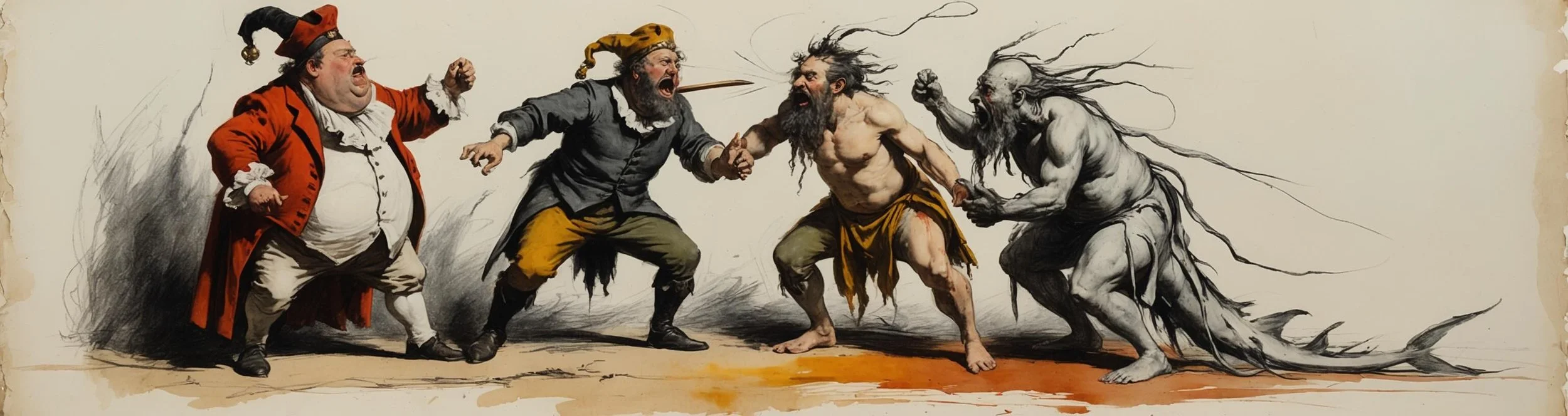
- What Happens: Caliban proposes that Stephano murder Prospero in his afternoon sleep, seize his books and take Miranda. Ariel, invisible, provokes a fight by calling Trinculo a liar, then leads the three away with music.
- Key Characters: Caliban, Stephano, Trinculo; Ariel, invisible.
- Dramatic Function: The comic plot becomes a murder plot, and the play gives its most beautiful speech to the man planning the murder.
- Famous Quote:
"Be not afeard; the isle is full of noises,
Sounds and sweet airs, that give delight and hurt not."
(Caliban, Act 3, Scene 2) - Why It Matters: The scene holds the play’s cruellest plan and its loveliest poetry in the same mouth, which is the whole problem of Caliban in miniature.
Scene Summary
Stephano, Trinculo and Caliban are drinking the last of the wine. Stephano calls Caliban his servant-monster and promises to make him his lieutenant; Trinculo mocks the monster and observes that if the other two people on the island are as drunk as these three, the state totters. Caliban asks to be allowed to lick his lord’s shoe, refuses to serve Trinculo because he is not valiant, and complains of his mockery; Stephano threatens to hang the jester from the next tree if he proves a mutineer, and tells Caliban to kneel and repeat his suit.
Ariel enters, invisible. Caliban says that a tyrant and sorcerer has cheated him of the island; Ariel says thou liest, and Caliban, thinking it was Trinculo, rages at him. Stephano warns Trinculo to hold his tongue. Caliban continues: if Stephano will take revenge on Prospero, he shall be lord of the island and Caliban will serve him. Ariel interrupts again; Stephano beats Trinculo for a lie he did not tell; Trinculo curses the bottle and moves away. Caliban then lays out the plan in detail. Prospero sleeps in the afternoon; seize his books first, because without them he is powerless and his spirits hate him; then brain him with a log, stab him with a stake, or cut his throat. Prospero’s daughter is a beauty beyond compare, and she would bear Stephano fine children.
Stephano decides: he will kill Prospero, marry the daughter and be king, with Trinculo and Caliban as viceroys. Trinculo approves, and Stephano apologises for beating him. Ariel resolves to tell its master. Caliban, delighted, asks for the catch Stephano taught him, and the two men sing. Ariel plays the tune on a pipe and drum, and the drunkards are terrified by music coming from nobody. Caliban tells them not to be afraid: the isle is full of noises and sweet airs that delight and do not hurt, and sometimes he dreams of clouds opening to drop riches on him and cries when he wakes to dream again. Stephano is pleased that his kingdom will come with free music; Trinculo suggests they follow the sound and do their work afterwards; and they go out after it.
A Court of Three
The scene begins as a parody of a court: a king with a bottle, a jester who mocks the king’s subject, and a subject who wants to lick the king’s shoe. Trinculo sees the joke and states it.
Original
Servant-monster! The folly of this island! They say there's but five upon this isle: we are three of them; if th' other two be brained like us, the state totters.
(Trinculo, Act 3, Scene 2)
Shakespeare Retold (Modern Verse)
Servant-monster! This island is bonkers! They say there’s only five people on this island: we are three of them. If the other two are as daft as us, the country is in trouble.
Five people on the island, three of them drunk, and the state totters. The line is a joke about the conspiracy, and it is also the play’s comment on every other government in it. Stephano’s court has ranks (lieutenant, standard, subject, mutineer), punishments (the next tree), and a protocol for petitions (kneel and repeat). It is power and control reduced to its gestures, and the gestures are Prospero’s own. The scene’s first movement is Caliban’s petition: he refuses to serve the jester because Trinculo is not valiant, and asks his lord for protection from mockery, which Stephano grants with a threat of hanging. A monster, a butler and a fool have reconstructed the hierarchy of Naples in an afternoon, and the reconstruction is exact enough to be uncomfortable.
The Plot Against Prospero
Ariel’s interruptions turn the petition into a farce, but the plan Caliban finally lays out is not funny at all. It is practical, detailed and correct about the one thing that matters.
Original
Why, as I told thee, 'tis a custom with him,
I' th' afternoon to sleep: there thou mayst brain him,
Having first seized his books, or with a log
Batter his skull, or paunch him with a stake,
Or cut his wezand with thy knife. Remember
First to possess his books; for without them
He's but a sot, as I am, nor hath not
One spirit to command: they all do hate him
As rootedly as I. Burn but his books.
(Caliban, Act 3, Scene 2)
Shakespeare Retold (Modern Verse)
Well, as I told you, he has got this ritual
To sleep each afternoon: that’s where you’ll kill him,
Once you have snatched his spell books, with a log
You’ll smash his skull, or stab him with a spear,
Or cut his windpipe with your knife. Remember
To get his books; for if he doesn’t have them,
He’s just a fool, like me, and doesn’t have
A single spirit to command. They hate him
As much as I do. Go and burn his books.
Take the books first. Caliban knows what Prospero’s power rests on, and he knows it better than anyone else in the play: without the books, Prospero is a sot like himself with not one spirit to command, and the spirits hate him as rootedly as Caliban does. The methods offered for the murder – a log, a stake, a knife to the windpipe – are the methods of a man who has carried logs and cut wood for twelve years, and the tools are the tools of his servitude. The speech is the clearest statement in the play of what magic and art is from underneath: not art but equipment, and equipment can be seized. It also shows Caliban’s loyalty being bought again. The plan is offered as a gift, with Miranda thrown in as a bonus, and Stephano’s response – kill this man, marry the daughter, be king – is Antonio’s plot from Act 2 with the rhetoric removed. Ariel hears it all, and the audience knows that Prospero will too.
The Isle Is Full of Noises
Ariel’s music terrifies the two Neapolitans, and Caliban comforts them. The speech that follows is the most beautiful in the play, and it belongs to the character who has just planned a murder.
Original
Be not afeard; the isle is full of noises,
Sounds and sweet airs, that give delight and hurt not.
Sometimes a thousand twangling instruments
Will hum about mine ears, and sometime voices
That, if I then had waked after long sleep,
Will make me sleep again: and then, in dreaming,
The clouds methought would open and show riches
Ready to drop upon me that, when I waked,
I cried to dream again.
(Caliban, Act 3, Scene 2)
Shakespeare Retold (Modern Verse)
Don’t be afraid; the isle is full of noises,
Sounds and sweet tunes that bring delight, not pain.
Sometimes a thousand plucking instruments
Will hum around my ears, and sometimes voices
That, if I’d woken from a slumberous sleep,
Would put me back to sleep again. Then, dreaming,
I’d think the clouds would open, showing gold
To drop upon me, so that when I woke up,
I cried to have the dream again.
The island Caliban describes is the island nobody else can hear: full of sounds and sweet airs that give delight and hurt not, a thousand twangling instruments, voices that put him to sleep and dreams in which the clouds open to drop riches on him. The last line is the one that matters. When he wakes he cries to dream again, and the phrase gives his rebellion a motive that is not spite. He has had the dream and had it taken away; Prospero’s rule is pinches and cramps, and the noises are what the island was before. The speech reverses everything the scene has set up. The drunkards are afraid of the music; the monster is at home in it. Stephano’s response – a brave kingdom, with music for nothing – is the play’s joke about illusion and reality: the man who plans to own the island cannot hear it, and the man who can hear it is planning to hand it over. Then the music moves and they follow, which is what Ariel intended, and what Prospero’s art does to everyone on the island.
Language and Technique
- Invisible interruption: Ariel’s “Thou liest”, spoken three times in Trinculo’s voice, drives the scene’s farce: a lie nobody told, punished with a beating, is the play’s method of making fools of conspirators.
- Prose plot, verse dream: Caliban’s murder plan is in verse and so is his speech about the noises; the drunkards answer both in prose. The contrast is the scene’s argument.
- The catalogue of methods: Brain him, batter his skull, paunch him, cut his wezand: the list of ways to kill Prospero is a labourer’s inventory, and every tool in it is one Caliban has used for work.
- Books as the source of power: “Remember / First to possess his books” – Caliban’s insight that magic is equipment, repeated three times, is the scene’s most important practical observation.
- Sound effects: The tune played by “the picture of Nobody” is stage magic: invisible music that the audience hears and the characters cannot explain.
- The dream that ends in tears: “I cried to dream again” – a single plain line that turns a description of pleasure into an account of loss.
Key Quotes from Act 3, Scene 2
Quote 1
I say, by sorcery he got this isle;
From me he got it. If thy greatness will
Revenge it on him, – for I know thou darest,
But this thing dare not...
(Caliban, Act 3, Scene 2)
Shakespeare Retold (Modern Verse)
I say, he won this island using magic;
He stole it from me. If you, my great leader,
Will take revenge on him…I know you dare,
Unlike me, I don’t dare…
Quote Analysis: Caliban’s case against Prospero, put to his new lord: the island was got by sorcery and taken from him. The modern verse keeps the accusation and the flattery that follows it, since Stephano is brave and Trinculo is not. Notice the word sorcery – Prospero calls his own magic art.
Yea, yea, my lord: I'll yield him thee asleep,
Where thou mayst knock a nail into his head.
(Caliban, Act 3, Scene 2)
Shakespeare Retold (Modern Verse)
Yes, yes, my lord; I’ll take you when he’s sleeping,
So you can knock a nail into his head.
Quote Analysis: The first version of the plan, before the books are mentioned: catch him asleep and knock a nail into his head. The modern verse keeps the nail. Caliban’s plots are always domestic, made from the objects of his labour.
And that most deeply to consider is
The beauty of his daughter; he himself
Calls her a nonpareil: I never saw a woman,
But only Sycorax my dam and she;
But she as far surpasseth Sycorax
As great'st does least.
(Caliban, Act 3, Scene 2)
Shakespeare Retold (Modern Verse)
But what you really need to think about is
How beautiful his daughter is. He says
She is unmatched. I never saw a woman,
Except for Sycorax – my mum – and her;
But she’s more beautiful than Sycorax,
Quite opposite to her.
Quote Analysis: Miranda offered as part of the bargain. Caliban has seen only two women, his mother and Prospero’s daughter, and measures one against the other; the modern verse keeps the comparison. The line reminds the audience of the attempted rape in Act 1, and of how the play uses Miranda as the prize in every plot.
This will prove a brave kingdom to me, where I shall have my music for nothing.
(Stephano, Act 3, Scene 2)
Shakespeare Retold (Modern Verse)
This will be a wonderful kingdom for me, where I shall have my music played for nothing.
Quote Analysis: Stephano’s answer to the most beautiful speech in the play is to price it. Music for nothing, in a kingdom to be won by murder: the modern prose keeps the small-mindedness exact, and the audience hears what Caliban has thrown himself away on.
Key Takeaways
- The books are the power: Caliban’s insistence that Prospero’s books must be seized first is the play’s plainest statement that magic is a possession, not a gift.
- A murder plot in beautiful verse: The same character plans to cut Prospero’s throat and describes the island’s music: the scene refuses to let Caliban be simply monster or simply victim.
- Ariel runs the scene: The invisible interruptions and the music are Prospero’s art at work; the conspirators are being watched and led from the first line.
- A parody of court and kingdom: Stephano’s lieutenant, standard, mutineer and viceroys mirror the real hierarchy of Naples, and the state totters.
Study Questions and Analysis
What is Caliban’s plan to kill Prospero?
To catch him asleep in the afternoon, which Caliban says is his custom, and kill him with whatever comes to hand: a log to batter his skull, a stake to stab him, a knife to cut his throat. The essential step comes first. Stephano must seize Prospero’s books, because without them he is as powerless as Caliban and has not one spirit to command; the spirits, Caliban adds, hate Prospero as deeply as he does. Then Stephano is to burn the books, take the fine things in Prospero’s cell, and marry his daughter.
Why, as I told thee, 'tis a custom with him,
I' th' afternoon to sleep: there thou mayst brain him,
Having first seized his books, or with a log
Batter his skull, or paunch him with a stake,
Or cut his wezand with thy knife. Remember
First to possess his books; for without them
He's but a sot, as I am, nor hath not
One spirit to command: they all do hate him
As rootedly as I. Burn but his books.
(Caliban, Act 3, Scene 2)
Shakespeare Retold (Modern Verse)
Well, as I told you, he has got this ritual
To sleep each afternoon: that’s where you’ll kill him,
Once you have snatched his spell books, with a log
You’ll smash his skull, or stab him with a spear,
Or cut his windpipe with your knife. Remember
To get his books; for if he doesn’t have them,
He’s just a fool, like me, and doesn’t have
A single spirit to command. They hate him
As much as I do. Go and burn his books.
The plan is more intelligent than the men it is offered to. Caliban has understood that magic and art on this island is a matter of equipment, and his three reminders about the books show that he knows exactly where Prospero is vulnerable; Prospero himself will confirm it in Act 5, when he drowns the book as the act that ends his power. What defeats the plot is not its design but its executors. Ariel overhears everything, leads the three into a bog, and hangs gaudy clothes on a line by Prospero’s cell in Act 4, and Stephano and Trinculo stop to loot the clothes while Caliban begs them to get on with the murder. Frank Kermode (1954) read Caliban as the play’s figure of nature against Prospero’s art; this scene shows nature reasoning quite clearly about how art works, and being let down by drink.
Why does Ariel keep saying “Thou liest”?
To break up the conspiracy by setting the conspirators against each other, and to make fools of them for the audience. Ariel, invisible, throws the accusation into Caliban’s speech three times, each time in Trinculo’s voice; Caliban rages at the jester, Stephano warns him, and finally beats him for a lie he never told. The trick works because the three are drunk and because none of them can imagine a fourth voice, so the interruptions are simply blamed on the man standing nearest.
The device is Prospero’s method in comic form. Everywhere on the island his art produces confusion in people who cannot see its source: the courtiers hear lions, Ferdinand follows music, the drunkards fight over an invisible lie. Samuel Johnson, in his 1765 notes, admired the play’s airy spirits for their humorous and frolic control of nature, and this scene is the clearest example of frolic used as policy. It also plants the pattern for the scene’s end, when the same invisible Ariel plays the catch on a pipe and drum and the terrified drunkards are led away by it. The lie and the tune are the same trick, and the audience, who can see the trickster, is invited to enjoy both.
What does Caliban’s speech about the island’s noises mean?
It is his answer to Stephano’s fear of the invisible music, and it becomes a description of the island as he experiences it: full of sounds and sweet airs that delight and never hurt, a thousand instruments humming about his ears, voices that lull him to sleep, and dreams in which the clouds open and riches are about to fall on him. When he wakes, he says, he cries to dream again. The speech is the play’s most famous passage after Prospero’s revels, and it belongs to the character everyone else calls a monster.
Sometimes a thousand twangling instruments
Will hum about mine ears, and sometime voices
That, if I then had waked after long sleep,
Will make me sleep again: and then, in dreaming,
The clouds methought would open and show riches
Ready to drop upon me that, when I waked,
I cried to dream again.
(Caliban, Act 3, Scene 2)
Shakespeare Retold (Modern Verse)
Sometimes a thousand plucking instruments
Will hum around my ears, and sometimes voices
That, if I’d woken from a slumberous sleep,
Would put me back to sleep again. Then, dreaming,
I’d think the clouds would open, showing gold
To drop upon me, so that when I woke up,
I cried to have the dream again.
Its placement is the point. Samuel Taylor Coleridge, lecturing in 1811, called Caliban in some respects a noble being, a creature whose images are all drawn from nature and highly poetical, and this speech is his evidence. But the same man has just described how to cut Prospero’s throat, and the play does not let the audience separate the two. The dream of riches from the clouds is what the island was before Prospero, or what Caliban remembers it as; the crying on waking is what it is now. The speech gives the plot against Prospero a motive that is not only revenge, and it raises, in the middle of a comic scene, the play’s serious question about nature and nurture: whoever taught Caliban language did not teach him this.
Why does Caliban call Prospero’s magic “sorcery”?
Because from where Caliban stands it is. He tells Stephano that a tyrant and sorcerer has cheated him of the island, and later that Prospero got it by sorcery. Prospero, by contrast, never uses the word of himself; his magic is always art, secret studies, potent art, and the words witch and sorcery are kept for Sycorax. The scene is the only place in the play where Prospero’s magic is described entirely by someone it is used against.
The vocabulary matters because the distinction between art and sorcery was a live one in 1611, when the king in the audience had written a book against witchcraft and the law punished conjuration. The play protects Prospero by giving him the learned magician’s vocabulary and Sycorax the witch’s, and Caliban’s word is the crack in the protection: a slave does not care which kind of magic pinches him. Readers of the play as a study of colonialism and empire, from Paul Brown (1985) onwards, have made much of this reversal, since it lets the island’s native name the coloniser’s power in the coloniser’s own terms of abuse. It is worth remembering, too, that Prospero will call his own magic rough when he gives it up.
How is Stephano’s plot different from Antonio’s?
In everything but its shape. Antonio’s temptation of Sebastian in Act 2, Scene 1 is conducted in verse, by a man who has done it before, through a chain of reasoning about heirs and distances that makes murder look like destiny; Stephano’s decision takes four lines of prose and is prompted by a monster’s description of a girl. Antonio has no conscience and knows it; Stephano has no thoughts at all. One plot is against a king, the other against a magician; one is interrupted by Ariel’s song, the other led astray by Ariel’s tune.
The parallel is deliberate and the difference is instructive. Jan Kott (1964) read the play as the same story of power told at every level of the island, and the comic version deflates the serious one: after watching a butler resolve to be king because a monster has offered him a bride, the audience finds Antonio’s rhetoric of prologue and discharge harder to admire. Both plots also fail for the same reason, which is that Prospero’s art is watching. The difference the play does insist on is in the outcome. Stephano and Trinculo are pardoned as fools; Antonio is forgiven as a villain and never says a word in reply.
Why do the conspirators follow the music?
Because Ariel plays it and they cannot help themselves. The tune is the catch Stephano has just taught Caliban, played on a pipe and drum by nobody they can see; Trinculo calls it the picture of Nobody, Stephano challenges it to show itself, and both are frightened. Caliban reassures them, Stephano decides the music is a perk of his future kingdom, and Trinculo suggests they follow the sound and do their murder afterwards. So they go, and the murder is never done.
The music does what music does everywhere in the play: it moves people where Prospero wants them. Ferdinand followed Ariel’s song up the beach to Miranda; Gonzalo was woken by a song from the swords; the courtiers will be drawn to a banquet by strange shapes and solemn music in the next scene. Here the conspirators are led off towards the filthy pond that Ariel will describe in Act 4, and the scene’s structure makes the point without comment. Three men have just planned to seize the island by force; the island’s own music leads them away like children. The theme of illusion and reality in this play is carried as much by sound as by sight, and this scene is its clearest demonstration.