The Tempest: Act 3, Scene 1 – Analysis
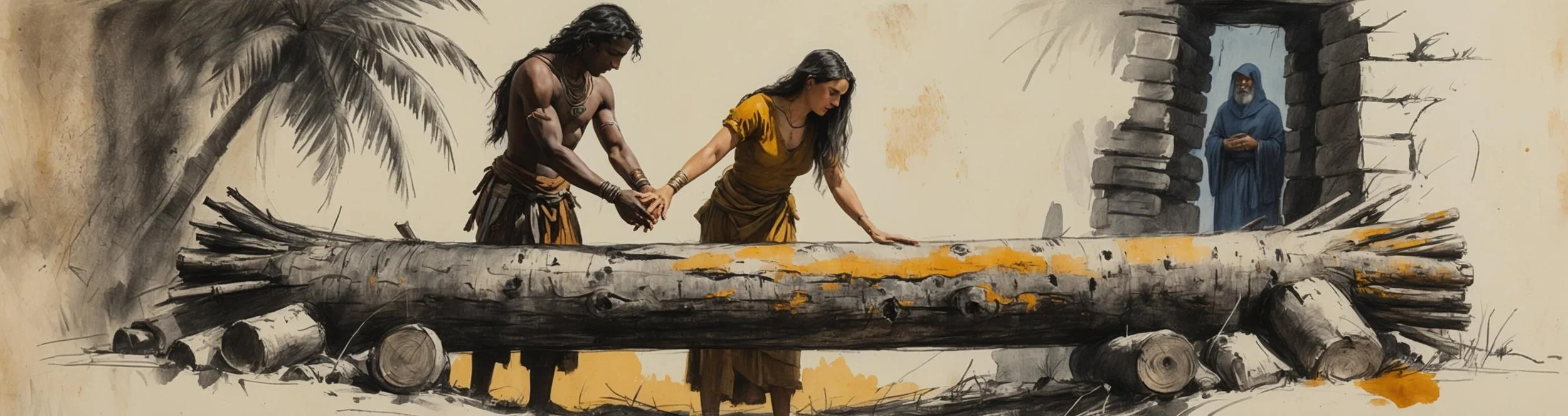
Scene Profile – At a Glance
- Location: Before Prospero’s cell, where Ferdinand has been set to carrying logs.
- What Happens: Ferdinand finds his labour light because Miranda watches him. She offers to carry his logs, tells him her name, and proposes marriage; he accepts. Prospero, unseen, blesses the match.
- Key Characters: Ferdinand and Miranda; Prospero, watching unseen.
- Dramatic Function: The love plot is settled: the betrothal that will unite Naples and Milan is made in a hundred lines, under the eye of the man who arranged it.
- Famous Quote:
"I am your wife, if you will marry me;
If not, I'll die your maid: to be your fellow
You may deny me; but I'll be your servant,
Whether you will or no."
(Miranda, Act 3, Scene 1) - Why It Matters: The play’s only love scene is also its most direct study of service: a prince carrying logs for love, a princess offering to carry them for him, and a father watching his plan come true.
Scene Summary
Ferdinand enters carrying a log. Prospero has set him to shifting thousands of them, and he reflects that some kinds of baseness are nobly undergone: the task would be hateful, but the mistress he serves makes his labours pleasures, and she weeps when she sees him work. Miranda comes to him, with Prospero following unseen. She begs him to rest, says her father is safe at his studies for three hours, and offers to carry the logs herself. Ferdinand refuses: he would rather break his back than see her do such work while he sat by. Prospero, aside, notes that his daughter is infected with love.
Ferdinand asks her name, so that he can put it in his prayers. She tells him, and at once realises she has broken her father’s command. Ferdinand calls her admired Miranda, the top of admiration, and says that though he has liked many women for their several virtues, each had some defect, and she alone is perfect. Miranda answers that she has never seen another woman’s face except her own in a mirror, nor any men but him and her father, and cannot imagine wanting any companion but him. Ferdinand tells her that he is a prince and probably now a king, that he would never endure this wooden slavery but for her sake, and that his heart flew to her service the instant he saw her. She asks whether he loves her; he calls heaven and earth to witness that he does, beyond all limit.
Miranda weeps at her own unworthiness, then puts aside what she calls bashful cunning and proposes: she is his wife if he will marry her, and if not she will die his maid; he may refuse her as a companion, but she will be his servant whether he will or no. Ferdinand answers that he is hers, and humble ever, and gives her his hand; she gives him hers, with her heart in it, and they part for half an hour. Prospero, left alone, says he cannot be as glad as they are, who are surprised by it, but that nothing could rejoice him more, and goes to his book, since there is much business to do before supper.
The Patient Log-Man
The scene opens with a prince doing a slave’s work and explaining why he does not mind. His soliloquy is a small essay on service, and it announces the scene’s subject.
Original
There be some sports are painful, and their labour
Delight in them sets off: some kinds of baseness
Are nobly undergone and most poor matters
Point to rich ends. This my mean task
Would be as heavy to me as odious, but
The mistress which I serve quickens what's dead
And makes my labours pleasures...
(Ferdinand, Act 3, Scene 1)
Shakespeare Retold (Modern Verse)
Some sports are painful, but the effort needed
Brings great delight; and sometimes, menial tasks
Are done without complaint, for tiresome jobs
End up being rewarding. This tough job
Would be as tough for me as it is dull, but
The lady that I do it for relieves
The pain and makes it pleasurable.
Ferdinand’s argument is that labour is transformed by what it is for. Some sports are painful and the pain sets off the delight; some baseness is nobly undergone; poor matters point to rich ends. The logs are Prospero’s test, and Ferdinand passes it without knowing it is one, because the mistress he serves quickens what is dead. The vocabulary is the vocabulary of masters and servants, and the play puts it in the mouth of the one character who serves willingly. Caliban carries the same wood under threat of cramps; Ariel serves for the promise of freedom; Ferdinand carries logs because a girl weeps when she sees him do it. The scene invites the comparison and does not labour it. What it establishes is that on this island the same task can be slavery or devotion depending on who has set it and why, and that Prospero, who set this one, is standing a few feet away.
Miranda Proposes
The courtship breaks every rule the play’s first audience would have known, because Miranda does not know the rules. Her speech about what she has and has not seen is the reason.
Original
I do not know
One of my sex; no woman's face remember,
Save, from my glass, mine own; nor have I seen
More that I may call men than you, good friend,
And my dear father: how features are abroad,
I am skilless of; but, by my modesty,
The jewel in my dower, I would not wish
Any companion in the world but you,
Nor can imagination form a shape,
Besides yourself, to like of.
(Miranda, Act 3, Scene 1)
Shakespeare Retold (Modern Verse)
I don’t know
Another lady; I’ve not seen a woman,
Except me in the mirror; nor have I seen
Another man except for you, good friend,
And my dear father. How outsiders look,
I’ve no idea; but I swear as a virgin –
The purest gift to give you – I would not wish
To marry anyone except for you,
And nor can I imagine anybody,
Except for you, to love.
She has seen no woman’s face but her own in a glass, and no men but Ferdinand and her father. The admission would be a confession of ignorance in any other heroine; here it is the ground of a startling directness, since a girl with no models has no idea that she is supposed to wait to be asked. So she asks. The proposal is prefaced by a self-rebuke – hence, bashful cunning – and delivered as a set of terms: wife if he will marry her, maid if he will not, servant either way. It is the play’s most complete statement of love as service, and it is made by the character with the least power on the island, to a prince who has just said that his heart flew to her service the instant he saw her. The two are competing to serve each other, and the scene’s argument about nature and nurture is settled by the competition: whatever Prospero’s schooling gave Miranda, this directness is her own.
The Watcher
Prospero has three speeches in the scene, all asides, and the last is a soliloquy. Together they turn a love scene into a scene about the man watching it.
Original
So glad of this as they I cannot be,
Who are surprised withal; but my rejoicing
At nothing can be more. I'll to my book,
For yet ere supper-time must I perform
Much business appertaining.
(Prospero, Act 3, Scene 1)
Shakespeare Retold (Modern Verse)
I cannot be as glad of this as they are,
For they’re surprised, but it’s my plan; I’m thrilled,
And can’t be happier. Now, to my magic,
For I’ve some work to do prior to supper
About the love between them.
His first aside is clinical – poor worm, thou art infected – and his second is a blessing. The closing speech is both, and something else besides. He cannot be as glad as the lovers, because they are surprised by what has happened and he is not; the joy is theirs, the plan is his. Then he goes back to his book, because there is business to finish before supper. The lines are the play’s clearest picture of Prospero as director, pleased with a scene that has gone as written and already thinking about the next one. They also carry a loss the play never states outright: a father who has arranged his daughter’s marriage cannot share the surprise that makes it a marriage rather than a transaction. The scene’s argument about power and control is here, in a man who has got exactly what he wanted and notes that it is not the same as getting it by chance.
Language and Technique
- Soliloquy as argument: Ferdinand’s opening speech reasons its way from painful sports to pleasurable labour – the logic of a man persuading himself that he is happy, and succeeding.
- Asides: Prospero speaks three times over the lovers’ heads, so the audience watches the courtship twice: once as it happens and once as it was planned.
- Superlatives: “Admired Miranda”, “the top of admiration”, “so perfect and so peerless”: Ferdinand’s praise is built on extremes, and her name itself means the one to be wondered at.
- Plain speech: Miranda’s proposal is in the plainest language of the play – wife, maid, servant – which is what makes it a proposal and not a compliment.
- The language of bondage: Slave, service, bondage, freedom: the lovers borrow the play’s vocabulary of mastery to describe love, and turn it inside out.
Key Quotes from Act 3, Scene 1
Quote 1
If you'll sit down,
I'll bear your logs the while: pray, give me that;
I'll carry it to the pile.
(Miranda, Act 3, Scene 1)
Shakespeare Retold (Modern Verse)
If you’ll sit down,
I’ll lift some of your logs: please, give me that;
I’ll carry it to the pile.
Quote Analysis: Miranda’s offer to carry the logs is the scene’s first act of love, and it is practical. The modern verse keeps it as plain as the original: sit down, give me that, I will carry it. Ferdinand’s refusal is the gallantry the play expects; her offer is the surprise.
I am in my condition
A prince, Miranda; I do think, a king;
I would, not so! – and would no more endure
This wooden slavery than to suffer
The flesh-fly blow my mouth. Hear my soul speak:
The very instant that I saw you, did
My heart fly to your service; there resides,
To make me slave to it; and for your sake
Am I this patient log-man.
(Ferdinand, Act 3, Scene 1)
Shakespeare Retold (Modern Verse)
I am
A prince, Miranda; and, I think, a king –
I wish it wasn’t so! – and I’d no more
Endure this log-work slavery than let
A fly breed in my mouth. But hear my heart speak:
The very moment I first saw you, then
I gave my heart to you; and there it lives,
So I’m a slave to you now; and for you,
I am this patient log-man.
Quote Analysis: Ferdinand’s declaration, which begins with rank and ends with a log. He is a prince, and probably a king, and he would not endure this slavery for anything but her; the modern verse keeps the movement from title to service, and the final self-description, patient log-man, is its own joke.
Fair encounter
Of two most rare affections! Heavens rain grace
On that which breeds between 'em!
(Prospero, Act 3, Scene 1)
Shakespeare Retold (Modern Verse)
That’s lovely
And rare when two loves meet! May heaven grant them
A happy path ahead!
Quote Analysis: Prospero’s blessing, spoken to nobody. It is the warmest thing he says in the play, and the lovers do not hear it; the modern verse keeps the prayer for grace on what is growing between them, which is also a prayer for the plan.
Key Takeaways
- Service turned into love: Ferdinand carries logs, Miranda offers to carry them, and each claims to be the other’s servant: the play’s vocabulary of mastery becomes the vocabulary of courtship.
- Miranda breaks the rules: She disobeys her father twice in a hundred lines, by giving her name and by proposing, and the play treats both as innocence rather than rebellion.
- A wedding under observation: Prospero watches the whole scene unseen, blesses the match, and goes back to work: the love story is his plot’s success as much as the lovers’.
- The play’s centre of calm: Between the murder plot of Act 2 and the drunken conspiracy of the next scene, this is the one scene in which nobody threatens anybody.
Study Questions and Analysis
Why does Prospero make Ferdinand carry logs?
He says why in Act 1, Scene 2: the two have fallen in love too quickly, and too light a winning would make the prize light. The log-carrying is a trial designed to make the love cost something, and it works exactly as intended. Ferdinand finds the labour light because Miranda watches him, Miranda’s pity for him turns into a proposal, and Prospero, listening, gets the betrothal he planned.
The test also has a shape that the play repeats. Carrying wood is Caliban’s job – he is sent for fuel in the same scene in which Ferdinand is captured – and giving the prince the slave’s task puts the play’s question about masters and servants in its plainest form. The difference is not the work but the reason for it. Ferdinand’s soliloquy argues that baseness can be nobly undergone when it points to rich ends; Caliban, in the next scene, is plotting to murder the man who set him the same labour. Frank Kermode’s Arden edition (1954) read the contrast as central to the play’s opposition of nurture and nature, with Ferdinand’s willing service as the civil version of Caliban’s forced one. Whether that is fair to Caliban is a question the play leaves open, but the parallel is certainly deliberate.
Why is Miranda’s proposal so unusual?
Because a woman proposing marriage, in plain terms, on her own initiative, is almost unknown on the Jacobean stage, and Miranda does it in a dozen lines: she is his wife if he will marry her, and if not she will die his maid. She has already broken her father’s command by telling Ferdinand her name, and she says so out loud. The play presents both acts of disobedience as the natural behaviour of a girl who has never seen a courtship and does not know she is supposed to wait.
I am your wife, if you will marry me;
If not, I'll die your maid: to be your fellow
You may deny me; but I'll be your servant,
Whether you will or no.
(Miranda, Act 3, Scene 1)
Shakespeare Retold (Modern Verse)
I’ll be your wife, if you will marry me;
If not, I’ll die a virgin. As your wife,
You’re free to turn me down; but I will serve you,
If you say yes or no.
The proposal is also the play’s most exact statement of love as a form of service, since Miranda offers to be his servant whether he will or no, and Ferdinand has just said that his heart flew to her service the instant he saw her. Critics have read the speech in opposite ways. Anne Barton, in her New Penguin edition (1968), found in the play a work that lends itself to almost any interpretation, and Miranda’s directness has been taken both as Shakespeare’s picture of unspoilt nature and, by Lorie Jerrell Leininger in “The Miranda Trap” (1980), as evidence of how completely Prospero’s plot needs her to fall in love on cue. The scene supports both. She speaks for herself, and she speaks exactly the lines her father’s plan requires.
What is the significance of Miranda’s name?
It means the one who is to be wondered at, from the Latin, and Ferdinand hears the meaning at once: admired Miranda, the top of admiration. The name is the first thing she gives him, against her father’s orders, and his response turns it into a title. The play is full of wonder – it is the word Miranda herself will use in Act 5 for the brave new world – and her name makes her the object of it.
It also connects her to the play’s pattern of seeing. Ferdinand took her for a goddess when he first saw her, Prospero describes the lovers as having changed eyes, and the whole scene is watched by a hidden father. Miranda is the play’s most looked-at character and, until this scene, its least heard; her speech about never having seen another woman’s face makes the point that she has done very little looking herself. The proposal changes that. For the length of one speech she is the one who acts, and the man who wonders at her is the one who answers.
What does Prospero’s final speech in the scene mean?
That he is pleased, and that his pleasure is different in kind from the lovers’. They are surprised by what has happened; he is not, because he arranged it, so he cannot be as glad as they are. But nothing could rejoice him more, and he goes back to his book, since there is much business to do before supper. The speech is the play’s clearest expression of Prospero as the author of what the other characters experience as life.
So glad of this as they I cannot be,
Who are surprised withal; but my rejoicing
At nothing can be more. I'll to my book,
For yet ere supper-time must I perform
Much business appertaining.
(Prospero, Act 3, Scene 1)
Shakespeare Retold (Modern Verse)
I cannot be as glad of this as they are,
For they’re surprised, but it’s my plan; I’m thrilled,
And can’t be happier. Now, to my magic,
For I’ve some work to do prior to supper
About the love between them.
G. Wilson Knight, in The Crown of Life (1947), argued that Prospero automatically reflects Shakespeare himself, and this speech is often cited in support: a dramatist watching a love scene go as written, and turning to the next one. But the speech also admits a cost. A man who has planned everything is denied the one thing the lovers have, surprise, and the play’s later scenes – the vexed interruption of the masque, the third thought given to the grave – suggest that the cost is real. The business before supper is the drunkards’ plot and the harpy’s banquet; the man who has just blessed a marriage is about to go and torment his enemies.
How does this scene fit into the structure of the play?
It is the still centre. On either side of it are plots to kill a ruler – Antonio’s against Alonso in Act 2, Scene 1, and Caliban’s against Prospero in Act 3, Scene 2 – and the love scene sits between them as the one piece of the afternoon in which nothing is threatened. It is also the point at which Prospero’s plan for the future is secured: with Ferdinand and Miranda betrothed, Naples and Milan will be united by marriage, and everything that follows is the settling of the past.
The scene’s placement also shapes the play’s argument about imprisonment and freedom. Ferdinand is technically a prisoner, and describes his service as slavery; Miranda offers to be a servant; and both are happier than anyone else on the island. The next scene shows Caliban, Stephano and Trinculo planning their liberation through murder, and the contrast does the work of a whole essay. The play’s freest people, at this point, are two captives who have chosen each other, and its least free are three men who think they are about to inherit a kingdom.