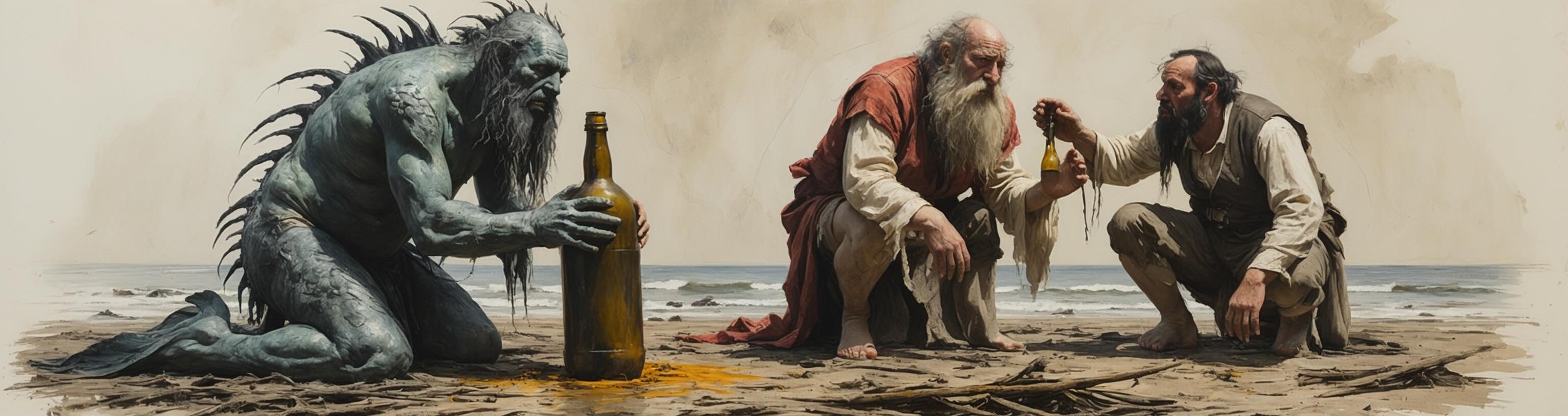
Scene Profile – At a Glance
- Location: Another part of the island, in a thunderstorm.
- What Happens: Caliban, cursing Prospero, hides from a stranger under his cloak. Trinculo the jester crawls in beside him; Stephano the drunken butler finds a four-legged monster with two voices, gives it wine, and gains a worshipper.
- Key Characters: Caliban; Trinculo, the king’s jester; Stephano, the king’s butler.
- Dramatic Function: The comic plot begins: the play’s third power grab, in which the island’s native swears himself the subject of a drunk with a bottle.
- Famous Quote:
"misery acquaints a man with strange bed-fellows."
(Trinculo, Act 2, Scene 2) - Why It Matters: The scene parodies everything serious in the play – discovery, worship, mastery, freedom – and gives Caliban a new god who is worse than the old master.
Scene Summary
Caliban enters with a load of wood, cursing Prospero and describing the torments his spirits inflict: apes that bite, hedgehogs in his path, adders that hiss him mad. Thunder sounds and a stranger approaches; Caliban takes him for a spirit sent to punish him and lies flat under his cloak. The stranger is Trinculo, the king’s jester, looking for shelter from the coming storm. He finds the shape on the ground, cannot decide whether it is a man or a fish, and reflects that in England, where people will not give a penny to a beggar but will pay to see a dead Indian, such a monster would make his fortune. When the thunder returns he crawls under the cloak too: misery, he says, acquaints a man with strange bedfellows.
Stephano, the king’s butler, arrives drunk, singing sea-songs, with a bottle he has made from bark. He finds a creature with four legs and two voices, one of which cries out not to be tormented, and decides it is a monster of the island with a fever that he might tame and take to Naples to sell. He pours wine into one mouth; the other mouth calls him by name. It is Trinculo, and the two Neapolitans, each of whom thought the other drowned, are reunited over the monster’s body. Stephano explains that he floated ashore on a barrel of wine.
Caliban, who has never tasted wine, decides that the man with the bottle is a god who has dropped from the moon, and swears on the bottle to be his subject. He offers to show his new master every fertile inch of the island, to dig him pignuts, catch him marmosets and fetch him young seabirds from the rocks, and curses the tyrant Prospero whose sticks he will carry no more. Trinculo thinks it the most ridiculous thing he has ever seen. Stephano, reasoning that the king and everyone else are drowned, announces that they will inherit the island, and Caliban leads them off singing that he has a new master and is free.
Curses and Torments
The scene opens with Caliban alone, and the audience learns what Prospero’s rule feels like from underneath. The speech is a catalogue of small cruelties, and it explains the rest of the scene.
Original
All the infections that the sun sucks up
From bogs, fens, flats, on Prosper fall and make him
By inch-meal a disease!
(Caliban, Act 2, Scene 2)
Shakespeare Retold (Modern Verse)
May all infections rising in the air
From boggy swamps taint Prospero and make him
Be inch-by-inch diseased!
Caliban curses knowing that he will be punished for it – his spirits hear me, and yet I needs must curse – and the torments he describes are not grand but constant: pinches, fright-shows, being led astray in the dark, apes and hedgehogs and adders set on him for every trifle. It is the daily texture of the relationship between masters and servants that Prospero’s speeches present as justice. The second half of the speech shows the result. A stranger appears, and Caliban assumes he is a spirit come to torment him for bringing wood in slowly, so he lies down and hopes not to be noticed. That reflex, the flinch of a creature who expects to be hurt, is what the comedy that follows is built on; every misunderstanding in the scene begins with Caliban’s fear.
A Man or a Fish?
Trinculo’s examination of the thing under the cloak is the play’s most explicit joke about the New World, and it is a joke at England’s expense.
Original
This is some monster of the isle with four legs, who hath got, as I take it, an ague. Where the devil should he learn our language? I will give him some relief, if it be but for that. If I can recover him and keep him tame and get to Naples with him, he's a present for any emperor that ever trod on neat's leather.
(Stephano, Act 2, Scene 2)
Shakespeare Retold (Modern Verse)
This is some kind of monster from the island that has got, as far as I can tell, a fever. How on earth has he learnt our language? I will help him, if only because he can speak our language. If I can make him better and tame him and get him to Naples with me, he’s a fine present for any emperor that has ever worn leather shoes.
Trinculo cannot tell whether he is looking at a man or a fish, and settles the question by smell. Then he thinks of money. In England any strange beast makes a man’s fortune; the people who will not spare a coin for a lame beggar will pay to see a dead Indian. Stephano, arriving a few minutes later, has the same idea in the same words: tame the monster, get him to Naples, sell him to an emperor. Neither man has any interest in what the creature is; both see at once what it could fetch. The scene plants the play’s argument about colonialism and empire in its lowest register, where it is funniest and least deniable. Prospero at least taught Caliban language before enslaving him; the butler and the jester go straight to the price. And the bedfellows joke, which has become a proverb, is the scene’s own comment on the alliances that follow: a monster, a fool and a drunk, huddled under one cloak because the weather forced them.
A New God
Wine does in a minute what Prospero’s language lessons took years to do. Caliban, tasting it for the first time, finds a god, and the scene’s last movement is a parody of worship, mastery and liberation all at once.
Original
I'll show thee the best springs; I'll pluck thee berries;
I'll fish for thee and get thee wood enough.
A plague upon the tyrant that I serve!
I'll bear him no more sticks, but follow thee,
Thou wondrous man.
(Caliban, Act 2, Scene 2)
Shakespeare Retold (Modern Verse)
I’ll show you water springs; I’ll pick you berries;
I’ll fish for you and gather up your wood.
I curse that tyrant whom I work for now!
I’ll not bring wood for him; I’ll follow you,
You wondrous man.
The offer is the same offer Caliban made to Prospero twelve years ago, and the play wants the audience to hear the repetition: the springs, the berries, the fish, the wood, every fertile inch of the island shown to a newcomer in exchange for kindness. Caliban has learnt nothing, or rather he has learnt the wrong lesson, that a master who gives you something is a god. Trinculo says it for us – a most ridiculous monster, to make a wonder of a poor drunkard – and the scene’s closing song says it again in Caliban’s own mouth, since the freedom he celebrates is announced in the same breath as a new master. It is the play’s sharpest joke about imprisonment and freedom, and it is not only a joke about Caliban. Stephano’s plan to inherit the island because everyone else is drowned is Antonio’s plot from the previous scene, replayed with a bottle for a sword.
Language and Technique
- Prose for the clowns, verse for the monster: Stephano and Trinculo speak prose; Caliban, even drunk, speaks verse. The island’s native has the play’s higher register and its lowest company.
- The two-voiced monster: The physical joke of four legs and two voices under one cloak is a stage image of the scene’s theme: two men who are useless apart and worse together.
- Catalogue of torments: Apes, hedgehogs, adders: Caliban’s curse is a list, and the list makes Prospero’s punishments feel routine rather than terrible.
- Repetition with a difference: Caliban’s offer to show Stephano the island echoes his account of welcoming Prospero in Act 1, so the audience watches the same mistake made twice.
- Songs as character: Stephano’s sailor’s ballad about Kate and Caliban’s song of freedom bookend the scene: a drunkard’s tune and a slave’s, both about escape.
- The proverb: “Misery acquaints a man with strange bed-fellows” – a throwaway line that has outlived the scene, because it states a truth the whole play tests.
Key Quotes from Act 2, Scene 2
Quote 1
What have we here? A man or a fish? Dead or alive? A fish: he smells like a fish...
(Trinculo, Act 2, Scene 2)
Shakespeare Retold (Modern Verse)
What have we here? Is it a man or a fish? Is it dead or alive? It’s a fish: he stinks like a fish...
Quote Analysis: Trinculo’s first sight of Caliban, and the play’s first description of him by someone who does not own him. Man or fish, dead or alive: the questions are a showman’s, and the answer is settled by smell. The modern prose keeps the interrogation.
That's a brave god and bears celestial liquor.
I will kneel to him.
(Caliban, Act 2, Scene 2)
Shakespeare Retold (Modern Verse)
He is a strong god, bringing magic liquor.
I will pray to him.
Quote Analysis: Caliban’s conversion, in two lines. Wine is celestial liquor and the man holding it is a god; the modern verse keeps the kneeling. The play has already shown Ferdinand mistaking Miranda for a goddess, and the parody is deliberate.
I prithee, let me bring thee where crabs grow;
And I with my long nails will dig thee pignuts;
Show thee a jay's nest and instruct thee how
To snare the nimble marmoset; I'll bring thee
To clustering filberts and sometimes I'll get thee
Young scamels from the rock. Wilt thou go with me?
(Caliban, Act 2, Scene 2)
Shakespeare Retold (Modern Verse)
Please, let me take you where you’ll find some crabs;
And with my long nails, I’ll dig up some groundnuts;
I’ll take you to a jay’s nest, and I’ll teach you
To catch a nimble monkey; I will take you
To find some hazelnuts, and maybe get you
Some seabirds off the rock. Will you come with me?
Quote Analysis: The island as Caliban knows it: crabs, pignuts, jays’ nests, marmosets, filberts, seabirds on the rocks. The speech is the most detailed natural description in the play and it is offered to a drunk. The modern verse keeps the inventory and the eagerness.
Trinculo, the king and all our company else being drowned, we will inherit here...
(Stephano, Act 2, Scene 2)
Shakespeare Retold (Modern Verse)
Trinculo, the king and everyone else on board have drowned, so this land is ours.
Quote Analysis: Stephano’s claim to the island, made in passing between orders about the bottle. The king is drowned, so the butler inherits: it is Antonio’s logic from the previous scene, and the modern prose keeps the casualness.
Key Takeaways
- The third plot for power: Stephano’s claim to inherit the island repeats Antonio’s plot against Naples and Prospero’s rule, in prose and with a bottle.
- Caliban makes the same mistake twice: His offer to show Stephano the island’s springs and berries is the offer he once made to Prospero; kindness from a stranger still looks like divinity to him.
- Freedom with a new master: The closing song celebrates liberty in the same breath as a new master, which is the play’s joke about what freedom means to a slave.
- The New World for sale: Trinculo and Stephano both think first of exhibiting or selling the monster: the scene’s comedy carries the play’s sharpest point about colonial greed.
Study Questions and Analysis
Why does Caliban think Stephano is a god?
Because Stephano gives him wine, and Caliban has never tasted it. He calls it celestial liquor, decides that a man who carries it must have dropped from heaven, and when Stephano jokes that he was once the man in the moon, Caliban says he has seen him there, with his dog and his bush, because Miranda once showed him. The credulity is real: Caliban’s whole idea of the world comes from what Prospero and Miranda taught him, and a stranger with a bottle fits the pattern of a stranger with the names of the sun and moon.
I'll show thee the best springs; I'll pluck thee berries;
I'll fish for thee and get thee wood enough.
A plague upon the tyrant that I serve!
I'll bear him no more sticks, but follow thee,
Thou wondrous man.
(Caliban, Act 2, Scene 2)
Shakespeare Retold (Modern Verse)
I’ll show you water springs; I’ll pick you berries;
I’ll fish for you and gather up your wood.
I curse that tyrant whom I work for now!
I’ll not bring wood for him; I’ll follow you,
You wondrous man.
The play makes the repetition unmistakable. Caliban’s offer to show Stephano the island’s springs and berries and to fetch his wood is, almost word for word, his memory in Act 1 of welcoming Prospero, and his curse on the tyrant he serves is followed at once by an oath to serve someone else. Samuel Taylor Coleridge, lecturing in 1811, praised Caliban as a creature whose images are all drawn from nature, and the speeches to Stephano are the proof: crabs, pignuts, jays’ nests, marmosets, filberts. What Caliban lacks is not intelligence but experience of anyone who is not a master. His mistake is the play’s comment on nature and nurture: a creature nurtured only by servitude will worship whoever feeds him.
What does “misery acquaints a man with strange bedfellows” mean?
That hardship forces people together who would never otherwise choose each other. Trinculo says it as he crawls under Caliban’s cloak: the storm is returning, there is no other shelter, and the only bed available is beside a creature he has just decided is a fish or a monster. The line has become a proverb, usually with politics substituted for misery, and it survives because it is funny and true.
In the play it is more than a joke. Every alliance on the island is a strange bedfellowship made by circumstance: Antonio and Sebastian, Prospero and the spirit he keeps threatening, Ferdinand carrying logs for the man who calls him a traitor, and now a jester, a butler and a monster under one gaberdine. Trinculo’s line names the pattern in the scene that shows it most literally, with four legs and two voices sticking out from under a cloak. The modern prose gives it an equivalent idiom – when the chips are down, a man can end up in bed with strange people – so that the joke still lands on stage.
What is the joke about the dead Indian?
Trinculo, looking at the thing on the ground, thinks of what it would be worth in England. Any strange beast there makes a man’s fortune; the English will not give a small coin to a lame beggar, but they will pay ten to see a dead Indian. The joke refers to a real practice: native people from the Americas were brought to London in Shakespeare’s lifetime and exhibited, alive and sometimes dead, for money. Stephano has the same thought a few lines later, planning to tame the monster and sell him to an emperor.
The lines are the play’s most direct reference to the New World, and they are the reason the comic scenes have mattered so much to readers interested in colonialism and empire. Alden and Virginia Vaughan’s Shakespeare’s Caliban (1991) traces how the character was later taken for an American Indian, an African slave and a symbol of the colonised, and this scene is where the tradition starts: the first Europeans who meet him without Prospero’s mediation see him as an exhibit. The joke is on the English audience, who are told what they would pay for. Trinculo does not know it, but the monster he is pricing has just described the island’s every spring and pit, and speaks better verse than he does.
Why do Stephano and Trinculo speak prose while Caliban speaks verse?
Because Shakespeare gives verse to the character with the richer inner life, whatever his rank. Stephano and Trinculo are servants of the court, a butler and a jester, and they speak the prose of clowns throughout the play: puns, oaths, sea-songs and business with the bottle. Caliban, the monster they mean to sell, speaks in blank verse from his first line to his last, and some of the play’s most beautiful lines are his.
The contrast is the scene’s quiet argument. The two Neapolitans have every advantage of civilisation and use it for nothing but drink and profit; the island’s native, whom they call a moon-calf and a puppy-headed monster, describes his world in verse of real precision. William Hazlitt, in Characters of Shakespear’s Plays (1817), called Caliban the essence of grossness without a particle of vulgarity, and the distinction is exactly the one the verse makes: Caliban is coarse, but the drunkards are vulgar, and the language tells the audience which is which. A student tracking masters and servants across the play should notice that the servant here speaks better than the men who claim to be his masters.
How does this scene parallel the rest of the play?
It is the comic version of everything the serious scenes do. Trinculo’s discovery of Caliban parodies Ferdinand’s discovery of Miranda in the previous act: one stranger finds a goddess, the other finds a fish. Caliban’s worship of Stephano parodies the play’s real scenes of wonder. Stephano’s decision that the king is drowned and the island is his repeats Antonio’s temptation of Sebastian, which the audience has just watched. And the closing song of freedom with a new master is a parody of Ariel’s real bargain for liberty.
The parallels are structural, not decorative. Jan Kott, in Shakespeare Our Contemporary (1964), read the island as a place where the same story of power is played over and over at different levels, and this scene is the lowest level of the repetition: the plot to seize the island conducted by a drunk, a fool and a slave. It matters because it deflates the higher versions. After watching Stephano inherit the island by right of surviving a barrel, the audience finds it harder to take Antonio’s rhetoric of destiny at face value, and Prospero’s own claim to the island, made by right of arrival and books, looks less different from the butler’s than he would like.
What does Caliban’s song at the end of the scene mean?
He is singing that his old chores are over – no more dams for fish, no more fetching wood or scraping plates – because he has a new master, and the refrain is freedom. The song is the scene’s climax and its joke: the word freedom is shouted by a creature who has just sworn on a bottle to be another man’s subject and offered to kiss his foot. The play lets him enjoy the moment and lets the audience see the contradiction.
Freedom, hey-day! Hey-day, freedom! Freedom,
hey-day, freedom!
(Caliban, Act 2, Scene 2)
Shakespeare Retold (Modern Verse)
Freedom, hey-hey! Hey-hey, freedom! Freedom,
hey-hey, freedom!
The song has had a long afterlife. Aimé Césaire’s Une Tempête (1969) ends on Caliban’s cry of freedom, turned from a drunken chorus into a liberation slogan, and productions since have often played the moment as real joy rather than delusion. The text allows both. Caliban’s freedom is a change of owner, but the impulse behind it, the refusal to bear the tyrant’s sticks any longer, is the same impulse that gives him the play’s speech about the island’s noises in the next act. The question of what imprisonment and freedom mean on an island where everyone serves someone is asked here, in a song, and it is not answered until Ariel is set free in Act 5.