
The Tempest: Act 2, Scene 1 – Analysis
Scene Profile – At a Glance
- Location: Another part of the island, where the king’s party has come ashore.
- What Happens: Gonzalo tries to comfort the grieving king while Antonio and Sebastian mock him. Ariel puts the court to sleep, and Antonio talks Sebastian into murdering Alonso; Ariel wakes Gonzalo just in time.
- Key Characters: Alonso, Gonzalo, Antonio, Sebastian, Adrian and Francisco; Ariel, invisible.
- Dramatic Function: The court party’s first scene and the play’s first murder plot: it shows the men Prospero has to forgive at their worst, and shows his art keeping them alive.
- Famous Quote:
"And by that destiny to perform an act
Whereof what's past is prologue, what to come
In yours and my discharge."
(Antonio, Act 2, Scene 1) - Why It Matters: Antonio’s temptation of Sebastian replays the usurpation of Milan in front of the audience, so that the crime in Prospero’s story becomes a crime we watch being planned.
Scene Summary
The King of Naples has come ashore with his brother Sebastian, Antonio, old Gonzalo and the lords Adrian and Francisco. Alonso believes his son drowned and will not be comforted. Gonzalo tries anyway: they have survived a wreck that few in millions survive, and should weigh their sorrow against their comfort. Antonio and Sebastian sit apart and heckle every sentence, betting on who will speak first, punning on his words, and contradicting his cheerful account of the island. Gonzalo finds the air sweet and the grass green; they find the air rotten and the ground tawny. He marvels that their clothes are as fresh as when they put them on at Tunis for the wedding of the king’s daughter Claribel; they jeer at his remark about widow Dido and his claim that Tunis was Carthage.
The mention of the wedding breaks Alonso’s patience. He wishes he had never married his daughter in Africa, since the voyage has cost him his son and, as good as, his daughter too. Francisco says he saw Ferdinand swimming strongly for the shore; Alonso does not believe him. Sebastian tells his brother the loss is his own fault for marrying Claribel to an African against everyone’s advice. Gonzalo rebukes him for rubbing the sore instead of bringing the plaster, and to change the mood imagines what he would do if he had the island to plant: a commonwealth with no trade, no law, no letters, no riches or poverty, no work, no weapons and no king, in which nature would provide everything and everyone would be innocent and idle. Antonio and Sebastian point out that the man who abolishes kings would still be king of it. Alonso tells Gonzalo he is talking nothing.
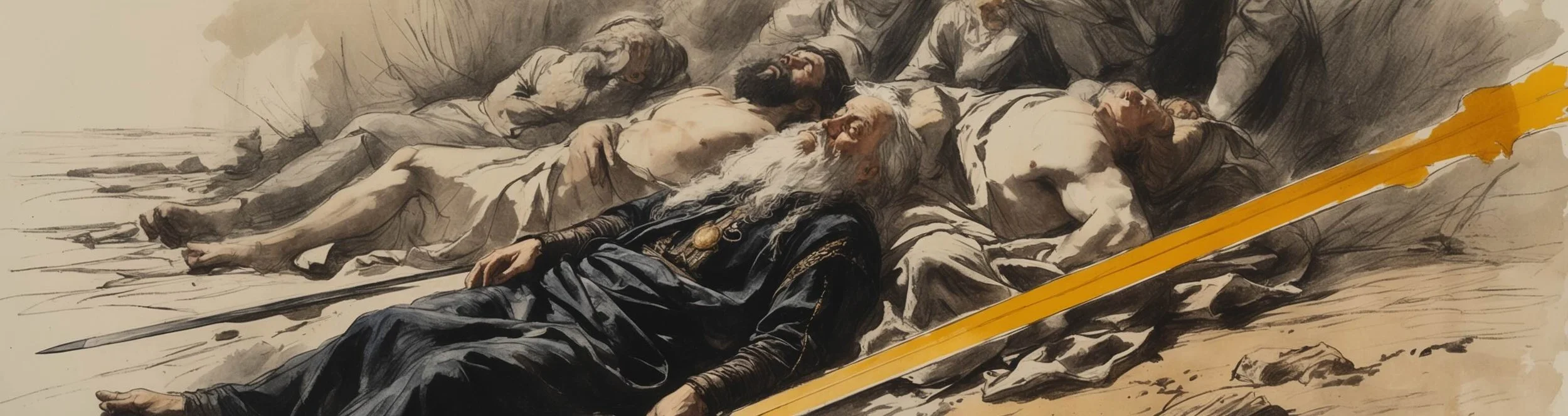
Ariel enters, invisible, playing solemn music, and everyone falls asleep except Alonso, Sebastian and Antonio. Alonso, offered rest, sleeps too, and Antonio and Sebastian promise to guard him. Antonio then sets to work. He says he sees a crown dropping on Sebastian’s head. Sebastian is slow, then interested. Antonio’s argument: Ferdinand is drowned; the next heir, Claribel, is in Tunis, too far away to matter; so the sleeping king and the old counsellor are all that stand between Sebastian and Naples, and three inches of steel will remove them. Sebastian asks about his conscience. Antonio says he does not feel one, and that if twenty consciences stood between him and Milan they would melt. Sebastian agrees: as Antonio got Milan, he will get Naples, and one stroke will free Antonio from the tribute he pays.
They draw their swords. Ariel returns, sent by Prospero to keep his friend Gonzalo alive, and sings in the old man’s ear that conspiracy is awake while he snores. Gonzalo wakes, sees the drawn swords and rouses the king. Sebastian and Antonio claim they heard a roar of lions and drew to defend him. Gonzalo says he heard a humming. The party moves off to continue the search for Ferdinand, and Ariel goes to report to Prospero.
Comfort Like Cold Porridge
The scene opens with the play’s best man trying to console its saddest, while its two worst men provide a commentary. The staging makes the audience listen with Antonio and Sebastian, and that is uncomfortable.
Original
Beseech you, sir, be merry; you have cause,
So have we all, of joy; for our escape
Is much beyond our loss. Our hint of woe
Is common; every day some sailor's wife,
The masters of some merchant and the merchant
Have just our theme of woe; but for the miracle,
I mean our preservation, few in millions
Can speak like us: then wisely, good sir, weigh
Our sorrow with our comfort.
(Gonzalo, Act 2, Scene 1)
Shakespeare Retold (Modern Verse)
I urge you, sir, be happy; you have reason,
As we all have, for happiness. Surviving
Is better than what we have lost. Our sadness
Is common. Every day, some sailor’s wife,
The owners of a ship and all its produce,
Will suffer like us. But, miraculously –
I mean that we survived – one in a million
Will live to tell the tale. And so, consider
Our sadness with our fortune.
Gonzalo’s speech is sensible, kind and slightly too long, and the play knows it. Every day a sailor’s wife loses a husband; few in millions escape a wreck; weigh the sorrow against the comfort. It is the argument the whole play will make about loss – that survival is a miracle and grief a common thing – but the man it is offered to is not ready for it, and the men listening are only interested in mocking it. The heckling is funny and it is characterising. Antonio and Sebastian bet on who will crow first, pun on entertainer and dollar, and correct every observation about the island: sweet air becomes rotten lungs, green grass becomes tawny ground. The exchange sets up the play’s argument about illusion and reality in the plainest terms. Two men look at the same island and see different places, and the scene never tells us which of them is right.
The Commonwealth
When Alonso’s grief turns to anger and Sebastian to cruelty, Gonzalo tries to lift the mood with a daydream. What he describes is a society without any of the things that make his own society work.
Original
I' the commonwealth I would by contraries
Execute all things; for no kind of traffic
Would I admit; no name of magistrate;
Letters should not be known; riches, poverty,
And use of service, none; contract, succession,
Bourn, bound of land, tilth, vineyard, none;
No use of metal, corn, or wine, or oil;
No occupation; all men idle, all;
And women too, but innocent and pure;
No sovereignty...
(Gonzalo, Act 2, Scene 1)
Shakespeare Retold (Modern Verse)
I’d run my commonwealth quite opposite
To every other place: no form of commerce
Would I allow; there’d be no law or judges;
There’d be no books; no riches, poverty
Or servants; contracts, nor inheritance,
No boundaries, rights to land, no farms nor vineyards;
No metal work, grain-grinding, wine, nor oil;
No one would work; all men would just be idle;
All women too, except they’d all be virgins;
There’d be no king…
The speech is lifted almost line for line from Montaigne’s essay “Of the Cannibals”, in the translation of 1603, where the natives of Brazil are praised for having no trade, no magistrates, no letters and no poverty. Gonzalo’s version is kind and impossible in equal measure, and the scene gives the objection to Sebastian and Antonio before Gonzalo has finished: no sovereignty, and yet he would be king of it. The heckle is fair. Every commonwealth in this play has a king in it, whether Prospero on his island, Stephano with his bottle, or the old man dreaming of the golden age; and Gonzalo’s fantasy of idle innocence sits a few hundred yards from Caliban, the island’s actual native, who has just been sent for wood. The speech is the play’s clearest statement of the hope that the New World could be a place without power and control, and the scene’s structure is the play’s answer.
The Temptation of Sebastian
Ariel’s music puts the court to sleep, and the two men who stay awake do what Antonio did in Milan. The temptation is one of the play’s finest passages of persuasion, and it works because Antonio never hurries.
Original
And yet me thinks I see it in thy face,
What thou shouldst be: the occasion speaks thee, and
My strong imagination sees a crown
Dropping upon thy head.
(Antonio, Act 2, Scene 1)
Shakespeare Retold (Modern Verse)
But now I think I see it in your face
Who you’re destined to be. The moment calls you,
And in my mind, I see you with a crown
Upon your head.
He begins with an image – a crown dropping on Sebastian’s head – and lets Sebastian call it sleepy language. Then he removes the obstacles one at a time. Ferdinand is drowned; Sebastian grants it. Claribel is queen of Tunis, ten leagues beyond man’s life, too far for news to reach Naples before a newborn’s beard is rough enough to shave; Sebastian grants that too. And so what is past is prologue, and what comes next is in their hands. The rhetoric is the rhetoric of destiny, but the content is a murder, and the speech’s most chilling moment is its quietest: there are men who can rule Naples as well as the one who sleeps here. Antonio’s method is to make the crime look like a fact of nature, and Sebastian’s slowness is the audience’s, so that we watch ourselves being talked into it. This is power and control as the play understands it: not seized but argued for, until the seizing seems merely to follow.
Twenty Consciences
Sebastian asks the one question that might stop the plot, and Antonio’s answer is the play’s coldest speech. The scene then hands the plan to Sebastian, who states it as a precedent.
Original
Thy case, dear friend,
Shall be my precedent; as thou got'st Milan,
I'll come by Naples. Draw thy sword: one stroke
Shall free thee from the tribute which thou payest;
And I the king shall love thee.
(Sebastian, Act 2, Scene 1)
Shakespeare Retold (Modern Verse)
What you have done, friend,
Will be my precedent; as you won Milan,
I’ll conquer Naples. Draw your sword: one stab
Will free you from subservience to Naples;
And I as king will love you.
Sebastian’s lines make the parallel explicit. As Antonio got Milan, he will get Naples; the crime Prospero described in Act 1 as history is about to be repeated as action, and the audience, who know that Prospero is watching, see the usurpation of Milan re-enacted in front of its victim’s spirit. The plot is also a bargain: one stroke frees Antonio from the tribute he owes Naples, so the murder pays both men. Then Ariel intervenes, and the play’s mechanism shows itself. Prospero foresees the danger through his art and sends the spirit to keep them living, because otherwise his project dies. The conspirators’ excuse about lions is transparent, Gonzalo half sees the swords, and nothing is resolved; Antonio and Sebastian will try again. What the scene has established is that the men Prospero must decide whether to forgive are, at this moment, drawing swords over a sleeping man, and that the argument about revenge and forgiveness which ends the play will be conducted with that knowledge.
Language and Technique
- Prose heckling against verse consolation: Gonzalo speaks in careful verse; Antonio and Sebastian answer in quick prose asides, so the scene’s two moods are two kinds of language.
- Puns: “Dolour” for dollar, “entertainer” for host: the courtiers turn Gonzalo’s comfort into wordplay, which is how the play shows contempt.
- A borrowed speech: Gonzalo’s commonwealth comes from Montaigne’s essay on the cannibals, in Florio’s 1603 translation – Shakespeare stages a source and then lets the courtiers heckle it.
- Sleep as a stage device: Ariel’s music puts the innocent to sleep and leaves the guilty awake: the plot’s moral sorting is done by who can and cannot close their eyes.
- Persuasion by elimination: Antonio removes the heirs one by one – Ferdinand drowned, Claribel too far – so that the murder seems to follow from arithmetic.
- The unfelt conscience: The chilblain and the slipper: Antonio makes conscience a minor physical complaint, and the joke is the measure of the man.
Key Quotes from Act 2, Scene 1
Quote 1
You cram these words into mine ears against
The stomach of my sense. Would I had never
Married my daughter there! For, coming thence,
My son is lost and, in my rate, she too,
Who is so far from Italy removed
I ne'er again shall see her. O thou mine heir
Of Naples and of Milan, what strange fish
Hath made his meal on thee?
(Alonso, Act 2, Scene 1)
Shakespeare Retold (Modern Verse)
You’re forcing me to hear these words although
I’ve no desire to hear them. I should never
Have had my daughter wed there! For, returning,
I’ve lost my son, and sort of lost my daughter,
For she is now so far from Italy
I won’t see her again. Oh, son and heir
Of Naples and Milan, what weird fish
Has eaten you?
Quote Analysis: Alonso’s grief breaks through the courtiers’ chatter. The wedding at Tunis has cost him a son and, as good as, a daughter, and the closing image – what strange fish has made a meal of the heir of Naples and Milan – is the first time the play lets the king speak at length. The modern verse keeps the weird fish.
Sir, you may thank yourself for this great loss,
That would not bless our Europe with your daughter,
But rather lose her to an African...
(Sebastian, Act 2, Scene 1)
Shakespeare Retold (Modern Verse)
It’s your fault that this tragedy occurred,
Holding your daughter from a European,
Wedding her to an African instead...
Quote Analysis: Sebastian’s consolation to his grieving brother is to blame him. The marriage of Claribel to the King of Tunis, made against everyone’s advice, is the reason they are here; the cruelty is exact, and the modern verse keeps the reproach. It is the kind of thing Gonzalo means when he says Sebastian rubs the sore.
GONZALO: Had I plantation of this isle, my lord, –
ANTONIO: He'ld sow't with nettle-seed.
SEBASTIAN: Or docks, or mallows.
GONZALO: And were the king on't, what would I do?
SEBASTIAN: 'Scape being drunk for want of wine.
(Act 2, Scene 1)
Shakespeare Retold (Modern Verse)
GONZALO: If I had a plantation on this island…
ANTONIO: He’d cover it with nettles.
SEBASTIAN: Weeds and brambles.
GONZALO: And were I king of it, what would I do?
SEBASTIAN: You’d not get drunk for there’s no wine.
Quote Analysis: The commonwealth speech begins with a heckle already attached. “Plantation” meant colonisation, and Antonio and Sebastian answer with what they would plant: nettles and weeds. The modern verse keeps the three voices, so the reader hears Gonzalo trying to start and the others refusing to let him.
I would with such perfection govern, sir,
To excel the golden age.
(Gonzalo, Act 2, Scene 1)
Shakespeare Retold (Modern Verse)
I’d govern here with such perfection, sir,
It would exceed the golden age.
Quote Analysis: The dream’s last words name its source: the golden age of the classical poets, when the earth gave food without labour. Sebastian and Antonio cry God save his majesty, which is the joke the whole speech has been walking into. The modern verse keeps the boast intact.
Prospero my lord shall know what I have done:
So, king, go safely on to seek thy son.
(Ariel, Act 2, Scene 1)
Shakespeare Retold (Modern Verse)
Prospero, my lord, shall know what I have done:
So, king, go safely on to seek your son.
Quote Analysis: Ariel’s couplet closes the scene and reminds the audience who is really in charge. The king goes safely on to seek his son because a spirit was sent to keep him alive; the rhyme on done and son makes the rescue sound like a nursery tale, and the modern verse keeps the rhyme.
Key Takeaways
- Two ways of seeing one island: Gonzalo’s sweet air and green grass against Antonio’s rotten lungs and tawny ground: the scene sets up the play’s argument about perception.
- The commonwealth has a king in it: Gonzalo’s Montaigne-inspired utopia is heckled to death by the observation that he would rule it, which is the play’s judgement on every utopia.
- Milan replayed: Antonio talks Sebastian into murdering Alonso exactly as he once removed Prospero, so the audience watches the play’s original crime being planned.
- Conscience is a chilblain: Antonio’s answer to the question of conscience is the play’s clearest portrait of a man without one, and explains why he never repents.
- Prospero’s art keeps them alive: Ariel is sent to save Gonzalo because Prospero’s project depends on it: the villains are preserved so that they can be forgiven.
Study Questions and Analysis
What is Gonzalo’s commonwealth speech about, and where does it come from?
Gonzalo imagines what he would do if he had the island to plant and were its king: a society without trade, law, letters, wealth, poverty, servants, contracts, inheritance, land boundaries, farming, metal, corn, wine, oil, work or sovereignty, in which nature would provide everything and the people would be innocent and idle. It is a description of a golden age, and it is offered to cheer up a grieving king.
All things in common nature should produce
Without sweat or endeavour: treason, felony,
Sword, pike, knife, gun, or need of any engine,
Would I not have; but nature should bring forth,
Of its own kind, all foison, all abundance,
To feed my innocent people.
(Gonzalo, Act 2, Scene 1)
Shakespeare Retold (Modern Verse)
Our Mother Nature will produce the produce
Without us working for it; treason, crime,
Swords, spears, knives, guns or any kind of weapon
I’d not allow; but nature will produce,
All by itself, a rich and bumper harvest,
To feed my innocent people.
The speech comes almost word for word from Montaigne’s essay “Of the Cannibals”, which Shakespeare read in John Florio’s translation of 1603; Montaigne describes the natives of Brazil by the same list of things they lack and asks whether Europe has any right to call them savages. Frank Kermode’s Arden edition (1954) set the borrowing at the centre of the play’s argument about art and nature, with Gonzalo’s natural commonwealth as one pole and Prospero’s art as the other. What Shakespeare adds is the heckling. Sebastian and Antonio point out that a commonwealth with no sovereignty would still have Gonzalo as its king, and the objection lands, because every society in the play, from Prospero’s island to Stephano’s drunken kingdom, has a master in it. The speech is a dream of colonialism and empire without conquest, and the scene shows why it stays a dream.
Why do Antonio and Sebastian mock Gonzalo?
Partly because he talks too much, and partly because mockery is what they have instead of feeling. Gonzalo’s comfort is well meant and long-winded, and the two courtiers make a game of it, betting on who will speak first, punning on his words and contradicting each description of the island. Their jokes are good. They are also the only response to the wreck that either man makes: no grief, no prayer, no thought for the drowned prince, only contempt for the one man trying to help.
The mockery does structural work. It establishes the pair as a unit before the murder plot, so that when Antonio begins to tempt Sebastian the audience already knows how they think; and it puts the audience in an awkward position, since the jokes are funny and the man they are made at is the play’s kindest character. Gonzalo’s own answer, that they are gentlemen of brave metal who would lift the moon out of her sphere, is the play’s judgement on them: they will do anything, as long as it is destructive. The scene’s contrast between the man who tries to console and the men who sneer is the first sight of the moral division that Prospero’s forgiveness will have to cross in Act 5.
How does Antonio persuade Sebastian to kill the king?
By making the murder look like a conclusion rather than a choice. He starts with an image, a crown dropping on Sebastian’s head, and lets Sebastian laugh at it as sleepy talk. Then he eliminates the heirs. Ferdinand is drowned; Sebastian agrees. Claribel, the next heir, is queen of Tunis, ten leagues beyond man’s life, too far for any news to reach Naples in time; Sebastian agrees to that as well. What remains is a sleeping king, an old counsellor, and a few lords who will believe whatever they are told.
This deity in my bosom: twenty consciences,
That stand 'twixt me and Milan, candied be they
And melt ere they molest!
(Antonio, Act 2, Scene 1)
Shakespeare Retold (Modern Verse)
This conscience in my heart; twenty consciences
Between me and the dukedom of Milan
Could melt before they stop me!
The one obstacle Antonio cannot argue away is conscience, and he does not try; he simply reports that he has not got one. The chilblain and the slipper make conscience a small physical complaint, and the twenty consciences melting like sweets are the vocabulary of a man to whom other people’s lives are confectionery. Jan Kott, in Shakespeare Our Contemporary (1964), read the island as a place where the history of Milan is compressed and replayed, and this speech is the replay’s centre: the usurper explaining his method to his pupil. Sebastian’s answer, that Antonio’s case will be his precedent, shows that the lesson has been learnt.
Why does Ariel put the court to sleep?
Because Prospero wants the conspiracy to happen. Ariel’s music sends Gonzalo, Adrian, Francisco and then Alonso to sleep and leaves Antonio and Sebastian awake, which gives the two men the opportunity and the privacy to plan the murder. When they draw their swords, Ariel returns and wakes Gonzalo with a song, because, as the spirit says, Prospero’s project dies if his friend is killed. The plot is allowed to reach the point of drawn steel and no further.
The effect is to expose Antonio and Sebastian completely while keeping everyone alive. Prospero learns exactly what his brother is capable of, twelve years on, and the audience learns it with him; but the crime itself is prevented, so that the men who planned it can be forgiven at the end rather than punished. The staging shows Prospero’s art working as a kind of moral experiment. Paul Brown, in his 1985 essay on the play and colonial discourse, read the whole island as a place where Prospero produces the disorders he then masters; the sleeping court and the waking conspirators are the clearest single example of it. The scene ends with Antonio and Sebastian agreeing to try again, and the play lets them, because it has already seen enough.
What is the significance of Claribel and the wedding at Tunis?
Claribel is Alonso’s daughter, married to the King of Tunis just before the play begins; the court party was sailing home from the wedding when the storm struck. She never appears, but she is the reason for everything. Without the voyage there would be no wreck; without the marriage Alonso would have an heir within reach, and Antonio’s plot would have no opening. Sebastian blames the king for marrying her to an African against all advice, and Alonso himself wishes he had never done it.
The wedding also gives the scene its geography. The courtiers’ argument about widow Dido, Carthage and Tunis places the island somewhere on the North African coast, in the sea Aeneas crossed, and the running joke about Gonzalo’s claim that Tunis was Carthage sits beside a serious point: this is a play about an old world rather than a new one, whatever its Bermuda sources. Claribel herself is the play’s most distant character, so far from Naples, in Antonio’s phrase, that the man in the moon would be too slow to carry the news. She is the loss that makes Alonso’s guilt possible, and the marriage across the sea that the play’s ending, with Ferdinand and Miranda uniting Naples and Milan, quietly corrects.
Is Gonzalo a fool or a wise man?
The scene lets him be both. He is long-winded, easily mocked, and wrong about the island’s grass; his commonwealth collapses under a single objection; and Alonso tells him to his face that he is talking nothing. But he is also the only person on the beach who tries to help, the man who once stocked Prospero’s boat with food and books, and the one Prospero calls his friend and sends Ariel to save. His account of the miracle of their preservation happens to be true, and his joke in the storm scene about the Boatswain’s gallows face happens to be prophetic.
Critics have generally treated him kindly. Samuel Taylor Coleridge, lecturing in 1818, admired the way the play keeps its good characters distinct from its supernatural ones, and Gonzalo is the play’s ordinary goodness, unmagical and a little absurd. The scene’s structure protects him: the men who mock him are about to plan a murder, so their judgement of him is discredited before the audience can adopt it. What Gonzalo offers Alonso is the play’s own consolation, that loss can be weighed against survival, and the king will accept it in Act 5 when he has earned it. Gonzalo’s fault is only that he offers it too soon.
What does “what’s past is prologue” mean in context?
It is Antonio’s way of saying that everything that has happened up to now – the wedding, the wreck, the drowning of Ferdinand, the survival of the rest – was only the introduction, and that the real action, the seizing of Naples, is theirs to write. The image is theatrical: the past is the prologue of a play, and the performance, the act to be discharged, belongs to Sebastian and himself. Destiny, he says, has cast them ashore for the purpose.
In context the line is a piece of tempter’s rhetoric, and it is worth noticing how it works. By calling the past a prologue Antonio makes it weightless: nobody is responsible for a prologue, and nobody need feel anything about it. By calling the future a discharge he makes the murder sound like a duty. The line has since been carved on public buildings as a motto of optimism, which is a strange fate for words invented to justify killing a sleeping man; a student who quotes it should know who says it and why. The theme of power and control in this play is carried by exactly this kind of language, in which taking a crown is made to sound like accepting a role.
How does this scene connect to the rest of the play?
It is the first of three plots for power that run in parallel through the middle acts, and the one that most closely copies the play’s original crime. Antonio’s usurpation of Milan, told in Act 1, Scene 2, is re-enacted here as a plan against Naples; Caliban’s plot with Stephano to kill Prospero follows in the next scene and the one after; and Prospero, who already has the power, spends the play deciding what to do with it. The three plots comment on one another, and this one establishes that the courtiers’ version is the deadliest.
The scene also plants the guilt that Act 3, Scene 3 will harvest. Alonso’s grief for Ferdinand, expressed here for the first time at length, is what the vanishing banquet and the harpy will work on, and the sleeping king’s helplessness under two drawn swords is the image Prospero will have in mind when he forgives the men who held them. Antonio and Sebastian never do repent, and this scene is the reason the audience does not expect them to. Whether Prospero’s forgiveness in Act 5 is wisdom or weakness depends partly on how a reader has judged the two men here.
