Hippolyta
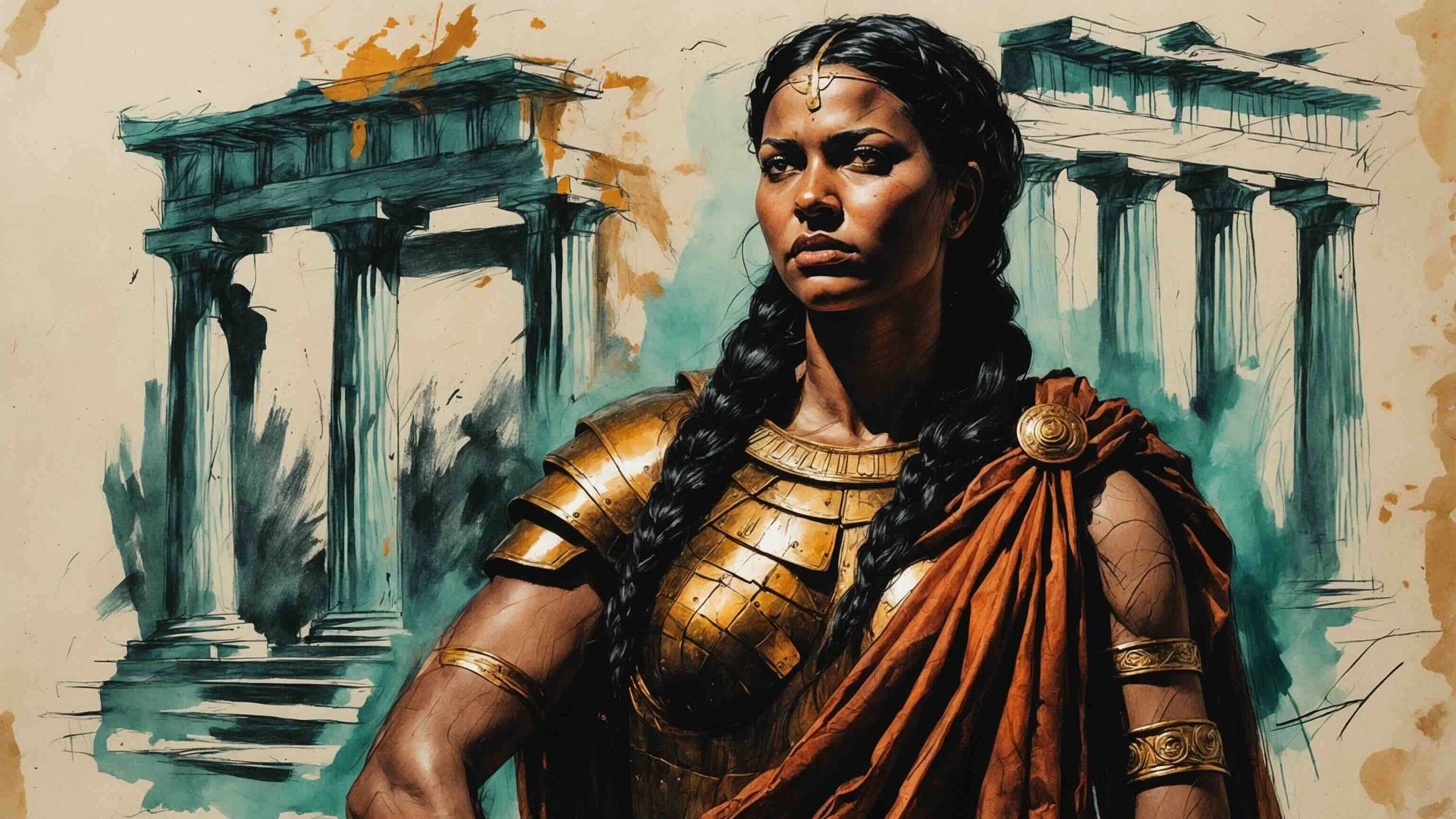
Character Profile – At a Glance
- Role: Queen of the Amazons, defeated in war by Theseus and now about to marry him. The play opens four days before the wedding and ends on the wedding night.
- Key Traits: Composed, observant and sparing with words. A warrior and a huntress who has seen more of the world than Athens. Quietly unconvinced by her husband’s certainties.
- The Core Conflict: Hippolyta was won with a sword and is being married with pomp. She says almost nothing about either, and the play leaves the audience to decide what her silence means.
- Key Actions: Answers Theseus’s impatience with a speech about the moon (A1S1). Recalls hunting with Hercules and Cadmus in Crete (A4S1). Calls the lovers’ story strange and, against Theseus, argues that it holds together. Objects to mocking the workmen, then mocks them, and pities Pyramus (A5S1).
- Famous Quote:
"But all the story of the night told over,
And all their minds transfigured so together..."
(Act 5, Scene 1) - The Outcome: Married to Theseus. She goes to bed at midnight and the fairies bless the house she now belongs to.
The Bouncing Amazon
Hippolyta is described before she is understood. Theseus tells her in the first scene that he wooed her with his sword; and in the wood, Titania uses her as a weapon against Oberon, accusing him of an old affection for the warrior bride.
Original
But that, forsooth, the bouncing Amazon,
Your buskined mistress and your warrior love,
To Theseus must be wedded, and you come
To give their bed joy and prosperity.
(Titania, Act 2, Scene 1)
Shakespeare Retold (Modern Verse)
Because that Amazonian, Hippolyta –
Your booted mistress, warrior love interest –
Is to be wed to Theseus, and you’ve come
To wish them both joy and prosperity.
"Bouncing", "buskined", "warrior love": the fairy queen’s Hippolyta is a figure of strength and appetite, a woman in hunting boots, and the mockery in the phrase does not hide a certain respect. The Amazons of legend were a nation of women who fought and ruled without men. Theseus, in the myth Shakespeare inherited from Chaucer and Plutarch, defeated them and took their queen.
None of this is dramatised. The war is over before the play begins, and Hippolyta never mentions it. What the play gives us instead is a woman standing beside her conqueror and speaking, when she speaks at all, with complete self-possession. The theme of gender and patriarchy in this play begins with a conquered queen, and the conquest is the one thing she never discusses.
Four Days Will Quickly Steep Themselves in Night
Theseus opens the play complaining that the moon is slow. Hippolyta’s reply is her only speech in the scene, and it corrects him without contradicting him.
Original
Four days will quickly steep themselves in night;
Four nights will quickly dream away the time;
And then the moon, like to a silver bow
New-bent in heaven, shall behold the night
Of our solemnities.
(Act 1, Scene 1)
Shakespeare Retold (Modern Verse)
Four days will soon dissolve into the night;
Four nights will soon evaporate as dreams;
And then the crescent moon, shaped like a bow
Appearing in the sky, will cast its gaze
Upon our wedding vows.
Where he sees an old moon lingering like a stepmother, she sees four nights that will "dream away the time" and a new moon like a silver bow, which is an Amazon’s image. Her speech is calm where his is impatient, and it introduces the word that names the play. The night, in Hippolyta’s mouth, is not an obstacle but a dreaming.
Then Egeus enters with his daughter, and Hippolyta says nothing for the rest of the scene. She hears a girl sentenced to death or a convent for refusing her father’s choice of husband, and the play gives her no line. Theseus, leaving, asks "what cheer, my love?", which suggests her face has said something. The theme of order and chaos in Athens is pronounced by the duke in front of a bride who has just been told, in effect, what happens to women who do not consent.
So Musical a Discord
On May morning Theseus brings her to the wood to hear his hounds, and for the first time Hippolyta speaks at length about her own life.
Original
I was with Hercules and Cadmus once,
When in a wood of Crete they bayed the bear
With hounds of Sparta: never did I hear
Such gallant chiding: for, besides the groves,
The skies, the fountains, every region near
Seemed all one mutual cry: I never heard
So musical a discord, such sweet thunder.
(Act 4, Scene 1)
Shakespeare Retold (Modern Verse)
I was with Hercules and Cadmus once,
When in a wood in Crete they trapped a bear
With Spartan hunting dogs: I’ve never heard
Such fearless barking: all around the forest,
The skies, the fountains, everywhere nearby
Seemed like it barked in harmony. I’ve not heard
Such wild music, such a thunderous sound.
She has hunted with Hercules. She has heard the hounds of Sparta bay a bear in a Cretan wood. The speech reminds the audience, and perhaps the duke, that she was a queen and a warrior in a wider world than Athens before she was anyone’s bride, and Theseus answers by boasting of his own kennel. It is the nearest the two of them come to an exchange between equals, and it is about dogs.
The phrase "musical a discord" is hers, and it is the play’s. A Midsummer Night’s Dream is built on discords that resolve, the fairy quarrel, the lovers’ muddle, the tragical mirth of the workmen, and Hippolyta names the pattern before the duke borrows it. The theme of order and chaos depends on discord becoming music, and the Amazon is the first to say so.
Something of Great Constancy
On the wedding night she remarks that the lovers’ story is strange. Theseus replies with the speech about lunatics, lovers and poets, explaining that none of it happened. Hippolyta lets him finish, and then disagrees.
Original
But all the story of the night told over,
And all their minds transfigured so together,
More witnesseth than fancy's images
And grows to something of great constancy;
But, howsoever, strange and admirable.
(Act 5, Scene 1)
Shakespeare Retold (Modern Verse)
But all the tales the lovers told of last night,
And as their stories all were told the same,
It seems it must be true, and not a dream,
And this is strengthened by each common story,
Despite how strange and dumbfounding it is.
Her argument is a good one. Four people tell the same story; that is evidence, not fancy; and whatever happened has changed them all in the same way. Theseus does not reply. He announces the lovers and calls for entertainment, and the question is left where she put it.
It is the play’s final word on its own reality, and it is given to the character who has seen least of it. Hippolyta was not in the wood, does not believe in fairies and has no stake in the lovers. She simply listens better than her husband. The theme of dreams and reality is argued out between the two of them in twenty-five lines, and the woman who speaks five of them wins.
"The festive conclusion of A Midsummer Night’s Dream depends upon the success of a process by which the female pride and power manifested in misanthropic warriors, possessive mothers, unruly wives, and willful daughters are brought under the control of lords and husbands."
— Louis Adrian Montrose, ‘Shaping Fantasies’: Figurations of Gender and Power in Elizabethan Culture, 1983
Key Quotes
Quote 1
I love not to see wretchedness o'er charged
And duty in his service perishing.
(Act 5, Scene 1)
Shakespeare Retold (Modern Verse)
I hate to see incompetence exploited,
Humiliating those who strive to serve you.
Quote Analysis: Hippolyta, told that the workmen’s play is worthless and that Theseus means to watch it anyway. She does not want to see poor men humiliate themselves out of loyalty, and she says so. Theseus answers with a gracious speech about reading a welcome in a frightened man’s silence, and the play goes ahead. It is a small moment, and it shows the difference between the two of them: the duke enjoys the workmen’s failure as a kind of tribute, and the Amazon would rather they were spared it.
Indeed he hath played on his prologue like a child on a recorder; a sound, but not in government.
(Act 5, Scene 1)
Shakespeare Retold (Modern Verse)
Indeed, he has read the prologue like a child playing the recorder; there’s sound, but no control.
Quote Analysis: Hippolyta on Quince’s mangled prologue. Having objected to mocking the workmen, she joins in within a few lines, and her image is the best of the three: a child with a recorder makes a noise but cannot govern it. "Government" is a political word, and this is a queen speaking. The line is funny, and it is also a reminder that Hippolyta’s scruples do not stop her enjoying the show once it begins. She is not a saint. She is a sharp-eyed woman at a bad play.
HIPPOLYTA: This is the silliest stuff that ever I heard.
THESEUS: The best in this kind are but shadows; and the worst
are no worse, if imagination amend them.
HIPPOLYTA: It must be your imagination then, and not theirs.
(Act 5, Scene 1)
Shakespeare Retold (Modern Verse)
HIPPOLYTA: This is the silliest play I’ve ever seen.
THESEUS: The best plays are merely a reflection of reality; and the worst
plays aren’t so bad if you let your imagination run free.
HIPPOLYTA: Then your imagination is the strength, not their acting skills.
Quote Analysis: The play’s sharpest exchange about theatre. Hippolyta says the play is silly; Theseus answers that the best actors are only shadows and the worst no worse if the audience’s imagination helps them; and Hippolyta observes that in that case the imagination is doing the actors’ work for them. She is right, and Theseus changes the subject. The exchange matters because Theseus has just spent a speech insisting that imagination shows nothing true, and is now recommending it as the way to enjoy a play.
Beshrew my heart, but I pity the man.
(Act 5, Scene 1)
Shakespeare Retold (Modern Verse)
Curse my heart, but I have some sympathy for the man.
Quote Analysis: Hippolyta as Pyramus dies. The court has been laughing for a hundred lines, and Theseus has just remarked that this passion and the death of a dear friend would go near to make a man look sad. Hippolyta’s answer is a single line of feeling. Whether she pities Bottom for his acting or Pyramus for his death the line does not say, and it is better for not saying. It is the one moment in Act 5 when someone in the audience is moved, and it is the Amazon.
Key Takeaways
- The Conquered Queen: Hippolyta was defeated in war by the man she is marrying, and never once refers to it.
- The Moon and the Dream: Her first speech turns Theseus's impatience into four nights that will dream away the time; she gives the play its word.
- The Huntress: Her memory of Hercules and the hounds of Sparta reminds the audience she had a life before Athens.
- Something of Great Constancy: Against Theseus's scepticism, she argues that four matching stories make evidence, and he does not answer.
Study Questions and Analysis
Who is Hippolyta, and why is she marrying Theseus?
She is the queen of the Amazons, the legendary nation of warrior women, and she is marrying Theseus because he beat her. He says so himself, in the play’s first scene, without embarrassment:
Hippolyta, I wooed thee with my sword,
And won thy love, doing thee injuries...
(Theseus, Act 1, Scene 1)
Shakespeare Retold (Modern Verse)
Hippolyta, I wooed you in a battle
And won your heart whilst I was hurting you...
Shakespeare found the story in Chaucer’s Knight’s Tale, which opens with Theseus bringing his conquered Amazon bride home to Athens, and in Plutarch’s life of Theseus, translated by Thomas North in 1579, which records the war with the Amazons and Theseus’s marriage to their queen. In some versions she is called Antiopa, a name Oberon uses in the wood for one of Theseus’s abandoned lovers.
Louis Adrian Montrose, in "Shaping Fantasies" (1983), made Hippolyta the first item on a list. The play’s happy ending, he argued, requires that "the female pride and power manifested in misanthropic warriors, possessive mothers, unruly wives, and willful daughters are brought under the control of lords and husbands", and the misanthropic warrior is the Amazon queen, whose wedding is the frame for all the others. On this reading the marriage is not a romance but the final act of a conquest, and the four days of the play are the interval between the surrender and the ceremony. The text neither confirms nor denies it. Hippolyta says nothing about the war, and her silence has been the play’s open question for four hundred years. The theme of gender and patriarchy begins here, in a bride who was a prisoner and does not say which she is now.
Is Hippolyta a willing bride?
The play does not say, and the omission is striking. Hippolyta speaks once in the opening scene, about the moon, and then watches in silence as a girl is sentenced to death for refusing a husband. As Theseus leads her off, he seems to notice something in her face:
Come, my Hippolyta: what cheer, my love?
(Theseus, Act 1, Scene 1)
Shakespeare Retold (Modern Verse)
Come, dear Hippolyta: do you have good news?
The line is a question, and it is not answered. Directors have read it every way. In some productions Hippolyta is a contented bride and the question is affectionate; in others she is a captive in chains, and Theseus is checking that she has not made a scene.
Nothing in the text rules out either reading, and the play seems to have been written so that it would not. Hippolyta’s first speech is warm, her fourth-act speech is companionable, and her fifth-act speeches are witty and independent; she never expresses reluctance, and she never expresses love. Montrose (1983) took the silence as the sign of a woman being brought under control; readers who follow C. L. Barber’s Shakespeare’s Festive Comedy (1959) tend to take the wedding as the play’s true occasion and Hippolyta as its gracious hostess. The most that can be said is that Shakespeare, who could have given her a line of consent or a line of grief, gave her neither, and that since Peter Brook’s 1970 production doubled her with Titania, audiences have watched the same actress drugged and mastered in the wood and then married in Athens, which tends to settle the question one way.
Why does Hippolyta side with the lovers against Theseus?
Because she has listened to them and he has not. When she calls the lovers’ story strange, Theseus dismisses it before she has finished the thought:
More strange than true: I never may believe
These antique fables, nor these fairy toys.
(Theseus, Act 5, Scene 1)
Shakespeare Retold (Modern Verse)
More strange than true: I never have believed
Old folklore nor these made-up fairy tales.
What follows is his famous speech on lunatics, lovers and poets, in which imagination is the disease that makes people see what is not there. Hippolyta waits until he has finished and then makes the case for the defence: four minds "transfigured so together" testify to something more than fancy, and the something "grows to something of great constancy".
David P. Young took her phrase as the title of his 1966 book, Something of Great Constancy, because it is the play’s own claim for what it has shown: strange, and yet consistent. R. W. Dent, in Shakespeare Quarterly (1964), argued that neither the lovers’ abandonment to imagination nor Theseus’s denial of it is the play’s position, and Hippolyta’s reply is where the balance is struck: she does not say the story is true, only that it is constant, and that constancy deserves attention. Catherine Belsey (1993) noted that the audience, having seen the fairies, cannot share the duke’s rational dismissal; Hippolyta, without seeing anything, reaches the same conclusion by reasoning from the evidence. It is the sole argument Theseus loses in the play, and he loses it by not replying. The theme of dreams and reality is decided, as far as the play decides it, by the Amazon.
Why is Hippolyta so often doubled with Titania?
Because the play half suggests it. Oberon and Titania quarrel about the human couple as though they were old acquaintances: Titania taunts Oberon with his affection for the "bouncing Amazon", and Oberon replies in kind:
Glance at my credit with Hippolyta,
Knowing I know thy love to Theseus?
(Oberon, Act 2, Scene 1)
Shakespeare Retold (Modern Verse)
Referring to my past with Hippolyta,
When you know that I know that you love Theseus?
The fairy king and queen have histories with the duke and duchess, and the histories mirror each other. Each mortal ruler is the object of the other fairy’s desire.
Peter Brook’s 1970 production for the Royal Shakespeare Company made the mirror literal by casting Sara Kestelman as both Hippolyta and Titania and Alan Howard as both Theseus and Oberon, and the doubling has been standard practice since. Its effect on Hippolyta is considerable. The conquered queen of Act 1 becomes, in the wood, a queen who is drugged, humiliated and robbed by her husband, and then returns to Athens to be married. James L. Calderwood, in his 1992 study, read the wood as something like the mortal couple’s dream on the eve of the wedding, with Oberon as Theseus’s dreaming self and Titania as Hippolyta’s; on that reading the fairy quarrel is the argument the Athenian couple never has aloud. The text does not require the doubling and the two queens speak quite differently, Titania in long lyrical flights and Hippolyta in short, dry observations. But the doubling gives Hippolyta a story the play otherwise withholds, and it makes her silence in Act 1 easier to read. The theme of gender and patriarchy in the play is the same on both sides of the wood, and on Brook’s stage it had the same face.
What does Hippolyta think of Pyramus and Thisbe?
Not much, and she says so. She did not want to watch it, on the grounds that duty overstretched is painful to see; she then watches it, and is the first to lose patience:
I am aweary of this moon: would he would change!
(Act 5, Scene 1)
Shakespeare Retold (Modern Verse)
I’m fed up with this moon: I wish he’d wax or wane offstage!
She calls the play the silliest stuff she ever heard, tells Theseus that the imagination improving it must be his and not the actors’, and hopes Thisbe will be brief. She also, alone of the court, pities Pyramus when he dies.
The mixture is the point. Hippolyta is neither the kind spectator nor the cruel one; she is the honest one, bored by a bad play and moved by a moment in it. David P. Young (1966) read the workmen’s play as a mirror the court cannot see itself in, and Hippolyta is the spectator who comes closest to seeing. Her exchange with Theseus about shadows and imagination is the play’s clearest statement of how theatre works, and she has the better of it. Anne Barton, writing in Shakespeare Survey (1971), observed how oddly qualified Theseus’s confident theories are by what surrounds them, and Hippolyta is the chief qualifier. The theme of art and theatre in Act 5 is argued between a duke who defends bad actors and a queen who would rather they were spared; both are being generous, in different ways, and hers is the rarer kind.
How much does Hippolyta actually say?
Very little: fourteen speeches in the whole play, most of them a line or two, and none in Acts 2 and 3. She is absent from the wood entirely. When she does speak, it is often to be spoken over: Theseus opens the play by addressing her, and closes his invitation to the hunt with a promise of what she will hear:
We will, fair queen, up to the mountain's top,
And mark the musical confusion
Of hounds and echo in conjunction.
(Theseus, Act 4, Scene 1)
Shakespeare Retold (Modern Verse)
My gorgeous queen, we’ll go atop the mountain
And listen to cacophonous sounding music
Of barking dogs that echo off each other.
"Fair queen" is his title for her, and it is worth noticing that he uses it. Hippolyta is a queen in her own right, not a duchess by marriage, and the play never lets the audience forget it, even while giving her almost nothing to do.
The scarcity has made her a critics’ character rather than an audience’s. Montrose (1983) reads her silence as the play’s method; Barber (1959) barely mentions her; the great Romantic critics, Hazlitt and Coleridge, pass over her altogether. What the text gives is a handful of speeches of unusual quality: the moon, the hounds, the constancy of the lovers’ story, the child with the recorder, the pity for Pyramus. Each is intelligent, each is brief, and each is unanswered. Shakespeare wrote a woman who says less than anyone in the room and is wrong less often, and left the audience to notice. The theme of gender and patriarchy in this play is not only about the women who are silenced; it is also about the one who chooses her words.
How has Hippolyta been staged?
For most of the play’s history, barely at all. The Restoration and Victorian theatre cut and rearranged the play so freely that Hippolyta was often a walk-on in a costume, present at the beginning and end for the spectacle of the wedding. Samuel Pepys, seeing the play in 1662, recorded only "some good dancing and some handsome women". The twentieth century restored the text and with it her four scenes, and the doubling with Titania, introduced by Peter Brook in 1970, gave the part a weight it had never carried.
Since then the choice has been about the war. Some productions dress Hippolyta as a captive, in chains or a cage, for the first scene, and play "what cheer, my love?" as a conqueror’s warning; others give her a soldier’s bearing and let the marriage look like an alliance between equals. Both are defensible. The text mentions the sword and the injuries once and never again, and a director must decide how much the audience is to remember.
What every production has to solve is the fifth act, where Hippolyta suddenly has more to say than in the rest of the play combined, and where she twice gets the better of her husband. A Hippolyta who has been a silent captive for four acts and then out-argues the duke is a different woman from one who has been his equal throughout, and the part can be played either way. The best productions let the audience see, in the exchange about imagination, that the Amazon has been listening all along.