Theseus
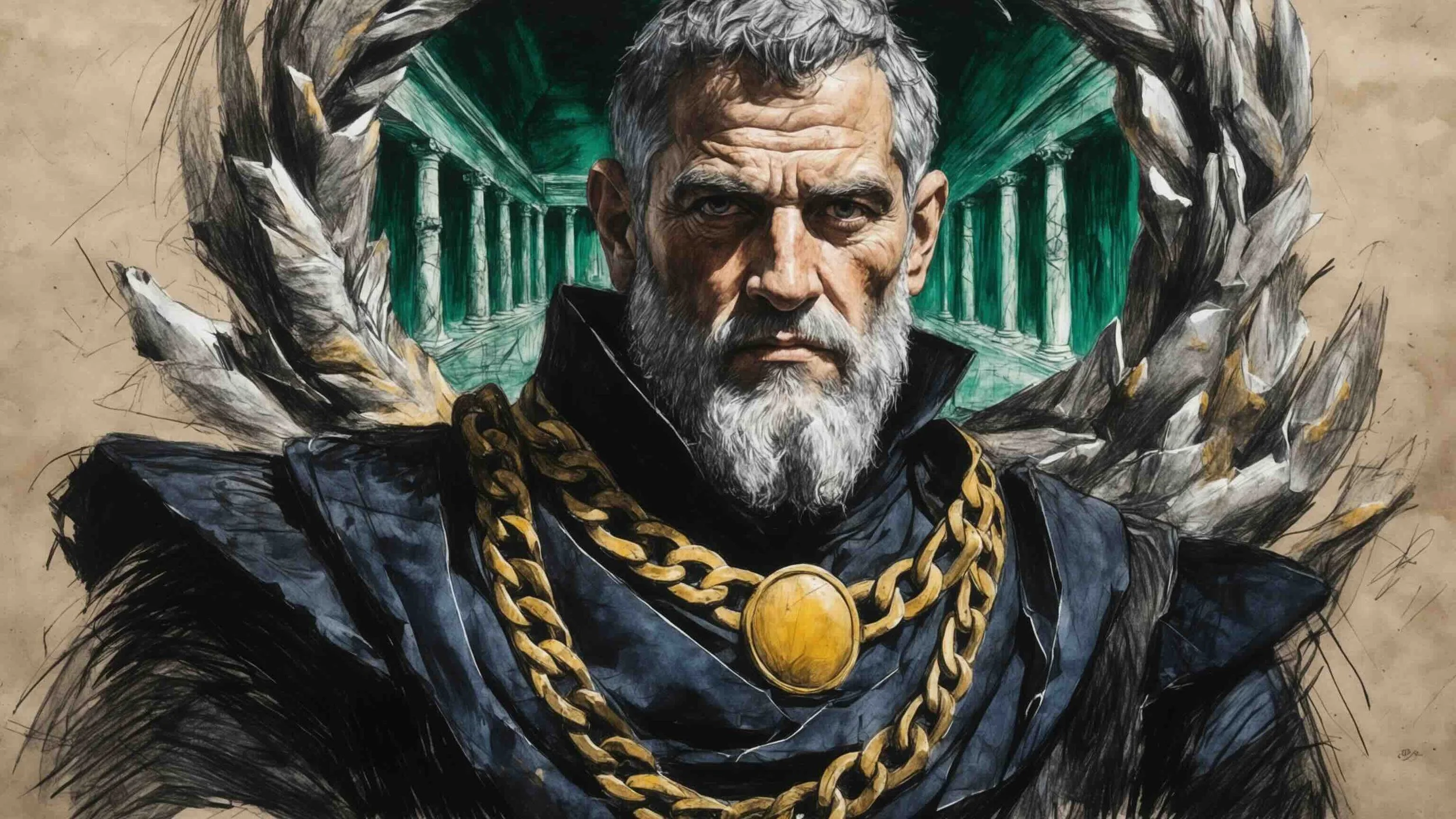
Character Profile – At a Glance
- Role: Duke of Athens, about to marry Hippolyta, the Amazon queen he defeated in battle. He judges Hermia’s case, overrules her father in the morning, and presides over the wedding night’s entertainment.
- Key Traits: Rational, confident and courteous. A soldier and a hunter who values order and plain duty. Sure that fairies do not exist, in a play full of them.
- The Core Conflict: Theseus rules by law and reason, and the play sets him on the edge of a wood where neither applies. He never enters it, and never learns what happened there.
- Key Actions: Announces his wedding and hears Egeus’s complaint against Hermia, giving her four days to choose between Demetrius, a convent and death (A1S1). Hunts at dawn, finds the lovers asleep, and orders a triple wedding (A4S1). Dismisses the lovers’ story as imagination, chooses the workmen’s play and defends it against Hippolyta’s scorn (A5S1).
- Famous Quote:
"The lunatic, the lover and the poet
Are of imagination all compact..."
(Act 5, Scene 1) - The Outcome: Married to Hippolyta and host to two more weddings. He sends the lovers to bed at midnight, "almost fairy time", and the fairies he does not believe in bless his house.
I Wooed Thee with My Sword
The play opens on Theseus counting the days to his wedding, and the woman he is marrying is a prisoner of war. He does not hide it. In his fourth speech he tells Hippolyta exactly how their courtship went.
Original
Hippolyta, I wooed thee with my sword,
And won thy love, doing thee injuries;
But I will wed thee in another key,
With pomp, with triumph and with revelling.
(Act 1, Scene 1)
Shakespeare Retold (Modern Verse)
Hippolyta, I wooed you in a battle
And won your heart whilst I was hurting you;
But I will marry you a different way,
With fanfare and triumphant revelry.
"Doing thee injuries" is a remarkable admission for a bridegroom, and Theseus makes it lightly, as a thing settled. The war is over, the Amazon is won, and the wedding will be in "another key". Hippolyta says nothing in reply. Her one speech in the scene is about the moon.
This is the pattern of Theseus’s rule: a conquest, followed by a celebration that asks everyone to forget the conquest. The theme of gender and patriarchy in the play begins with its most powerful man describing how he took his wife by force and promising to make it up to her with a party. The play does not condemn him for it. It simply lets him say it, and lets the audience hear.
The Law of Athens
Egeus brings his daughter before the duke and demands the ancient privilege of Athens: she will marry Demetrius or die. Theseus does not question the law. He explains it to Hermia, courteously and at length.
Original
What say you, Hermia? Be advised fair maid:
To you your father should be as a god;
One that composed your beauties, yea, and one
To whom you are but as a form in wax
By him imprinted and within his power
To leave the figure or disfigure it.
(Act 1, Scene 1)
Shakespeare Retold (Modern Verse)
What do you say to that, Hermia? Be warned:
You ought to treat your father like a god;
For he created all your beauty, and
You’re merely just a waxwork form of him,
Created by him, and he has the power
To keep the waxwork figure or destroy it.
The image is precise and appalling. A daughter is wax; her father pressed the shape into it; he may keep the figure or melt it down. Theseus offers Hermia a third option, the convent, which the law did not mention, and then describes the convent so bleakly, "chanting faint hymns to the cold fruitless moon", that it hardly counts as mercy. He gives her four days, until his own wedding, to decide.
He is not cruel. He admits Lysander is worthy, takes Demetrius and Egeus aside for "some private schooling", and clearly hopes the thing can be arranged. But he will not bend the law, "which by no means we may extenuate", and the girl who cannot bend either runs into the wood that night. The theme of order and chaos in Athens is Theseus, and Theseus in Act 1 is the law with good manners.
The Music of My Hounds
Theseus does not appear again until dawn on May morning, when he brings Hippolyta to the wood to hear his hounds. It is the only time he enters the play’s green world, and he enters it as a sportsman.
Original
My hounds are bred out of the Spartan kind,
So flewed, so sanded, and their heads are hung
With ears that sweep away the morning dew;
Crook-kneed, and dew-lapped like Thessalian bulls;
Slow in pursuit, but matched in mouth like bells,
Each under each.
(Act 4, Scene 1)
Shakespeare Retold (Modern Verse)
My dogs are thoroughbreds of Spartan hounds,
So fleshy-jawed, sand-coloured, and their heads
Have ears that brush the dew off morning grass;
They’ve bended knees, and neck-flaps like a bull;
Although slow in the chase, their bark is bell-like,
Each in a different pitch.
The speech is a connoisseur’s, all breeding and ears and matched voices, and it answers Hippolyta’s memory of hunting with Hercules and Cadmus in Crete. For a moment the two of them are equals, comparing kennels. Then the duke notices four young people asleep on the ground, and Egeus tells him who they are.
What Theseus does next reverses Act 1 in three lines. He hears Lysander’s confession, hears Demetrius renounce Hermia, and overrules Egeus on the spot. The law that could not be extenuated is set aside without a word of explanation, and the couples are told to come to the temple. The theme of order and chaos turns out to be whatever Theseus says it is on the day, and the wood, which he never entered, has changed his mind for him.
Cool Reason
On the wedding night Hippolyta remarks that the lovers’ story is strange. Theseus’s reply is the most famous speech in the play, and it is a speech about why none of it happened.
Original
Lovers and madmen have such seething brains,
Such shaping fantasies, that apprehend
More than cool reason ever comprehends.
(Act 5, Scene 1)
Shakespeare Retold (Modern Verse)
Lovers’ and loonies’ minds are overactive
As both create deranged interpretations
Devoid of rational semblance of the truth.
Lovers, madmen and poets, he goes on, all suffer from the same disease: imagination, which sees devils in the dark, Helen of Troy in a plain face, and gives "airy nothing a local habitation and a name". It is a wonderful speech, and its wonder is the problem. Theseus describes the poet’s eye rolling from heaven to earth in verse that only a poet could write, and dismisses as fantasy a night the audience has just watched.
He is wrong, and the play knows it. Puck is about to enter the room. But he is not foolish; he is a sane man in a world that contains fairies, and the play gives his sanity its due before proving it incomplete. The theme of dreams and reality rests on this speech and on Hippolyta’s answer to it, and Shakespeare gives the last word to the woman who wonders rather than the man who explains.
"Even Titian never made a hunting-piece of a gusto so fresh and lusty, and so near the first ages of the world as this."
— William Hazlitt, Characters of Shakespear’s Plays, 1817
Key Quotes
Quote 1
Now, fair Hippolyta, our nuptial hour
Draws on apace; four happy days bring in
Another moon: but, O, methinks, how slow
This old moon wanes! She lingers my desires,
Like to a step-dame or a dowager
Long withering out a young man revenue.
(Act 1, Scene 1)
Shakespeare Retold (Modern Verse)
My dear Hippolyta, our wedding day
Is fast approaching; in four days from now
A new moon will appear. But, oh, how slow
The old moon fades! It keeps my wishes waiting,
Much like a stepmother or wealthy widow
Holds up a young man’s due inheritance.
Quote Analysis: The first lines of the play. Theseus is impatient for his wedding and complains that the old moon is slow to die, like a stepmother or a rich widow keeping a young man from his inheritance. The simile is revealing. The duke thinks of the moon as an obstacle between him and something owed to him, and of his bride as a revenue. Hippolyta’s answer softens the image into a silver bow bent in heaven, and the exchange sets the play’s two registers side by side: the man’s appetite, the woman’s patience.
Egeus, I will overbear your will;
For in the temple by and by with us
These couples shall eternally be knit:
And, for the morning now is something worn,
Our purposed hunting shall be set aside.
Away with us to Athens; three and three,
We'll hold a feast in great solemnity.
(Act 4, Scene 1)
Shakespeare Retold (Modern Verse)
Egeus, I will overrule your wishes;
For later on with us, within the temple,
These couples shall be wed eternally;
And as the morning now is nearly over,
I’m cancelling our plans to go out hunting.
Let’s leave for Athens; three men and three wives,
Will hold a feast to celebrate our lives.
Quote Analysis: Theseus overruling the father. In Act 1 he could not extenuate the law; in Act 4 he overbears the man who invoked it, and does not say why. The reason is standing in front of him: Demetrius no longer wants Hermia, so the father’s case has no plaintiff. But Theseus does not put it that way. He announces the weddings, cancels the hunt and orders a feast, and the speed of it tells the audience that the law was never the point. The duke’s will was, and it has changed.
The poet's eye, in fine frenzy rolling,
Doth glance from heaven to earth, from earth to heaven;
And as imagination bodies forth
The forms of things unknown, the poet's pen
Turns them to shapes and gives to airy nothing
A local habitation and a name.
(Act 5, Scene 1)
Shakespeare Retold (Modern Verse)
The poet always looks around the place,
And stares up at the sky, then back to earth,
And as they see things with imagination
That are not real, the poet starts to write
And gives to fancies that are made of nothing,
A name and somewhere that they might exist.
Quote Analysis: The heart of the imagination speech, and the lines most often quoted out of it. Theseus means them as a diagnosis: the poet, like the lunatic and the lover, makes something out of nothing. But the description is so exact and so admiring that it reads as praise, and it has been taken as Shakespeare’s own account of his art ever since. The irony is that Theseus is a character in exactly the kind of thing he is describing, a shape given to airy nothing by a poet’s pen, and the poet has given him the best lines.
The best in this kind are but shadows; and the worst are no worse, if imagination amend them.
(Act 5, Scene 1)
Shakespeare Retold (Modern Verse)
The best plays are merely a reflection of reality; and the worst plays aren’t so bad if you let your imagination run free.
Quote Analysis: Theseus defending the workmen’s play to Hippolyta, who has called it the silliest stuff she ever heard. "Shadows" is what Oberon calls his fairies and what Puck will call the whole company in the epilogue, and Theseus uses it here for actors: the best of them are only shadows, and the worst are no worse if the audience supplies what is missing. It is a generous theory of theatre from a man who has just denied that imagination shows us anything true. Hippolyta’s reply, that the imagination must then be his and not the actors’, is the sharper line, and he does not answer it.
Key Takeaways
- The Conqueror Bridegroom: Theseus won Hippolyta in war and says so in his fourth speech; the wedding is meant to change the key.
- The Law with Good Manners: He explains the Athenian law to Hermia courteously and refuses to bend it, then sets it aside in Act 4 without explanation.
- The Sceptic: His speech on lunatics, lovers and poets denies the whole night in the wood, in verse only a poet could write.
- Never in the Wood: He is the one major character who never enters the fairy world, and the fairies bless his house while he sleeps.
Study Questions and Analysis
What kind of ruler is Theseus?
A lawful one, which in this play is not the same as a just one. He hears Egeus’s case against Hermia with perfect courtesy, admits that Lysander is a worthy man, and then tells the girl what will happen to her if she does not obey:
For you, fair Hermia, look you arm yourself
To fit your fancies to your father's will;
Or else the law of Athens yields you up –
Which by no means we may extenuate –
To death, or to a vow of single life.
(Act 1, Scene 1)
Shakespeare Retold (Modern Verse)
And as for you, fair Hermia, prepare
To follow out the wishes of your father,
Or else the law of Athens falls upon you –
Which we cannot extenuate at all –
And you’ll be put to death, or live alone.
He will not soften the law and he will not pretend it is other than it is. What he offers instead is time, four days, and a private word with the men. It is the behaviour of a ruler who dislikes the law but regards it as beyond him, and there is something to be said for it. There is also the fact that in Act 4 he abandons the law in an instant, once the men have agreed among themselves.
Louis Adrian Montrose, in "Shaping Fantasies" (1983), read Theseus as the play’s embodiment of a patriarchal order that must, by the end, bring "misanthropic warriors, possessive mothers, unruly wives, and willful daughters" under "the control of lords and husbands", and pointed out that the Athenian law is enforced exactly as long as it serves the men who invoke it. Catherine Belsey, in her 1993 essay for the Folger edition, was more concerned with what the audience knows that the duke does not: because we have seen the fairies, "we are therefore in no position to share his entirely rational dismissal of lovers, along with lunatics and poets". Both critics notice the same limit. Theseus is reasonable, and the play has arranged for reason to be insufficient. The theme of order and chaos in Athens is real, courteous and beside the point.
What does the "lunatic, the lover and the poet" speech mean?
On its face, that the lovers’ story of the night is not to be believed. Hippolyta calls it strange; Theseus calls it imagination, and lists the three kinds of people who have too much of it. Lovers, madmen and poets all "apprehend more than cool reason ever comprehends", and the speech ends with the plainest example he can find:
Such tricks hath strong imagination,
That if it would but apprehend some joy,
It comprehends some bringer of that joy;
Or in the night, imagining some fear,
How easy is a bush supposed a bear!
(Act 5, Scene 1)
Shakespeare Retold (Modern Verse)
These people have such strong imagination,
That every time that they are feeling happy,
They think some other force has brought them joy;
Or, when at night they start feeling afraid,
They think a bush is actually a bear!
It is a sceptic’s creed, and it is delivered by a character in a play whose audience has seen the fairies. Theseus is explaining why there was no Puck, thirty lines before Puck comes on with a broom.
Critics have long noticed that the speech undercuts itself. R. W. Dent, in an essay on imagination in the play for Shakespeare Quarterly (1964), argued that Theseus is not the play’s spokesman but one of its subjects: his dismissal of imagination is as one-sided as the lovers’ surrender to it, and the play’s real position lies between them, with an imagination that is controlled rather than either indulged or denied. Anne Barton, in an essay for Shakespeare Survey (1971), observed how oddly qualified Theseus’s confident speech is by everything around it, from Hippolyta’s reply to the fairies’ entrance. Northrop Frye, in Anatomy of Criticism (1957), described the play’s dream world as colliding with "the stumbling and blinded follies of the world of experience, of Theseus’ Athens with its idiotic marriage law", and on his reading Theseus’s reason is precisely the thing the green world exists to correct. None of this makes the speech less beautiful. It makes it a character’s speech rather than the author’s, which is what it always was. The theme of dreams and reality is argued out between Theseus and Hippolyta, and the play, having given him the poetry, gives her the point.
How does Hippolyta answer him?
Briefly and decisively. Theseus has explained that the lovers imagined the whole thing. Hippolyta points out that four people imagined the same thing:
But all the story of the night told over,
And all their minds transfigured so together,
More witnesseth than fancy's images
And grows to something of great constancy;
But, howsoever, strange and admirable.
(Hippolyta, Act 5, Scene 1)
Shakespeare Retold (Modern Verse)
But all the tales the lovers told of last night,
And as their stories all were told the same,
It seems it must be true, and not a dream,
And this is strengthened by each common story,
Despite how strange and dumbfounding it is.
"Something of great constancy" is her phrase for a story that holds together because four witnesses tell it alike, and it is the phrase David P. Young chose as the title of his 1966 study of the play, Something of Great Constancy, because it states the play’s own claim for itself: strange, and true. Theseus does not reply. He announces the lovers’ entrance and changes the subject.
The exchange is the play’s final word on its central question, and it is significant that the word is given to Hippolyta. She is the character with least to say in the play and the most reason to distrust Theseus’s explanations, having been conquered by him. Her scepticism about his scepticism is the only opposition he meets in Athens, and the play lets it stand. Catherine Belsey (1993) noted that the audience, having seen the fairies, cannot share Theseus’s dismissal; Hippolyta, who has seen nothing, arrives at the audience’s position by reasoning alone. The theme of dreams and reality is not settled by either of them, but the last argument is hers.
Is Theseus a sympathetic character?
Increasingly, as the play goes on. In Act 1 he is the voice of a law that would kill a girl for choosing her own husband. By Act 5 he is the man who insists on hearing the workmen’s play when his master of revels tells him it is worthless:
I will hear that play;
For never anything can be amiss,
When simpleness and duty tender it.
(Act 5, Scene 1)
Shakespeare Retold (Modern Verse)
I will see this play;
For nothing ever can be truly awful
When it is simply offered out of duty.
He then explains to Hippolyta, who does not want to watch poor men humiliate themselves, that he has learned to read a welcome in the silence of a frightened speaker, and to value "tongue-tied simplicity" over eloquence. It is a generous speech, and a duke who can make it has more in him than the judge of Act 1.
William Hazlitt, in Characters of Shakespear’s Plays (1817), found the play’s Theseus most alive in the hunting scene, writing of the exchange about the hounds that "even Titian never made a hunting-piece of a gusto so fresh and lusty, and so near the first ages of the world as this". C. L. Barber, in Shakespeare’s Festive Comedy (1959), read Theseus as the presiding figure of the play’s holiday, the lord whose wedding the whole action serves and whose good humour in Act 5 is the sign that the release of the night has led to clarification. Against these readings stands the fact that Theseus mocks the workmen throughout their play, that he wooed his wife with a sword, and that he never questions his own right to dispose of anyone. He is sympathetic in the way a good-natured man with absolute power is sympathetic: the audience likes him, and notices what he could do if he chose. The theme of art and theatre in Act 5 is largely in his hands, and he handles it well, with jokes.
Why does Theseus choose Pyramus and Thisbe?
Because its description makes no sense. Philostrate offers him a list of entertainments, and the duke rejects a Centaur battle, a Bacchanal and a satire on learning before reaching the workmen’s offering, "a tedious brief scene" of "very tragical mirth":
Merry and tragical! tedious and brief!
That is, hot ice and wondrous strange snow.
How shall we find the concord of this discord?
(Act 5, Scene 1)
Shakespeare Retold (Modern Verse)
Happy and sad! It’s boring and it’s brief!
That’s like saying hot ice or weird snow.
How can we make sense of such contradictions?
The phrase "the concord of this discord" is the same one he used, that morning, for the music of his hounds. Theseus likes contradictions resolved into harmony, and he picks the play that promises the most discord. Philostrate warns him that it is nothing, that the actors are labourers who have never used their minds before, and Theseus insists.
Part of the reason is stated: nothing can be amiss when simpleness and duty offer it. Part is not stated, and critics have supplied it. The rejected entertainments are all stories from Theseus’s own myth, Hercules his kinsman, the Thracian singer, the conqueror of Thebes, and he is tired of them. The workmen’s play is new, and it is about lovers who defy their parents and meet by night in a wood, which is the story of the four young people sitting beside him. David P. Young (1966) read Pyramus and Thisbe as the play’s mirror of itself, in which the court can watch its own night without recognising it, and noted that the mechanicals are "far too ambitious in their dramatic metaphors", which is the joke the court enjoys. Theseus, choosing the play, chooses the one thing on the list that might have told him what happened in the wood, and laughs all the way through it. The theme of art and theatre is his, for an evening, and he uses it to be entertained.
Who was Theseus in myth, and why does Shakespeare use him?
The legendary hero and king of Athens: slayer of the Minotaur, conqueror of the Amazons, and a notorious abandoner of women. Shakespeare knew him from Chaucer’s Knight’s Tale, which opens with Theseus returning to Athens with his conquered bride Hippolyta, and from Plutarch’s life of Theseus in Thomas North’s 1579 translation, which supplied the less flattering material. Oberon knows the record too, and uses it against Titania:
Didst thou not lead him through the glimmering night
From Perigenia, whom he ravished?
And make him with fair Aegle break his faith,
With Ariadne and Antiopa?
(Oberon, Act 2, Scene 1)
Shakespeare Retold (Modern Verse)
Did you not tempt him through the shimmering night
Away from Perigenia, whom he’d ravished?
And made him cheat on others, such as Aegle
And Ariadne and Antiopa?
Perigenia, Aegle, Ariadne, Antiopa: a list of women Theseus loved and left, recited by a fairy king in the middle of a marital quarrel. The duke about to marry an Amazon has, according to his own mythology, already abandoned one.
Shakespeare uses the myth without being bound by it. His Theseus is a reasonable ruler whose past is mentioned once, by a fairy, and never again; the audience is free to remember it or not. What the myth provides is a frame. Chaucer’s Theseus presides over a story of two young men fighting for one woman, which is roughly Shakespeare’s lovers’ plot with the numbers doubled, and Plutarch’s Theseus is a man whose conquests, in war and love, are the same thing. Since Peter Brook’s 1970 production cast Alan Howard as both Theseus and Oberon, and Sara Kestelman as both Hippolyta and Titania, the myth has acquired a stage form: the fairy king who lists Theseus’s women is, on those nights, Theseus himself. James L. Calderwood, in his 1992 study, read the night in the wood as something like the duke’s own pre-wedding dream, with Oberon as its dramatist. The theme of magic and illusion may, on that reading, be the rational man’s way of dreaming what he will not think.
What does Theseus mean by "’tis almost fairy time"?
He means it is late, and he is using a phrase he does not believe in. The workmen’s play is over, the Bergomask danced, and the duke sends everyone to bed with a joke about the hour:
The iron tongue of midnight hath told twelve:
Lovers, to bed; 'tis almost fairy time.
(Act 5, Scene 1)
Shakespeare Retold (Modern Verse)
The iron clock-hand shows it’s midnight now:
Lovers, to bed; it’s nearly fairy time.
The man who explained, an hour earlier, that fairies are the product of seething brains, now tells his guests that the fairies’ hour is approaching. He is teasing. And within twenty lines Puck is in the room with a broom, and Oberon and Titania are blessing his marriage bed.
Peter Holland, in his Oxford edition (1994), argued that the play’s final movement puts the obligation on the audience to treat what it has seen as a benevolent dream, a true and prophetic one, and Theseus’s "fairy time" is the moment the sceptic hands the play over to the believers without knowing it. Northrop Frye (1957) described the comic structure as a return from the green world to the normal one; here the green world follows the mortals home. The last word of the human play is Theseus’s, and it is a joke at the expense of things he thinks do not exist. The last word of the whole play is Puck’s, and it invites the audience to agree with the duke if they like: you have only slept, and this was a dream. The theme of dreams and reality ends with the rational man asleep in a house full of fairies, which is either the play’s final irony or its final kindness to him.