ACT 1
A Midsummer Night's Dream Act 1, Scene 1: Retold in Modern English Verse
A wedding and a daughter’s refusal
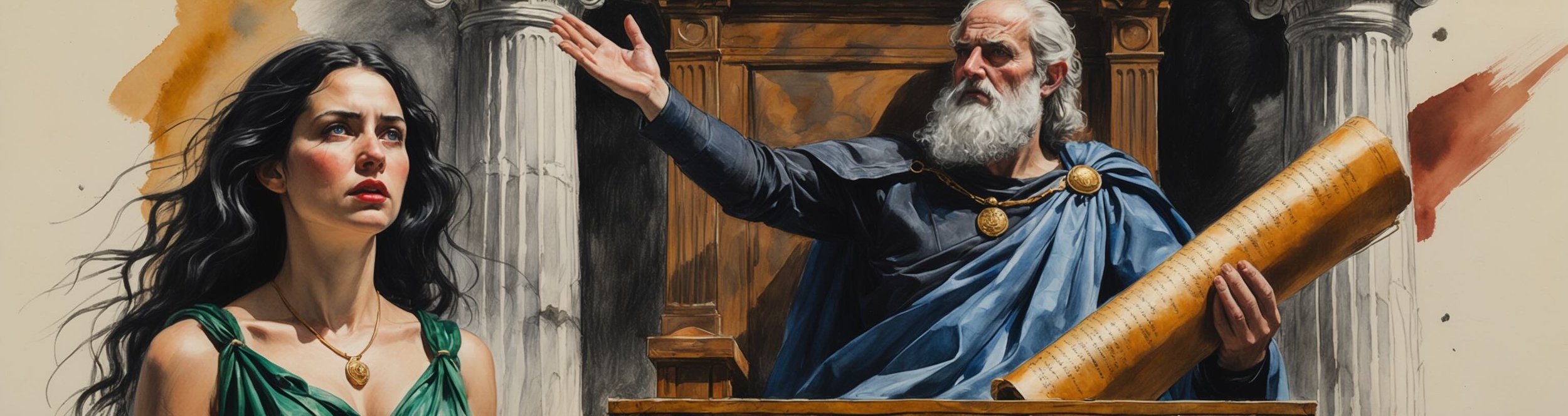
Theseus, Duke of Athens, counts the four days to his wedding with Hippolyta, the Amazon queen he won by conquest. Egeus demands that his daughter Hermia marry Demetrius, and Theseus gives her until the wedding day to obey, become a nun or die. Hermia and Lysander plan to run away through the wood, and tell Helena, who loves Demetrius. Alone, Helena decides to betray the plan to him.
Characters appearing: Theseus | Hippolyta | Philostrate | Egeus | Hermia | Lysander | Demetrius | Helena
Key themes: Love and Folly | Control and Rebellion | Order vs Chaos
ATHENS. THE PALACE OF THESEUS.
[ENTER THESEUS, HIPPOLYTA, PHILOSTRATE, AND ATTENDANTS]
THESEUS
Now, fair Hippolyta, our nuptial hour
My dear Hippolyta, our wedding day
Draws on apace; four happy days bring in
Is fast approaching; in four days from now
Another moon: but, O, methinks, how slow
A new moon will appear. But, oh, how slow
This old moon wanes! She lingers my desires,
The old moon fades! It keeps my wishes waiting,
Like to a step-dame or a dowager
Much like a stepmother or wealthy widow
Long withering out a young man revenue.
Holds up a young man’s due inheritance.
HIPPOLYTA
Four days will quickly steep themselves in night;
Four days will soon dissolve into the night;
Four nights will quickly dream away the time;
Four nights will soon evaporate as dreams;
And then the moon, like to a silver bow
And then the crescent moon, shaped like a bow
New-bent in heaven, shall behold the night
Appearing in the sky, will cast its gaze
Of our solemnities.
Upon our wedding vows.
THESEUS
Go, Philostrate,
Go, Philostrate,
Stir up the Athenian youth to merriments;
Go start a party with the youth of Athens;
Awake the pert and nimble spirit of mirth;
Fire up their jovial and lively spirits;
Turn melancholy forth to funerals;
Make sadness dissipate to funerals,
The pale companion is not for our pomp.
For sorrow has no place when celebrating.
[EXIT PHILOSTRATE]
Hippolyta, I wooed thee with my sword,
Hippolyta, I wooed you in a battle
And won thy love, doing thee injuries;
And won your heart whilst I was hurting you;
But I will wed thee in another key,
But I will marry you a different way,
With pomp, with triumph and with revelling.
With fanfare and triumphant revelry.
[ENTER EGEUS, HERMIA, LYSANDER, AND DEMETRIUS]
EGEUS
Happy be Theseus, our renowned duke!
Be happy, Theseus, our famous duke!
THESEUS
Thanks, good Egeus: what's the news with thee?
Thank you, Egeus: what’s the news with you?
EGEUS
Full of vexation come I, with complaint
I’ve come here as I’m properly annoyed
Against my child, my daughter Hermia.
With my own child, my daughter Hermia.
Stand forth, Demetrius. My noble lord,
Step up, Demetrius. My noble lord,
This man hath my consent to marry her.
This man has my consent to marry her.
Stand forth, Lysander: and my gracious duke,
Step up, Lysander: and my gracious duke,
This man hath bewitched the bosom of my child;
This man has cast a spell on my child’s heart.
Thou, thou, Lysander, thou hast given her rhymes,
Lysander, you have sent her rhyming poems,
And interchanged love-tokens with my child:
And traded tokens of your love with her.
Thou hast by moonlight at her window sung,
You’ve sung outside her window by the moonlight,
With feigning voice verses of feigning love,
By falsely singing love songs of false love,
And stolen the impression of her fantasy
And made her fall for you by being devious
With bracelets of thy hair, rings, gawds, conceits,
In gifting her your kiss-curls, rings, fake trinkets,
Knacks, trifles, nosegays, sweetmeats, messengers
Knickknacks, little bouquets, and candied fruit
Of strong prevailment in unhardened youth:
That influence someone who’s immature.
With cunning hast thou filched my daughter's heart,
You’ve robbed my daughter’s heart by being cunning;
Turned her obedience, which is due to me,
You’ve changed the manners I’ve instilled in her
To stubborn harshness: and, my gracious duke,
To stubborn cruelty; and, my dear duke,
Be it so she will not here before your grace
If here, before your grace, she says she won’t
Consent to marry with Demetrius,
Give her consent to wed Demetrius,
I beg the ancient privilege of Athens,
I ask to use the old custom of Athens,
As she is mine, I may dispose of her:
Since she is mine, that I may choose her fate:
Which shall be either to this gentleman
Which is she either weds this gentleman
Or to her death, according to our law
Or she’ll be killed, as stated in our law,
Immediately provided in that case.
Immediately if that proves the case.
THESEUS
What say you, Hermia? Be advised fair maid:
What do you say to that, Hermia? Be warned:
To you your father should be as a god;
You ought to treat your father like a god;
One that composed your beauties, yea, and one
For he created all your beauty, and
To whom you are but as a form in wax
You’re merely just a waxwork form of him,
By him imprinted and within his power
Created by him, and he has the power
To leave the figure or disfigure it.
To keep the waxwork figure or destroy it.
Demetrius is a worthy gentleman.
Demetrius is a decent gentleman.
HERMIA
So is Lysander.
So is Lysander.
THESEUS
In himself he is;
I agree he is;
But in this kind, wanting your father's voice,
But here, without permission from your father,
The other must be held the worthier.
Demetrius has to be the better choice.
HERMIA
I would my father looked but with my eyes.
I wish my father saw what I can see.
THESEUS
Rather your eyes must with his judgment look.
Except you have to heed what he observes.
HERMIA
I do entreat your grace to pardon me.
I ask your grace to offer me forgiveness.
I know not by what power I am made bold,
I don’t know whether I may be so bold,
Nor how it may concern my modesty,
Nor how it will affect my reputation,
In such a presence here to plead my thoughts;
Expressing my desires in your presence;
But I beseech your grace that I may know
But I would like to ask your grace to know
The worst that may befall me in this case,
The worst thing that might happen to me here
If I refuse to wed Demetrius.
If I refuse to wed Demetrius.
THESEUS
Either to die the death or to abjure
You either will be killed or be deprived
For ever the society of men.
Of ever being with a man again.
Therefore, fair Hermia, question your desires;
So, Hermia, consider what you wish for;
Know of your youth, examine well your blood,
Consider that you’re young; think of your feelings,
Whether, if you yield not to your father's choice,
And whether, if you disobey your father,
You can endure the livery of a nun,
You could live out your life dressed as a nun,
For aye to be in shady cloister mewed,
Confined forever in a shady convent,
To live a barren sister all your life,
To live a lonely woman all your life,
Chanting faint hymns to the cold fruitless moon.
And worship the goddess of chastity.
Thrice-blessed they that master so their blood,
The nuns that tame their passions are thrice-blessed
To undergo such maiden pilgrimage;
For living out their lives as faithful virgins;
But earthlier happy is the rose distilled,
But roses turned to perfume breed contentment,
Than that which withering on the virgin thorn
Like women’s children do; but virgins suffer
Grows, lives and dies in single blessedness.
To live and die alone without a child.
HERMIA
So will I grow, so live, so die, my lord,
And so that’s how I’ll live and die, my lord,
Ere I will my virgin patent up
Before I give up my virginity
Unto his lordship, whose unwished yoke
To that man, whose control I don’t desire
My soul consents not to give sovereignty.
And unto whom my heart won’t acquiesce.
THESEUS
Take time to pause; and, by the next new moon –
Take time to contemplate; and by the new moon –
The sealing-day betwixt my love and me,
The day my love and I will tie the knot
For everlasting bond of fellowship –
Of marriage in an everlasting bond –
Upon that day either prepare to die
Upon that day either prepare to die
For disobedience to your father's will,
For disobeying what your father wishes,
Or else to wed Demetrius, as he would;
Or else, do what he wants, and wed Demetrius;
Or on Diana's altar to protest
Or vow devotion to goddess Diana
For aye austerity and single life.
And live a virgin in austerity.
DEMETRIUS
Relent, sweet Hermia: and, Lysander, yield
Give in, dear Hermia; and, Lysander, give up
Thy crazed title to my certain right.
Your idiotic chase for what is mine.
LYSANDER
You have her father's love, Demetrius;
You have her father’s love, Demetrius;
Let me have Hermia's: do you marry him.
Let me wed her, and you can marry him.
EGEUS
Scornful Lysander! True, he hath my love,
How rude, Lysander! Yes, it’s true I love him,
And what is mine my love shall render him.
And through my love I’ll give him what is mine.
And she is mine, and all my right of her
And she is mine, and all my rights to her
I do estate unto Demetrius.
I’m giving over to Demetrius.
LYSANDER
I am, my lord, as well derived as he,
My lord, I am as noble as he is,
As well possessed; my love is more than his;
And just as rich; I love Hermia more;
My fortunes every way as fairly ranked,
My fortunes and my prospects are the same,
If not with vantage, as Demetrius';
And maybe better, as Demetrius’;
And, which is more than all these boasts can be,
And most of all, outweighing all these boasts,
I am beloved of beauteous Hermia:
The beautiful Hermia loves me back.
Why should not I then prosecute my right?
Why can’t I have the right to marry her?
Demetrius, I'll avouch it to his head,
Demetrius – I’ll say this to his face –
Made love to Nedar's daughter, Helena,
Toyed and seduced Helena, Nedar’s daughter
And won her soul; and she, sweet lady, dotes,
And won her heart; and she, sweet lady, dotes,
Devoutly dotes, dotes in idolatry,
Completely dotes, besotted, idolising,
Upon this spotted and inconstant man.
Upon this tarnished, inconsistent man.
THESEUS
I must confess that I have heard so much,
I must admit that I have heard that said,
And with Demetrius thought to have spoke thereof;
And I have thought to speak to him about it;
But, being over-full of self-affairs,
But, being overwhelmed with my own business,
My mind did lose it. But, Demetrius, come;
I then forgot it. But, come here, Demetrius;
And come, Egeus; you shall go with me,
Come too, Egeus; you will come with me,
I have some private schooling for you both.
I’ve some advice to share with you in private.
For you, fair Hermia, look you arm yourself
And as for you, fair Hermia, prepare
To fit your fancies to your father's will;
To follow out the wishes of your father,
Or else the law of Athens yields you up –
Or else the law of Athens falls upon you –
Which by no means we may extenuate –
Which we cannot extenuate at all –
To death, or to a vow of single life.
And you’ll be put to death, or live alone.
Come, my Hippolyta: what cheer, my love?
Come, dear Hippolyta: do you have good news?
Demetrius and Egeus, go along:
Demetrius and Egeus, come along:
I must employ you in some business
I have some tasks that you must do for me
Against our nuptial and confer with you
Relating to our wedding, and I’ll tell you
Of something nearly that concerns yourselves.
About an issue that concerns you both.
EGEUS
With duty and desire we follow you.
With glad obedience, we’ll follow you.
[EXEUNT ALL BUT LYSANDER AND HERMIA]
LYSANDER
How now, my love! Why is your cheek so pale?
What’s up, my love! Why are your cheeks so pale?
How chance the roses there do fade so fast?
How come your rosy cheeks have quickly faded?
HERMIA
Belike for want of rain, which I could well
Perhaps from lack of rain, which I could make
Beteem them from the tempest of my eyes.
By sobbing out a rainstorm from my eyes.
LYSANDER
Ay me! For aught that I could ever read,
My dear! In every book that I could read,
Could ever hear by tale or history,
And hearing every story ever told,
The course of true love never did run smooth;
The path to true love isn’t ever easy;
But, either it was different in blood, –
Perhaps they come from different social classes…
HERMIA
O cross! Too high to be enthralled to low.
An obstacle! Too noble for a pauper.
LYSANDER
Or else misgraffed in respect of years, –
Or else they’re mismatched by too many years…
HERMIA
O spite! Too old to be engaged to young.
Good grief! Too old to marry someone younger.
LYSANDER
Or else it stood upon the choice of friends, –
Or else it’s not the wishes of their kin…
HERMIA
O hell! To choose love by another's eyes.
That’s hell! To let another pick your lover.
LYSANDER
Or, if there were a sympathy in choice,
Or, if there was approval of the choice,
War, death, or sickness did lay siege to it,
War, death or sickness had put paid to it,
Making it momentany as a sound,
To make it momentary, like a sound,
Swift as a shadow, short as any dream;
Or like a darting shadow, or a short dream;
Brief as the lightning in the collied night,
As brief as lightning bolts within the night,
That, in a spleen, unfolds both heaven and earth,
That split the sky and earth as they unfold,
And ere a man hath power to say 'Behold!'
Before a man has time to cry ‘look out!’
The jaws of darkness do devour it up:
The lightning’s gone and darkness has returned:
So quick bright things come to confusion.
For things that brightly shine will quickly vanish.
HERMIA
If then true lovers have been ever crossed,
So if true lovers always suffer setbacks,
It stands as an edict in destiny:
That’s just the way true love is meant to be;
Then let us teach our trial patience,
So let us teach ourselves to act with patience
Because it is a customary cross,
To overcome the crosses we must bear,
As due to love as thoughts and dreams and sighs,
For love will make us think and dream and sigh,
Wishes and tears, poor fancy's followers.
And, inescapably, love makes us sob.
LYSANDER
A good persuasion: therefore, hear me, Hermia.
Well-reasoned: therefore, listen, Hermia.
I have a widow aunt, a dowager
I have a widowed aunt, who was bequeathed
Of great revenue, and she hath no child:
A massive fortune, and she has no children.
From Athens is her house remote seven leagues;
Her home is twenty-one miles outside Athens,
And she respects me as her only son.
And she respects me like her only son.
There, gentle Hermia, may I marry thee;
There, gentle Hermia, we can be married;
And to that place the sharp Athenian law
And over there the vicious laws of Athens
Cannot pursue us. If thou lovest me then,
Do not apply. And, therefore, if you love me,
Steal forth thy father's house to-morrow night;
Tomorrow night sneak from your father’s house,
And in the wood, a league without the town,
And in the wood, three miles out of town,
Where I did meet thee once with Helena,
Where I once met with you and Helena
To do observance to a morn of May,
To watch the sunrise on a May-day morning,
There will I stay for thee.
There I will wait for you.
HERMIA
My good Lysander!
My dear Lysander!
I swear to thee, by Cupid's strongest bow,
I swear, by Cupid, god of love’s strong bow,
By his best arrow with the golden head,
And by his finest arrow tipped with gold,
By the simplicity of Venus' doves,
And doves that pulled the chariot of Venus,
By that which knitteth souls and prospers loves,
By that which binds our souls with love between us,
And by that fire which burned the Carthage queen,
And by that fire which burned the Carthage queen,
When the false Troyan under sail was seen,
When cheating Aeneas was, sailing, seen,
By all the vows that ever men have broke,
And by all promises that men have broke,
In number more than ever women spoke,
Which number more than women ever spoke,
In that same place thou hast appointed me,
That in that place you’ve said that I should be,
To-morrow truly will I meet with thee.
I swear, tomorrow, there you’ll meet with me.
LYSANDER
Keep promise, love. Look, here comes Helena.
Do keep your promise. Look, here comes Helena.
[ENTER HELENA]
HERMIA
God speed fair Helena! Whither away?
Hello there, lovely Helena! You off?
HELENA
Call you me fair? That fair again unsay.
You say I’m beautiful? Oh, don’t you scoff.
Demetrius loves your fair: O happy fair!
Demetrius loves your beauty: lucky you!
Your eyes are lode-stars; and your tongue's sweet air
Your eyes are guiding stars; your vocal hue
More tuneable than lark to shepherd's ear,
Sings sweeter than the lark when spring resumes,
When wheat is green, when hawthorn buds appear.
When wheat is green and hawthorn flower blooms.
Sickness is catching: O, were favour so,
But sickness is contagious: were looks so,
Yours would I catch, fair Hermia, ere I go;
I’d catch yours, gorgeous Hermia, then I’d go;
My ear should catch your voice, my eye your eye,
My ears and eyes would match all that you do,
My tongue should catch your tongue's sweet melody.
My tongue would learn to sing as well as you.
Were the world mine, Demetrius being bated,
If all were mine, Demetrius aside,
The rest I'd give to be to you translated.
I’d swap it to be you personified.
O, teach me how you look, and with what art
Oh, teach me how you look, and show the art
You sway the motion of Demetrius' heart.
You’ve used to steal away Demetrius’ heart.
HERMIA
I frown upon him, yet he loves me still.
I frown at him, but yet he loves me still.
HELENA
O that your frowns would teach my smiles such skill!
Oh, that your frowns would teach my smiles such skill!
HERMIA
I give him curses, yet he gives me love.
I curse him, but then he still loves me back.
HELENA
O that my prayers could such affection move!
For love, I wish my prayers could find the knack!
HERMIA
The more I hate, the more he follows me.
The more I hate, the closer he becomes.
HELENA
The more I love, the more he hateth me.
The more I love, the further that he runs.
HERMIA
His folly, Helena, is no fault of mine.
It’s not my fault that he behaves this way.
HELENA
None, but your beauty: would that fault were mine!
No, but I wish my beauty had your sway!
HERMIA
Take comfort: he no more shall see my face;
Don’t worry: he’ll no longer see my face;
Lysander and myself will fly this place.
Lysander and myself will leave this place.
Before the time I did Lysander see,
Before I saw Lysander, I did see
Seemed Athens as a paradise to me:
That Athens was a paradise for me:
O, then, what graces in my love do dwell,
But all the strengths that in Lysander dwell
That he hath turned a heaven unto a hell!
Have turned my perfect heaven into hell!
LYSANDER
Helen, to you our minds we will unfold:
Helena, we will share our plans with you:
To-morrow night, when Phoebe doth behold
Tomorrow, when the moon comes into view
Her silver visage in the watery glass,
And shines upon the water’s mirrored glass
Decking with liquid pearl the bladed grass,
And evening dew is spread across the grass,
A time that lovers' flights doth still conceal,
It’s then these lovers run away to hide
Through Athens' gates have we devised to steal.
And out through Athens’ gates we both will slide.
HERMIA
And in the wood, where often you and I
And in the wood, where often you and I
Upon faint primrose-beds were wont to lie,
Would, on those primrose flowerbeds, both lie
Emptying our bosoms of their counsel sweet,
And share the loving secrets of our heart,
There my Lysander and myself shall meet;
That’s where I’ll meet Lysander, then depart
And thence from Athens turn away our eyes,
Away from Athens, and we won’t turn round,
To seek new friends and stranger companies.
But then new friends and strangers will be found.
Farewell, sweet playfellow: pray thou for us;
Goodbye, sweet friend; I ask you pray for us;
And good luck grant thee thy Demetrius!
And hopefully you’ll win Demetrius!
Keep word, Lysander: we must starve our sight
Stay true, Lysander; let’s stay out of sight
From lovers' food till morrow deep midnight.
Of one another till tomorrow night.
LYSANDER
I will, my Hermia.
I will, my Hermia.
[EXIT HERMIA]
Helena, adieu:
Helena, adieu:
As you on him, Demetrius dote on you!
And may Demetrius also dote on you!
[EXIT]
HELENA
How happy some o'er other some can be!
Such happiness that others can incur!
Through Athens I am thought as fair as she.
In Athens, I’m as beautiful as her.
But what of that? Demetrius thinks not so;
So what? Demetrius does not agree;
He will not know what all but he do know:
He’ll never know of what the others see.
And as he errs, doting on Hermia's eyes,
And as he wanders, dreaming of her eyes,
So I, admiring of his qualities:
I think of him and all I idolise,
Things base and vile, folding no quantity,
The rude and ugly, wicked and pugnacious,
Love can transpose to form and dignity:
Through eyes that love, seem beautiful and gracious;
Love looks not with the eyes, but with the mind;
Love doesn’t look with eyes, but with the mind,
And therefore is winged Cupid painted blind:
So that’s why Cupid, god of love, is blind;
Nor hath Love's mind of any judgement taste;
And Cupid’s taste is mired with imprecisions;
Wings and no eyes figure unheedy haste:
His wings and blindness drive his rash decisions.
And therefore is Love said to be a child,
Hence, Love is often like a child perceived
Because in choice he is so oft beguiled.
Because a child’s so easily deceived.
As waggish boys in game themselves forswear,
As cheeky boys renounce what they once said,
So the boy Love is perjured every where:
So, much the same, will Love make his lies spread.
For ere Demetrius looked on Hermia's eyne,
Before Demetrius saw Hermia’s eyes,
He hailed down oaths that he was only mine;
His words of love would just for me arise.
And when this hail some heat from Hermia felt,
But when he melted, seeing Hermia,
So he dissolved, and showers of oaths did melt.
His words of love dissolved from me to her.
I will go tell him of fair Hermia's flight:
I’ll tell him Hermia is taking flight,
Then to the wood will he to-morrow night
Then he’ll go to the woods tomorrow night
Pursue her; and for this intelligence
Pursuing her; and with this knowledge, he
If I have thanks, it is a dear expense:
May offer thanks, at painful cost to me.
But herein mean I to enrich my pain,
But in this way, I will enhance my pain,
To have his sight thither and back again.
To see him go there then come back again.
[EXIT]