Control and Rebellion
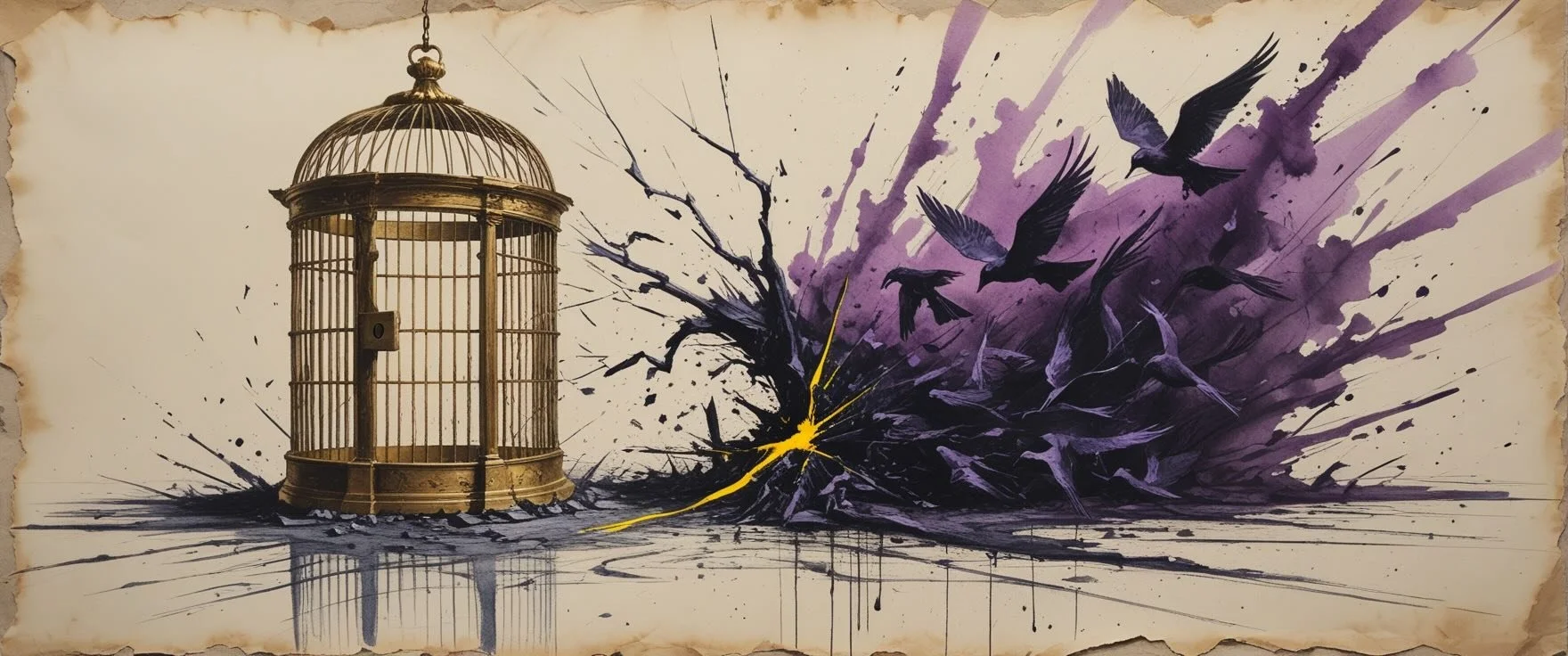
Theme Profile – At a Glance
- Focus: The play’s contests of will: a father against a daughter, a fairy king against his queen, a duke against the woman he conquered, a servant against his master, a company against its star. Who gives orders, who refuses, and how the refusals are put down.
- Key Characters: Hermia, Theseus, Oberon, Titania, Helena, Puck, Bottom, Hippolyta.
- The Core Tension: Everyone with power in the play is disobeyed, and every act of disobedience is answered not by argument but by force, magic or decree. The rebels win only when the rulers change their minds.
- Key Manifestations: Egeus and Theseus against Hermia, and Hermia’s refusal (A1S1); the lovers’ flight from the law (A1S1); Oberon’s demand for the changeling and Titania’s refusal (A2S1); Helena pursuing a man who orders her away (A2S1); Puck’s mistake and his defence of it (A3S2); Bottom against Quince for every part (A1S2); Titania’s surrender and release (A4S1); Theseus overbearing Egeus (A4S1).
- Famous Quote:
"I would my father looked but with my eyes."
(Act 1, Scene 1) - The Outcome: Every rebellion is settled from above. Titania gives way under a spell, Egeus is overruled by the duke, Puck is forgiven, and the lovers get what they wanted because a fairy and a ruler decided they should.
A Form in Wax
The play’s first contest of will is a father’s. Egeus has chosen a husband for Hermia, Hermia has chosen another, and Egeus brings her before the duke to have the law settle it. Theseus explains to her what a daughter is.
Original
To you your father should be as a god;
One that composed your beauties, yea, and one
To whom you are but as a form in wax
By him imprinted and within his power
To leave the figure or disfigure it.
(Theseus, Act 1, Scene 1)
Shakespeare Retold (Modern Verse)
You ought to treat your father like a god;
For he created all your beauty, and
You’re merely just a waxwork form of him,
Created by him, and he has the power
To keep the waxwork figure or destroy it.
A daughter is wax; her father pressed the shape into it; he may keep the figure or melt it down. It is the most complete statement of paternal control in Shakespeare, and it is delivered courteously, by a reasonable man, as a description of how things are. Hermia’s answer is three lines of refusal: she does not know by what power she is made bold, but her soul does not consent.
The scene sets the pattern for the play. Control is stated as law and backed by death; rebellion is stated as a fact about the rebel’s soul; and neither side can move the other. The only way out is to leave, and the theme of order and chaos is what the lovers leave when they run for the wood.
Am Not I Thy Lord?
The fairy court has the same argument on a larger scale. Oberon wants the changeling boy and Titania will not give him up; he asks whether he is not her lord, and she answers that if he is, she must be his lady, which is not the same as obedient. When she leaves, he tells the empty stage what he will do.
Original
Well, go thy way: thou shalt not from this grove
Till I torment thee for this injury.
(Oberon, Act 2, Scene 1)
Shakespeare Retold (Modern Verse)
Well, leave then: but you will not leave this grove
Until I’ve made you suffer for your actions.
"Injury" is the word a ruler uses for being refused. Oberon does not try to persuade Titania again; he sends for the flower, drugs her while she sleeps, watches her dote on an ass, and takes the boy while she is helpless. The rebellion is put down by magic, and the queen never agrees to anything. She wakes to find the argument over and the boy gone.
What the fairy plot adds to the human one is a picture of what happens after control wins. Oberon pities Titania, releases her, dances with her and never tells her. The theme of gender and patriarchy is close by throughout, because every rebel in the play is a woman or a servant, and every ruler is a king, a duke or a father.
Steal Forth Thy Father's House
The lovers’ rebellion is not an argument but an escape. Lysander has an aunt seven leagues off, beyond the reach of Athens, and proposes that Hermia leave her father’s house by night and meet him in the wood.
Original
And to that place the sharp Athenian law
Cannot pursue us. If thou lovest me then,
Steal forth thy father's house to-morrow night...
(Lysander, Act 1, Scene 1)
Shakespeare Retold (Modern Verse)
And over there the vicious laws of Athens
Do not apply. And, therefore, if you love me,
Tomorrow night sneak from your father’s house...
It is the classic form of comic rebellion, the elopement, and it is respectable in its way: an inheritance, a house, a marriage. What the lovers cannot know is that the wood between them and freedom has a king of its own, and that his servant will spend the night rearranging their affections without asking.
The lovers never reach the aunt. They are controlled in the wood far more thoroughly than they were controlled in Athens, and by a power they cannot see, argue with or run from. The theme of magic and illusion is the play’s second and more efficient form of control, and it is the one that finally settles the human plot.
I Beg the Law, the Law, Upon His Head
In the morning the father has his chance. Egeus finds the four lovers asleep in the wood, hears Lysander confess the elopement, and demands the punishment the law provides.
Original
Enough, enough, my lord; you have enough:
I beg the law, the law, upon his head.
(Egeus, Act 4, Scene 1)
Shakespeare Retold (Modern Verse)
I’ve heard enough, my lord; you’ve heard enough:
I want the full force of the law upon him.
He does not get it. Demetrius announces that he no longer wants Hermia, and Theseus, who could not extenuate the law in Act 1, overbears Egeus in a line and orders a triple wedding. The father who invoked the ancient privilege of Athens is not answered; he follows the duke off the stage and, in this text, does not speak again.
The rebels win, then, but not by rebelling. Hermia’s defiance changed nothing; Lysander’s escape led into a trap; what freed them was a suitor’s enchanted change of heart and a ruler’s decision to be generous. Control in the play is never overthrown. It is redirected, from above, by the people who hold it. The theme of dreams and reality is how the play lets everyone forget that this is what happened.
"Thus, ironically, the vestal’s very freedom from fancy guarantees the subjections of others."
— Louis Adrian Montrose, ‘Shaping Fantasies’: Figurations of Gender and Power in Elizabethan Culture, 1983
Key Quotes on Control and Rebellion
Quote 1
So will I grow, so live, so die, my lord,
Ere I will my virgin patent up
Unto his lordship, whose unwished yoke
My soul consents not to give sovereignty.
(Hermia, Act 1, Scene 1)
Shakespeare Retold (Modern Verse)
And so that’s how I’ll live and die, my lord,
Before I give up my virginity
To that man, whose control I don’t desire
And unto whom my heart won’t acquiesce.
Quote Analysis: Hermia’s answer to the duke. "Sovereignty" is a political word and she uses it about her own body: Demetrius may have her father’s consent and the law’s, but her soul will not give him rule. She has no power in the room and speaks as though she had. The speech is the play’s clearest act of rebellion and its least effective; Theseus gives her four days to think again, and the plot moves to the wood. What it establishes is the rebel’s only weapon in this play, which is refusal.
Not for thy fairy kingdom. Fairies, away!
We shall chide downright, if I longer stay.
(Titania, Act 2, Scene 1)
Shakespeare Retold (Modern Verse)
Not for your fairy kingdom. Fairies, leave!
If I stay here, a fight’s all we’ll achieve.
Quote Analysis: Titania ending the argument with Oberon. He has offered to join her revels if she gives him the boy; she will not sell the child for his whole kingdom, and leaves before the quarrel becomes a fight. It is a queen’s exit, and it is the last free choice she makes in the play. Everything Titania does after this line she does under a spell or in ignorance of one. Oberon lets her go, and tells the audience what he intends.
When I had at my pleasure taunted her
And she in mild terms begged my patience,
I then did ask of her her changeling child;
Which straight she gave me, and her fairy sent
To bear him to my bower in fairy land.
(Oberon, Act 4, Scene 1)
Shakespeare Retold (Modern Verse)
When I had teased her to my heart’s content
And she had begged that I desist with it,
I asked she cede her Indian boy to me,
Which she gave straightaway, and sent her fairy
To take him to my room in fairy land.
Quote Analysis: Oberon describing his victory. He found Titania garlanding the ass with flowers, taunted her "at my pleasure" until she begged him to stop, asked for the boy, and got him at once. The frankness is the point: the fairy king does not pretend the queen was persuaded, and the play does not pretend either. Her surrender is the act of a drugged woman being mocked by her husband, and the pity he mentions a few lines earlier arrives after the boy is safely in his bower.
You can play no part but Pyramus; for Pyramus is a sweet-faced man; a proper man, as one shall see in a summer's day; a most lovely gentleman-like man: therefore you must needs play Pyramus.
(Quince, Act 1, Scene 2)
Shakespeare Retold (Modern Verse)
You will only play the part of Pyramus, for Pyramus is a handsome man; as decent a man as you might see out on a summer’s day; a lovely gentlemanly man. Therefore you have to play Pyramus.
Quote Analysis: Quince managing Bottom. The weaver has asked for Pyramus, then Thisbe, then the lion, and Quince, who is nominally in charge, gets his way by telling him that Pyramus is the handsomest man in Athens. It is the play’s smallest contest of will and its funniest, and it shows control working by flattery rather than force. Quince has no law, no magic and no duke behind him; he has a company to keep together and a star who wants every part, and he wins with a compliment.
Key Takeaways
- A Daughter Is Wax: Theseus states paternal control as law and Hermia refuses it as a fact about her soul; neither can move the other.
- The Queen Is Drugged: Oberon answers Titania's refusal not with argument but with the flower; she surrenders the boy under a spell and is never told.
- Escape Leads Into a Trap: The lovers' flight from Athenian law delivers them to a fairy king who controls them far more completely.
- Rebels Win From Above: Every rebellion is settled by the powerful changing their minds: Theseus overrules Egeus, and Oberon relents.
Study Questions and Analysis
Why does Hermia defy her father and the duke?
Because she cannot do otherwise, and she says so. Asked to marry Demetrius on pain of death, Hermia asks permission to speak and then admits she does not know where her boldness comes from:
I know not by what power I am made bold,
Nor how it may concern my modesty...
(Hermia, Act 1, Scene 1)
Shakespeare Retold (Modern Verse)
I don’t know whether I may be so bold,
Nor how it will affect my reputation...
It is the play’s first mention of an unexplained power, and it is not magic; it is a young woman’s will, which surprises her as much as it surprises the court. She has not planned to defy anyone. She simply finds that her soul does not consent.
Louis Adrian Montrose, in "Shaping Fantasies" (1983), placed Hermia among the "willful daughters" whose pride and power the play’s ending brings under "the control of lords and husbands", and read her defiance as the thing the comedy exists to tame. Catherine Belsey, in her 1993 essay for the Folger edition, noted that the play "does not ignore the trace of violence that exists within love when the other person fails to conform to the lover’s idealized image", and Hermia meets that violence twice, from a father who would rather see her dead than married to the wrong man and from a lover who, enchanted, calls her a serpent. She stands up to both. What she cannot resist is the one force the play does not let her fight, which is the flower. The theme of love and folly is where her rebellion is finally overruled.
How does Oberon win the quarrel with Titania?
By not arguing. Once Titania has refused him, Oberon sends for the love-in-idleness flower and explains to the audience exactly what he means to do with it:
And ere I take this charm from off her sight,
As I can take it with another herb,
I'll make her render up her page to me.
(Oberon, Act 2, Scene 1)
Shakespeare Retold (Modern Verse)
And then before I break her spell of sight,
As I’ll do with another flower’s nectar,
I’ll make her give her little boy to me.
The plan works in every particular. Titania wakes, loves Bottom, is taunted by her husband until she begs, and gives up the boy; Oberon then lifts the spell and dances with her. She never agrees to anything. She is not persuaded, or defeated, or bought; she is drugged, and when she wakes the argument is over.
Shirley Nelson Garner, in a 1981 essay for Women’s Studies, read this as the play’s design rather than its accident: the comic ending requires the bonds between women, Titania’s with the dead votaress and Hermia’s with Helena, to be broken so that each woman can be given to a man, and the changeling is the price. Louis Adrian Montrose (1983) listed "possessive mothers" and "unruly wives" among the forms of female power the play subdues, and Titania is both. The gentler reading is C. L. Barber’s (1959), for whom the fairy quarrel is a disorder that the holiday must resolve before the seasons can be righted, and Oberon’s trick is the play’s festive machinery rather than a husband’s cruelty. The text supports the harder reading, because it insists on the mechanism: Oberon does not win the boy; he takes him. The theme of magic and illusion is, in the fairy plot, the name for control that does not need consent.
Is Helena’s pursuit of Demetrius a kind of rebellion?
It is the play’s strangest one. Helena is ordered away by Demetrius in the plainest terms, and disobeys him at every step, following him into the wood, asking to be used as his spaniel, and refusing every threat he makes. When he says he will run and hide, she tells him the old stories will be reversed:
The wildest hath not such a heart as you.
Run when you will, the story shall be changed:
Apollo flies, and Daphne holds the chase...
(Helena, Act 2, Scene 1)
Shakespeare Retold (Modern Verse)
Ferocious creatures aren’t as cruel as you.
Run if you like: the chaser’s now the chased,
Like virgin Daphne chasing lewd Apollo...
Daphne chasing Apollo, the dove pursuing the griffin: Helena knows she has turned the rules of courtship upside down, and says a few lines later that women "cannot fight for love, as men may do". Her disobedience is the only kind available to her.
Jan Kott, in Shakespeare Our Contemporary (1964), read the spaniel speech as close to masochism and made it part of his case that the play’s treatment of desire is far darker than its reputation. Louis Adrian Montrose (1983) noticed the irony that Helena, the one woman in the play who asks to submit, is the one the men reject until a fairy changes their minds. Whether her persistence is abasement or determination is a fair essay question, and the play gives evidence for both. What it does not do is punish her for it. Helena disobeys a man, a convention and her own better judgement, and she is rewarded with the husband she chased, though by a means she never learns. The theme of gender and patriarchy is the frame: Helena rebels against the rule that women are wooed, and the play, having laughed at her, quietly gives her what she wanted.
Does Puck disobey Oberon?
Not on purpose, and Oberon is not sure. When the love-juice lands on the wrong Athenian and the lovers’ night dissolves into a brawl, the fairy king turns on his servant with two possibilities:
This is thy negligence: still thou mistakest,
Or else committ'st thy knaveries wilfully.
(Oberon, Act 3, Scene 2)
Shakespeare Retold (Modern Verse)
You’ve messed this up: you’re always making errors,
Or maybe you commit mistakes on purpose.
Puck’s defence is that he followed the instruction he was given, a man in Athenian clothes, and that anyway the result has been excellent sport. He is not sorry. Oberon lets it go, gives him the counter-charm and moves on; a fairy king has no better servant, and both of them know it.
The exchange is the play’s only look at control between master and servant, and it is remarkably relaxed. William Hazlitt, in Characters of Shakespear’s Plays (1817), contrasted Puck with Ariel, who serves Prospero on a promise of freedom and is threatened with an oak when he asks for it too soon; Puck "is a mad-cap sprite, full of wantonness and mischief", and nobody threatens him with anything. Oberon rules his queen by force and his servant by tolerance, and the difference tells the audience where the play thinks the real contest of will lies. Puck can be careless because he is not a rival. Titania is punished because she is.
Who is in charge of the Mechanicals?
Quince, in theory. He has written the play, cast it, brought the parts and called the rehearsal; and from the first line of the casting scene Bottom is running it. Bottom wants Pyramus and Thisbe and the lion, and Quince has to say the same thing three times before it sticks:
No, no; you must play Pyramus: and, Flute, you Thisbe.
(Quince, Act 1, Scene 2)
Shakespeare Retold (Modern Verse)
No, no; you must play Pyramus. And, Flute, you’re Thisbe.
The company is the play’s one working democracy, and it works by flattery and patience. Quince never gives an order Bottom cannot talk over; he gets his way by telling the weaver that Pyramus is a sweet-faced man, a proper man, a most lovely gentleman-like man, and Bottom, who cannot resist, agrees.
William Hazlitt (1817) drew the company as a set of temperaments rather than a chorus: Snug "the moral man of the piece, who proceeds by measurement and discretion in all things", Starveling who "keeps the peace, and objects to the lion and the drawn sword", and Bottom "the most romantic of mechanics". Samuel Johnson (1765) saw in Bottom the eternal actor who "is for engrossing every part, and would exclude his inferiors from all possibility of distinction". Between them they describe a group in which nobody has power and everybody has a view, which is the opposite of Athens and the fairy court. It is not an accident that the workmen are the only characters in the play who never try to control anyone but themselves, and the only ones nobody drugs. The theme of art and theatre is where the play keeps its picture of consent.
Why does Theseus change his mind about the law?
Because the man the law was serving has changed his. In Act 1 Theseus told Hermia the law of Athens could by no means be extenuated; in Act 4, hearing that Demetrius now loves Helena, he sets it aside in three lines:
Egeus, I will overbear your will;
For in the temple by and by with us
These couples shall eternally be knit...
(Theseus, Act 4, Scene 1)
Shakespeare Retold (Modern Verse)
Egeus, I will overrule your wishes;
For later on with us, within the temple,
These couples shall be wed eternally...
Egeus, who a moment earlier was demanding the law upon Lysander’s head, is not answered. The law has not been repealed and no reason is given. The duke has simply decided.
Louis Adrian Montrose (1983) read the reversal as the play showing its hand: the Athenian law is enforced exactly as long as it serves the men who invoke it, and when the preferred suitor withdraws, the father’s absolute right evaporates. On that reading Theseus is not being merciful; he is recognising a new arrangement among the men and adjusting the law to fit. C. L. Barber (1959) read it more kindly, as the old order giving way to a new one once the holiday in the wood has done its work. Northrop Frye, in Anatomy of Criticism (1957), simply called it "Theseus’ Athens with its idiotic marriage law", a folly of the world of experience that the green world exists to correct. All three agree on the mechanism. The rebellion succeeds not because the rebels won but because the ruler chose to let them. The theme of order and chaos at the end of the play is a ruler’s generosity, and the play is honest enough to show it as that.
Who is in control at the end of the play?
Not the duke, though he thinks so. Theseus ends the human play by sending everyone to bed, with a joke about fairy time; and then the fairies come, and Oberon leads them through the palace blessing the marriages and the children to come, and Puck sweeps the dust behind the door and speaks the last words to the audience. The final authority in Athens belongs to a king Athens does not believe in.
Catherine Belsey (1993) observed that "by handing over the conclusion to the fairies, the play displaces the apparent closure, the celebration of restored identity"; the mortals think the play ended with the wedding, and it did not. Peter Holland, in his Oxford edition (1994), noted that Puck’s epilogue then hands the whole play to the audience as something they may choose to treat as a dream. The chain of control runs from Egeus to Theseus to Oberon to Puck to the people in the seats, and each link is unaware of the next.
That is the play’s last word on the subject, and it is a comic one. Everyone in A Midsummer Night’s Dream who gives orders is being managed by someone they cannot see, and the audience, who can see everyone, is asked at the end to clap. Control in the play is real, and it is also a dream, and Puck’s request for the audience’s hands is the only exercise of authority in the play that asks for consent. The theme of dreams and reality is where the play lets its rulers off.