Bottom
Character Profile – At a Glance
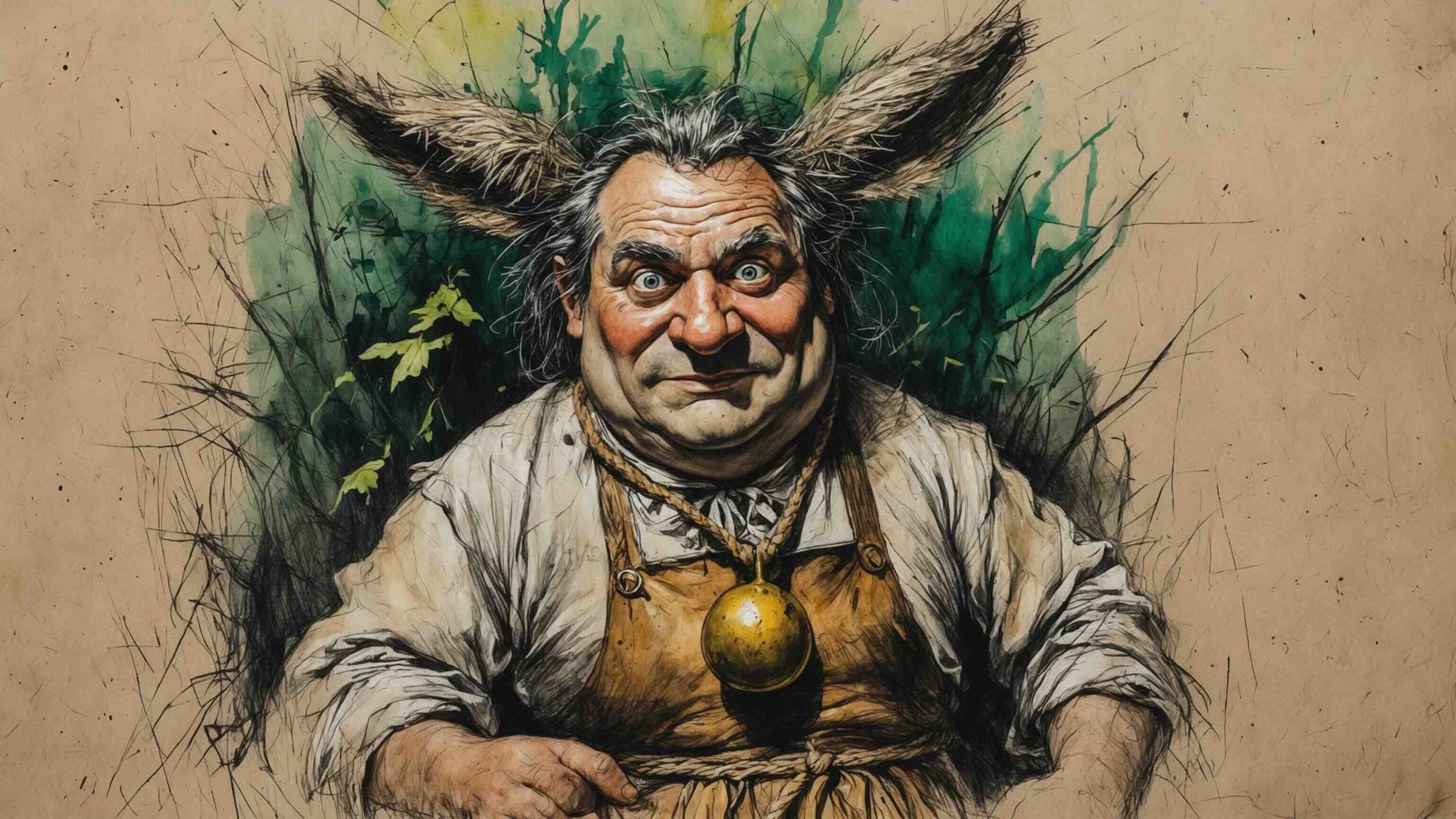
- Role: Nick Bottom, an Athenian weaver and the star of the workmen’s play. He is given an ass’s head by Puck, loved by Titania for a night, and plays Pyramus before the duke.
- Key Traits: Confident, generous and completely without self-doubt. Wants every part in every play. Takes fairies, queens and dukes in his stride.
- The Core Conflict: Bottom believes he can do anything, and the play keeps testing the belief: with a role, with a transformation, with a fairy queen, and with an audience of mockers.
- Key Actions: Volunteers for every part in Pyramus and Thisbe (A1S2). Solves the problems of the lion, the wall and the moon (A3S1). Is transformed, sings to keep his courage up, and is loved by Titania. Orders her fairies about and falls asleep in her arms (A4S1). Wakes, tries to describe his dream, and rejoins his friends (A4S2). Plays and dies as Pyramus, then gets up to offer an epilogue (A5S1).
- Famous Quote:
"I have had a most rare vision."
(Act 4, Scene 1) - The Outcome: Restored to his own head, he performs Pyramus with total commitment, dies at length, and is the only mortal who was ever inside the fairy world.
Let Me Play the Lion Too
Bottom is the first of the workmen to speak and the last to stop. At the casting meeting in Quince’s house he is given the lead, Pyramus, and immediately wants to know whether the part is a lover or a tyrant, because he could do either. Then he asks for Thisbe as well. Then the lion.
Original
Let me play the lion too: I will roar, that I will do any man's heart good to hear me; I will roar, that I will make the duke say 'Let him roar again, let him roar again.'
(Act 1, Scene 2)
Shakespeare Retold (Modern Verse)
Let me play the lion too: I will roar so well that it’ll help anyone who hears me; I will roar so well that I’ll make the duke say, ‘Let him roar again, let him roar again.’
When Quince objects that a roaring lion would frighten the ladies, Bottom offers to roar as gently as a sucking dove. He is not being difficult. He simply cannot imagine a part he could not play better than the man who has it, and the imagination is so cheerful that nobody resents it. The other workmen end the scene deferring to him, and Quince, the nominal director, gets his way only by flattery.
It is a portrait of a particular kind of amateur, and everyone who has been in a school play knows him. What lifts Bottom above the type is the scale of his appetite. He wants to move storms, to make the duke call for an encore, to be a lover, a tyrant, a woman and a beast in the same evening. The theme of art and theatre in this play belongs, at first, to a weaver who has never seen a play performed.
Thou Art Translated
At the rehearsal in the wood, Bottom exits into a thicket for his cue and comes back with an ass’s head. His friends run screaming; Quince tells him he is translated; and Bottom, who cannot see the head, decides the whole thing is a joke at his expense.
Original
I see their knavery: this is to make an ass of me; to fright me, if they could. But I will not stir from this place, do what they can: I will walk up and down here, and I will sing, that they shall hear I am not afraid.
(Act 3, Scene 1)
Shakespeare Retold (Modern Verse)
I see through their trick: they’re trying to make an ass of me; they think they can scare me. But I’ll not move from this place, whatever they try to do. I will walk up and down here, and I will sing, so that they hear me and know I am not afraid.
"To make an ass of me" is the play’s best pun, and Bottom does not know he has made it. His response to terror is to sing, loudly, so that everyone will hear he is not afraid, and the song wakes Titania. The transformation that Puck intended as a humiliation becomes, within twenty lines, the greatest thing that has ever happened to him.
Notice what does not change. Bottom with an ass’s head has the same voice, the same confidence and the same good manners as Bottom without one. He is not degraded by the head; he barely notices it, apart from a new itch and a taste for hay. The theme of magic and illusion works on everyone else in the wood by altering what they love. On Bottom it alters only what he looks like.
Reason and Love Keep Little Company
Titania wakes, hears him singing, and swears she loves him. Bottom’s reply is the sanest thing anyone says in the wood.
Original
Methinks, mistress, you should have little reason for that: and yet, to say the truth, reason and love keep little company together now-a-days; the more the pity that some honest neighbours will not make them friends. Nay, I can gleek upon occasion.
(Act 3, Scene 1)
Shakespeare Retold (Modern Verse)
Lady, I don’t think you should have any reason to love me; but, then again, truth, logic and love rarely go together these days. What a shame that some of their kind friends don’t introduce them to one another. No, I can tell a joke occasionally.
A fairy queen has just declared her love, and the weaver observes, mildly, that she has no reason to, and that reason and love seldom keep company anyway. Then he apologises for the joke. It is a moment of pure equilibrium: the most enchanted creature in the play talking to the least enchantable man in Athens.
What follows is his court. Titania gives him four fairies, and Bottom greets each one with elaborate politeness, asks after Peaseblossom’s parents, and promises to make use of Cobweb if he cuts his finger. He is never overawed and never rude. The theme of love and folly in this play is about what people see when they are bewitched; Bottom is the only character who is loved without being bewitched himself, and he treats it as a pleasant social occasion.
Bottom's Dream
When the spell is lifted and the fairies gone, Bottom wakes alone in the wood, calls for his cue, and finds nobody there. Then he tries to say what happened to him.
Original
I have had a dream, past the wit of man to say what dream it was: man is but an ass, if he go about to expound this dream. Methought I was – there is no man can tell what. Methought I was, – and methought I had, – but man is but a patched fool, if he will offer to say what methought I had.
(Act 4, Scene 1)
Shakespeare Retold (Modern Verse)
I’ve had a dream beyond the ability of man to say what the dream was: a man would be an ass if he goes around elaborating on this dream. I thought I was… there is no one who can tell me what I thought I was. I thought I was… I thought I had… but a man would be a jester if he tried to say what I thought I had.
Three times he begins, "Methought I was", "Methought I had", and three times he stops, because the thing he was and had cannot be said. He has been an ass, loved by a queen, and he knows it and does not know it at once. The speech is comic because Bottom is inarticulate, and moving because he is inarticulate about something real. He was there. The lovers only dreamed.
He resolves to have Quince write it up as a ballad, "Bottom’s Dream", because it has no bottom, and to sing it at Thisbe’s death. Then he goes home. The theme of dreams and reality is the play’s subject, and its deepest statement is given to a weaver who cannot finish a sentence. Everyone else explains their night. Bottom is the only one who admits it was beyond him.
"Bottom the Weaver is a character that has not had justice done him. He is the most romantic of mechanics."
— William Hazlitt, Characters of Shakespear’s Plays, 1817
Key Quotes
Quote 1
I will discharge it in either your straw-colour beard, your orange-tawny beard, your purple-in-grain beard, or your French-crown-colour beard, your perfect yellow.
(Act 1, Scene 2)
Shakespeare Retold (Modern Verse)
I will perform it in either your straw-coloured beard, your orange-tawny beard, your dyed purple beard, or your French-coin-coloured beard, which is a perfect yellow.
Quote Analysis: Bottom choosing a beard for Pyramus. He has been told the part is a lover and a proper man, and his mind goes at once to costume, listing four colours of false beard as though the choice were the whole art of acting. It is a small joke about theatre and a large one about Bottom, whose confidence is always in the externals. Quince’s reply, that some French crowns have no hair at all, is a syphilis joke the groundlings would have caught, and Bottom, characteristically, does not.
Some man or other must present Wall: and let him have some plaster, or some loam, or some rough-cast about him, to signify wall; and let him hold his fingers thus, and through that cranny shall Pyramus and Thisbe whisper.
(Act 3, Scene 1)
Shakespeare Retold (Modern Verse)
Someone must play the part of Wall: and have him have some plaster, or clay soil, or pebbled plaster around him, to signify that he’s a wall; and have him hold his fingers like this, and through that gap Pyramus and Thisbe will whisper.
Quote Analysis: Bottom solving the problem of the wall. The workmen have discovered that their play needs moonlight and a wall in a room that has neither, and Bottom’s solution is to have a man play the wall and hold up his fingers for the chink. It is exactly how theatre works, and exactly what Theseus will mock in Act 5. The joke is that Bottom is right. A man saying he is a wall is a wall if the audience agrees, and the play we are watching is built on the same bargain: a bare stage, a wood, a fairy queen.
The eye of man hath not heard, the ear of man hath not seen, man's hand is not able to taste, his tongue to conceive, nor his heart to report, what my dream was.
(Act 4, Scene 1)
Shakespeare Retold (Modern Verse)
The eyes of man haven’t heard, the ears of man haven’t seen, a man’s hand never tasted, his tongue never felt, nor his heart has revealed, what my dream was.
Quote Analysis: The centre of Bottom’s Dream, and the play’s most famous muddle. He is reaching for a text he half remembers, St Paul on the things God has prepared for those who love him, which eye has not seen nor ear heard, and he gets every sense attached to the wrong organ. The eye hears, the ear sees, the hand tastes. It is nonsense, and it is also the truest description in the play of an experience that overturned the ordinary order of things. Bottom has been somewhere the senses do not reach, and his sentence knows it even if he does not.
Now am I dead,
Now am I fled;
My soul is in the sky:
Tongue, lose thy light;
Moon take thy flight:
Now die, die, die, die, die.
(Act 5, Scene 1)
Shakespeare Retold (Modern Verse)
Now I am dead,
Now I have fled;
My soul is in the sky:
Tongue, do not shine;
Moon, speak no line:
Now die, die, die, die, die.
Quote Analysis: Pyramus dying, at length, before the duke. Bottom has been given the tragic lead and plays it with everything he has: the short lines, the exclamations, the instructions to his own tongue and to the moon, and a final line that dies five times. The court mocks him for it, and the audience laughs, but the mockery is part of the design. Bottom is doing exactly what he promised in Act 1, moving storms and condoling in some measure, and the fact that nobody in the room is moved does not make him stop.
Key Takeaways
- The Man Who Wants Every Part: Bottom volunteers for Pyramus, Thisbe and the lion, and cannot imagine a role he would not play better.
- Translated: Given an ass's head, he sings to hide his fear, wakes the fairy queen, and takes her love as a social occasion.
- Reason and Love: He is the only character who is loved without being enchanted, and he says so.
- Bottom's Dream: Waking alone, he cannot describe what happened to him, and his failure is the play's truest account of the night.
Study Questions and Analysis
Why is Bottom given an ass’s head?
Because Puck found him funny. Bottom is the most self-important of the workmen rehearsing near Titania’s bower, and Puck, watching, picks him out for the joke. His report to Oberon is precise about the choice:
The shallowest thick-skin of that barren sort,
Who Pyramus presented, in their sport
Forsook his scene and entered in a brake
When I did him at this advantage take,
An ass's nole I fixed on his head...
(Puck, Act 3, Scene 2)
Shakespeare Retold (Modern Verse)
The biggest fool within that bunch of twits,
Who’s playing Pyramus within their skits,
Retreated from his scene into a bush
Where I did take my chance and on him push
A donkey’s head, which I firmly applied.
The ass is the traditional emblem of stupidity, and the head is a literal version of the insult Bottom himself makes without knowing it: "this is to make an ass of me." Behind it lies Apuleius’s The Golden Ass, translated by William Adlington in 1566, in which a man is turned into a donkey and, in one episode, loved by a woman; Shakespeare seems to have known it.
Samuel Johnson (1765), with a dry eye on the theatre of his own day, suggested that "Bottom was perhaps the head of a rival house, and is therefore honoured with an Ass’s head." Jan Kott, in Shakespeare Our Contemporary (1964), read the animal differently: in classical and Renaissance lore the ass stood for sexual potency, not dullness, and Titania’s night with Bottom was, for Kott, the play’s hidden erotic centre. The two readings are not as far apart as they look. Both notice that the head is a joke about what Bottom is, and both notice that the joke lands on the fairy queen rather than on him. Bottom never sees the ears. Titania kisses them. The theme of magic and illusion works on the beholder, and the beheld goes on asking for hay.
Is Bottom a fool, or the wisest character in the play?
He is both, and the play lets him be. He mangles words, wants every part, and never once suspects that the court is laughing at him. He also says, when a fairy queen tells him he is as wise as he is beautiful, the most level-headed thing in the wood:
Not so, neither: but if I had wit enough to get out of this wood, I have enough to serve mine own turn.
(Act 3, Scene 1)
Shakespeare Retold (Modern Verse)
That’s not true, neither. But if I was smart enough to find my way out of this wood, that would be enough for me.
Everyone else in the play wants something they cannot have: a forbidden lover, a changeling boy, a rival’s girl. Bottom wants to find his way home, and when that proves impossible, he settles for being fed apricots. Whether that is wisdom or the absence of imagination is the question his character asks.
The critical tradition has swung between the two. Samuel Johnson (1765) noted that "Bottom, who is generally acknowledged the principal Actor, declares his inclination to be for a tyrant, for a part of fury, tumult, and noise, such as every young man pants to perform when he first steps upon the Stage", and left him a vain amateur. William Hazlitt (1817) reversed the verdict: "Bottom the Weaver is a character that has not had justice done him. He is the most romantic of mechanics", and, on the question of the wall and the moonlight, "Bottom seems to have understood the subject of dramatic illusion at least as well as any modern essayist." Northrop Frye, in A Natural Perspective (1965), went further and suggested that Bottom, with what Puck calls his fool’s eyes, may have seen into the heart of comedy itself. The play does not decide. It gives its deepest speech about the limits of understanding to the man least equipped to understand, and trusts the audience to notice.
What does Bottom’s Dream mean?
Bottom wakes alone, tries to describe the night, and fails. What he manages is a garbled version of St Paul, with every sense attached to the wrong organ, and a title:
I will get Peter Quince to write a ballad of this dream: it shall be called Bottom's Dream, because it hath no bottom; and I will sing it in the latter end of a play, before the duke: peradventure, to make it the more gracious, I shall sing it at her death.
(Act 4, Scene 1)
Shakespeare Retold (Modern Verse)
I will get Peter Quince to write a ballad about this dream: it will be called ‘Bottom’s Dream’, because it doesn’t have a bottom; and I will sing it towards the end of the play, in front of the duke: or maybe, to make it sound more formal, I will sing it when Thisbe dies.
The source of the muddle is 1 Corinthians 2:9, which in the Bishops’ Bible Shakespeare’s audience heard in church reads that eye hath not seen, nor ear heard, nor have entered into the heart of man, the things God has prepared for those who love him. Bottom has replaced the mysteries of God with a night in a fairy’s bower, and scrambled the senses in the process.
Frank Kermode, in an essay on the mature comedies (1961), treated the speech as the centre of the play, a comic statement about a love that is blind and yet sees more than reason can. Marjorie Garber, in Dream in Shakespeare (1974), read the Pauline echo as the play’s way of giving Bottom’s experience a weight it cannot articulate. David P. Young, in Something of Great Constancy (1966), titled a whole chapter "Bottom’s Dream" and used the speech as the key to a play in which "the familiar categories by which we judge experience waver, alter, merge, and separate again before our eyes". The joke of the title is that a dream with no bottom is bottomless, and the man describing it is Bottom. The seriousness of the joke is that he alone of the mortals was actually there. The theme of dreams and reality turns on this speech, and Shakespeare gave it to a weaver.
How does Bottom behave at Titania’s court?
Like a gentleman being looked after at an inn. The fairy queen offers him music, and he asks for the tongs and the bones. She offers to send a fairy for new nuts, and he would rather have dried peas. Asked what he wants to eat, he is candid:
Truly, a peck of provender: I could munch your good dry oats. Methinks I have a great desire to a bottle of hay: good hay, sweet hay, hath no fellow.
(Act 4, Scene 1)
Shakespeare Retold (Modern Verse)
In truth, I’d like two gallons of animal feed. Or I could eat some of your dry oats. Actually, I’d really like to have a bundle of hay: nothing quite matches good, sweet hay.
The ass’s appetites have crept into him without his noticing, and the comedy is in the courtesy with which he expresses them. He calls the fairies "mounsieur", asks them not to tire themselves, and worries that Cobweb will be drowned in honey. Titania’s ravishing verse is answered in prose about scratching.
Jan Kott (1964) found the scene grotesque and meant it as praise: the beast in the queen’s arms is the play saying aloud what romantic comedy usually leaves unsaid about desire. Peter Brook’s 1970 production followed him, sending Bottom off to Titania’s bower to the Wedding March with the fairies’ arms raised in a gesture nobody in the audience mistook. Gentler readers have preferred William Hazlitt’s note (1817) that the scene has "a certain cloying sweetness" and that Bottom keeps his dignity through it, which he does. The truth is that the scene works both ways at once. Bottom is a man being spoiled by a woman who cannot see him clearly, and the play invites us to find that both funny and sad, in whichever order we prefer.
Is Bottom a bad actor?
He is a wholehearted one, which is not the same thing. His Pyramus is ridiculous, but the ridicule comes from the script, from Quince’s alliteration and the eight-times-repeated "O", not from any lack of commitment. And when Theseus jokes that the wall should curse back, Bottom breaks character to correct the duke:
No, in truth, sir, he should not. 'Deceiving me' is Thisbe's cue: she is to enter now, and I am to spy her through the wall. You shall see, it will fall pat as I told you. Yonder she comes.
(Act 5, Scene 1)
Shakespeare Retold (Modern Verse)
In truth, sir, no he shouldn’t. ‘Cheated me’ is Thisbe’s cue to come on: she will enter now and I will spy on her through the wall. You will see that it will unfold exactly as I’ve told you. Here she comes now.
This is the same man who, in the wood, wanted the lion to explain that he was really Snug the joiner and the prologue to say that Pyramus was really Bottom. He has no sense that theatre depends on the audience forgetting the actor, and so he keeps reminding them. The court finds this hilarious. Hazlitt found it profound.
David P. Young (1966) put the problem exactly: "The mechanicals are far too ambitious in their dramatic metaphors: men changed into walls and moons, a Thisby with a ‘monstrous little voice,’ a lion that roars like (here simile enters) a sucking dove or a nightingale." Bottom’s theatre has no gap between the thing and the image of it; a wall must be a wall, a lion a lion, or the ladies will be frightened. The play we are watching depends on that gap being wide, and in Act 5 Shakespeare puts the two kinds of theatre in the same room. It is a joke against Bottom, but it is also a reminder that the fairies, the wood and Titania were played by men on a bare stage, and that the duke who mocks him is an actor too. The theme of art and theatre is argued out between the two, and Bottom, who loses every exchange, is not quite wrong.
Why does Bottom want to play every part?
Because he can hear himself doing them. Told that Pyramus is a lover who kills himself, Bottom is already performing the death before the part is his:
That will ask some tears in the true performing of it: if I do it, let the audience look to their eyes; I will move storms, I will condole in some measure. To the rest: yet my chief humour is for a...
(Act 1, Scene 2)
Shakespeare Retold (Modern Verse)
That will demand some real tears from me if I’m to perform it well: if I do that, the audience will need to check their own eyes, for they will be sobbing so much as I express such heartache. But on with the other roles… although my preference...
He tries Thisbe’s voice a minute later, and the lion’s roar after that. Quince has to tell him three times that he can play no part but Pyramus, and finally wins him over by describing Pyramus as the handsomest man in Athens, which Bottom cannot resist.
Samuel Johnson (1765) drew the type with affection and some experience of actors: "The same Bottom, who seems bred in a tiring-room, has another histrionical passion. He is for engrossing every part, and would exclude his inferiors from all possibility of distinction." That is fair, and it misses something. Bottom does not want to exclude anyone; he wants to be everyone, and the wish is the same one that makes the play possible. A theatre company is a group of people agreeing to be other people. Bottom is the only member of Quince’s company who understands what an extraordinary thing that is, and his greed for parts is a kind of wonder. The theme of art and theatre begins with a weaver who cannot believe his luck.
How has Bottom been played?
As a clown, mostly, and the clowns have been good ones. Will Kemp, the leading comic actor of Shakespeare’s company in the mid-1590s, is usually assumed to have created the part. James Cagney played him in Max Reinhardt’s 1935 film, with Mickey Rooney as Puck and Mendelssohn on the soundtrack, and gave him a gangster’s swagger. David Waller, in Peter Brook’s 1970 production, wore a clown’s red nose in place of the traditional ass’s head, and the scene in Titania’s bower was played as an open sexual triumph.
The head itself has always been the difficulty. Hazlitt, writing in 1817 after seeing the play at Covent Garden, complained that "Bottom’s head in the play is a fantastic illusion, produced by magic spells: on the stage, it is an ass’s head, and nothing more; certainly a very strange costume for a gentleman to appear in." Productions since have tried full masks, half masks, ears alone, and Brook’s nose, and the choice always says something about how much of Bottom the production wants to keep visible.
The best Bottoms keep almost all of him. The part fails when it is played as a buffoon, because the buffoon cannot carry the dream speech; and it fails when it is played for pathos, because Bottom is never sorry for himself. What it needs is a man who is delighted by everything that happens to him, including the ears, and who would do it all again tomorrow.