Puck
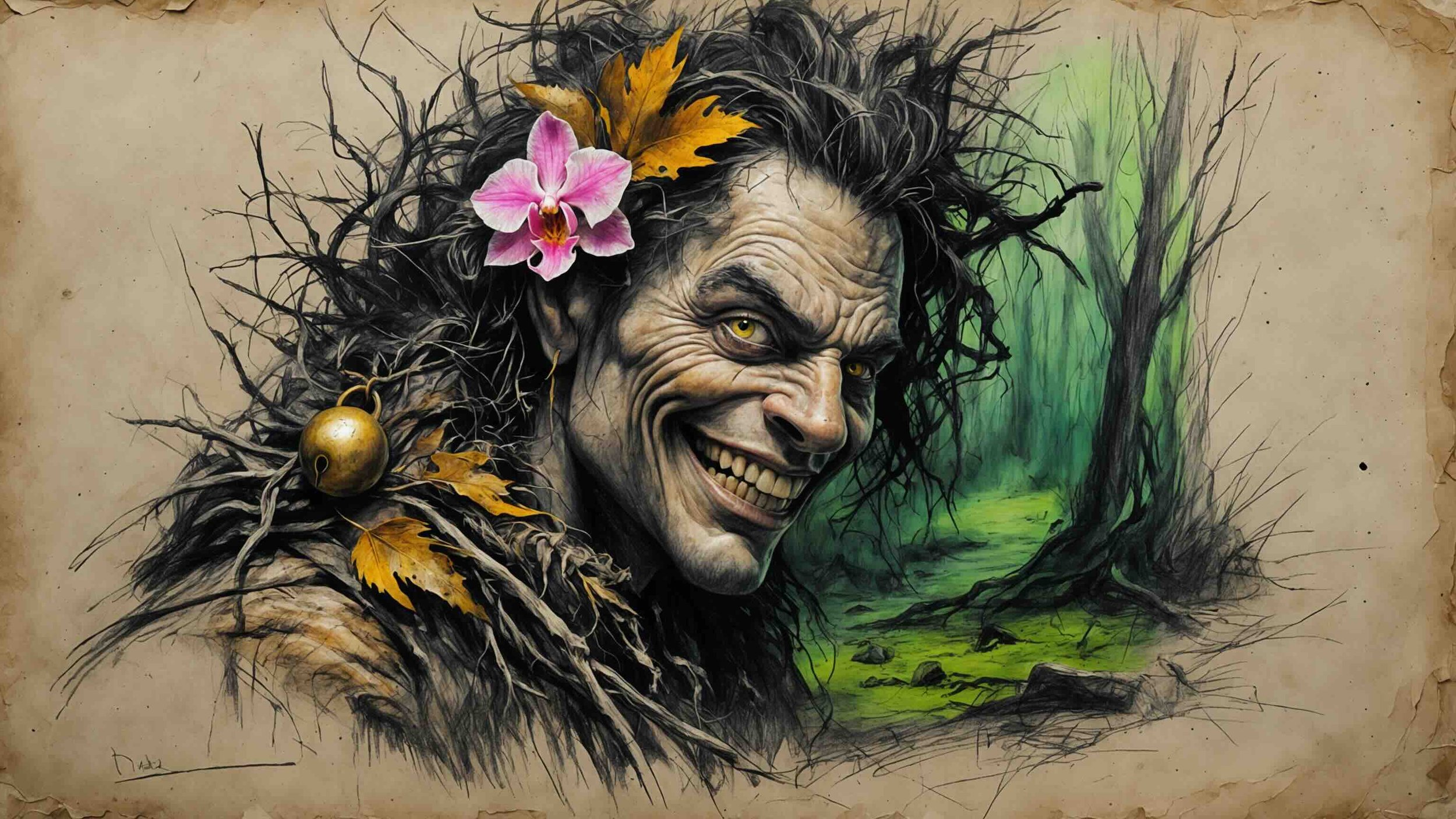
Character Profile – At a Glance
- Role: Also called Robin Goodfellow: a mischievous spirit who serves Oberon, the fairy king. He fetches the magic flower, anoints the wrong Athenian, gives Bottom an ass’s head, and speaks the play’s last words.
- Key Traits: Quick, playful and careless. Delighted by human folly. Loyal to Oberon but never sorry for a joke that goes wrong.
- The Core Conflict: Puck is sent to do one careful thing and does it carelessly. The lovers’ night of chaos is the result, and Puck enjoys every minute of it.
- Key Actions: Describes his own tricks to a fairy (A2S1). Fetches the love-in-idleness flower and anoints Lysander instead of Demetrius (A2S2). Transforms Bottom’s head (A3S1). Leads the two rivals apart with false voices and reverses his mistake (A3S2). Removes the ass’s head (A4S1). Sweeps the house and asks the audience’s pardon (A5S1).
- Famous Quote:
"Lord, what fools these mortals be!"
(Act 3, Scene 2) - The Outcome: Forgiven by Oberon, he blesses the sleeping palace and ends the play by asking the audience to treat it all as a dream.
That Merry Wanderer of the Night
Puck is introduced by reputation before he speaks a full sentence about himself. A passing fairy recognises him as the sprite who frightens village girls, spoils the butter and misleads travellers at night, and Puck does not deny a word of it. He adds a few tricks of his own.
Original
Thou speak'st aright;
I am that merry wanderer of the night.
I jest to Oberon and make him smile
When I a fat and bean-fed horse beguile,
Neighing in likeness of a filly foal...
(Act 2, Scene 1)
Shakespeare Retold (Modern Verse)
You’re absolutely right;
I am that merry wanderer of the night.
I joke with Oberon and make him smile
By tricking fat old horses with a style
Of neighing in the likeness of a foal...
The list that follows is a catalogue of small cruelties: a horse tricked with a false neigh, an old woman’s ale spilt down her chin, a stool pulled from under her so that the whole room laughs. None of it does lasting harm, and all of it is done for an audience. Puck wants Oberon to smile, and he wants the villagers to laugh. He is a performer before he is a servant.
This is the folklore Puck, the Robin Goodfellow of country stories who could be bribed with a bowl of milk. Shakespeare keeps his rough edges and then gives him something the stories never had: a court to belong to and a king to please. The theme of magic and illusion in this play runs through Puck’s hands, and his magic is never solemn.
The Mistake in the Wood
Oberon gives Puck one job with one instruction: find the Athenian man who scorns the woman following him, and anoint his eyes. Puck finds an Athenian man asleep beside a woman and does not stop to check. The man is Lysander, the woman Hermia, and when Lysander wakes he sees Helena and forgets the girl he ran away with.
Original
Believe me, king of shadows, I mistook.
Did not you tell me I should know the man
By the Athenian garment he had on?
And so far blameless proves my enterprise,
That I have 'nointed an Athenian's eyes;
And so far am I glad it so did sort
As this their jangling I esteem a sport.
(Act 3, Scene 2)
Shakespeare Retold (Modern Verse)
Believe me, king of shadows, it’s my error.
Did you not tell me I should recognise him
By the Athenian clothes that he had on?
And so I’m blameless for what I have done,
Anointing eyes of the Athenian;
And how it’s all occurred, I’m not complaining,
For all their fighting is so entertaining.
Puck’s defence is worth reading twice. He begins with an apology, moves at once to blaming the instructions, and ends by admitting that he is glad it happened because the quarrel is such good entertainment. There is no remorse anywhere in it. Puck is not malicious, but he is not kind either; he is a creature for whom human unhappiness is simply interesting.
The mistake matters because it is the engine of the middle of the play. Without it the lovers would have sorted themselves out in a single scene. With it, the wood becomes a place where every vow is reversed, every friendship broken and every certainty dissolved. The theme of love and folly needs a Puck to set it going, and Shakespeare makes sure the audience never quite blames him.
An Actor Too, Perhaps
When Puck stumbles on the the workmen rehearsing near Titania’s bower, he decides to watch, and then to join in. His contribution is to fit Bottom with an ass’s head and chase the rest of the company through the wood, changing shape as he goes.
Original
I'll follow you, I'll lead you about a round,
Through bog, through bush, through brake, through brier:
Sometime a horse I'll be, sometime a hound,
A hog, a headless bear, sometime a fire;
And neigh, and bark, and grunt, and roar, and burn,
Like horse, hound, hog, bear, fire, at every turn.
(Act 3, Scene 1)
Shakespeare Retold (Modern Verse)
I’ll follow you and lead you folk around,
Through bushes, hedges, thickets and a bog:
Sometimes I’ll be a horse, sometimes a hound,
A headless bear, a fire, sometimes a hog;
And neigh, and bark, and grunt, and roar, and burn,
Like horse, hound, hog, bear, fire, at every turn.
The speech is a list of transformations, and the delight is in the speed of it. Puck can be a horse, a hound, a hog, a headless bear or a fire in the space of a line, and the rhythm of the verse gallops to match. This is the freedom of the fairy world set against the plodding literalness of the workmen, who need a man to play Wall and another to carry a lantern for Moonshine.
It is also the moment the play’s two comedies collide. Bottom, who wanted to play every part, is given the one part he never asked for, and Puck, who came to watch, becomes the author of the evening’s best scene. The theme of art and theatre is usually discussed through the mechanicals, but Puck is the play’s most gifted improviser.
If We Shadows Have Offended
Puck has the last word, and it is a very different word from anything he has said before. The mischief-maker who laughed at mortals steps forward alone and asks the audience, politely, to forgive the play.
Original
If we shadows have offended,
Think but this, and all is mended,
That you have but slumbered here
While these visions did appear.
And this weak and idle theme,
No more yielding but a dream.
(Act 5, Scene 1)
Shakespeare Retold (Modern Verse)
If we ghosts have caused offence,
Think of this as recompense:
You’ve been merely sleeping here
While these visions did appear.
And this poor and silly tale
Was merely just a dreamy veil.
The offer is a generous one. If anything on stage has displeased you, Puck says, pretend you slept through it and dreamed the rest. The word "shadows" does double duty: it is Oberon’s name for his fairies and Theseus’s name for actors, and Puck is both. The speech folds the whole evening back into its title.
It also changes the audience’s relationship with him. For four acts we have watched Puck watching mortals; now he watches us, and asks for our hands. The theme of dreams and reality ends not with Theseus’s scepticism or Hippolyta’s wonder but with a fairy inviting the whole theatre to decide for itself what it has seen.
"Puck is a mad-cap sprite, full of wantonness and mischief, who laughs at those whom he misleads"
— William Hazlitt, Characters of Shakespear’s Plays, 1817
Key Quotes
Quote 1
I'll put a girdle round about the earth
In forty minutes.
(Act 2, Scene 1)
Shakespeare Retold (Modern Verse)
I plan to travel all around the earth
In forty minutes.
Quote Analysis: Puck’s answer when Oberon tells him to fetch the flower before a whale can swim a league. The boast is a measure of scale: the fairies move at a speed no mortal can imagine, and Puck says so in a line and a half. It is also a promise he keeps. The next time we see him he has the flower in his hand. Directors love the line because it is the first time Puck leaves the stage, and how he goes tells the audience what kind of creature he is.
Up and down, up and down,
I will lead them up and down:
I am feared in field and town:
Goblin, lead them up and down.
(Act 3, Scene 2)
Shakespeare Retold (Modern Verse)
Over here, over there,
I will lead them everywhere:
In field and town, I can scare:
Goblin, lead them everywhere.
Quote Analysis: Puck’s chant as he prepares to lead Lysander and Demetrius in circles through the fog. The short rhyming lines are the fairies’ own metre, and the repetition mimics the aimless wandering he is about to inflict. Notice the middle line: "I am feared in field and town." For a moment the playful sprite reminds us that country people were frightened of Robin Goodfellow, and that the fear was not entirely a joke.
And the country proverb known,
That every man should take his own,
In your waking shall be shown:
Jack shall have Jill;
Nought shall go ill;
The man shall have his mare again, and all shall be well.
(Act 3, Scene 2)
Shakespeare Retold (Modern Verse)
And that country proverb known
Says that man shall have his own,
And, waking up, this will be shown:
‘Jack will have Jill
There’ll be no ill;
The man will have his girl again, and all will turn out well.’
Quote Analysis: Puck’s spell over the sleeping Lysander, which undoes his earlier mistake. The magic is dressed as a nursery rhyme: Jack and Jill, the man and his mare, everyone paired off as the proverb says they should be. It is the play’s comic promise in miniature, that whatever chaos the night produces, the morning will sort the couples into their proper pairs. Whether the proverb is a comfort or a cage is a question the play leaves open.
Now the hungry lion roars,
And the wolf behowls the moon;
Whilst the heavy ploughman snores,
All with weary task fordone.
Now the wasted brands do glow,
Whilst the screech-owl, screeching loud,
Puts the wretch that lies in woe
In remembrance of a shroud.
(Act 5, Scene 1)
Shakespeare Retold (Modern Verse)
Now the hungry lion roars,
And the wolf howls at the moon;
Whilst the tired farmer snores,
Exhausted from the work he’s done.
Embers glow where they were laid,
Whilst the owl hoots aloud
To make the sleeping man afraid
Of being buried in a shroud.
Quote Analysis: Puck’s entrance after the mortals have gone to bed. The lion, the wolf, the screech-owl and the shroud belong to a darker play than the one we have been watching, and Puck lists them with relish before announcing that the fairies are here to bless the house. The speech reminds us that night is the fairies’ element, and that the same darkness which frightens the ploughman is where Puck is most at home.
Key Takeaways
- Robin Goodfellow: Puck is the folklore hobgoblin of country stories, given a fairy court to serve and a king to amuse.
- The Careless Servant: His mistake with the love-juice drives the middle of the play, and he enjoys the results far more than he regrets them.
- The Play's Improviser: He gives Bottom the ass's head and stages the night's best comedy without a script.
- The Last Word: His epilogue offers the audience the choice of treating the whole play as a dream.
Study Questions and Analysis
Who is Puck, and is he a fairy?
Puck is both a name and a type. In Shakespeare’s England a "puck" was a general word for a mischievous spirit, and Robin Goodfellow was the best known of them: a household hobgoblin who would grind the malt or sweep the floor if he was left a bowl of milk, and spoil the butter if he was not. When the fairy meets him in the wood, she recognises him from exactly these stories:
Either I mistake your shape and making quite,
Or else you are that shrewd and knavish sprite
Called Robin Goodfellow: are not you he
That frights the maidens of the villagery;
Skim milk, and sometimes labour in the quern
And bootless make the breathless housewife churn;
And sometime make the drink to bear no barm;
Mislead night-wanderers, laughing at their harm?
(Fairy, Act 2, Scene 1)
Shakespeare Retold (Modern Verse)
I’m either much mistaken by your frame,
Or you’re that naughty spirit by the name
Of Robin Goodfellow: is that not you
That scares the village maidens through and through;
Who clogs the millstone, skims the cream, they utter,
So housewives churn the milk but make no butter;
And sometimes stop the beer they make from foaming,
And laugh at wandering folk that you send roaming?
The tricks she lists are the ones the country stories gave him. Reginald Scot’s The Discoverie of Witchcraft (1584), a book Shakespeare almost certainly knew, records that "your grandams maides were woont to set a boll of milke before him and his cousine Robin good-fellow, for grinding of malt or mustard, and sweeping the house at midnight", and lists "Robin good-fellowe" among the bugs of which, he says, "we are afraid of our owne shadowes". Shakespeare took a nursery bogeyman and made him Oberon’s jester.
Whether he is a fairy in the same sense as Peaseblossom and Cobweb is less clear. The fairy calls him a "lob of spirits", a lump among the delicate; he is bigger, coarser and older than Titania’s attendants, and he belongs to the king’s side of the court rather than the queen’s. William Hazlitt, in Characters of Shakespear’s Plays (1817), drew the line by comparison: "Puck is a mad-cap sprite, full of wantonness and mischief, who laughs at those whom he misleads." The word "sprite" rather than "fairy" is well chosen. Puck is a spirit of the countryside who has taken service with the fairy king, and he never quite loses the smell of the farmyard.
Is Puck’s mistake with the love-juice an accident?
On the face of it, yes. Oberon told him to look for a man in Athenian clothes, and Puck found one. When Oberon scolds him he says so, and the play gives us no reason to think he is lying. But the way he takes the news is revealing. Oberon sees a true love turned false; Puck sees the ordinary state of the world:
Then fate o'er-rules, that, one man holding troth,
A million fail, confounding oath on oath.
(Act 3, Scene 2)
Shakespeare Retold (Modern Verse)
That’s fate at work, for each man who stays true,
A million others break their oaths anew.
One man in a million keeps his word, Puck says; the rest break oath after oath. It is a cynic’s view of love, and it happens to describe the play exactly. Demetrius has already broken his vows to Helena before the fairies arrive; Lysander breaks his to Hermia under the spell. Puck’s carelessness only speeds up what the mortals were doing for themselves.
Critics have read the mistake in two ways. C. L. Barber, in Shakespeare’s Festive Comedy (1959), treated the night in the wood as a holiday "release" that leads, through confusion, to "clarification": on this reading Puck’s error is the play’s method, the necessary disorder before the morning sorts everything out. Jan Kott, in Shakespeare Our Contemporary (1964), read the same night as a nightmare in which the lovers discover how interchangeable and how brutal their desires are; for Kott the mistake exposes something, and Puck is the play’s instrument of exposure. Either way, the point is that Shakespeare made the disaster an accident. A malicious Puck would make the wood a sinister place. A careless one keeps it a comedy.
What does "Lord, what fools these mortals be" mean?
Puck has just watched Lysander kneel to Helena, who thinks she is being mocked, while Demetrius sleeps nearby with the love-juice on his eyes. He knows what is about to happen, and he invites Oberon to watch it with him:
Shall we their fond pageant see?
Lord, what fools these mortals be!
(Act 3, Scene 2)
Shakespeare Retold (Modern Verse)
Shall we watch their show afar?
Lord, what fools these mortals are!
"Fond" meant foolish as well as loving, and "pageant" is a show; the lovers are a play, and Puck and Oberon are its audience. The line is often quoted as though it were a piece of wisdom about human nature, and it is, but the speaker is not wise. He is the one who caused the muddle, and he is enjoying it.
That double edge is the reason the line has lasted. From the fairies’ height the lovers’ oaths and tears are ridiculous, and the audience, sitting with Puck, is invited to find them so. But the audience is mortal too. Catherine Belsey, in her essay for the Folger edition (1993), observed that "the four lovers are virtually indistinguishable" and that "Romantic love is in this sense oddly impersonal": the spell does not make the lovers behave unlike themselves, it makes them behave like lovers. Puck is laughing at something the audience recognises, and the laugh is not entirely comfortable.
How does Puck compare with Ariel in The Tempest?
Both are spirits who serve a master, run errands at impossible speed and produce the illusions on which the plot depends. Puck’s boast about circling the earth in forty minutes has its match in Ariel’s promise to return before Prospero’s pulse beats twice, and both spirits are sent off with a flourish:
I go, I go; look how I go,
Swifter than arrow from the Tartar's bow.
(Act 3, Scene 2)
Shakespeare Retold (Modern Verse)
I’m off, I’m off; look how I’m going smarter:
I’m faster than an arrow from a Tartar.
The differences are in temperament and in what the master wants. Ariel wants his freedom and serves on a promise; Puck never mentions freedom and seems to serve because it is fun. Ariel feels pity for the men he torments and says so; Puck feels nothing of the kind and says that too.
William Hazlitt (1817) made the comparison the centre of his account of the play: Puck "is the Ariel of the Midsummer’s Night Dream; and yet as unlike as can be to the Ariel in The Tempest." Where "Ariel is a minister of retribution, who is touched with a sense of pity at the woes he inflicts", Puck is "a mad-cap sprite, full of wantonness and mischief". Hazlitt went further and set the two plays against each other: "Prospero and his world of spirits are a set of moralists; but with Oberon and his fairies we are launched at once into the empire of the butterflies." The comparison is a useful one for students because it shows how much of a play’s tone is carried by its spirit. A pitying Puck would make a different comedy; a laughing Ariel would wreck the romance.
Is Puck cruel?
He would not understand the question. Puck does not set out to hurt anyone, but he does not mind when they are hurt, and he says so with disarming honesty when the two rivals are about to fight over a woman neither of them loved the day before:
And those things do best please me
That befal preposterously.
(Act 3, Scene 2)
Shakespeare Retold (Modern Verse)
And I laugh the most at things
That cause such foolish revellings.
The word "preposterously" is precise: it means back to front, the natural order reversed. Puck likes things upside down. He likes the old woman falling off her stool, the horse cheated of its foal, the weaver with an ass’s head. What he enjoys is not suffering but confusion, and he does not much notice that confusion and suffering can be the same thing from the inside.
Productions have to decide how far to lean into this. Peter Brook’s 1970 production for the Royal Shakespeare Company, played in Sally Jacobs’s white box with trapezes and spinning plates, gave the fairies an unsettling physical presence and drew openly on Kott’s darker reading; Peter Holland, in his Oxford edition (1994), described Brook’s adult male fairies as disconcertingly strange and threatening. Earlier stage tradition had gone the other way, casting Puck as a child or a young woman and playing the mischief as harmless. The text supports both. Hazlitt’s "mad-cap sprite" and Kott’s agent of nightmare are the same character, seen in different lights, and a good Puck usually lets the audience see both.
What is the point of Puck’s epilogue?
Epilogues usually ask for applause. Puck’s does that, but it also does something odder: it offers the audience a way of not believing what they have just seen. If the play offended, pretend you slept through it. Then, having made the offer, Puck immediately promises to do better next time and asks for the audience’s hands:
Gentles, do not reprehend:
If you pardon, we will mend:
And, as I am an honest Puck,
If we have unearned luck
Now to 'scape the serpent's tongue,
We will make amends ere long;
Else the Puck a liar call;
So, good night unto you all.
Give me your hands, if we be friends,
And Robin shall restore amends.
(Act 5, Scene 1)
Shakespeare Retold (Modern Verse)
Folks, if you don’t tell us off,
We’ll resolve if you don’t scoff.
And, as I’m an honest Puck,
If you grant us unearned luck
To escape your boos and hisses,
We will fix our faults and misses.
Else, call me Puck the liar, do;
So, goodnight to each of you.
Join hands if we’re still friends tonight,
And Robin Puck shall put it right.
"If we be friends" is the key phrase. The fairy who spent the night laughing at mortals ends by asking to be friends with them, and the handclap that follows is a kind of reconciliation between the two worlds of the play.
Peter Holland (1994) pointed out that "Robin even gives the whole audience the option of considering the entire play as a dream in his epilogue", and that this is the last of several invitations the play makes to doubt its own reality: Bottom’s "rare vision", the lovers’ half-remembered night, Theseus’s scepticism, Hippolyta’s wonder. Northrop Frye, in Anatomy of Criticism (1957), described the shape of Shakespearean comedy as a movement from the normal world into a "green world" of transformation and back again, and noted that the green world "has analogies, not only to the fertile world of ritual, but to the dream world that we create out of our own desires." Puck’s epilogue is the moment the play steps back over the border and hands the dream to us. The theme of dreams and reality is not resolved by the speech; it is passed on.
How has Puck been played on stage?
Almost every way possible. For most of the nineteenth century Puck was a child’s part: Ellen Terry played Puck for Charles Kean at the Princess’s Theatre in 1856, aged nine, and the tradition of a small, quick, girlish sprite lasted well into the twentieth century. Max Reinhardt’s 1935 Hollywood film, with Mendelssohn’s music and James Cagney as Bottom, cast the fourteen-year-old Mickey Rooney, who played the part as a cackling wild child.
Brook’s 1970 production broke with all of that. John Kane’s Puck was a grown man who doubled the courtier Philostrate, and the tricks were done in plain sight with circus skills rather than stage illusion. Since then Puck has been played by men and women of every age, as a punk, a clown, a satyr and a stagehand, and the doubling with Philostrate has become common: the duke’s master of revels and the fairy king’s are, in that reading, the same job.
Hazlitt, writing in 1817 after a Covent Garden revival, thought the play could not be staged at all: "Fairies are not incredible, but fairies six feet high are so." He had a point about the Victorian spectacle he was watching, but the history of the part since then suggests that Puck survives any casting, because what makes him is not size or costume but attitude. He must enjoy the mortals, and he must not be sorry.