
Helena
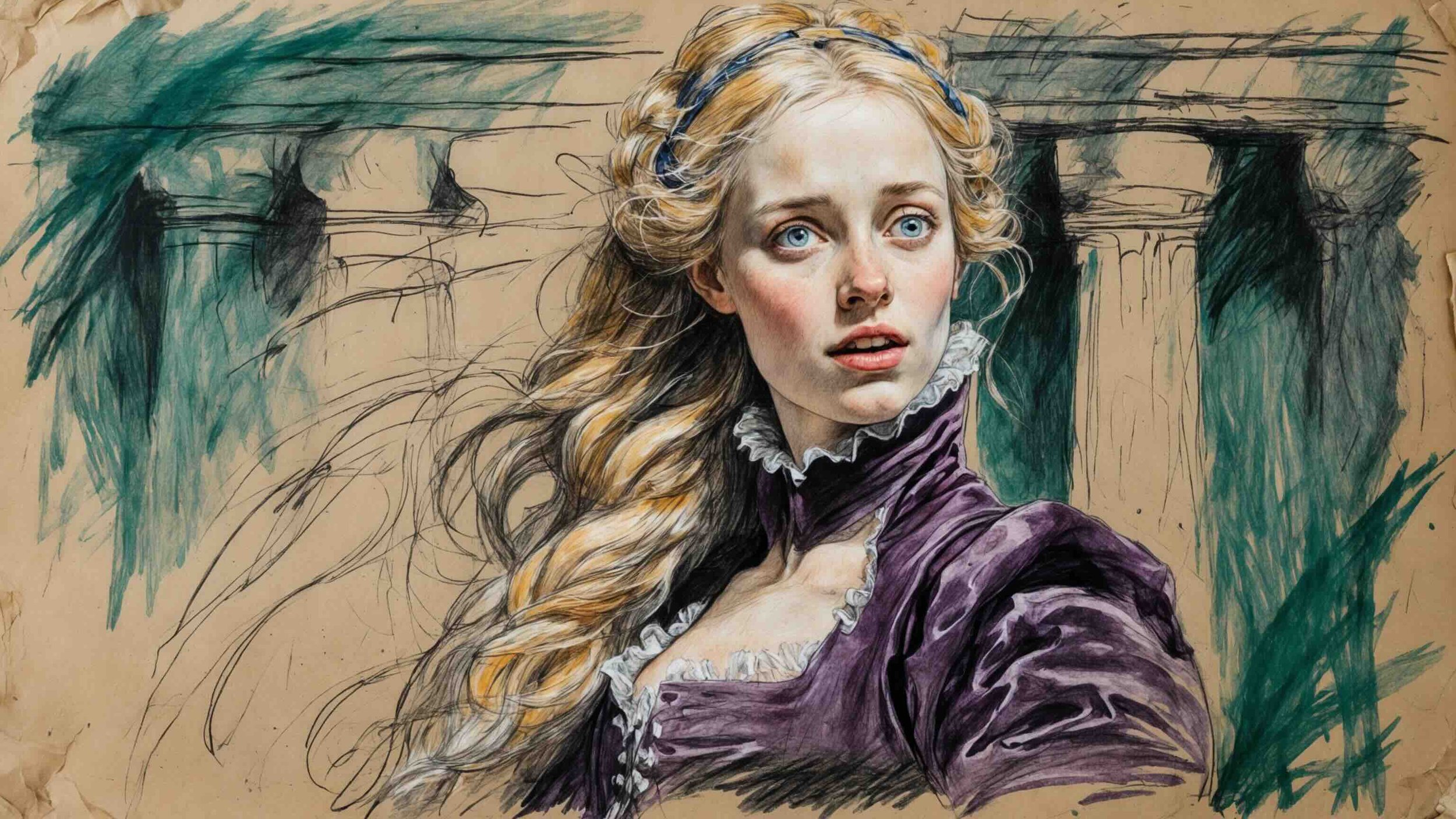
Character Profile – At a Glance
- Role: An Athenian gentlewoman, Hermia’s oldest friend, in love with Demetrius, who once courted her and now loves Hermia. She follows him into the wood and finds herself, by fairy accident, loved by both men at once.
- Key Traits: Self-doubting, persistent and clear-eyed about everything except Demetrius. Tall, fair and convinced she is ugly. Quick to suspect mockery, because she has had so much of it.
- The Core Conflict: Helena loves a man who says he is sick at the sight of her. When the spell makes him and Lysander adore her, she cannot believe it, and the night that gives her everything she wanted feels like the cruellest joke of all.
- Key Actions: Envies Hermia’s beauty and betrays the elopement to Demetrius (A1S1). Follows him into the wood and begs to be treated as his spaniel (A2S1). Is wooed by the bewitched Lysander and thinks he mocks her (A2S2). Wooed by both men, accuses Hermia of conspiracy and pleads the double cherry (A3S2). Wakes to find Demetrius hers, "mine own, and not mine own" (A4S1).
- Famous Quote:
"Love looks not with the eyes, but with the mind..."
(Act 1, Scene 1) - The Outcome: Married to Demetrius, who still has the love-juice on his eyes. Like Hermia, she is silent in the final act.
Call You Me Fair?
Helena enters the play as the odd one out. Hermia and Lysander are planning an elopement; Helena is in love with the man Hermia is running away from. Greeted as "fair", she flinches, and spends her first speech explaining that Hermia’s beauty is a disease she would gladly catch. Left alone, she thinks about what love actually is.
Original
Things base and vile, folding no quantity,
Love can transpose to form and dignity:
Love looks not with the eyes, but with the mind;
And therefore is winged Cupid painted blind:
Nor hath Love's mind of any judgement taste;
Wings and no eyes figure unheedy haste...
(Act 1, Scene 1)
Shakespeare Retold (Modern Verse)
The rude and ugly, wicked and pugnacious,
Through eyes that love, seem beautiful and gracious;
Love doesn’t look with eyes, but with the mind,
So that’s why Cupid, god of love, is blind;
And Cupid’s taste is mired with imprecisions;
His wings and blindness drive his rash decisions.
It is the play’s thesis, spoken in Act 1 by the character with least reason to believe it. Love does not see; it imagines. Cupid is painted blind because lovers are, and winged because they are hasty. Helena knows this about Demetrius, whose love for Hermia she can see is a kind of blindness, and she knows it about herself, and knowing it changes nothing.
Then she does something the audience is not expecting: she decides to betray her friend. She will tell Demetrius about the elopement so that he will follow Hermia into the wood, and she will follow him, for the pleasure of watching him go and come back. The theme of love and folly is set out in her speech, and its first casualty is her friendship with Hermia.
I Am Your Spaniel
In the wood, Demetrius tells her plainly that he does not and cannot love her, and orders her to stop following him. Helena’s reply has embarrassed audiences for four hundred years.
Original
I am your spaniel; and, Demetrius,
The more you beat me, I will fawn on you:
Use me but as your spaniel, spurn me, strike me,
Neglect me, lose me; only give me leave,
Unworthy as I am, to follow you.
(Act 2, Scene 1)
Shakespeare Retold (Modern Verse)
I am your puppy; and, Demetrius,
The more you tell me off, the more I love you.
So use me as your puppy, spurn me, slap me,
Ignore me, run away; but only let me
Run after you, although I am not worthy.
Spurn me, strike me, neglect me, lose me: the list is a catalogue of what a bad master does to a dog, and Helena asks for all of it as a privilege. When Demetrius threatens to leave her to the wild beasts she answers that the wildest beast is kinder than he is, and follows him anyway. Whatever this is, it is not the blindness she described in Act 1. Helena sees Demetrius exactly, and loves him.
It is also the speech that changes the play. Oberon, invisible, is listening, and it is Helena’s abasement rather than her beauty that moves him to act. The theme of magic and illusion enters the human plot because a fairy king overheard a woman asking to be treated like a dog and decided she deserved better.
The Double Cherry
Puck’s mistake gives Helena what she wanted and more. Lysander wakes and loves her; then Demetrius wakes and loves her; and Helena, who has been told she is ugly by the one man whose opinion she cares about, can only conclude that the two of them have agreed to mock her. When Hermia arrives, she assumes the plot is complete, and turns on her friend with a memory.
Original
We, Hermia, like two artificial gods,
Have with our needles created both one flower,
Both on one sampler, sitting on one cushion,
Both warbling of one song, both in one key,
As if our hands, our sides, voices and minds,
Had been incorporate. So we grow together,
Like to a double cherry, seeming parted,
But yet an union in partition;
Two lovely berries moulded on one stem...
(Act 3, Scene 2)
Shakespeare Retold (Modern Verse)
We used to be like two gods of the arts,
Sewing a single flower with our needles
Upon a piece of cloth, sat on one cushion,
Both singing out one song in harmony,
As if our hands, our sides, voices and minds
Were one. That’s how we both grew up together,
Much like two cherries, seemingly apart,
But yet connected, though they seem divided;
Like berries bound together on a stem...
The speech is the play’s finest description of friendship, and it is spoken as an accusation. Two girls on one cushion, sewing one flower, singing one song, so grown together that they were one body with two faces: and now, Helena says, Hermia has torn all that apart to join two men in laughing at her. She is wrong about the facts. She is right about the loss.
Hermia, baffled, says she is amazed; Lysander calls Hermia a dwarf; and the double cherry becomes a fight about height. Helena, who is tall, runs. Friendship in this play reaches its height and its breaking point in a single speech, and it is Helena who speaks it.
Mine Own, and Not Mine Own
In the morning Demetrius is still under the spell, and Helena is his. Theseus overrules Egeus, orders the weddings, and leaves the four lovers to make sense of the night. Helena’s attempt is the shortest and the strangest.
Original
And I have found Demetrius like a jewel,
Mine own, and not mine own.
(Act 4, Scene 1)
Shakespeare Retold (Modern Verse)
And, like a jewel, I’ve found Demetrius;
He’s mine but owned by someone else.
A jewel found in the road is yours and not yours: you have it, and someone else lost it. Helena has Demetrius, and she seems to know, without being able to say how, that he was not given to her by anything she did. It is the only moment in the play where a lover suspects the truth, and she lets it go at once. The four agree to recount their dreams, and Helena does not speak again.
Whether she has a happy ending is a question the play leaves to the audience. She has what she asked for, and the man she has is the one character who never wakes up. The theme of dreams and reality is gentlest with the lovers who forget; Helena’s two lines suggest that she has not quite managed to.
"I am convinced that Shakespeare availed himself of the title of this play in his own mind, and worked upon it as a dream throughout, but especially, and perhaps unpleasingly, in this broad determination of ungrateful treachery in Helena, so undisguisedly avowed to herself, and this, too, after the witty cool philosophising that precedes."
— Samuel Taylor Coleridge, Notes on A Midsummer Night’s Dream, 1818
Key Quotes
Quote 1
Sickness is catching: O, were favour so,
Yours would I catch, fair Hermia, ere I go;
My ear should catch your voice, my eye your eye,
My tongue should catch your tongue's sweet melody.
Were the world mine, Demetrius being bated,
The rest I'd give to be to you translated.
(Act 1, Scene 1)
Shakespeare Retold (Modern Verse)
But sickness is contagious: were looks so,
I’d catch yours, gorgeous Hermia, then I’d go;
My ears and eyes would match all that you do,
My tongue would learn to sing as well as you.
If all were mine, Demetrius aside,
I’d swap it to be you personified.
Quote Analysis: Helena to Hermia, in the play’s first scene. The wish to catch beauty like an infection is grotesque and touching at once, and the last line goes further: she would give the whole world, minus Demetrius, to be turned into her friend. "Translated" is the word Quince will use for Bottom with the ass’s head. Helena wants a transformation too, and the wood will give her one, though not the one she asked for.
Your wrongs do set a scandal on my sex:
We cannot fight for love, as men may do;
We should be wood and were not made to woo.
(Act 2, Scene 1)
Shakespeare Retold (Modern Verse)
Your wrongdoing is shameful to all women:
We cannot fight for love, as men can do;
We have to wait for men to come and woo.
Quote Analysis: Helena, left alone by Demetrius. The pun on "wood", which meant mad as well as forest, is one of the play’s best: women should be wooed, not woo; but she is in the wood, and she is mad with love, and she is doing the wooing. The couplet is a complaint about the rules of courtship from a woman who is breaking them, and the play does not punish her for it. It rewards her, though by means she never learns about.
No, no, I am as ugly as a bear;
For beasts that meet me run away for fear:
Therefore no marvel though Demetrius
Do, as a monster fly my presence thus.
(Act 2, Scene 2)
Shakespeare Retold (Modern Verse)
No, no, I am as ugly as a bear;
For beasts that meet me run away in fear:
So it is no surprise Demetrius
Runs off from me, for monsters would do thus.
Quote Analysis: Helena in the dark, out of breath from chasing Demetrius. The self-portrait is absurd, and the play has told us so: Athens thinks her as fair as Hermia, and Lysander will shortly compare her eyes to stars. But she believes it, because Demetrius runs from her and she can find no other explanation. The bear and the monster are the wood’s creatures, and Helena has made herself one of them in her own mind before any fairy has touched her.
O spite! O hell! I see you all are bent
To set against me for your merriment:
If you were civil and knew courtesy,
You would not do me thus much injury.
Can you not hate me, as I know you do,
But you must join in souls to mock me too?
(Act 3, Scene 2)
Shakespeare Retold (Modern Verse)
Oh, bloody hell! I see you’re all intent
To make fun of me for your merriment.
If you were nice and not so reprehensive
To me, you wouldn’t be quite so offensive.
Is hating me then not enough for you
That you must join the folk who mock me too?
Quote Analysis: Helena’s reaction when Demetrius wakes and calls her a goddess. Two men now adore her, and she is certain it is a conspiracy. The speech is funny because the audience knows the truth, and painful because Helena’s logic is sound: a woman who has been told she is hateful will not believe sudden worship, and should not. "Join in souls" is a bitter phrase. The two rivals, she thinks, have found the one thing they can agree on.
Key Takeaways
- Love Without Eyes: Helena's speech in Act 1 is the play's thesis: love sees with the mind, not the eyes, and she proves it by loving a man who despises her.
- The Spaniel: Her plea to be used like Demetrius's dog is the play's most uncomfortable speech, and the one that moves Oberon to help her.
- The Double Cherry: Her memory of her childhood with Hermia is the play's finest picture of friendship, spoken as it breaks.
- Mine Own, and Not Mine Own: She wins Demetrius by a spell he never wakes from, and her two lines in the morning suggest she half knows it.
Study Questions and Analysis
Why does Helena betray Hermia’s plan to Demetrius?
She tells us, and the reason is not a good one. Hermia has confided the elopement to her as a friend, and Helena, alone, decides to pass it on:
I will go tell him of fair Hermia's flight:
Then to the wood will he to-morrow night
Pursue her; and for this intelligence
If I have thanks, it is a dear expense:
But herein mean I to enrich my pain,
To have his sight thither and back again.
(Act 1, Scene 1)
Shakespeare Retold (Modern Verse)
I’ll tell him Hermia is taking flight,
Then he’ll go to the woods tomorrow night
Pursuing her; and with this knowledge, he
May offer thanks, at painful cost to me.
But in this way, I will enhance my pain,
To see him go there then come back again.
There is no advantage to her in it. Demetrius will follow Hermia, not Helena; the "thanks" she hopes for is a poor return; and she knows it. What she wants is to see him, going and coming back. It is love as pure compulsion, and Shakespeare lets her state it without disguise.
Samuel Taylor Coleridge was troubled by the speech. In his notes on the play he called it a "broad determination of ungrateful treachery in Helena, so undisguisedly avowed to herself", coming "after the witty cool philosophising that precedes", and concluded that Shakespeare must have been working on the whole play as a dream, in which such a lapse could pass. Shirley Nelson Garner, in a 1981 essay for Women’s Studies, saw the betrayal as the first move in a pattern: the play’s comic ending requires the bonds between women to break so that each woman can be paired with a man, and Helena breaks the first one herself, before any fairy has interfered. The friendship is compromised in Act 1, by the character who will later describe it most beautifully, and the play seems to want us to hold both facts at once.
Is Helena’s love for Demetrius degrading?
She thinks so and does not care. The spaniel speech asks for blows and neglect as favours, and when Demetrius says he is sick at the sight of her, she answers that she is sick when she cannot see him. Her only request is to be allowed to follow:
What worser place can I beg in your love, –
And yet a place of high respect with me, –
Than to be used as you use your dog?
(Act 2, Scene 1)
Shakespeare Retold (Modern Verse)
Is there a worse place I can beg for love –
Although it is a place I’d love to be –
Than to be used as you would use your dog?
Audiences have found this hard to watch since the play was new, and directors have tried everything from playing it for laughs to playing it as a portrait of obsession. The text supports the second reading more than the first. Helena is not being witty. She is describing, accurately, what she is prepared to accept.
Jan Kott, in Shakespeare Our Contemporary (1964), read the speech as close to masochism and made it part of his case that the play’s treatment of desire is far more brutal than its reputation. Louis Adrian Montrose, in "Shaping Fantasies" (1983), placed it in a play where every form of female will is eventually brought under male control, and noted the irony that Helena, the one woman who wants to submit, is the one the men reject. The most useful thing to notice may be what Helena herself says a few lines later: that women "cannot fight for love, as men may do". She has no weapon but persistence, and she uses it. Whether that makes her the play’s most pathetic lover or its most determined is a fair subject for debate. The theme of gender and patriarchy is not that Helena is weak; it is that the only strength available to her looks like weakness.
Why does Helena think everyone is mocking her?
Because it is the only explanation that fits what she knows. Lysander, who loves Hermia, wakes and swears he loves Helena. Helena, who knows he loves Hermia, can only hear it as scorn:
Wherefore was I to this keen mockery born?
When at your hands did I deserve this scorn?
Is't not enough, is't not enough, young man,
That I did never, no, nor never can,
Deserve a sweet look from Demetrius' eye,
But you must flout my insufficiency?
(Act 2, Scene 2)
Shakespeare Retold (Modern Verse)
Why was I born to be a laughingstock?
Why do you think that I’m OK to mock?
So, it is not sufficient then, young man,
That I have never, no, nor never can
Expect Demetrius to make advances,
So you must mock that I have zero chances?
When Demetrius wakes and does the same, the conspiracy is confirmed, and when Hermia arrives, Helena assumes she is its author. Every new declaration of love makes her more certain she is being laughed at. The audience, who knows about the flower, laughs; but the laugh is at the situation, not at Helena’s reasoning, which is sound.
David P. Young, in Something of Great Constancy (1966), described the lovers as "confronted in the woods with forces they do not begin to understand, forces which are at once within and outside them", and Helena’s bewilderment is the clearest case. The force outside her is Puck’s juice; the force inside her is a settled conviction of her own worthlessness, built up over months of Demetrius’s contempt. The spell changes the men. It cannot change what Helena believes about herself, and so the night that should be her triumph is, from where she stands, an elaborate humiliation. Catherine Belsey (1993) noted that the play’s lovers are "virtually indistinguishable"; Helena is the exception, because she is the only one whose suffering is not caused by the flower. The theme of love and folly is usually about blindness. Helena’s is about seeing too clearly to accept good fortune.
What is the significance of the double cherry speech?
It is the play’s only extended picture of a relationship that is not romantic, and it is spoken at the moment the relationship ends. Helena, convinced that Hermia has joined the men in mocking her, reminds her of what they were:
Is all the counsel that we two have shared,
The sisters' vows, the hours that we have spent,
When we have chid the hasty-footed time
For parting us, – O, is it all forgot?
All school-days' friendship, childhood innocence?
(Act 3, Scene 2)
Shakespeare Retold (Modern Verse)
Have those times we’ve confided in each other,
Like sisters share their secrets, and those hours
When we berated time for passing quickly
For separating us… Have you forgotten?
Our naïve friendship since our days at school?
Then comes the image itself: two girls sewing one flower on one sampler, singing one song in one key, growing together like a double cherry, two berries on one stem, two bodies with one heart. The heraldic figure that closes the passage, two coats of arms under one crest, makes the friendship sound like a marriage.
That is the point critics have made of it. Shirley Nelson Garner (1981) argued that the play’s movement toward its three weddings is also a movement away from bonds between women, and that the double cherry speech is the elegy for the bond it is about to break: Helena and Hermia will not exchange another friendly word in the play. Louis Adrian Montrose (1983) read the pattern more broadly as the play’s "process by which the female pride and power" of its women are "brought under the control of lords and husbands". Readers need not accept the whole argument to see what the speech does. It gives the friendship a language as rich as anything the lovers say to each other, and then lets the lovers’ quarrel drown it out. Friendship between women is the play’s hidden subject, and the double cherry is where it comes nearest the surface.
Why does the play make so much of Helena’s height?
Partly because of the boys. Shakespeare’s women were played by boy actors, and the running joke about tall Helena and short Hermia almost certainly began as a fact about the company. But Shakespeare built it into the text so thoroughly that it became a piece of character. Helena is a "painted maypole"; Hermia is a "dwarf" and an "acorn"; and when the fight threatens to turn physical, Helena finds the one advantage her height gives her:
Your hands than mine are quicker for a fray,
My legs are longer though, to run away.
(Act 3, Scene 2)
Shakespeare Retold (Modern Verse)
Your hands are swifter than mine in a fight,
But I’ve got longer legs, so I’ll take flight.
It is a good exit line, and it is also the last thing she says to Hermia. The friendship of the double cherry ends with one woman running from the other’s fingernails.
The height joke does serious work. The two women are drawn as physical opposites, tall and fair against short and dark, and the play makes the point that neither man’s love has anything to do with either. Lysander loved the short dark one and then the tall fair one; Demetrius did the reverse; and the only reasons either can give for the change are the women’s bodies, which have not changed. William Hazlitt, in Characters of Shakespear’s Plays (1817), remarked of the play’s stage fairies that "fairies are not incredible, but fairies six feet high are so", and the same principle applies in reverse to the lovers: their bodies are what the audience sees, and the play insists they are beside the point. The theme of love and folly in this play is that lovers see with the mind, and the mind can be made to see a maypole or a goddess in the same woman.
Does Helena get a happy ending?
She gets Demetrius, and Demetrius is still under the spell. Puck reverses Lysander’s enchantment but nobody reverses Demetrius’s; he wakes loving Helena because Oberon’s juice is on his eyes, and he explains it to Theseus as a recovered childhood love:
To her, my lord,
Was I betrothed ere I saw Hermia...
(Demetrius, Act 4, Scene 1)
Shakespeare Retold (Modern Verse)
My lord, to her
I was engaged, prior to meeting Hermia.
The engagement is news to the audience, though Lysander mentioned in Act 1 that Demetrius had "made love to Nedar’s daughter". Demetrius has found a story that makes his change of heart respectable, and the duke accepts it.
Catherine Belsey, in her 1993 essay for the Folger edition, put the difficulty plainly: "Demetrius still has the love-juice on his eyes, and yet the play gives no indication of a difference between this marriage and the others." Helena’s own verdict is the two-line speech about the jewel that is hers and not hers, and after it she says nothing for the rest of the play. The lovers’ silence in Act 5, while the men joke through Pyramus and Thisbe, has struck many readers as pointed. Helena spent four acts talking, pleading, accusing and explaining; married, she watches. Whether that is contentment or the play quietly declining to answer its own question, each production decides. What can be said is that Helena wanted Demetrius and has him, and that the play, which knows exactly how, does not tell her. The theme of dreams and reality covers the fairies’ tracks, and Helena is the one lover who seems, for two lines, to have noticed the footprints.
How does Helena’s speech about love in Act 1 relate to the rest of the play?
It is the play in miniature, delivered before the play has properly begun. Love looks with the mind, not the eyes; Cupid is blind and winged; love is a child who chooses badly; and boys break their oaths in games as Love breaks his everywhere. Every one of these propositions is then demonstrated in the wood. Lysander and Demetrius see Helena with minds that have been altered, and their eyes follow. Cupid’s arrow, in Oberon’s story, literally misses its target and hits a flower. The lovers’ oaths melt like hail, as Helena says Demetrius’s did.
R. W. Dent, in an essay for Shakespeare Quarterly (1964), argued that the play’s subject is imagination, and that the lovers’ imaginations, running unchecked, are what the wood exposes; Helena’s speech is the first diagnosis, and it is a correct one. What makes it remarkable is that the diagnosis comes from a patient. Helena understands that love is a disorder of perception and then acts, for the rest of the play, exactly as the disorder dictates. Theseus will say something similar in Act 5, from a great height, about lovers and madmen. Helena said it first, from inside, and went on loving.
The speech also gives the play its most quoted image, the blind Cupid. It is worth noticing what the image does not say. Helena does not claim that love is worthless because it is blind; she claims that it transforms what it sees, giving "form and dignity" to "things base and vile". That is a description of what happens to Bottom in Titania’s arms, and it is not an insult. The theme of love and folly in this play is not that lovers are fools but that love makes something out of nothing, and Helena, who ends the play with a husband made by a flower, is its proof.
