Demetrius
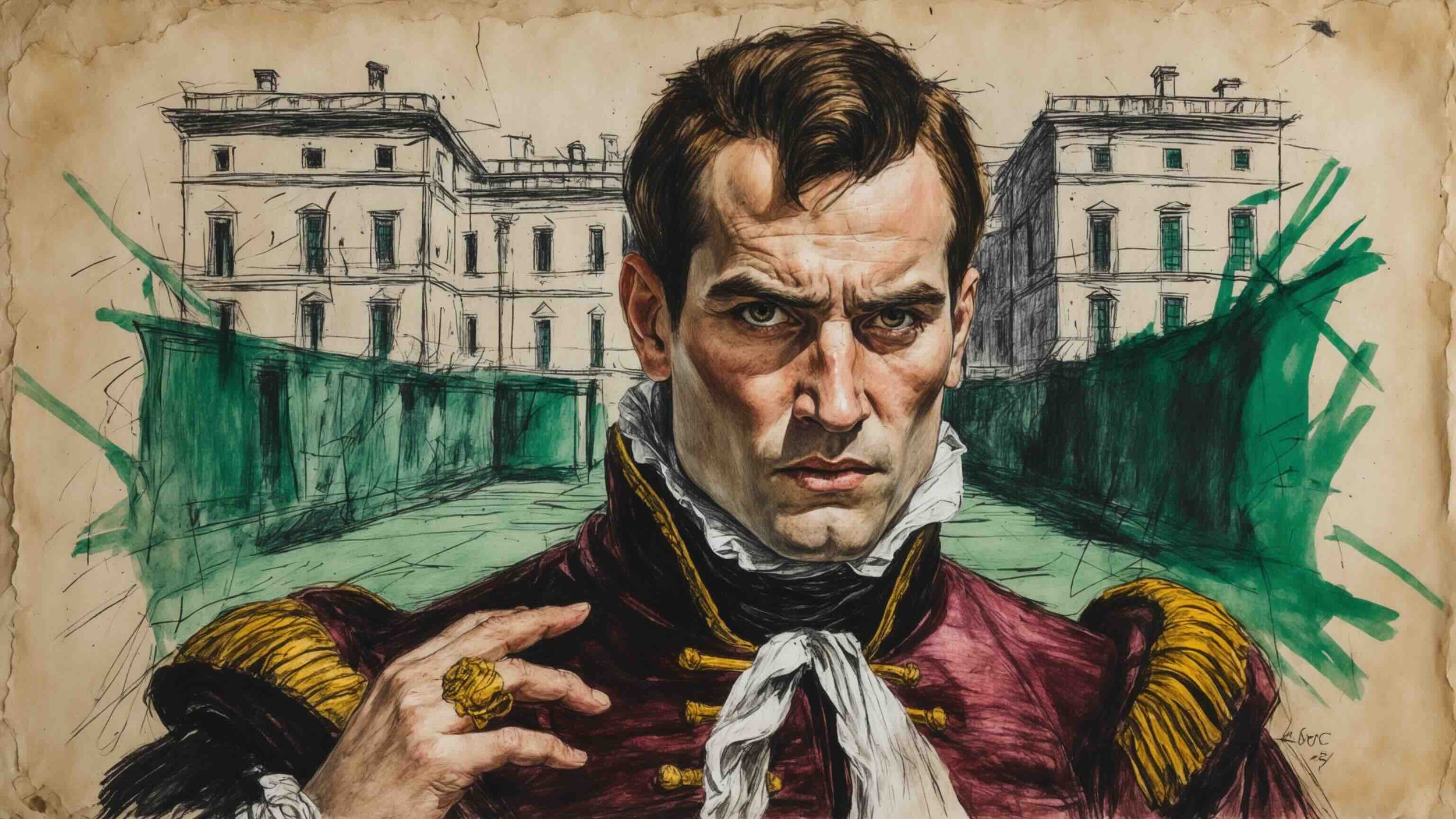
Character Profile – At a Glance
- Role: The suitor Egeus has chosen for Hermia. He once courted Helena and dropped her; now he loves Hermia, who cannot stand him. In the wood, Oberon’s juice returns him to Helena, and he is the one lover who never wakes from the spell.
- Key Traits: Proud, harsh and used to getting what he wants. Capable of real cruelty to Helena and real ardour once the flower has changed his eyes.
- The Core Conflict: Demetrius has the law and the father on his side, and the woman on the other. He pursues Hermia into the wood, threatens Helena, and is transformed by a fairy into the man Helena always wanted.
- Key Actions: Claims Hermia before the duke (A1S1). Follows the eloping couple into the wood and tries to shake off Helena with insults and threats (A2S1). Is accused of murder by Hermia and falls asleep (A3S2). Wakes anointed, adores Helena, and challenges Lysander to a duel. Wakes in the morning, renounces Hermia, and explains that his love melted like snow (A4S1). Mocks the workmen’s play (A5S1).
- Famous Quote:
"I love thee not, therefore pursue me not."
(Act 2, Scene 1) - The Outcome: Married to Helena, with the love-juice still on his eyes. His account of a childhood betrothal to her is the story everyone agrees to believe.
The Spotted and Inconstant Man
Demetrius has two lines in the trial scene and both are commands. He tells Hermia to give in and Lysander to give up, and he does it with the confidence of a man who has the law, the father and the duke behind him.
Original
Relent, sweet Hermia: and, Lysander, yield
Thy crazed title to my certain right.
(Act 1, Scene 1)
Shakespeare Retold (Modern Verse)
Give in, dear Hermia; and, Lysander, give up
Your idiotic chase for what is mine.
"My certain right" is the language of property, and it is Egeus’s language too. What Demetrius does not expect is Lysander’s reply, which tells the court that Demetrius courted Helena first, won her, and left her doting. Theseus admits he had heard the same. Demetrius says nothing. The charge is true, and the scene establishes him as the one lover whose inconstancy needs no fairy to explain it.
It is an unpromising start, and Shakespeare means it to be. Of the four lovers Demetrius is the only one who begins the play in the wrong, and the only one who has already done to a woman what the flower will make Lysander do to Hermia. The theme of love and folly in this play is inconstancy, and Demetrius is its natural specimen.
I Am Sick When I Do Look on Thee
Helena tells him about the elopement, hoping for thanks, and gets contempt. Demetrius follows Hermia into the wood, Helena follows him, and the scene between them is the harshest in the play.
Original
I will not stay thy questions; let me go:
Or, if thou follow me, do not believe
But I shall do thee mischief in the wood.
(Act 2, Scene 1)
Shakespeare Retold (Modern Verse)
I will not listen to you; leave me be,
Or, if you follow me, you’d best believe
I’ll do bad things to you within the wood.
The threat is not idle. He has already told her he is sick when he looks at her, warned her that she is risking her virginity by following a man who does not love her into a deserted place, and promised to leave her to the wild beasts. Now he says that if she persists he will hurt her. Helena says she is used to it, and follows. Whether "mischief" means violence or rape the play does not say, and productions have made both choices.
Oberon is listening, and the speech is what moves him. The fairy king has his own quarrel to settle and no reason to care about mortals; but he hears a man threaten a woman who loves him, and decides to reverse it. The theme of gender and patriarchy in the wood is set out here as plainly as in the court. Helena cannot fight for love as men do. Demetrius can, and does.
Goddess, Nymph, Perfect, Divine
Puck’s mistake sends the juice to Lysander first. Oberon corrects it by anointing Demetrius himself, and the man who was sick at the sight of Helena wakes, sees her, and produces the most extravagant love poetry in the play.
Original
O Helena, goddess, nymph, perfect, divine!
To what, my love, shall I compare thine eyne?
Crystal is muddy. O, how ripe in show
Thy lips, those kissing cherries, tempting grow!
(Act 3, Scene 2)
Shakespeare Retold (Modern Verse)
Oh Helena, you goddess, golden dove!
What shall I match your eyes to, oh my love?
Crystals seem muddy next to them. Perfection
Your lips are, kissing cherries, sweet affection!
Crystal is muddy beside her eyes; the snow on Mount Taurus is a crow beside her hand. It is conventional praise turned up as far as it will go, and coming from Demetrius it is grotesque, because Helena remembers what he said an hour ago. She decides the two men have conspired to mock her, and nothing either of them says can shift her.
The speech shows what the flower does. It does not create love out of nothing; it takes the language every Elizabethan lover had ready and pours it in a new direction. Demetrius is not a different man. He is the same man with a different object, and the theme of magic and illusion in this play is that the object is all that ever changes.
Melted as the Snow
In the morning the duke finds the four lovers asleep and demands an explanation. Lysander’s is honest bewilderment. Demetrius’s is something more polished.
Original
But, my good lord, I wot not by what power, –
But by some power it is, – my love to Hermia,
Melted as the snow, seems to me now
As the remembrance of an idle gaud
Which in my childhood I did dote upon...
(Act 4, Scene 1)
Shakespeare Retold (Modern Verse)
But, my good lord, I don’t know what has caused it –
But something’s done it – for my love for Hermia
Has melted like the snow, and now it seems
Much like a little trinket I remembered
From childhood that once I used to love...
He then tells Theseus that he was betrothed to Helena before he ever saw Hermia, that his love for Hermia was a sickness, and that he has recovered his natural taste. It is a good story and it saves the day: Theseus, hearing it, overrules Egeus and orders the weddings. But the audience knows the power Demetrius cannot name. It is a flower, and it is still working.
Demetrius is the play’s loose end. Puck restores Lysander with a second herb; nobody restores Demetrius, and Oberon never intends to. He goes to the altar enchanted, and the play treats his marriage exactly like the others. The theme of dreams and reality lets every other lover wake up. Demetrius, in the strict sense, never does.
"Demetrius still has the love-juice on his eyes, and yet the play gives no indication of a difference between this marriage and the others."
— Catherine Belsey, A Midsummer Night’s Dream: A Modern Perspective, 1993
Key Quotes
Quote 1
So should the murdered look, and so should I,
Pierced through the heart with your stern cruelty:
Yet you, the murderer, look as bright, as clear,
As yonder Venus in her glimmering sphere.
(Act 3, Scene 2)
Shakespeare Retold (Modern Verse)
That’s how the murdered look, and so do I,
For, by your cruelty, I feel I die:
Yet you, the murderer, look clear and bright,
Like Venus shining in the starry night.
Quote Analysis: Demetrius answering Hermia, who has accused him of murdering Lysander. He turns the charge into a compliment: he is the murdered one, killed by her cruelty, and she is the murderer who shines like Venus. It is the language of the sonnet tradition, in which the cold mistress kills with her eyes, and Demetrius uses it while still in love with Hermia. Within a hundred lines he will be using it about Helena. The poetry is the same; only the name changes.
Lysander, keep thy Hermia; I will none:
If e'er I loved her, all that love is gone.
My heart to her but as guest-wise sojourned,
And now to Helen is it home returned,
There to remain.
(Act 3, Scene 2)
Shakespeare Retold (Modern Verse)
Lysander, Hermia’s yours; to me, she’s banished:
If once I loved her, all that love has vanished.
My heart was like a guest out on vacation,
Returned to Helena now, in its station,
For good.
Quote Analysis: Demetrius renouncing Hermia, with the juice on his eyes. The image of the heart as a guest who has finally gone home is neat and slightly chilling. His love for Hermia was a visit; his love for Helena is where he lives. The audience knows that both feelings were produced by the same forces, one by ordinary inconstancy and one by a flower, and that Demetrius can tell no difference between them. He is entirely sincere, and he has been entirely sincere every time.
Are you sure
That we are awake? It seems to me
That yet we sleep, we dream. Do not you think
The duke was here, and bid us follow him?
(Act 4, Scene 1)
Shakespeare Retold (Modern Verse)
Are you sure
That we’re awake? Because it seems to me
That we are sleeping, dreaming. Don’t you think
The duke was here, and ordered us to follow?
Quote Analysis: Demetrius in the morning, after Theseus has gone. Of the four lovers he is the one who asks the question the play keeps asking: are we awake? The others reassure him that the duke was real, and Hermia adds her father, and Helena Hippolyta, and Demetrius concludes that they must be awake after all. It is a comic exchange with a serious floor under it. Demetrius is the one lover who has not woken up, and he is the one who wants most to be sure that he has.
It is the wittiest partition that ever I heard discourse, my lord.
(Act 5, Scene 1)
Shakespeare Retold (Modern Verse)
It is the smartest wall that I’ve ever heard speaking, my lord.
Quote Analysis: Demetrius heckling Snout’s Wall. The joke is on the workmen, and it is a good one; but the audience may remember that the man laughing at a wall which talks spent the previous night swearing eternal love to a woman he had threatened to hurt, under a spell that has not been lifted. The court’s jokes in Act 5 are the play’s way of asking who, exactly, is in a position to laugh at illusion. Demetrius, of all of them, is the least entitled.
Key Takeaways
- Inconstant Before the Flower: Demetrius courted Helena and left her for Hermia before any fairy touched him; his inconstancy is natural, not magical.
- The Harsh Suitor: His threats to Helena in the wood are the play's cruellest speeches, and they are what move Oberon to intervene.
- Transformed by Oberon: Anointed by the fairy king, he wakes adoring Helena in the same poetry he used for Hermia.
- Never Released: Alone among the lovers, he goes to the altar still under the spell, and his story of a childhood betrothal is the one the play accepts.
Study Questions and Analysis
Why did Demetrius abandon Helena for Hermia?
The play never says, and the silence is deliberate. Lysander tells the court that Demetrius "made love to Nedar’s daughter, Helena, and won her soul"; Theseus confirms he had heard it; Demetrius does not deny it. Helena’s own account, alone at the end of the first scene, is the fullest we get:
For ere Demetrius looked on Hermia's eyne,
He hailed down oaths that he was only mine;
And when this hail some heat from Hermia felt,
So he dissolved, and showers of oaths did melt.
(Helena, Act 1, Scene 1)
Shakespeare Retold (Modern Verse)
Before Demetrius saw Hermia’s eyes,
His words of love would just for me arise.
But when he melted, seeing Hermia,
His words of love dissolved from me to her.
Oaths like hail, melting at the first warmth from another woman: the image is exact and it gives no reason. Demetrius looked at Hermia and changed. That is all.
Catherine Belsey, in her 1993 essay for the Folger edition, made this arbitrariness the key to the play: the lovers are "virtually indistinguishable" and "Romantic love is in this sense oddly impersonal", so that the question why Demetrius preferred Hermia has no more answer than the question why Egeus preferred Demetrius. Alexander Leggatt, in Shakespeare’s Comedy of Love (1974), argued that the play keeps its audience at a deliberate distance from the lovers so that the pattern of their changes, rather than the psychology behind them, is what we watch. Demetrius’s first inconstancy is the pattern’s starting point. Before any fairy has entered the play, one lover has already done exactly what the flower will do to another, and the play is asking us to notice that we cannot tell the two kinds of change apart. The theme of love and folly is not that magic makes people fickle. It is that people are fickle, and magic is simply faster.
Is Demetrius the villain of the play?
He is the nearest thing the lovers’ plot has to one, and the play does not soften him. His treatment of Helena in the wood goes well beyond rejection:
Tempt not too much the hatred of my spirit;
For I am sick when I do look on thee.
(Act 2, Scene 1)
Shakespeare Retold (Modern Verse)
Don’t tempt me into hating you some more;
For I am sick when I just look at you.
He follows this with a threat to abandon her to wild beasts and a promise to do her "mischief" if she keeps following. No other character in the play speaks to a woman like this, including Egeus. And yet Demetrius is not punished. He is rewarded, with the woman he threatened, and the play calls it a happy ending.
Jan Kott, in Shakespeare Our Contemporary (1964), took the wood’s brutality as the play’s real subject and Demetrius as its most honest voice: a lover who says what he feels without the decoration the others use. Catherine Belsey (1993) read the same scenes more carefully, noting that the play "does not ignore the trace of violence that exists within love when the other person fails to conform to the lover’s idealized image"; Demetrius is the character in whom that trace is clearest. Whether he is a villain depends on what the audience does with the flower. If the juice reveals the man he really was, betrothed to Helena before Hermia turned his head, then the harshness was the aberration. If the juice simply overwrites him, then the harsh man is still there, under the poetry, married to the woman he told to go away. The play permits both readings and, characteristically, chooses neither. The theme of magic and illusion makes Demetrius acceptable. It does not make him good.
Why is Demetrius the only lover left under the spell?
Because Oberon wants it that way. When Puck’s mistake is discovered, Oberon gives instructions for the night’s repair, and they cover one man only:
Then crush this herb into Lysander's eye;
Whose liquor hath this virtuous property,
To take from thence all error with his might,
And make his eyeballs roll with wonted sight.
(Oberon, Act 3, Scene 2)
Shakespeare Retold (Modern Verse)
Then crush this herb into Lysander’s eye,
Whose nectar has the trait to purify,
Removing all the errors of sedation,
Reverting him to normal observation.
Lysander is to be restored to Hermia. Demetrius was anointed by Oberon on purpose, to love Helena, and Oberon sees no reason to undo his own work. So Demetrius wakes in the morning still enchanted, and the play’s three weddings include one made by a fairy.
Critics have long noticed the anomaly and have disagreed about whether it is a problem. C. L. Barber, in Shakespeare’s Festive Comedy (1959), read the night in the wood as a holiday release that ends in clarification, and on his reading Demetrius’s enchantment is simply the play’s way of restoring him to his first and proper love; the juice corrects an error rather than creating one. Catherine Belsey (1993) was less reassured, and her observation that "Demetrius still has the love-juice on his eyes, and yet the play gives no indication of a difference between this marriage and the others" has become the standard statement of the difficulty. The two readings are not really in conflict. Barber is describing what the play does; Belsey is asking what it means that the play does it without comment. A comedy that ends with one husband permanently drugged, and treats his marriage as no different from the rest, is making a claim about all marriages, and the claim is not a comfortable one. The theme of dreams and reality lets the other lovers wake. Demetrius is the play’s reminder that some of them never do.
Is Demetrius telling the truth about being betrothed to Helena?
Partly. In Act 1 Lysander said that Demetrius had courted Helena and won her, so there is a history; but a betrothal is a formal engagement, and nobody mentioned one until Demetrius needed an explanation for the duke. His account of his change of heart is a story about health:
But, like in sickness, did I loathe this food;
But, as in health, come to my natural taste,
Now I do wish it, love it, long for it,
And will for evermore be true to it.
(Act 4, Scene 1)
Shakespeare Retold (Modern Verse)
But like, when sick, I hated her like food;
But now I’m healthy, and my taste’s restored,
I wish for her, I love her, long for her,
And I’ll be true to her for evermore.
Loving Hermia was an illness; loving Helena is recovery; and the recovered man promises to be true for ever. It is exactly what a man under a spell would say, and exactly what a man who had come to his senses would say, and the play does not tell us which he is.
Peter Holland, in his Oxford edition (1994), argued that the play’s characters use the word "dream" and its equivalents to make the night bearable: whatever cannot be explained is filed as a vision and set aside. Demetrius’s speech is the most sophisticated example, because it does not call the night a dream at all. It calls the day before a sickness. David P. Young, in Something of Great Constancy (1966), described the play as one in which "the familiar categories by which we judge experience waver, alter, merge, and separate again before our eyes", and Demetrius’s speech is where sickness and health, dream and waking, natural taste and magic, are folded into a single respectable narrative that satisfies a duke. Whether it is true is the wrong question. It is the story that lets the play end, and everyone, including Helena, agrees to it. The theme of dreams and reality in Act 4 is not about what happened in the wood but about what the lovers will say happened, and Demetrius is the best storyteller among them.
What is Demetrius doing during Pyramus and Thisbe?
Making jokes, and good ones. Of the three men who heckle the workmen’s play, Demetrius is the sharpest: the wall is the wittiest partition he ever heard discourse, the lion is not so good at valour as at discretion, and when Pyramus dies he is an ace rather than a die, "for he is but one". His verdict on the two lovers is characteristically balanced:
A mote will turn the balance, which Pyramus, which Thisbe, is the better; he for a man, God warrant us; she for a woman, God bless us.
(Act 5, Scene 1)
Shakespeare Retold (Modern Verse)
A speck of dust will tip the scales between whether Pyramus or Thisbe is the better person; if it’s the man, God bless us; if it’s the woman, God bless us too.
It is a fair review of the acting, and it is spoken by a man who, twenty-four hours earlier, was on his knees to a woman he had threatened, comparing her hand to the snow on Mount Taurus.
David P. Young (1966) read the workmen’s play as a mirror held up to the court: Pyramus and Thisbe are lovers who defy their parents, meet in a wood at night, and mistake a stained cloak for a death, and the young men mocking them have just done everything but the last. The mirror is not flattering. Anne Barton, in an essay for Shakespeare Survey (1971), observed how oddly the confident speeches of the Athenian court are qualified by what surrounds them, and Demetrius’s jokes are a case in point. He laughs at a lion who explains that he is only Snug the joiner, in a play whose audience knows that Demetrius is only a man with juice on his eyes. The theme of art and theatre in Act 5 is partly about the distance between an audience and a play, and Demetrius, who has the least distance of anyone, is the one who laughs loudest.
How does Demetrius differ from Lysander?
Less than either of them would like. Both are young, well born and eloquent; both love Hermia at the start and Helena in the middle; both are ready to fight for a woman they scorned the day before. When they quarrel over Helena in the wood, Demetrius’s challenge could have been spoken by either of them:
Disparage not the faith thou dost not know,
Lest, to thy peril, thou aby it dear.
Look, where thy love comes; yonder is thy dear.
(Act 3, Scene 2)
Shakespeare Retold (Modern Verse)
Don’t mock a love that you can never view,
Or else you’ll pay the price for it, I swear.
Look, here’s your lover coming over there.
The play draws the two men as nearly alike as it can, and the reason is structural. If the audience could see a real difference between them, the swapping of partners would look like a choice; because it cannot, the swapping looks like what it is, a pattern imposed from outside.
Enid Welsford, in The Court Masque (1927), was among the first to argue that the lovers are figures in a dance rather than individuals, and G. K. Hunter (1962) and Alexander Leggatt (1974) developed the reading: the lovers are kept deliberately flat so that the shape of their movements can be seen. Within the sameness there are two differences worth an essay. Demetrius is inconstant before the play begins and Lysander only under a spell; and Demetrius ends the play enchanted while Lysander is released. The man whose love was never reliable is given a permanent magical one, and the man whose love was reliable is given it back. Whether that is justice or irony is the kind of question the play prefers to leave with its audience. The rivalry between the two men is one the morning turns into brotherhood, and neither of them asks how.
Why does Theseus overrule Egeus for Demetrius’s sake?
Because Demetrius has withdrawn his claim, and without a claimant the father’s case collapses. In Act 1 Theseus refused to soften the law by so much as a word. In Act 4, hearing that Demetrius now loves Helena, he reverses himself in three lines:
Egeus, I will overbear your will;
For in the temple by and by with us
These couples shall eternally be knit...
(Theseus, Act 4, Scene 1)
Shakespeare Retold (Modern Verse)
Egeus, I will overrule your wishes;
For later on with us, within the temple,
These couples shall be wed eternally...
Egeus, who a moment earlier was demanding "the law, the law, upon his head", is not answered. He follows the duke off stage and, in the text as we have it, does not speak again.
The reversal has puzzled readers because the law has not changed; only Demetrius has. Louis Adrian Montrose, in "Shaping Fantasies" (1983), read the Athenian law as a dramatisation of the power of fathers and husbands over daughters and wives, and noticed that it is enforced only as long as it serves the men: when the preferred suitor changes his mind, the father’s absolute right evaporates and the duke discovers a flexibility he denied in Act 1. On this reading Theseus is not being merciful; he is recognising that the men have reached a new arrangement among themselves, and adjusting the law to fit. A kinder reading is C. L. Barber’s (1959), in which the holiday in the wood has done its work and the law, which belonged to the old order, simply gives way before a new one. Either way, it is Demetrius’s change, produced by a fairy, that rescues Hermia from her father. The theme of order and chaos in Athens turns out to depend on what happened in the wood, and nobody in Athens knows it.