
A Midsummer Night’s Dream: Act 1, Scene 1 – Analysis
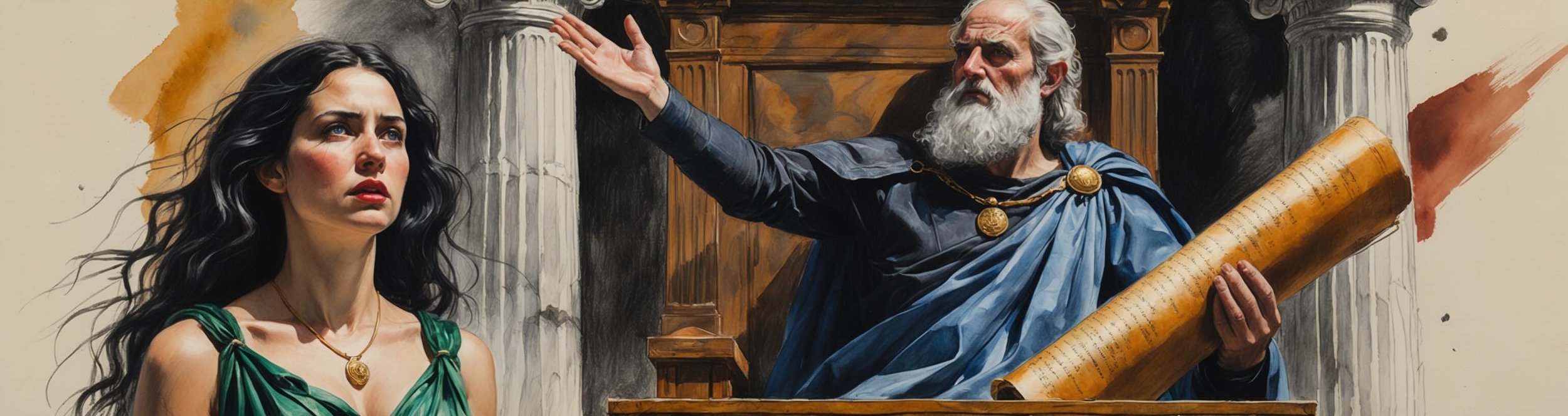
Scene Profile – At a Glance
- Location: The palace of Theseus, Duke of Athens, four days before his wedding.
- What Happens: Egeus demands that his daughter Hermia marry Demetrius; Theseus gives her until his wedding day to obey, become a nun or die. Hermia and Lysander plan to elope through the wood, and Helena decides to betray them to Demetrius.
- Key Characters: Theseus and Hippolyta; Egeus; Hermia, Lysander, Demetrius and Helena; Philostrate.
- Dramatic Function: The play’s exposition: the wedding that frames the action, the law that drives the lovers into the wood, and the four-way tangle of who loves whom.
- Famous Quote:
"The course of true love never did run smooth..."
(Lysander, Act 1, Scene 1) - Why It Matters: Everything the wood will undo is set up here – a marriage made by conquest, a father’s absolute claim on his daughter, and a theory of love as blind that the rest of the play proves.
Scene Summary
Theseus, Duke of Athens, is counting the four days until his wedding to Hippolyta, queen of the Amazons, and complains that the old moon is slow to wane. Hippolyta answers that four nights will quickly dream the time away. Theseus sends Philostrate to organise entertainments and reminds his bride that he won her by conquest but will marry her in another key, with pomp and revelling.
Egeus enters with a complaint against his daughter Hermia. He has promised her to Demetrius, but Lysander has bewitched her with rhymes, serenades and love-tokens, and she refuses to marry the man her father has chosen. Egeus asks Theseus to enforce the law of Athens: Hermia must marry Demetrius or die. Theseus tells Hermia that her father should be as a god to her, and that she is a form in wax which he may keep or destroy. Hermia asks what the worst outcome would be if she refuses; Theseus explains that she must either die or spend her life as a nun, and gives her until his own wedding day to choose. Hermia says she would rather live and die a virgin than yield to a husband her soul does not accept.
Lysander protests that he is Demetrius’s equal in birth and fortune and is loved by Hermia, and adds that Demetrius has already courted Helena and won her heart before abandoning her. Theseus admits he has heard as much, but says he has been too busy to deal with it. He takes Egeus and Demetrius away for a private word, and Hippolyta with them, leaving the lovers alone.
Lysander and Hermia lament that true love never runs smooth, then Lysander proposes a plan: he has a rich widowed aunt who lives seven leagues from Athens, beyond the reach of its law, and if Hermia will meet him tomorrow night in the wood outside the city, they can go there and marry. Hermia swears to come. Helena arrives, miserable because Demetrius has left her for Hermia, and begs to be taught how Hermia charms him. Hermia and Lysander tell her their plan, to reassure her that Hermia will soon be gone. Left alone, Helena reflects that love sees with the mind rather than the eyes, and decides to tell Demetrius about the elopement, so that she can at least follow him into the wood.
A Wedding Won by the Sword
The play opens on a countdown. Theseus wants his wedding night and the moon is in his way; Hippolyta, calmer, says the days will pass. Then, in the scene’s fourth speech, the duke reminds his bride how the courtship went.
Original
Hippolyta, I wooed thee with my sword,
And won thy love, doing thee injuries;
But I will wed thee in another key,
With pomp, with triumph and with revelling.
(Theseus, Act 1, Scene 1)
Shakespeare Retold (Modern Verse)
Hippolyta, I wooed you in a battle
And won your heart whilst I was hurting you;
But I will marry you a different way,
With fanfare and triumphant revelry.
It is a strange thing to say to a woman four days before the wedding, and the play does not soften it. Theseus defeated the Amazons, took their queen as a prize, and now proposes to marry her in a different key, as if a war and a wedding were two tunes on the same instrument. Hippolyta does not reply. Whether she is a willing bride or a captive making the best of it is a question the text leaves open, and productions have answered it both ways; what the speech settles is the pattern the whole play will follow. Every marriage in it is made by a man’s force or a fairy’s, and blessed afterwards. The duke’s court is the world of order and chaos, and its first act is to remind us that the order was won by conquest.
Egeus and the Law
Egeus arrives full of vexation, and the scene becomes a trial. His charge against Lysander is a list – rhymes, moonlight serenades, bracelets of hair, sweetmeats – and his claim over Hermia is stated in the language of property: she is his, and he may dispose of her. Theseus, asked to rule, explains to Hermia what a daughter is.
Original
What say you, Hermia? Be advised fair maid:
To you your father should be as a god;
One that composed your beauties, yea, and one
To whom you are but as a form in wax
By him imprinted and within his power
To leave the figure or disfigure it.
(Theseus, Act 1, Scene 1)
Shakespeare Retold (Modern Verse)
What do you say to that, Hermia? Be warned:
You ought to treat your father like a god;
For he created all your beauty, and
You’re merely just a waxwork form of him,
Created by him, and he has the power
To keep the waxwork figure or destroy it.
The image is exact and appalling. Hermia is wax; her father pressed the shape into it; he may keep the figure or melt it down. Theseus delivers this courteously, as a reasonable man describing how things are, which is what makes it the most complete statement of paternal control in Shakespeare. Hermia’s answer – that she wishes her father could see with her eyes – is turned straight back on her: her eyes must look with his judgement. There was no such law in Elizabethan England; Shakespeare invented the death penalty to make the principle visible, and the invention tells us how the play regards control and rebellion. The law is stated at full strength here so that the wood, and then the duke himself in Act 4, can quietly set it aside.
Hermia’s Answer and the Plan
Hermia does not know, she says, what power makes her bold, and then she is bold. Offered a convent as the alternative to Demetrius, she chooses it, to the duke’s face.
Original
So will I grow, so live, so die, my lord,
Ere I will my virgin patent up
Unto his lordship, whose unwished yoke
My soul consents not to give sovereignty.
(Hermia, Act 1, Scene 1)
Shakespeare Retold (Modern Verse)
And so that’s how I’ll live and die, my lord,
Before I give up my virginity
To that man, whose control I don’t desire
And unto whom my heart won’t acquiesce.
“Sovereignty” is a political word, and Hermia uses it about her own body: the law may give Demetrius her father’s consent, but her soul will not give him rule. She has no power in the room and speaks as though she had, and the play’s first unexplained power is not magic but a young woman’s will. When the court leaves, the lovers’ duet on the crosses of true love – different in blood, misgraffed in years, chosen by another’s eyes – is a catalogue of everything that has just happened to them, and Lysander’s remedy is the plot: a rich aunt seven leagues away, a wood a league outside the town, tomorrow night. The scene has shown love and folly as a thing forbidden by law; the wood is where the law cannot follow.
Helena’s Theory of Love
Helena enters in envy and leaves in treachery, and between the two she works out what the whole play is about. Her exchange with Hermia is a set of matched lines – the more I hate, the more he follows me; the more I love, the more he hates me – that show love as a machine running backwards. Then, alone, she explains the machine.
Original
Things base and vile, folding no quantity,
Love can transpose to form and dignity:
Love looks not with the eyes, but with the mind;
And therefore is winged Cupid painted blind:
Nor hath Love's mind of any judgement taste;
Wings and no eyes figure unheedy haste:
And therefore is Love said to be a child,
Because in choice he is so oft beguiled.
(Helena, Act 1, Scene 1)
Shakespeare Retold (Modern Verse)
The rude and ugly, wicked and pugnacious,
Through eyes that love, seem beautiful and gracious;
Love doesn’t look with eyes, but with the mind,
So that’s why Cupid, god of love, is blind;
And Cupid’s taste is mired with imprecisions;
His wings and blindness drive his rash decisions.
Hence, Love is often like a child perceived
Because a child’s so easily deceived.
Love does not see; it makes. Base and vile things are given form and dignity by the lover’s mind, which is why Cupid is painted blind and winged: he cannot look and will not wait. Every word of this is acted out in the wood, where two men see Helena with altered minds and their eyes follow. What makes the speech remarkable is what she does with it. Having diagnosed love as a disorder of perception, she decides in the same breath to betray her friend’s secret to Demetrius, for no better reward than the sight of him going to the wood and coming back. The play’s clearest thinker about love and folly is also its first casualty, and the scene ends with the whole cast bound for the same wood on the same night.
Language and Technique
- The moon: The scene opens with Theseus cursing the slow old moon and Hippolyta welcoming the new one like a silver bow; the moon returns in the convent’s cold fruitless moon and Lysander’s Phoebe. It is the play’s clock and its mood.
- Property language: Egeus says Hermia is his to dispose of and “estates” her to Demetrius as if she were land; Theseus makes her wax stamped by her father. The vocabulary of ownership is doing the play’s political work.
- Stichomythia: The lovers’ exchange on the crosses of love, and Hermia and Helena’s matched lines (I frown upon him / O that your frowns), trade one line for one line: a verbal duel that makes the lovers sound interchangeable, which they will shortly become.
- Rhyme: The court speaks blank verse; once the duke leaves, the lovers slide into rhyming couplets, and Helena’s soliloquy is all couplets. The change of music marks the change from law to love.
- Classical oaths: Hermia swears by Cupid’s bow, Venus’s doves and the fire that burned the Carthage queen, Dido abandoned by Aeneas – an unlucky precedent for a woman about to trust a man’s vows.
- Hail and fire: Helena describes Demetrius’s oaths as hail that melted at the heat of Hermia; the image of vows dissolving prepares the audience for the flower that will dissolve them again.
Key Quotes from Act 1, Scene 1
Quote 1
Four days will quickly steep themselves in night;
Four nights will quickly dream away the time;
And then the moon, like to a silver bow
New-bent in heaven, shall behold the night
Of our solemnities.
(Hippolyta, Act 1, Scene 1)
Shakespeare Retold (Modern Verse)
Four days will soon dissolve into the night;
Four nights will soon evaporate as dreams;
And then the crescent moon, shaped like a bow
Appearing in the sky, will cast its gaze
Upon our wedding vows.
Quote Analysis: Hippolyta’s first speech, and one of only a handful she has in the play. The Amazon queen sounds serene where Theseus sounds impatient, and her image of the new moon as a silver bow is a warrior’s image. The modern verse keeps the four days and four nights and the bow.
I know not by what power I am made bold,
Nor how it may concern my modesty,
In such a presence here to plead my thoughts;
But I beseech your grace that I may know
The worst that may befall me in this case,
If I refuse to wed Demetrius.
(Hermia, Act 1, Scene 1)
Shakespeare Retold (Modern Verse)
I don’t know whether I may be so bold,
Nor how it will affect my reputation,
Expressing my desires in your presence;
But I would like to ask your grace to know
The worst thing that might happen to me here
If I refuse to wed Demetrius.
Quote Analysis: Hermia asking the duke, in effect, what the worst is. The politeness is armour: she pleads pardon for speaking at all and then demands to know the penalty. The modern verse keeps the odd, honest admission that she does not know where the courage comes from.
Brief as the lightning in the collied night,
That, in a spleen, unfolds both heaven and earth,
And ere a man hath power to say 'Behold!'
The jaws of darkness do devour it up:
So quick bright things come to confusion.
(Lysander, Act 1, Scene 1)
Shakespeare Retold (Modern Verse)
As brief as lightning bolts within the night,
That split the sky and earth as they unfold,
Before a man has time to cry ‘look out!’
The lightning’s gone and darkness has returned:
For things that brightly shine will quickly vanish.
Quote Analysis: Lysander’s image of love as lightning that lights up heaven and earth for an instant before the dark swallows it. It is beautiful, and it is a young man enjoying his own misery. The modern verse keeps the flash and the jaws. An act later his own love will prove as brief as the lightning, and a flower, not death, will end it.
I will go tell him of fair Hermia's flight:
Then to the wood will he to-morrow night
Pursue her; and for this intelligence
If I have thanks, it is a dear expense:
But herein mean I to enrich my pain,
To have his sight thither and back again.
(Helena, Act 1, Scene 1)
Shakespeare Retold (Modern Verse)
I’ll tell him Hermia is taking flight,
Then he’ll go to the woods tomorrow night
Pursuing her; and with this knowledge, he
May offer thanks, at painful cost to me.
But in this way, I will enhance my pain,
To see him go there then come back again.
Quote Analysis: The close of Helena’s soliloquy, where the theory turns into an act. She will betray her friend’s escape to Demetrius, knows the thanks will cost her dear, and does it anyway for the sight of him. The modern verse keeps the pain and the pettiness of the reward.
Key Takeaways
- The frame is a wedding: Theseus’s marriage to a conquered queen opens the play and will close it; every plot inside the frame ends at the same altar.
- The law is invented: No Athenian or English law killed disobedient daughters; Shakespeare states paternal power at full strength so the play can undo it.
- Hermia starts the plot: Her refusal, and Lysander’s plan, send the lovers into the wood; nothing the fairies do would happen without her defiance.
- Helena explains the play: Love looks with the mind, not the eyes: the theory is stated before any fairy has touched anyone, by the character least able to act on it.
- Everyone is headed for the wood: By the end of the scene all four lovers have a reason to be there tomorrow night, and the mechanicals will follow in the next scene.
Study Questions and Analysis
Why does Theseus say he wooed Hippolyta with his sword?
Because he did. In the legend Shakespeare took from Chaucer and Plutarch, Theseus conquered the Amazons, the nation of warrior women, and took their queen home as his bride; the play’s second scene of dialogue has him say so plainly, and add that the wedding will be in another key. The line establishes that the play’s framing marriage was made by force before it was made by consent, and Hippolyta’s silence in reply leaves open how she feels about it.
But I will wed thee in another key,
With pomp, with triumph and with revelling.
(Theseus, Act 1, Scene 1)
Shakespeare Retold (Modern Verse)
But I will marry you a different way,
With fanfare and triumphant revelry.
Critics have made the line central. Louis Montrose, in “Shaping Fantasies” (1983), read the play’s whole movement as one in which female power – “misanthropic warriors, possessive mothers, unruly wives, and willful daughters” – is brought under the control of lords and husbands, and Hippolyta’s conquest is the first and clearest instance. Productions decide the question the text leaves open: Peter Brook’s 1970 staging doubled Hippolyta with Titania, so that the Amazon’s subjection and the fairy queen’s were the same story. A student can argue either that the play accepts the conquest as the price of order and chaos or that it keeps reminding us, through Hippolyta’s few cool lines, what the order cost.
What is the Athenian law, and is it real?
The law, as Egeus states it and Theseus confirms it, gives a father absolute power over his daughter’s marriage: she must marry the man he chooses, or die, or, as Theseus adds, enter a convent for life. Shakespeare invented it. Neither ancient Athens nor Elizabethan England put disobedient daughters to death, though English fathers had real power over their daughters’ marriages, and a match without parental consent was a scandal.
I beg the ancient privilege of Athens,
As she is mine, I may dispose of her:
Which shall be either to this gentleman
Or to her death, according to our law...
(Egeus, Act 1, Scene 1)
Shakespeare Retold (Modern Verse)
I ask to use the old custom of Athens,
Since she is mine, that I may choose her fate:
Which is she either weds this gentleman
Or she’ll be killed, as stated in our law...
The invention is the point. By stating paternal authority at its most extreme, the play makes the principle behind the ordinary version visible, and then lets us watch it fail: the lovers escape it by going into the wood, and in Act 4 Theseus, who here says the law can by no means be extenuated, overrules Egeus in a line without explaining why. The theme of control and rebellion runs through the play as a series of absolute claims that the night dissolves. A good essay notices that the duke who cannot bend the law in Act 1 bends it in Act 4 because the lovers’ feelings have changed, not because the law has.
Why does Helena betray Hermia’s plan to Demetrius?
For the sight of him. She says so at the end of her soliloquy: if she tells Demetrius that Hermia is fleeing, he will follow Hermia into the wood, and Helena will be able to follow him there and back. She knows the thanks will be a dear expense – Demetrius will not be grateful – and she does it anyway. It is not a plan to win him; it is a plan to be near him.
Coleridge found the moment troubling. He was convinced, he wrote in his notes on the play, that Shakespeare “worked upon it as a dream throughout, but especially, and perhaps unpleasingly, in this broad determination of ungrateful treachery in Helena, so undisguisedly avowed to herself, and this, too, after the witty cool philosophising that precedes.” The word to hold onto is “undisguisedly”: Helena does not deceive herself about what she is doing. That makes her the play’s most self-aware lover and its least dignified, and it sets up the wood, where her self-abasement before Demetrius will go further still. R. W. Dent, in Shakespeare Quarterly (1964), read the play as a study of imagination controlled and uncontrolled; Helena’s speech diagnoses the disorder and then demonstrates it.
What does Helena mean by “Love looks not with the eyes, but with the mind”?
That love is not a response to what a lover sees but a way of seeing. Demetrius does not love Hermia because she is fairer – all Athens, Helena says, thinks Helena as fair – but because his mind has decided to; and Helena admires Demetrius’s qualities in exactly the same way. Love takes things that are base and vile and gives them form and dignity. That is why Cupid is painted blind, and winged, and a child: he cannot see, he will not wait, and he chooses badly.
Love looks not with the eyes, but with the mind;
And therefore is winged Cupid painted blind...
(Helena, Act 1, Scene 1)
Shakespeare Retold (Modern Verse)
Love doesn’t look with eyes, but with the mind,
So that’s why Cupid, god of love, is blind...
The speech is the play’s thesis, delivered before any magic has happened, and the wood is a demonstration of it. When Puck’s flower makes Lysander love Helena, his eyes have not changed; his mind has, and his eyes obediently follow, and he supplies reasons. Catherine Belsey, in her essay for the Folger edition (1993), drew the conclusion the speech invites: “No wonder the four lovers are virtually indistinguishable. Romantic love is in this sense oddly impersonal.” Helena’s word for what the lover’s mind does is “transpose”, a musical term; love changes the key, as Theseus promised to do with his wedding. The theme of love and folly is stated here as clearly as anywhere in Shakespeare, and stated by someone about to prove it.
Why do the lovers speak in rhyme?
Because the play changes its music when the court leaves. Theseus, Hippolyta and Egeus speak blank verse, the unrhymed line of public business; the moment Lysander and Hermia are alone, they begin to rhyme, and by the time Helena arrives the scene is entirely in couplets, with the two women trading rhymed lines one for one. Helena’s soliloquy is twenty-six lines of couplets. The rhyme is the sound of the private world, and of youth.
HERMIA: I frown upon him, yet he loves me still.
HELENA: O that your frowns would teach my smiles such skill!
HERMIA: I give him curses, yet he gives me love.
HELENA: O that my prayers could such affection move!
(Act 1, Scene 1)
Shakespeare Retold (Modern Verse)
HERMIA: I frown at him, but yet he loves me still.
HELENA: Oh, that your frowns would teach my smiles such skill!
HERMIA: I curse him, but then he still loves me back.
HELENA: For love, I wish my prayers could find the knack!
It also has a cost, and Shakespeare seems to intend it. Rhymed stichomythia makes the speakers sound alike: Hermia and Helena’s exchange could almost be one voice answering itself, and that interchangeability is what the wood will exploit when both men switch from one woman to the other. Coleridge called the whole play “one continued specimen of the dramatised lyrical”, and the lovers’ couplets are the lyric at its most artificial – pretty, patterned and slightly absurd, which is the play’s view of young love. The rhyme returns whenever the lovers are under the spell, and disappears when they wake in Act 4 and speak plain verse again.
How does the first scene set up the rest of the play?
It sends everyone into the wood. By the end of the scene Lysander and Hermia have a plan to be there tomorrow night, Helena has decided to tell Demetrius, and Demetrius will therefore follow; the next scene sends the workmen there to rehearse, and Act 2 reveals that the fairies are there already. The scene also fixes the deadline: Theseus’s wedding is in four days, Hermia’s choice falls due on the same day, and the play’s clock runs from here.
Northrop Frye, in Anatomy of Criticism (1957), described the shape this scene begins: the action “begins in a world represented as a normal world, moves into the green world, goes into a metamorphosis there in which the comic resolution is achieved, and returns to the normal world.” Act 1, Scene 1 is the normal world at its most rigid – a duke, a law, a father, a deadline – and the rigidity is what makes the wood necessary. Everything the scene states as fixed (Hermia must marry Demetrius; Demetrius loves Hermia; the law cannot be extenuated) will be reversed by the time the court returns to the wood in Act 4 to find the lovers asleep. A useful essay approach is to list what the first scene declares impossible and show how the play makes each one happen.
