A Midsummer Night’s Dream: Act 1, Scene 2 – Analysis
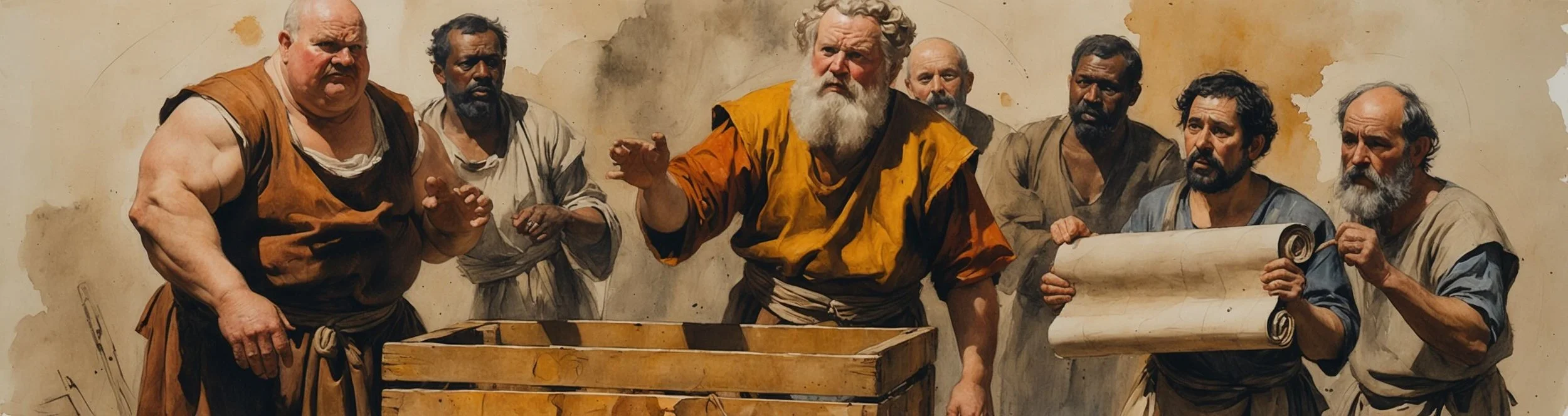
Scene Profile – At a Glance
- Location: Athens – Peter Quince the carpenter’s house, the same day.
- What Happens: Quince casts a group of Athenian workmen in a play of Pyramus and Thisbe for the duke’s wedding. Bottom wants every part. They agree to rehearse in the wood outside the town tomorrow night.
- Key Characters: Bottom; Quince, Flute, Snug, Snout and Starveling.
- Dramatic Function: The play’s third plot is launched and sent to the same wood on the same night as the lovers; the mechanicals’ Pyramus and Thisbe is set up as the play’s comic mirror of its own love story.
- Famous Quote:
"Let me play the lion too: I will roar, that I will do any man's heart good to hear me..."
(Bottom, Act 1, Scene 2) - Why It Matters: It introduces Bottom, the play’s greatest comic creation, and turns the theatre’s own machinery – casting, rehearsal, the fear of the audience – into the subject of the comedy.
Scene Summary
Quince, a carpenter, has gathered five fellow tradesmen to put on a play for the duke’s wedding night, and reads out the title: the most lamentable comedy and most cruel death of Pyramus and Thisbe. Bottom, a weaver, takes charge of the meeting at once, telling Quince how to run it, and is cast as Pyramus. He asks whether Pyramus is a lover or a tyrant, and on hearing that he is a lover who kills himself for love, promises to make the audience weep – though his real taste, he says, is for a tyrant, and he gives a sample of roaring verse.
Flute, a bellows-mender, is cast as Thisbe and objects that he has a beard coming; Quince tells him he can wear a mask and speak as small as he likes. Bottom offers to play Thisbe too, in a monstrous little voice, and is refused. Starveling the tailor is given Thisbe’s mother, Snout the tinker Pyramus’s father, Quince himself Thisbe’s father, and Snug the joiner the lion. Snug asks for the lion’s part in writing because he is slow of study, and is told it is nothing but roaring.
Bottom asks to play the lion as well, promising a roar that will make the duke call for more. Quince warns that too terrible a roar would frighten the ladies and get them all hanged, and the company agrees. Bottom replies that he will roar as gently as a sucking dove, and is finally persuaded that only he can play Pyramus, a sweet-faced, proper man. He deliberates over which colour of beard to wear. Quince hands out the parts, tells them to learn them by tomorrow night, and arranges to rehearse by moonlight in the palace wood a mile outside the town, where nobody will see them. They agree to meet at the duke’s oak.
Casting the Lamentable Comedy
The scene is a rehearsal for a rehearsal, and its first joke is the title. Quince announces the play with the pride of a man who has read it, and the words cancel each other out.
Original
Marry, our play is, The most lamentable comedy, and most cruel death of Pyramus and Thisbe.
(Quince, Act 1, Scene 2)
Shakespeare Retold (Modern Verse)
Well, our play is called, ‘The tragic comedy and cruel death of Pyramus and Thisbe’.
A lamentable comedy, a cruel death that is a merry piece of work: the workmen have no idea what kind of play they are in, and neither, for the moment, does the audience of A Midsummer Night’s Dream, which has just watched a girl sentenced to death in the previous scene. The title is the play’s first commentary on itself. Pyramus and Thisbe is the lovers’ story – two young people forbidden by their parents, meeting in secret, running to the dark – and the workmen will perform it in Act 5 as a farce in front of the very lovers whose night it was. The whole business of art and theatre in this play, the way a story changes with the telling, starts with a carpenter misreading a title page.
Bottom Wants Every Part
Bottom is cast as Pyramus and immediately wants to know whether that means a lover or a tyrant, because he can do both. He can also, it turns out, do the lady and the lion. The scene is a portrait of a particular kind of amateur, and every school play has one.
Original
That will ask some tears in the true performing of it: if I do it, let the audience look to their eyes; I will move storms, I will condole in some measure. To the rest: yet my chief humour is for a tyrant: I could play Ercles rarely, or a part to tear a cat in, to make all split.
(Bottom, Act 1, Scene 2)
Shakespeare Retold (Modern Verse)
That will demand some real tears from me if I’m to perform it well: if I do that, the audience will need to check their own eyes, for they will be sobbing so much as I express such heartache. But on with the other roles… although my preference is to play a tyrant: I could play Hercules, or any role that requires ranting to make a stir, such as…
What lifts Bottom above the type is the scale of the appetite. He does not want the best part; he wants all of them, and he cannot imagine a part he would not play better than the man who has it. His sample of a tyrant’s vein – raging rocks and shivering shocks – is doggerel, and he knows it is lofty. His plan for Thisbe is a monstrous little voice. His lion will roar gently. Each offer is refused and each refusal leaves him undented, and by the end of the scene he is choosing between five colours of beard for the one part he was given at the start. The play’s theme of art and theatre has its comic centre here: Bottom is the actor who believes that acting is simply being more, and the wood will shortly give him a transformation to match.
Frightening the Ladies
The one thing that checks Bottom is the thought of the audience. Quince’s objection to the lion is not aesthetic but practical, and the company backs him at once.
Original
An you should do it too terribly, you would fright the duchess and the ladies, that they would shriek; and that were enough to hang us all.
(Quince, Act 1, Scene 2)
Shakespeare Retold (Modern Verse)
But if you make it too terrifying, you will frighten the duchess and the ladies, and make them scream; and that’ll be enough to get us all hanged.
The fear is comic and not quite groundless. A company of tradesmen performing before a duke is performing before power, and the workmen’s anxiety about the ladies’ shrieks runs through every later scene: it is why Snug will explain in Act 5 that he is only a joiner, and why Bottom will want a prologue to say that Pyramus is not killed indeed. The play is laughing at a theory of theatre in which the audience cannot tell a lion from a man in a costume, and at the same time it is taking the theory seriously, because its own fairies are asking the audience to do exactly that. The scene ends with a plan that puts the workmen in the wood tomorrow night, at the duke’s oak, in the same moonlight as the lovers, which is the play’s way of managing order and chaos: three separate worlds, one appointment.
Language and Technique
- Malapropism: Bottom means “individually” and says “generally”; means “moderate” and says “aggravate”; means “seemly” and says “obscenely”. The wrong word is always grander than the right one, which is Bottom in a phrase.
- Oxymoron in the title: “Lamentable comedy” and “cruel death” in a “merry” piece: the workmen’s title puts opposites together without noticing, and the play will do the same on purpose in Act 5 (“tedious brief”, “tragical mirth”).
- Prose: The whole scene is prose, the first in the play, and it marks the workmen off from the verse-speaking court and lovers. Only Bottom’s sample of a tyrant’s speech is verse, and it is bad on purpose.
- Doggerel: “The raging rocks / And shivering shocks”: short thumping rhymes with heavy alliteration, a parody of the old bombastic style of the 1580s stage that Shakespeare’s audience would have recognised.
- The roll-call: Quince reads the scroll and each man answers “Here, Peter Quince” – a rhythm of ordinary work (a guild, a muster) turned into the machinery of a play.
- Similes turned inside out: A lion that roars “as gently as any sucking dove” or “an ’twere any nightingale”: Bottom’s comparisons undo the thing they describe, which is what the workmen’s whole theatre will do.
Key Quotes from Act 1, Scene 2
Quote 1
Nay, faith, let me not play a woman; I have a beard coming.
(Flute, Act 1, Scene 2)
Shakespeare Retold (Modern Verse)
Oh no, don’t have me playing a woman; I’m growing a beard.
Quote Analysis: Flute’s objection to playing Thisbe, and the play’s joke about its own casting: every woman on Shakespeare’s stage was a boy whose beard was coming. The modern verse keeps the plain embarrassment. Quince’s answer – play it in a mask – is what the professional theatre did too.
Have you the lion's part written? Pray you, if it be, give it me, for I am slow of study.
(Snug, Act 1, Scene 2)
Shakespeare Retold (Modern Verse)
Have you got the lion’s part written down? Please, if you have, give it to me for I’m a slow learner.
Quote Analysis: Snug the joiner, the play’s gentlest man, asking for a script for a part that is nothing but roaring. The modern verse keeps his modesty. Hazlitt thought Snug the moral man of the piece, proceeding by measurement in all things; here he measures even a roar.
You can play no part but Pyramus; for Pyramus is a sweet-faced man; a proper man, as one shall see in a summer's day; a most lovely gentleman-like man: therefore you must needs play Pyramus.
(Quince, Act 1, Scene 2)
Shakespeare Retold (Modern Verse)
You will only play the part of Pyramus, for Pyramus is a handsome man; as decent a man as you might see out on a summer’s day; a lovely gentlemanly man. Therefore you have to play Pyramus.
Quote Analysis: Quince managing Bottom by flattery, the only method that works. Pyramus becomes a sweet-faced, proper, lovely gentleman-like man because that is what will keep the weaver in one part. The modern verse keeps the piled-up praise and the firm “must”.
Key Takeaways
- A third world joins the play: After the court and the lovers, the workmen: tradesmen with a script, a deadline and a duke to please.
- Bottom wants everything: Lover, tyrant, lady, lion: his appetite for parts is comic, and it is also the play’s most generous idea of what theatre is.
- The play within the play is the lovers’ story: Pyramus and Thisbe – forbidden lovers, a secret meeting, a night that goes wrong – is Act 1, Scene 1 retold, and will be played as farce before the people it describes.
- The audience is the danger: The workmen fear that a lion will frighten the ladies and hang them all; the play keeps returning to what an audience can be trusted to believe.
- Same wood, same night: The rehearsal is set for the palace wood by moonlight tomorrow, exactly where and when the lovers will be.
Study Questions and Analysis
Who are the mechanicals, and why are they tradesmen?
Six Athenian workmen: Peter Quince, a carpenter; Nick Bottom, a weaver; Francis Flute, a bellows-mender; Tom Snout, a tinker; Snug, a joiner; and Robin Starveling, a tailor. Puck will later call them “hempen home-spuns” and “rude mechanicals”, meaning manual workers, and the name has stuck. Their trades are English, not Greek, and so are their names: Bottom is the core on which a weaver’s thread is wound, Quince is a carpenter’s wedge, Snout is a kettle’s spout.
Shakespeare’s audience knew amateur theatre by craftsmen. The great medieval mystery plays had been performed by trade guilds, and some cycles were still being staged within living memory of the 1590s; town corporations and tradesmen also got up pageants and shows when the Queen came on progress. The workmen’s anxiety to please the duke, their fear of frightening the ladies and their hope of a pension are drawn from that world. C. L. Barber, in Shakespeare’s Festive Comedy (1959), saw the play as gathering up the kinds of entertainment a noble wedding would have had piecemeal, and the mechanicals are the amateur pageant that every such occasion produced. The professional company laughing at them was, of course, a company of players who had themselves come up from trades.
Why does Bottom want to play every part?
Because he cannot imagine a part he would not do well, and because the pleasure of acting, for Bottom, is the pleasure of being more than one thing. Cast as Pyramus, he asks whether that is a lover or a tyrant and offers both; he then wants Thisbe, for the small voice, and the lion, for the roar. He is refused each time and takes the refusal cheerfully. What finally holds him to Pyramus is Quince’s flattery.
I grant you, friends, if that you should fright the ladies out of their wits, they would have no more discretion but to hang us: but I will aggravate my voice so that I will roar you as gently as any sucking dove; I will roar you an 'twere any nightingale.
(Bottom, Act 1, Scene 2)
Shakespeare Retold (Modern Verse)
I assure you, friends, that if you would frighten the ladies out of their wits, they would have no choice but to hang us. But I will aggravate – I mean, moderate – my voice so that I will roar as gently as a baby dove; I’ll roar at you as if I were a nightingale.
Samuel Johnson, in his edition of 1765, gave the definitive account: Bottom “is for engrossing every part, and would exclude his inferiors from all possibility of distinction”, and his passion for a tyrant is the passion “every young man pants to perform when he first steps upon the Stage.” Hazlitt (1817) took the more generous view, calling Bottom “the most romantic of mechanics”, and the two readings are not in conflict. Bottom’s greed for parts is vanity, and it is also wonder at what a theatre lets a weaver be. The play rewards him for it: he is the one mortal who gets to be a lover, a beast and a fairy queen’s consort in a single night.
What is the story of Pyramus and Thisbe, and why did Shakespeare choose it?
It comes from the fourth book of Ovid’s Metamorphoses, which Shakespeare knew in Arthur Golding’s translation of 1567. Two young lovers in Babylon are forbidden to marry by their parents and talk through a crack in the wall between their houses. They agree to meet at night at the tomb of Ninus. Thisbe arrives first, is frightened away by a lion and drops her cloak, which the lion bloodies; Pyramus finds the cloak, believes her dead, and stabs himself; she returns and kills herself over his body. The mulberry tree, stained by their blood, turns from white to red.
It is the lovers’ plot with the ending the fairies prevent. Hermia and Lysander are forbidden by a parent, flee into the dark by moonlight, and would come to grief without Oberon; Shakespeare used the same Ovidian story straight, and at the same time, in Romeo and Juliet. Giving it to the workmen lets the play show its own love story as tragedy and as farce in a single evening. David P. Young, in Something of Great Constancy (1966), noticed that the mechanicals’ failure is a failure of theatrical metaphor – they are, he wrote, far too ambitious in their dramatic metaphors, men changed into walls and moons – and the ambition begins here, with a joiner who wants his roar in writing. The theme of art and theatre runs on what a story does when the wrong people tell it.
Why are the workmen so afraid of frightening the ladies?
Because they are tradesmen performing before a duke, and they take the power in the room literally. Quince’s warning is that a lion roared too terribly would make the duchess and the ladies shriek, and that this would be enough to hang them all; the whole company agrees, every mother’s son. Bottom’s answer is to promise a lion as gentle as a sucking dove. The fear returns in Act 3, Scene 1, when the workmen decide the lion must show half his face and explain that he is Snug the joiner, and in Act 5, when he does.
The joke is about a naive theory of theatre – that an audience cannot tell a played lion from a real one – and the play has more sympathy with it than first appears. Its own fairies depend on the audience agreeing to be frightened and charmed by men in costumes, and Theseus in Act 5 will defend the workmen on exactly those grounds: the best in this kind are but shadows, and imagination must amend them. The mechanicals’ terror of the ladies is the play’s question about magic and illusion and belief put into the mouths of people who cannot answer it.
Why do the workmen rehearse in the wood?
Quince gives the reason: if they rehearse in the city they will be dogged with company and their devices known. They want secrecy for the surprise and, one suspects, to avoid being laughed at. So they arrange to meet at the duke’s oak in the palace wood, a mile outside the town, by moonlight, tomorrow night.
We will meet; and there we may rehearse most obscenely and courageously.
(Bottom, Act 1, Scene 2)
Shakespeare Retold (Modern Verse)
We’ll meet you there, and we can rehearse obscene – I mean, unseen – and with confidence.
Bottom’s “obscenely” is his word for “unseen”, and the modern verse lets him catch the slip. The plot needs them there. Lysander has just arranged to meet Hermia in the same wood, a league outside the town, on the same night, and Act 2 will reveal that the fairy court is there too. The wood is the play’s meeting place for its three worlds, and Shakespeare sends each of them there for a different reason – love, rehearsal, a quarrel over a changeling – so that the collisions of Act 3 look like accident. Northrop Frye called this the movement into the green world, where the normal world’s rules lapse; for the workmen the green world is simply a place where nobody will see them practise, and it will make one of them into an ass.