A Midsummer Night’s Dream: Act 2, Scene 1 – Analysis
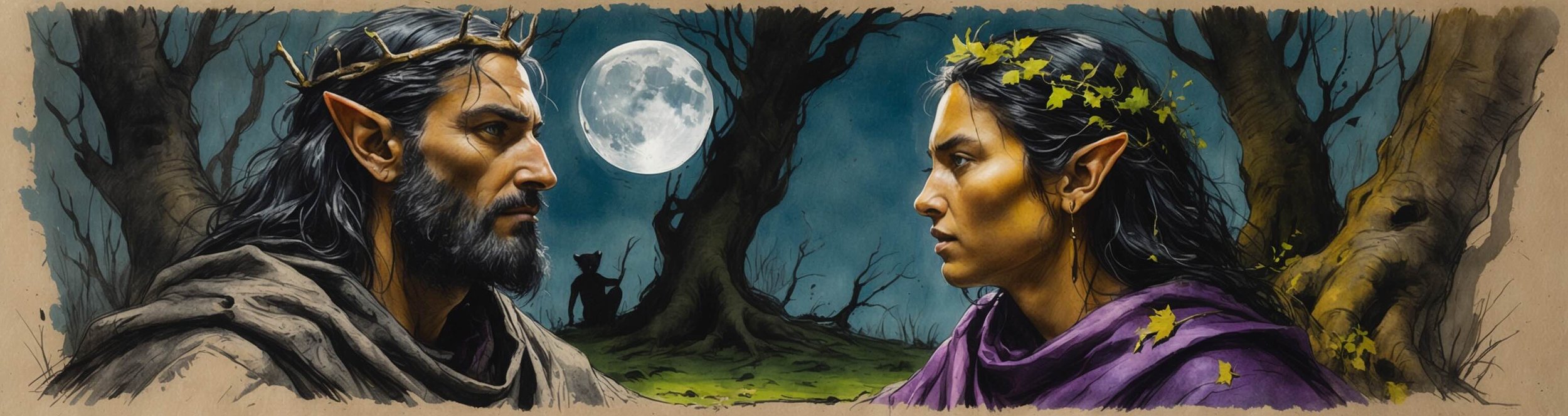
Scene Profile – At a Glance
- Location: The wood outside Athens, at night.
- What Happens: Puck and a fairy describe the quarrel between Oberon and Titania over a changeling boy; the king and queen meet and part in anger. Oberon sends Puck for a magic flower, overhears Helena pursuing Demetrius, and orders Puck to anoint the Athenian’s eyes.
- Key Characters: Puck and the Fairy; Oberon and Titania; Demetrius and Helena.
- Dramatic Function: The play’s third world arrives and takes charge: the fairy quarrel explains the disorder in nature, the flower supplies the plot’s engine, and Oberon’s decision to help Helena connects the fairies to the lovers.
- Famous Quote:
"Ill met by moonlight, proud Titania."
(Oberon, Act 2, Scene 1) - Why It Matters: The most lyrical scene in the play sets its machinery going: everything that happens to the lovers and to Bottom follows from the flower Oberon describes here, and the reason he wants it is a marital row.
Scene Summary
Puck meets one of Titania’s fairies in the wood and asks where she is going. She is hanging dew on the cowslips, and warns him that the queen and her elves are coming. Puck answers that the king holds his revels here tonight and the queen must keep out of his sight: Oberon is furious because Titania has adopted a boy stolen from an Indian king and refuses to give him up as his page, and the two have not met without quarrelling since. The fairy recognises Puck as Robin Goodfellow, the sprite who frightens village girls, spoils the butter and misleads travellers at night; Puck happily agrees, and describes a few of his tricks.
Oberon and Titania enter from opposite sides and meet badly. She accuses him of an affair with a shepherdess and of coming to the wood to bless Hippolyta’s wedding, since the Amazon was once his lover; he accuses her of loving Theseus and helping him abandon other women. Titania calls this the forgeries of jealousy and describes what their quarrel has done to the world: because the fairies have not danced since early summer, fogs and floods have ruined the harvest, the sheep have died, the country games are drowned in mud and the seasons have exchanged their clothes. Oberon says the remedy is in her hands – give him the boy. Titania refuses. The boy’s mother was a mortal follower of hers, who died in childbirth, and for her sake Titania will keep the child. She invites Oberon to join her dances or leave her alone, and goes.
Oberon swears to torment her before she leaves the wood. He reminds Puck of a night when he saw Cupid aim an arrow at a virgin queen enthroned in the west; the arrow was quenched in the moon’s beams, the queen passed on untouched, and the bolt fell on a white flower and turned it purple. The juice of that flower, love-in-idleness, laid on sleeping eyelids, makes the sleeper dote on the next living creature it sees. Oberon sends Puck to fetch it, and Puck promises to put a girdle round the earth in forty minutes. Oberon plans to drop the juice in Titania’s eyes so that she will love some vile creature, and to keep her enchanted until she gives up the page.
Demetrius comes through the wood looking for Lysander and Hermia, with Helena following. He tells her plainly that he does not and cannot love her; she answers that she is his spaniel and asks only to be allowed to follow him, whatever he does to her. He warns her that she is alone at night in a wood with a man who does not love her, threatens to leave her to the wild beasts, and runs off. She follows, saying that women cannot fight for love as men can. Oberon, invisible, has heard everything. When Puck returns with the flower, Oberon describes the bank of wild thyme where Titania sleeps and takes some of the juice for her; then he gives Puck the rest, tells him to find a disdainful Athenian youth and anoint his eyes so that he will love the lady who follows him, and says Puck will know the man by his Athenian clothes.
Puck and the Fairy
The wood’s first voices are not the lovers’ but two spirits comparing notes, and the play uses them to tell the audience what kind of creatures it is now among. The fairy’s skipping verse is a new music; Puck’s is the folklore of the English countryside, recited by someone who recognises him.
Original
Either I mistake your shape and making quite,
Or else you are that shrewd and knavish sprite
Called Robin Goodfellow: are not you he
That frights the maidens of the villagery;
Skim milk, and sometimes labour in the quern
And bootless make the breathless housewife churn;
And sometime make the drink to bear no barm;
Mislead night-wanderers, laughing at their harm?
(Fairy, Act 2, Scene 1)
Shakespeare Retold (Modern Verse)
I’m either much mistaken by your frame,
Or you’re that naughty spirit by the name
Of Robin Goodfellow: is that not you
That scares the village maidens through and through;
Who clogs the millstone, skims the cream, they utter,
So housewives churn the milk but make no butter;
And sometimes stop the beer they make from foaming,
And laugh at wandering folk that you send roaming?
This is Robin Goodfellow as an Elizabethan audience knew him before Shakespeare touched him: the hobgoblin who frightens the village girls, skims the cream, stops the butter coming and leads travellers into bogs for the fun of it. Puck’s answer adds the fat horse cheated by a false neigh, the old woman’s ale spilt down her chin, the stool pulled from under her while the whole room laughs. None of it is kind, and the play keeps the edge. What it adds is a court: Puck does these things to make Oberon smile, and his rough village tricks are about to be put to use on four Athenian lovers. The scene’s opening sixty lines are a briefing on magic and illusion – who the fairies are, what they can do, and that their king and queen are at war.
Ill Met by Moonlight
The king and queen enter from opposite sides and the first thing they do is refuse each other’s greeting. The exchange that follows is a marital row conducted in the language of mythology: each accuses the other of old affairs with mortals, and each is probably right.
Original
OBERON: Ill met by moonlight, proud Titania.
TITANIA: What, jealous Oberon! Fairies, skip hence:
I have forsworn his bed and company.
(Act 2, Scene 1)
Shakespeare Retold (Modern Verse)
OBERON: I’m not pleased meeting you tonight, Titania.
TITANIA: You’re jealous, Oberon? Fairies, skip off:
I swear I’ll never sleep with him again.
“Ill met” is a greeting turned inside out, and “jealous” is the word Titania answers with, naming the motive Oberon never admits to. She has left his bed; he demands to know whether he is not her lord; she says then she must be his lady, and reminds him of the shepherdess Phillida. He reminds her of Theseus. The accusations bind the fairy plot to the human one before the fairies have touched a mortal: Oberon has loved Hippolyta, Titania has loved Theseus, and both have come to the wood, without admitting it, for the duke’s wedding. The fairy marriage is the play’s only existing marriage, and it is introduced as a contest of wills, the control and rebellion theme at the top of the play’s hierarchy. The lovers are quarrelling over who loves whom; the king and queen of the fairies are quarrelling over who rules whom.
The Forgeries of Jealousy
Titania’s reply to the accusations is the longest speech in the play, and it turns a domestic argument into a public disaster. Because the fairies have not danced together since early summer, the weather has broken.
Original
The ox hath therefore stretched his yoke in vain,
The ploughman lost his sweat, and the green corn
Hath rotted ere his youth attained a beard;
The fold stands empty in the drowned field,
And crows are fatted with the murrion flock;
The nine men's morris is filled up with mud,
And the quaint mazes in the wanton green
For lack of tread are undistinguishable...
(Titania, Act 2, Scene 1)
Shakespeare Retold (Modern Verse)
The ox that ploughed the earth did so in vain,
The ploughman’s work was wasted, and the young corn
Has rotted prior to it getting ripe;
The cattle pen stands empty in the wet field,
And crows get fat by eating rotten livestock.
The playground on the village green is muddy,
And lovely mazes in the rambling grass
Are indiscernible, for no one walks there.
The details are English, not Athenian: the ploughman’s lost sweat, the corn rotting before it ripens, the fold empty in a drowned field, crows fattening on diseased sheep, the village games – the nine men’s morris, the turf maze – filled with mud because nobody comes to tread them. The summers of 1594 to 1596 were disastrously wet across England, and most editors hear them in these lines, whether or not Shakespeare meant them to be heard. The speech goes on to make the seasons exchange their liveries, frost in the rose’s lap and summer flowers on winter’s head, and it ends by naming the cause: the fairies are the parents of this progeny of evils. It is the play’s grandest statement of order and chaos and its collapse. The quarrel in the wood is not four young people lost among trees; it reaches from the fairy court to the harvest, and it makes the reconciliation of Act 4 a matter of the weather as well as the heart.
The Changeling and the Votaress
Oberon’s demand is stated at its smallest – a little changeling boy, to be my henchman – and Titania’s refusal is the play’s tenderest speech about a mortal.
Original
But she, being mortal, of that boy did die;
And for her sake do I rear up her boy,
And for her sake I will not part with him.
(Titania, Act 2, Scene 1)
Shakespeare Retold (Modern Verse)
But, being mortal, she died giving birth,
And, for her sake, I’m bringing up her boy,
And, for her sake, I will not part with him.
The boy’s mother was a votaress of Titania’s order, an Indian woman who sat with her on the shore watching the merchant ships, and who imitated their big-bellied sails with her own pregnant body, sailing over the land to fetch her mistress trifles. She died giving birth. The speech is about female friendship and about mortality, two things the fairy world otherwise does not admit, and it makes Titania’s refusal something better than stubbornness: she is keeping a promise to a dead friend. Oberon does not answer it. He asks how long she means to stay in the wood, and when she leaves he swears to torment her. The child himself never appears and never speaks; he is the object over which the gender and patriarchy contest of the fairy plot is fought, and by Act 4 Oberon will simply have him, taken while Titania was enchanted, without the play showing the transfer.
Cupid and the Flower
Alone with Puck, Oberon tells a story, and the story is the play’s engine. Once, sitting on a promontory, he saw Cupid take aim at a virgin queen, and miss.
Original
That very time I saw, but thou couldst not,
Flying between the cold moon and the earth,
Cupid all armed: a certain aim he took
At a fair vestal throned by the west,
And loosed his love-shaft smartly from his bow,
As it should pierce a hundred thousand hearts;
But I might see young Cupid's fiery shaft
Quenched in the chaste beams of the watery moon,
And the imperial votaress passed on,
In maiden meditation, fancy-free.
(Oberon, Act 2, Scene 1)
Shakespeare Retold (Modern Verse)
Right then I saw, although you couldn’t see it,
Flying between the cold moon and the earth,
Cupid all armed with bow and arrow, firing
At a sweet virgin seated on a throne,
And skilfully he fired a love arrow
As though to hit a hundred thousand hearts;
But I observed young Cupid’s burning arrow
Extinguished by the pure and dripping moonbeams,
To leave the royal virgin unaffected,
To ponder her virginity unswayed.
The fair vestal throned by the west is almost certainly Elizabeth I, unmarried by choice and praised by every court poet as the moon-goddess Diana; the arrow that should pierce a hundred thousand hearts is quenched in the moon’s chaste beams, and she passes on untouched. It is a courtier’s compliment to the one woman in the audience whom no man could dispose of. But the arrow has to land somewhere, and it lands on a flower, turning it from white to purple, and the flower’s juice does what the arrow could not. The Queen’s escape from love is the source of everyone else’s subjection to it. Oberon’s plan for the juice is immediate and cruel – Titania is to wake and pursue a lion, a bear, a monkey, whatever comes first, with the soul of love, until she surrenders the boy – and the play’s whole theory of love and folly as a disorder that can be induced from outside is stated here as a recipe.
Helena’s Spaniel
The mortals arrive, and the fairy king becomes an audience. What he overhears is Demetrius telling Helena, in the plainest words in the play, that he does not love her, and Helena refusing to take it.
Original
I am your spaniel; and, Demetrius,
The more you beat me, I will fawn on you:
Use me but as your spaniel, spurn me, strike me,
Neglect me, lose me; only give me leave,
Unworthy as I am, to follow you.
(Helena, Act 2, Scene 1)
Shakespeare Retold (Modern Verse)
I am your puppy; and, Demetrius,
The more you tell me off, the more I love you.
So use me as your puppy, spurn me, slap me,
Ignore me, run away; but only let me
Run after you, although I am not worthy.
Spurn me, strike me, neglect me, lose me: Helena asks for a bad master’s treatment of a dog as a privilege, and when Demetrius threatens to leave her to the wild beasts she says the beasts have kinder hearts than he has. The speech has embarrassed audiences for four centuries, and it should. This is not the blindness Helena diagnosed in Act 1, Scene 1; she sees Demetrius exactly and loves him anyway. Her one flash of resistance is the couplet about the story being changed – Apollo flying and Daphne giving chase, the dove pursuing the griffin – which tells the audience she knows the myths are running backwards and cannot stop. Demetrius’s threat of mischief in the wood is the play’s darkest line about gender and patriarchy, and Oberon’s response is the scene’s turn: he decides, on the spot, that before Demetrius leaves the grove he shall seek Helena’s love. The fairy king’s intervention in the human story begins as a reaction to watching a woman ask to be treated like a dog.
Language and Technique
- Fairy metre: The fairy and Puck speak in short lines with heavy stresses (“Over hill, over dale”), a skipping rhythm the mortals never use. The verse itself tells the audience these are different creatures.
- Folklore catalogue: The fairy lists Robin Goodfellow’s tricks and Puck adds his own: skimmed milk, spoilt beer, a false neigh, a stool pulled away. The list is village belief, recited by the thing believed in.
- Rural imagery: Titania’s speech is made of English farming: ox, plough, corn, sheepfold, crows, the nine men’s morris. The fairy queen describes a disaster in the vocabulary of a farmer.
- Personified seasons: Frost sits in the rose’s lap; old winter wears a summer garland “as in mockery”: the seasons are people who have swapped clothes, which makes the disorder look like a masque gone wrong.
- The Cupid allegory: A mermaid on a dolphin, an armed Cupid, a vestal on a throne, a flower that changes colour: Oberon’s story is told as a court pageant, with a compliment to the Queen hidden in it.
- Flower catalogue: “I know a bank” builds Titania’s bed flower by flower – thyme, oxlips, violet, woodbine, musk-roses, eglantine – until the verse is over-canopied. The beauty is the point, and so is the snake’s shed skin at the end of it.
- Inverted myths: Helena’s Apollo and Daphne, dove and griffin, hind and tiger: the chase runs the wrong way in every pair, which is exactly her complaint.
Key Quotes from Act 2, Scene 1
Quote 1
Over hill, over dale,
Thorough bush, thorough brier,
Over park, over pale,
Thorough flood, thorough fire,
I do wander everywhere,
Swifter than the moon's sphere;
And I serve the fairy queen,
To dew her orbs upon the green.
(Fairy, Act 2, Scene 1)
Shakespeare Retold (Modern Verse)
Over hill, over dale,
Through the bush, through the brier,
Over park, over pale,
Through the flood, through the fire,
I wander everywhere around,
Faster than the moon goes round;
And I serve the fairy queen,
Spreading dew on grasses green.
Quote Analysis: The play’s first fairy verse, and its first entry into the wood. Four lines cover hill, dale, bush, brier, park, pale, flood and fire; the fairy is faster than the moon. The modern verse keeps the gallop and the rhyme, and the audience learns in eight lines that it is among creatures who move at a different speed.
I'll put a girdle round about the earth
In forty minutes.
(Puck, Act 2, Scene 1)
Shakespeare Retold (Modern Verse)
I plan to travel all around the earth
In forty minutes.
Quote Analysis: Puck’s answer to an errand: a boast of scale that he then keeps, since the next time we see him he has the flower. Directors love the line because it is the first time Puck leaves the stage and how he goes tells you what he is – in Peter Brook’s 1970 production, by trapeze. The modern verse keeps the girdle.
I know a bank where the wild thyme blows,
Where oxlips and the nodding violet grows,
Quite over-canopied with luscious woodbine,
With sweet musk-roses and with eglantine:
There sleeps Titania sometime of the night,
Lulled in these flowers with dances and delight...
(Oberon, Act 2, Scene 1)
Shakespeare Retold (Modern Verse)
I know a grassy bank where wild thyme blows,
Where oxlips and the nodding violet grows,
And luscious honeysuckle offers shade,
Whilst roses share the sweet bouquet they’ve made.
And there, sometimes, Titania sleeps at night,
Lulled by the flowers dancing with delight...
Quote Analysis: Among the most quoted lines in Shakespeare, and worth remembering what they are for: Oberon is telling Puck where his wife sleeps so that he can drug her. The description is built up flower by flower, and the modern verse keeps the catalogue. The beauty and the meanness sit side by side without apology.
Run when you will, the story shall be changed:
Apollo flies, and Daphne holds the chase;
The dove pursues the griffin; the mild hind
Makes speed to catch the tiger; bootless speed,
When cowardice pursues and valour flies.
(Helena, Act 2, Scene 1)
Shakespeare Retold (Modern Verse)
Run if you like: the chaser’s now the chased,
Like virgin Daphne chasing lewd Apollo,
Or doves pursuing monsters, or tame deer
That sprint to catch a tiger. Speed is useless
When cowards chase the stronger ones away.
Quote Analysis: Helena’s one moment of clear sight in the wood. She knows the myths are running backwards – the nymph chasing the god, the dove chasing the monster – and names it as her scandal. The modern verse keeps the reversed pairs. It is a woman describing her own humiliation with perfect accuracy and continuing anyway.
Fare thee well, nymph: ere he do leave this grove,
Thou shalt fly him and he shall seek thy love.
(Oberon, Act 2, Scene 1)
Shakespeare Retold (Modern Verse)
Goodbye, young girl: before he leaves this grove,
You’ll run from him as he pursues your love.
Quote Analysis: The line that connects the fairies to the lovers. Oberon has watched Helena beg and decides, in a couplet, to reverse it. The modern verse keeps the promise and its neat symmetry. Every confusion of the next two acts follows from this decision and from Puck’s mistake in carrying it out.
Key Takeaways
- The fairies are a court at war: Oberon and Titania’s quarrel over a changeling boy is the play’s only existing marriage, and it is introduced as a contest for authority.
- The quarrel has broken the weather: Titania’s speech makes the fairies responsible for floods, failed harvests and confused seasons: the disorder in the wood reaches the whole world.
- The flower is the engine: Love-in-idleness, made by Cupid’s arrow missing a virgin queen, is the cause of everything that happens to the lovers and to Bottom.
- Helena asks to be a dog: Her spaniel speech is the play’s most uncomfortable statement of love as self-abasement, and Demetrius’s threats are its darkest lines.
- Oberon takes sides: Watching Helena, the fairy king decides to help her; the human plot and the fairy plot join here, on a whim.
Study Questions and Analysis
Who is Puck, and what is Robin Goodfellow?
Puck is Oberon’s servant and jester, the fairy who does the king’s errands and makes him laugh. Robin Goodfellow is the name the fairy gives him, and it was the name of a real figure in English folk belief: a household spirit, or hobgoblin, who would do the chores for a bowl of milk if he was pleased and spoil the butter, sour the beer and lead travellers astray if he was not. “Puck” was originally a general word for such a spirit rather than a name.
Thou speak'st aright;
I am that merry wanderer of the night.
(Puck, Act 2, Scene 1)
Shakespeare Retold (Modern Verse)
You’re absolutely right;
I am that merry wanderer of the night.
Shakespeare’s audience would have known the figure from stories and from Reginald Scot’s Discoverie of Witchcraft (1584), a sceptic’s catalogue of the spirits people no longer needed to fear, which records the bowl of milk left out for Robin Goodfellow and remarks that he had ceased to be much feared. The play keeps the rough village tricks and adds a court to belong to. Hazlitt, in Characters of Shakespear’s Plays (1817), contrasted him with Ariel: “Puck is a mad-cap sprite, full of wantonness and mischief, who laughs at those whom he misleads”, and the description fits everything he does in the wood. He is a performer before he is a servant, and the lovers are about to become his audience.
Why are Oberon and Titania quarrelling?
Over a child. Titania has adopted a boy stolen from an Indian king – a changeling, in the folklore sense of a human child taken by fairies – and Oberon wants him as his page, a knight of his train to hunt the forests with. She refuses, and the two have avoided each other since early summer, quarrelling whenever they meet. Behind the boy are older grievances: she accuses him of an affair with a shepherdess and of loving Hippolyta; he accuses her of loving Theseus.
The quarrel is about authority as much as about the child. Oberon’s question – am not I thy lord? – and Titania’s answer – then I must be thy lady – state the terms: he claims a husband’s right to command, she claims a queen’s right to refuse. Louis Montrose, in “Shaping Fantasies” (1983), read the fairy plot as the play’s clearest case of female power being brought under male control, and noted that Oberon’s method, the flower, is to make his queen love something contemptible until she gives way. A student can set that reading against the tenderness of Titania’s speech about the boy’s mother, which the play gives her and Oberon never answers. The quarrel is the control and rebellion theme in its purest form, and the play resolves it by force disguised as magic.
What does Titania’s speech about the weather mean?
That the fairies’ quarrel has broken the natural world. Because Oberon’s brawls have stopped the fairies dancing, Titania says, the winds have sucked up fogs from the sea, the rivers have flooded, the corn has rotted, the sheep have died of disease, the village games have drowned in mud, and the seasons have exchanged their clothes, with frost on the roses and summer flowers on winter’s head. She ends by naming the fairies as the parents of this progeny of evils.
And this same progeny of evils comes
From our debate, from our dissension;
We are their parents and original.
(Titania, Act 2, Scene 1)
Shakespeare Retold (Modern Verse)
And all this bad confusion has arisen
Out of our talking and our arguing;
We caused this; we’re the root cause of this problem.
Two contexts have been proposed. The summers of 1594, 1595 and 1596 were among the wettest on record in England, with failed harvests and high prices, and most editors since the eighteenth century have heard those years in the speech. Samuel Johnson, in 1765, preferred a literary source, hearing an imitation of Ovid’s Ceres grieving for her daughter and blighting the earth. Both may be right. What the speech does inside the play is establish scale: the disorder of the wood is not a private muddle but a cosmic one, and the reconciliation of the fairy king and queen in Act 4 is needed to put the seasons right. It also makes Titania the play’s most serious voice about order and chaos, which is worth remembering when she wakes in Act 3 to fall in love with an ass.
What does Titania’s story about the boy’s mother tell us?
That her refusal is loyalty, not stubbornness. The changeling’s mother was a mortal woman in Titania’s service, an Indian votaress, who sat with the fairy queen on the shore at night watching the merchant ships and, pregnant, imitated their swelling sails by sailing over the land to fetch her mistress trifles. She died in childbirth, and Titania is rearing her son for her sake. It is the only speech in the play about a friendship between women that is not broken, and the friend is dead.
The speech also introduces mortality into a world that otherwise ignores it: the votaress was mortal and died of the boy, and the child is a human among immortals. Montrose noticed that the play’s mothers are all absent – the votaress dead, Hermia’s and Helena’s never mentioned, Hippolyta an Amazon – and that Oberon’s demand for the boy takes a child from a woman’s keeping into a man’s. Titania’s speech is the case for the other side, made in the play’s most beautiful verse, and the fact that Oberon has no reply to it, only a threat, is the scene’s judgement on him. When he tells Puck in Act 4 that he has the boy, the audience is meant to remember what the boy cost.
Who is the “fair vestal throned by the west”?
Almost certainly Elizabeth I. Oberon describes Cupid aiming at a virgin priestess enthroned in the west, the arrow quenched in the chaste beams of the moon, and the imperial votaress passing on untouched, fancy-free. A vestal is a virgin; an imperial votaress is a woman of imperial rank vowed to chastity; the west is England; and the moon is Diana, the goddess under whose name the unmarried Queen was praised by every poet of the 1590s. Readers have taken the passage as a compliment to Elizabeth since the eighteenth century.
But I might see young Cupid's fiery shaft
Quenched in the chaste beams of the watery moon,
And the imperial votaress passed on,
In maiden meditation, fancy-free.
(Oberon, Act 2, Scene 1)
Shakespeare Retold (Modern Verse)
But I observed young Cupid’s burning arrow
Extinguished by the pure and dripping moonbeams,
To leave the royal virgin unaffected,
To ponder her virginity unswayed.
The compliment has a structure worth noticing. The Queen escapes love; the arrow that missed her makes the flower; the flower subjects everyone else. Montrose put it exactly: the vestal’s freedom from fancy is what guarantees the subjection of others. Shakespeare wrote, for a woman who ruled without a husband, a play in which every other woman ends the night under one, and placed the Queen outside the story as the single exception to its magic. Whether the play was performed before her is unknown; the compliment works either way, and it tells a student how carefully the play’s gender and patriarchy politics are arranged around the one woman no father or husband could dispose of.
What is love-in-idleness, and how does the flower work?
A small western flower, white until Cupid’s arrow fell on it and turned it purple with love’s wound; the name is a country name for the pansy, or heartsease. Its juice, dropped on the eyelids of a sleeper, makes the sleeper dote madly on the next living creature it sees on waking, whatever that creature is – Oberon’s list runs lion, bear, wolf, bull, monkey, ape. A second herb, which he mentions here and uses in Act 4, undoes the charm.
The juice of it on sleeping eye-lids laid
Will make or man or woman madly dote
Upon the next live creature that it sees.
(Oberon, Act 2, Scene 1)
Shakespeare Retold (Modern Verse)
The nectar of that flower dropped on eyelids
Will make a man or woman fall besotted
In love with the first creature that it sees.
The flower is the play’s single piece of machinery, and it is worth being precise about what it does: it changes what the sleeper loves without changing anything else. Lysander, anointed by mistake in the next scene, keeps his intelligence and uses it to explain why he was always meant to love Helena; Titania keeps her queenly manner and applies it to a donkey. The magic imitates what Helena described in Act 1, love looking with the mind and not the eyes, and the play never quite says whether the flower causes love or merely shows what love is. R. W. Dent, in Shakespeare Quarterly (1964), argued that the play’s subject is the difference between imagination controlled and imagination run to dotage, and the flower is dotage on demand. The theme of magic and illusion in this play is a hedgerow plant and a sleeping face.
Why does Helena call herself Demetrius’s spaniel?
Because she has decided that any place in his life is better than none. Demetrius has just told her, in the plainest words, that he does not love her and cannot; she answers that she loves him the more for it, and asks to be used as he would use his dog – spurned, struck, neglected, lost – if only she may follow him. When he says he is sick when he looks at her, she says she is sick when she does not.
Jan Kott, in Shakespeare Our Contemporary (1964), found the speech almost masochistic, and read the wood as a place where desire is shown at its most brutal; Peter Brook’s 1970 production took the hint. Catherine Belsey (1993) offered a cooler account: the play, she wrote, “does not ignore the trace of violence that exists within love when the other person fails to conform to the lover’s idealized image”, and Demetrius’s threats to leave Helena to the beasts and do her mischief in the wood are that trace made explicit. What both readings agree on is that Helena is not deceived. She sees Demetrius exactly, and her couplet on the story being changed shows she knows the myths have reversed. The play’s darkest account of love and folly is spoken by its most clear-sighted lover, and the fairy king, overhearing, is moved to pity rather than laughter.
Why does Oberon decide to help Helena?
He has been watching. Invisible, he hears Demetrius reject her and threaten her, and hears her beg to follow him anyway, and when the two run off he speaks a couplet: before Demetrius leaves the grove, Helena shall fly him and he shall seek her love. It is a whim, and a generous one; nothing in his own plot requires it. He then gives Puck the flower with instructions to anoint a disdainful youth in Athenian garments so that he wakes to love the lady following him.
The decision is the hinge of the play, because it is what connects the fairy plot to the lovers, and because it goes wrong. Puck will find the wrong Athenian, Lysander, asleep near Hermia, and the mistake produces the whole confusion of Act 3. Oberon’s motive is worth weighing: he is a husband about to drug his own wife into loving a monster, and in the same scene he is moved by a woman’s humiliation to put it right. The play’s fairy king is both things, and the scene does not ask us to choose. Northrop Frye’s account of the green world as the place where the comic resolution is achieved fits, but the resolution here begins as a fairy’s pity for a mortal, and the pity is administered by the same flower that is about to be used for revenge.