Hamlet: Act 1, Scene 4 – Analysis
Scene Profile – At a Glance
- Location: The guard platform on the walls of Elsinore, near midnight.
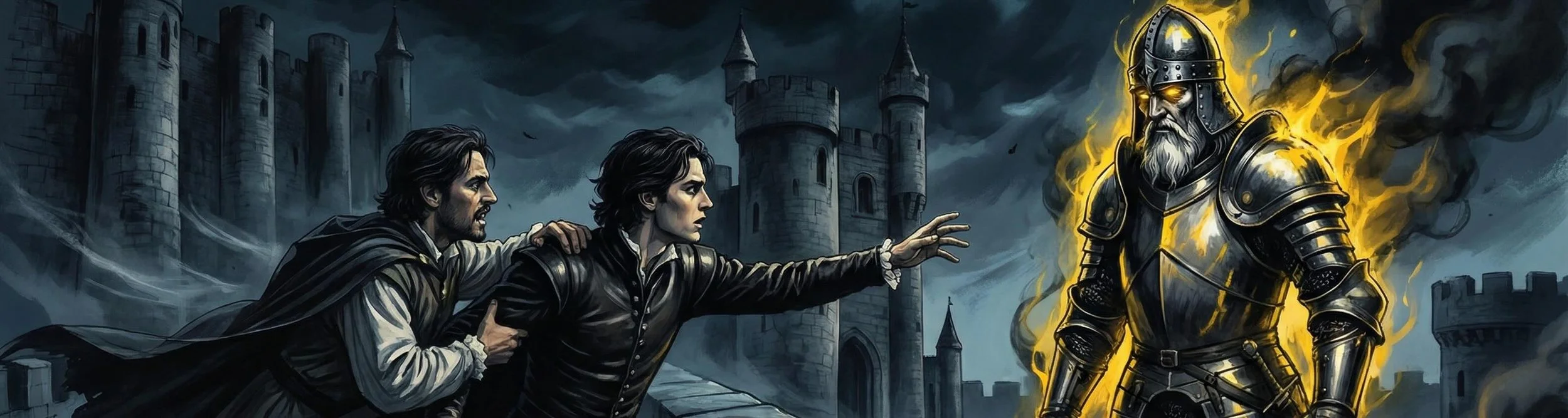
- What Happens: Hamlet waits on the cold battlements as the king drinks below. The Ghost appears and beckons Hamlet to follow it. Despite Horatio's warnings of danger, Hamlet breaks free and goes after it.
- Key Characters: Hamlet, Horatio, the Ghost, with Marcellus.
- Dramatic Function: The scene brings Hamlet face to face with the Ghost and sends them off alone, building to the great revelation of the next scene.
- Famous Quote:
"Something is rotten in the state of Denmark."
(Marcellus, Act 1, Scene 4) - Why It Matters: It tests Hamlet's courage and his fear that the Ghost might be a devil, and it sums up the whole play in one line about a kingdom gone wrong.
Scene Summary
It is again midnight and bitterly cold. Hamlet waits on the battlements with Horatio and Marcellus, while from inside the castle they hear the sound of Claudius drinking and celebrating. Hamlet is disgusted by the king's heavy carousing and remarks that it gives Denmark a bad name abroad.
The Ghost then appears. Hamlet calls on heaven to protect him and demands to know whether the figure is good or evil, but the Ghost will not answer; instead it silently beckons him to come away and speak alone. Horatio and Marcellus beg Hamlet not to follow, fearing the spirit may lead him to his death or drive him mad.
Hamlet refuses to be held back. He insists he does not value his life and that his immortal soul cannot be harmed, and when the others try to restrain him he threatens them and breaks free. He follows the Ghost offstage. Shaken, Horatio and Marcellus decide to go after him, and Marcellus speaks the scene's famous verdict that something is "rotten" in Denmark.
The Air Bites Shrewdly
The scene opens, like the play's first, in cold and darkness, with the same uneasy mood. As they wait, the trumpets and cannon of the king's late-night drinking echo up from below, and Hamlet's contempt for it shows how far he stands from the new court.
Original
The air bites shrewdly; it is very cold.
(Hamlet, Act 1, Scene 4)
Shakespeare Retold (Modern Verse)
The air is biting; it's a bitter cold.
The biting cold sets the mood and quietly reminds us of the play's opening night watch. Hamlet's complaint about the king's "heavy-headed revel" turns the cold outside into a moral judgement: while honest men shiver on guard, Claudius feasts. The drunken celebration below the walls makes the king's court look coarse and self-indulgent, exactly as the Ghost is about to confirm.
Spirit of Health or Goblin Damned?
When the Ghost appears, Hamlet's first instinct is fear and prayer. His great question is whether this figure comes from heaven or hell – whether it is his father's blessed spirit or a devil wearing his father's shape to trick him.
Original
Angels and ministers of grace defend us!
Be thou a spirit of health or goblin damned...
(Hamlet, Act 1, Scene 4)
Shakespeare Retold (Modern Verse)
Angels and saintly clergymen: defend us!
Whether you're a friendly ghost or demon...
This doubt is one of the most important ideas in the play. In Shakespeare's time, people genuinely feared that a devil could take the form of a dead loved one to lure a grieving person into sin. Hamlet's uncertainty here is why he cannot simply obey the Ghost and kill Claudius: he needs proof. The whole long delay of the play grows from this single, reasonable question – is the Ghost honest, or a trap for his soul?
Language and Technique
- Pathetic fallacy: The "bitter cold" and dark return us to the play's opening mood, so the setting feels charged with dread before the Ghost arrives.
- Antithesis: Hamlet weighs the Ghost in opposites – "spirit of health or goblin damned", "airs from heaven or blasts from hell" – framing it as a choice between salvation and damnation.
- Sound contrast: The offstage trumpets of the king's drinking break into the silent watch, setting Claudius's loud revelry against the tense quiet of the loyal men outside.
- Metaphor of disease: "Rotten" pictures Denmark as a body decaying from the inside, the play's recurring image of hidden corruption.
Key Quotes from Act 1, Scene 4
Quote 1I do not set my life in a pin's fee;
And for my soul, what can it do to that,
Being a thing immortal as itself?
(Hamlet, Act 1, Scene 4)
Shakespeare Retold (Modern Verse)
A pin has greater value than my life,
And what can it do to hurt my very soul
When this thing is immortal by itself?
What if it tempt you toward the flood, my lord,
Or to the dreadful summit of the cliff...
(Horatio, Act 1, Scene 4)
Shakespeare Retold (Modern Verse)
What if it tempts you onward to the ocean,
Or to the summit of a massive cliff...
Something is rotten in the state of Denmark.
(Marcellus, Act 1, Scene 4)
Shakespeare Retold (Modern Verse)
Something is rotten in the state of Denmark.
Key Takeaways
- The mood is cold and tense: The scene returns to the dark battlements, with the king's loud drinking heard below.
- Hamlet fears the Ghost may be a devil: He cannot tell if it is a "spirit of health or goblin damned", which sets up his later need for proof.
- Hamlet is fearless to the point of recklessness: He values his life "at a pin" and follows the Ghost despite the danger.
- Horatio warns of madness and death: The voice of reason fears the Ghost may harm Hamlet's mind.
- "Something is rotten": Marcellus names the corruption at the heart of Denmark in the play's most quoted line.
Study Questions and Analysis
Why does Hamlet greet the Ghost with "Angels and ministers of grace defend us"?
Hamlet's first reaction to the Ghost is to call on heaven for protection, because he is genuinely unsure what he is looking at. He asks whether it is a "spirit of health" (a good, saved soul) or a "goblin damned" (a devil), and whether it brings "airs from heaven or blasts from hell". This is not cowardice; it reflects a real fear of his age.
Many in Shakespeare's audience believed the Devil could disguise himself as a dead relative to deceive the grieving and tempt them into deadly sin. Stephen Greenblatt, in Hamlet in Purgatory (2001), shows how the play deliberately keeps the Ghost's status uncertain – it speaks like a Catholic soul from Purgatory, yet demands the very un-Christian act of revenge. Hamlet's prayer and his question expose that uncertainty, and explain why he cannot simply trust the Ghost and act. He needs evidence before he will kill a king.
What does "Something is rotten in the state of Denmark" mean?
The line means that something is deeply and secretly wrong with the kingdom. Marcellus says it as the Ghost leads Hamlet away, sensing that the appearance of a dead king's spirit must point to some hidden corruption at the top of the state. He cannot know about the murder, but he feels its effects, like a smell of decay.
The choice of the word "rotten" is important. Throughout the play, Shakespeare describes Denmark and its corruption in images of disease, infection and decay – an "unweeded garden", an "ulcer", "rank" corruption. The kingdom is imagined as a sick body, poisoned from within by Claudius's crime. That a plain soldier speaks the line, rather than a noble, also suggests that the rot is felt all the way down, by everyone, even those who do not yet understand its cause.
Why does Hamlet follow the Ghost despite the danger?
Hamlet follows for two linked reasons. The first is desperate courage: he says plainly that he values his life at less than a pin and that his immortal soul cannot be harmed, so he has nothing to lose. The second is need: this may be his father, with something vital to tell him, and Hamlet cannot bear to let the chance go.
By heaven, I'll make a ghost of him that lets me!
I say, away! Go on; I'll follow thee.
(Hamlet, Act 1, Scene 4)
Shakespeare Retold (Modern Verse)
By God, I'll make a ghost of him who stops me!
Clear off now! Carry on; I'll follow you.
He even threatens to kill any friend who holds him back ("make a ghost of him that lets me", where "lets" means hinders). This flash of violence is striking in a man so often accused of inaction, and it shows that Hamlet can move decisively when his feelings are fully engaged. His grief and his hunger for the truth overpower every warning, which is exactly what carries him into the Ghost's revelation.
What is the point of the king's drinking in this scene?
The offstage sounds of Claudius's "heavy-headed revel" do several jobs at once. They remind us that the new king celebrates loudly while the dead king's spirit walks unquiet outside. They give Hamlet a chance to voice his contempt for the court and to reflect on how one fault can spoil a whole reputation, just as one flaw can ruin an otherwise good man.
The drinking also deepens the contrast between Hamlet and Claudius. Claudius indulges his appetites in the warmth inside; Hamlet keeps a cold, sober watch outside, seeking truth. It is another version of the play's split between false show and honest feeling. The carousing makes Denmark under Claudius look coarse and excessive, preparing us to believe the Ghost when it calls the king a corrupting force on the whole kingdom.