Hamlet: Act 1, Scene 3 – Analysis
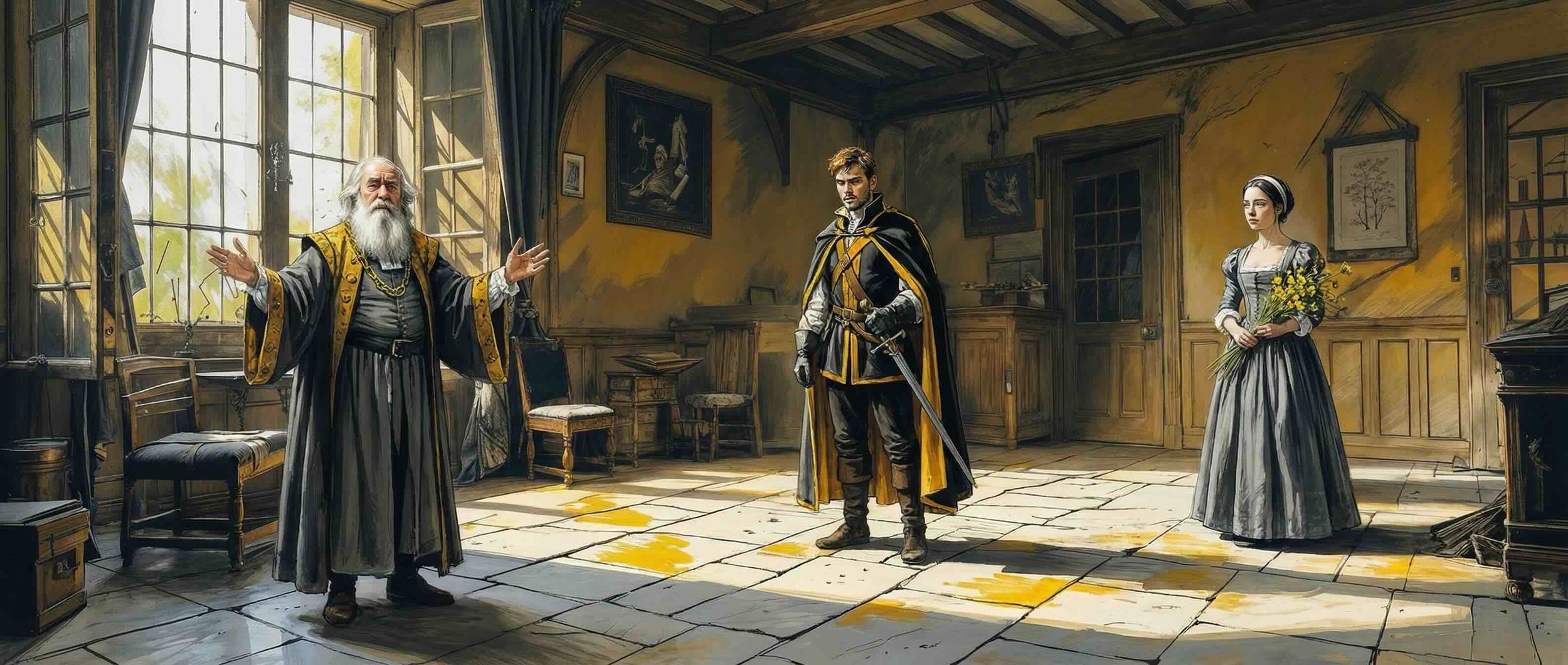
Scene Profile – At a Glance
- Location: A room in Polonius's house in Elsinore.
- What Happens: Laertes, leaving for France, warns his sister Ophelia not to trust Hamlet's love. Their father Polonius gives Laertes a long speech of advice, then orders Ophelia to stop seeing Hamlet altogether.
- Key Characters: Polonius, Laertes, Ophelia.
- Dramatic Function: The scene introduces Polonius's family, shows how the men control Ophelia, and casts doubt on Hamlet's courtship before we have seen it – setting up Ophelia's later tragedy.
- Famous Quote:
"This above all: to thine ownself be true..."
(Polonius, Act 1, Scene 3) - Why It Matters: It gives us the play's most quoted advice and its busiest talker, and it leaves Ophelia caught between her own feelings and her family's commands.
Scene Summary
As Laertes prepares to sail back to France, he says goodbye to his sister Ophelia and warns her about Hamlet. The prince may say he loves her, Laertes argues, but his feelings are likely to be a passing fancy, and in any case a prince cannot marry where he pleases. He urges her to guard her honour and keep her distance.
Ophelia agrees to take the advice to heart, but she answers back wittily, telling Laertes not to preach virtue to her while behaving badly himself in France. The exchange shows her to be clever and spirited, not a meek girl who simply obeys.
Their father Polonius arrives to send Laertes off and delivers a famous string of fatherly maxims about how to behave in the world. After Laertes leaves, Polonius turns to Ophelia and questions her about Hamlet. When she says Hamlet has courted her honourably, Polonius dismisses it as a trick, orders her to spend no more time with the prince, and Ophelia promises to obey.
Laertes Warns His Sister
Laertes loves Ophelia, but his advice is also a lesson in the world's hard rules for women. He tells her not to take Hamlet's attentions too seriously, picturing the prince's love as something sweet but short-lived.
Original
For Hamlet and the trifling of his favour,
Hold it a fashion and a toy in blood,
A violet in the youth of primy nature...
(Laertes, Act 1, Scene 3)
Shakespeare Retold (Modern Verse)
For Hamlet and his foolish faux affection,
Think of it as a passing amorous phase,
A springtime violet blooming whilst it's young...
The violet image is gentle but pointed: a flower that blooms early and fades fast. Laertes is telling Ophelia that Hamlet's love is real for now but will not last, and that the danger is all on her side. It is well-meant, but it treats Ophelia's heart as something to be defended rather than trusted, and it begins the scene's pattern of men deciding what Ophelia may feel and do.
Ophelia Answers Back
Ophelia listens, but she is no pushover. She gently warns Laertes not to be one of those preachers who points others to the hard road of virtue while taking the easy, pleasant road himself.
Original
Do not, as some ungracious pastors do,
Show me the steep and thorny way to heaven...
(Ophelia, Act 1, Scene 3)
Shakespeare Retold (Modern Verse)
Don't be like one of those immoral priests
Who preach the virtuous path to get to heaven...
This moment is important for how we read Ophelia's whole story. She is intelligent and capable of standing up for herself, which makes her later collapse into madness all the more tragic. She is not weak by nature; she is worn down by grief and by a world that gives her no real power. Here, for a moment, she has the wit and the spirit to push back.
"To Thine Ownself Be True"
Polonius arrives and unloads a stream of advice on the departing Laertes. The maxims are sensible, neat and endlessly quotable, and they climax in the play's most famous piece of wisdom.
Original
This above all: to thine ownself be true,
And it must follow, as the night the day,
Thou canst not then be false to any man.
(Polonius, Act 1, Scene 3)
Shakespeare Retold (Modern Verse)
But most of all: be true unto yourself,
And if you do, as night will follow day,
You can't be false to any other man.
Taken alone, it sounds like the noblest advice in the play. The catch is who says it. Polonius is a meddler who will soon set spies on this very son and use his daughter as bait to eavesdrop on Hamlet. The man preaching honesty to one's own self does not practise it. Shakespeare gives the best lines to a hypocrite on purpose, daring us to notice the gap between fine words and real conduct – the gap the whole play keeps exposing.
Language and Technique
- Extended metaphor: Laertes turns Hamlet's love into "a violet" that blooms early and dies, a flower image that quietly warns Ophelia it will not last.
- List of maxims: Polonius's advice piles up neat, balanced sayings, which makes him sound wise but also reveals a man in love with the sound of his own voice.
- Dramatic irony: "To thine ownself be true" rings hollow because we will watch Polonius behave dishonestly, so the audience catches a hypocrisy the speaker does not.
- Antithesis: Polonius advises in opposites – "rich, not gaudy", "Give every man thy ear, but few thy voice" – a tidy style that orders the world into easy rules.
- Imagery of trapping: Polonius calls Hamlet's vows "springes to catch woodcocks", picturing love as a hunter's snare and Ophelia as easy prey.
Key Quotes from Act 1, Scene 3
Quote 1See thou character. Give thy thoughts no tongue,
Nor any unproportioned thought his act.
(Polonius, Act 1, Scene 3)
Shakespeare Retold (Modern Verse)
About the rules of life. Don't share your thoughts,
Nor act out any inappropriate thoughts.
Give every man thy ear, but few thy voice;
Take each man's censure, but reserve thy judgment.
(Polonius, Act 1, Scene 3)
Shakespeare Retold (Modern Verse)
Listen to everyone, but speak to few;
Take everyone's advice but hold your own.
Neither a borrower nor a lender be;
For loan oft loses both itself and friend,
And borrowing dulls the edge of husbandry.
(Polonius, Act 1, Scene 3)
Shakespeare Retold (Modern Verse)
And never lend or borrow any money,
For you may lose the money and a friend,
And borrowing can blunt effectiveness.
Ay, springes to catch woodcocks.
(Polonius, Act 1, Scene 3)
Shakespeare Retold (Modern Verse)
Bah! They're just traps for stupid birds.
Key Takeaways
- Hamlet's love is questioned early: Both Laertes and Polonius warn Ophelia against it before we have seen the couple together.
- Ophelia is clever and spirited: She answers Laertes wittily, which makes her later breakdown more tragic.
- Polonius loves to advise: His maxims, ending in "to thine ownself be true", are wise-sounding but undercut by his own behaviour.
- Ophelia is controlled by men: Her brother and father both tell her what to feel and do, and she obeys her father's order to drop Hamlet.
- It sets up tragedy: Cutting Ophelia off from Hamlet helps push both towards the disasters to come.
Study Questions and Analysis
What advice does Laertes give Ophelia, and why?
Laertes warns Ophelia not to take Hamlet's love seriously. He argues that the prince's affection is youthful and temporary – "a violet" that blooms and fades – and that, as heir to the throne, Hamlet is not free to marry whomever he likes; his choice belongs to the state. He urges her to protect her "chaste treasure", her virginity and reputation, from Hamlet's persuasion.
The advice is partly loving and partly a lesson in the harsh realities facing a woman of her rank. In the world of the play, a woman's honour is fragile and easily lost, and the cost of a misjudged romance falls almost entirely on her. Laertes is protecting his sister, but he is also, like his father, assuming the right to manage her heart. His warning sets the tone for a scene in which Ophelia's own wishes count for very little.
How does Ophelia respond to her brother's lecture?
Ophelia takes the advice gracefully but turns it back on Laertes with a smile, reminding him not to be a hypocrite. She will guard her heart, she says, as long as he does not preach hard virtue to her while enjoying loose living himself in France.
Whiles, like a puffed and reckless libertine,
Himself the primrose path of dalliance treads...
(Ophelia, Act 1, Scene 3)
Shakespeare Retold (Modern Verse)
Whilst all the while philandering and letching
Along a path of sleaziness where you...
The "primrose path of dalliance" is the easy, flowery road of pleasure, set against the "steep and thorny way" of virtue. Ophelia's gentle teasing shows a sharp, independent mind. This matters enormously for the play: it proves that Ophelia begins as an intelligent young woman with a voice of her own, so that her descent into madness later is the breaking of a real person, not the fading of a faint one.
Is Polonius's advice to Laertes actually good advice?
Much of it is genuinely shrewd. Polonius tells Laertes to keep his own counsel, hold on to tested friends, avoid quarrels but stand firm once in them, dress well but not flashily, and avoid lending or borrowing money. As a guide to surviving in a competitive, watchful society, it is practical and well observed. Centuries of readers have quoted it because it works.
Costly thy habit as thy purse can buy,
But not expressed in fancy; rich, not gaudy;
For the apparel oft proclaims the man...
(Polonius, Act 1, Scene 3)
Shakespeare Retold (Modern Verse)
Dress in the finest clothes you can afford,
But don't be flashy – quality, not frills –
For clothes can be the marking of a man...
The problem is not the advice but the adviser. Polonius preaches honesty and self-knowledge, yet he spends the rest of the play scheming, spying and misreading people. "The apparel oft proclaims the man" is a telling choice from someone so concerned with surfaces. The scene therefore does two things at once: it gives us memorable wisdom and quietly warns us that the man dispensing it cannot live up to it.
How does this scene present the control of women?
Ophelia is surrounded by men who feel entitled to direct her life. Her brother lectures her on her love before he leaves, and her father then forbids her to see Hamlet at all, dismissing her own account of the courtship as naivety. At no point is Ophelia's judgement treated as enough; the decision is taken out of her hands.
This is central to the play's treatment of gender. Ophelia has feelings and intelligence, as her witty reply to Laertes shows, but she has almost no power. Obedience is expected, and she gives it – "I shall obey, my lord." Critics such as Elaine Showalter, in her influential 1985 essay Representing Ophelia, have argued that Ophelia is defined and confined by the men around her, so that her later madness becomes the only "language" left to a woman who has been denied a voice. This quiet scene of family advice is where that confinement begins.
What does "to thine own self be true" really mean here?
On the surface, Polonius is telling Laertes that if he stays true to his own nature and conscience, he will not be able to act falsely towards anyone else. It is a noble-sounding idea: honesty with yourself as the root of honesty with others. Lifted out of context, it has become one of the most quoted lines in English, often read as Shakespeare's own wisdom.
In the scene itself, though, the line is heavily ironic. It is spoken by a man who will shortly send a servant to spy on Laertes in France and who will use Ophelia to entrap Hamlet. Polonius does not know himself well, and he is rarely "true" to anyone. Shakespeare seems to be testing the audience: the advice is good, but the play asks whether the speaker has any right to give it, and whether fine maxims mean anything without the conduct to match. The gap between Polonius's words and his actions is itself part of the play's study of appearance and reality.
How does this scene prepare for Ophelia's later tragedy?
The scene plants the seeds of everything that destroys Ophelia. She is taught to distrust Hamlet's love and then ordered to break off contact with him, which leaves her isolated when Hamlet later turns on her. She is shown to be obedient to her father, so when Polonius later uses her as bait and is then killed by Hamlet, she is left torn between the two men she has been taught to obey, with no one to guide her.
Just as importantly, the scene establishes who Ophelia is before grief unmakes her: warm, witty and dutiful. By giving her real intelligence here, Shakespeare ensures that her breakdown in Act 4 lands as the loss of a whole person. Everything that happens to Ophelia flows from the powerlessness this scene quietly dramatises – a young woman whose feelings are overruled by the men who claim to love her.