Hamlet: Act 1, Scene 2 – Analysis
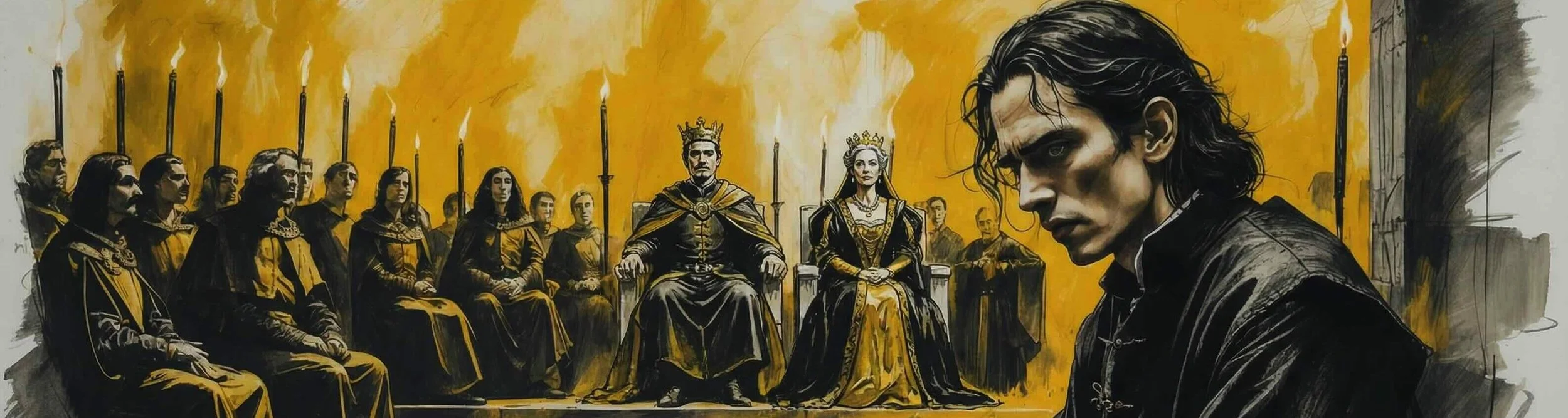
Scene Profile – At a Glance
- Location: A state room in Elsinore Castle, where the new king holds court.
- What Happens: Claudius addresses his court, handles the Norway threat, and lets Laertes leave for France. He and Gertrude urge Hamlet to stop mourning. Alone, Hamlet despairs in his first soliloquy, then Horatio arrives with news that the Ghost has appeared.
- Key Characters: Hamlet, Claudius, Gertrude, Horatio, with Laertes and Polonius.
- Dramatic Function: The scene introduces the court, the marriage of Claudius and Gertrude, and Hamlet's grief and disgust. It gives us our first real sight of the hero and sends him towards the Ghost.
- Famous Quote:
"Frailty, thy name is woman!"
(Hamlet, Act 1, Scene 2) - Why It Matters: Hamlet's first soliloquy reveals a man sick with grief and revolted by his mother's remarriage, weeks before he learns of any murder. It explains the despair he carries through the play.
Scene Summary
The scene moves from the cold battlements to the bright, crowded court of the new king. Claudius opens by acknowledging the death of his brother, old King Hamlet, and then explaining that he has married the widowed queen, Gertrude. He deals briskly with affairs of state, sending ambassadors to deal with young Fortinbras of Norway and graciously allowing Laertes to return to France.
Claudius and Gertrude then turn to Hamlet, who stands apart in mourning black. They tell him his grief has gone on too long and ask him to stay in Denmark rather than return to university at Wittenberg. Hamlet agrees to stay, but coldly. He insists that his grief is real, not a show put on for others.
Left alone, Hamlet pours out his despair in the play's first great soliloquy. He longs for death, rages at how quickly his mother remarried, and condemns the whole world as rotten and worthless. His grief is bound up with disgust at the marriage, which he sees as shamefully hasty and even incestuous.
Then Horatio arrives with Marcellus and Bernardo to tell Hamlet that a Ghost resembling his dead father has appeared on the battlements. Hamlet, suddenly alert, questions them closely and arranges to join the watch that night. Alone again, he senses "foul play" and waits, uneasy, for darkness.
A Court That Will Not Mourn
Claudius is a smooth, capable politician. In a single polished speech he buries his brother, justifies marrying his brother's widow, and gets the business of the state moving. The court goes along with all of it. When he turns to Hamlet, he and Gertrude treat the prince's grief as a problem to be managed rather than a wound to be shared.
Original
In obstinate condolement is a course
Of impious stubbornness; 'tis unmanly grief...
(Claudius, Act 1, Scene 2)
Shakespeare Retold (Modern Verse)
In bloody-minded mourning is a path
Pigheadedly ungodly; not man's grief...
Claudius calls Hamlet's mourning "unmanly" and against heaven, pressing him to move on. There is something chilling in it: the man who tells Hamlet to stop grieving is the one who, we will learn, caused the grief. The whole court is happy to forget the dead king, and Hamlet's refusal to forget sets him apart from everyone around him from the very start.
"I Know Not 'Seems'"
When Gertrude asks why his father's death "seems" to hit him so hard, Hamlet seizes on the word. He will not be told that his grief is a performance. His reply launches one of the play's deepest themes: the gap between how things look and how they really are.
Original
But I have that within which passeth show;
These but the trappings and the suits of woe.
(Hamlet, Act 1, Scene 2)
Shakespeare Retold (Modern Verse)
But I've within me grief you cannot see;
My clothes and actions aren't the all of me.
Hamlet says he "knows not 'seems'": his black clothes and sighs are only outward signs, while his real grief lies "within" where no one can see it. In a court built on appearances – on a king who smiles while hiding a crime – Hamlet stakes his claim to be the one person who is exactly what he appears. The irony is that to survive this court, he will soon have to start "seeming" too, putting on an "antic disposition".
"O, That This Too Too Solid Flesh"
The court empties, and for the first time Hamlet is alone with us. The polished, careful prince drops away, and out pours raw despair. He wishes his body would simply melt, and admits he would kill himself if God had not forbidden it.
Original
O, that this too too solid flesh would melt
Thaw and resolve itself into a dew!
(Hamlet, Act 1, Scene 2)
Shakespeare Retold (Modern Verse)
I wish my tarnished body would dissolve
Into a liquid, like a morning dew!
This is suicidal despair, and it comes before Hamlet knows anything about a murder. His grief alone, sharpened by the hasty marriage, has already made the world feel "weary, stale, flat and unprofitable". The soliloquy lets the audience inside Hamlet's mind and shows that his sorrow is genuine and dangerous. Everything the Ghost is about to tell him lands on a man already at the edge.
"Frailty, Thy Name Is Woman"
What disgusts Hamlet most is not simply that his father is dead but that his mother remarried so fast, and to his uncle. He measures the speed of it in bitter, exact terms, and his revulsion spills out into a sweeping attack on women in general.
Original
Thrift, thrift, Horatio! the funeral baked meats
Did coldly furnish forth the marriage tables.
(Hamlet, Act 1, Scene 2)
Shakespeare Retold (Modern Verse)
It was a bargain, for the funeral meats
Were then reused upon the marriage tables.
The joke is savage: the leftovers from the funeral were served cold at the wedding feast. To Hamlet, the marriage is not love but indecent haste, and because Gertrude has married her dead husband's brother, he feels it as something close to incest. His cry "Frailty, thy name is woman!" turns private hurt into a harsh general verdict, and it poisons his view of women – including Ophelia – for the rest of the play.
Language and Technique
- Soliloquy: Alone on stage, Hamlet speaks his real thoughts directly to us, so we trust his grief far more than the smooth public speeches around him.
- Antithesis: Claudius pairs opposites – "mirth in funeral", "dirge in marriage" – to make a shocking marriage sound balanced and reasonable.
- Wordplay on "seems": Hamlet splits "seems" from "is" to attack a court that runs on appearances, opening the play's appearance-versus-reality theme.
- Classical allusion: Calling his father "Hyperion" (the sun god) and Claudius "a satyr" (a crude half-beast) turns the comparison of the two men into an image of light against filth.
- Imagery of rot: The world as an "unweeded garden" gone to seed pictures Denmark, and Hamlet's own mind, as something fertile turned diseased.
Key Quotes from Act 1, Scene 2
Quote 1A little more than kin, and less than kind.
(Hamlet, Act 1, Scene 2)
Shakespeare Retold (Modern Verse)
Freshly related, not related well.
How weary, stale, flat and unprofitable,
Seem to me all the uses of this world!
(Hamlet, Act 1, Scene 2)
Shakespeare Retold (Modern Verse)
I feel so tired and useless. What's the point
Of anything there is within this world?
Fie on't! Ah fie! 'Tis an unweeded garden,
That grows to seed; things rank and gross in nature
Possess it merely.
(Hamlet, Act 1, Scene 2)
Shakespeare Retold (Modern Verse)
Damn it! Oh, damn! It's a neglected garden,
Once planted, but now overrun with weeds,
Destroying what it was.
In my mind's eye, Horatio.
(Hamlet, Act 1, Scene 2)
Shakespeare Retold (Modern Verse)
In my mind's eye, Horatio.
He was a man, take him for all in all,
I shall not look upon his like again.
(Hamlet, Act 1, Scene 2)
Shakespeare Retold (Modern Verse)
He was a perfect man in every way;
I'll never see the likes of him again.
Key Takeaways
- Claudius is a skilled politician: He calmly justifies his brother's burial and his hasty marriage, and the court accepts it.
- Hamlet stands apart: In mourning black, he insists his grief is real, not a show – "I know not 'seems'".
- The first soliloquy reveals despair: Hamlet longs for death and finds the world worthless, before he knows of any murder.
- The marriage disgusts him: Its speed, and the fact that Gertrude married her brother-in-law, feels to Hamlet like betrayal and incest.
- The Ghost summons him: Horatio's news turns Hamlet's grief towards suspicion of "foul play".
Study Questions and Analysis
How does Claudius present himself to the court in this scene?
Claudius is shown as an able and confident ruler. His opening speech is a masterclass in political balance: he mourns his brother and celebrates his marriage in the same breath, pairing "mirth in funeral" with "dirge in marriage" so that a shocking situation sounds measured and proper. He then deals efficiently with the Norway crisis and grants Laertes his request, looking every inch the competent king.
But the polish is part of the point. Where Hamlet's grief is private and genuine, Claudius's eloquence is public and managed, and the contrast plants an early doubt about him. Many critics note that Claudius is one of Shakespeare's most plausible villains precisely because he is so reasonable on the surface. A. C. Bradley, in his 1904 Shakespearean Tragedy, observed that Claudius is no melodramatic monster but a capable man whose smooth competence masks his guilt, which makes him far more dangerous.
What does Hamlet mean when he says "I know not 'seems'"?
Gertrude asks why his father's death "seems" to weigh so heavily on him, and Hamlet pounces on the word. He insists that his mourning is not a "seeming" at all – not a costume of black clothes and forced sighs that "a man might play" – but a true feeling "within" him that no outward sign can fully show. He is drawing a sharp line between appearance and reality and placing himself firmly on the side of what is real.
The moment matters because it states one of the play's central concerns. Elsinore is a world of surfaces, where a murderer wears a crown and a smile. Hamlet alone claims to be exactly what he appears. The deep irony, which the rest of the play develops, is that to outwit this false court Hamlet will himself have to put on a mask, pretending to be mad while his real thoughts stay hidden "within".
What does Hamlet's first soliloquy tell us about his state of mind?
The soliloquy reveals a man in deep depression and even suicidal despair. Hamlet wishes his "too too solid flesh" would melt away, and says openly that he would end his life if God had not forbidden it. The world has become "weary, stale, flat and unprofitable", an "unweeded garden" overgrown with rot. This is the real Hamlet, dropped from public view, and it is bleak.
Crucially, all of this comes before the Ghost's revelation. Hamlet is already broken by grief and by his mother's remarriage; he has no thought of revenge yet. Understanding this is key to the whole play, because the man asked to act decisively is one who can barely bear to be alive. T. S. Eliot, in his 1919 essay Hamlet and His Problems, controversially argued that Hamlet's emotions are larger than anything the plot gives him to feel, a mismatch he called the absence of an "objective correlative". Whether or not we accept Eliot's verdict, the soliloquy shows feelings so overwhelming that they seem to exceed their immediate cause.
Why is Hamlet so disgusted by his mother's remarriage?
Hamlet's revulsion has several layers. First is the sheer speed: his mother married "within a month" of the funeral, before, he says, the shoes she wore to it were old. Second is the partner: she has married her dead husband's brother, which by the thinking of the time counted as incest. Third is the comparison between the two men, which to Hamlet is the difference between a god and a beast.
So excellent a king; that was, to this,
Hyperion to a satyr; so loving to my mother
That he might not beteem the winds of heaven
Visit her face too roughly.
(Hamlet, Act 1, Scene 2)
Shakespeare Retold (Modern Verse)
He was a perfect king: compared to now,
A God, and not a fraud. He loved my mother
So much he wouldn't let the winds of heaven
Blow like the Mistral on her face.
The remarriage poisons Hamlet's view of his mother and, through her, of women in general – "Frailty, thy name is woman!" This bitterness will later fall cruelly on Ophelia, who has done nothing to deserve it. Many critics, following Ernest Jones's Freudian reading in Hamlet and Oedipus (1949), have seen something disturbed and excessive in Hamlet's fixation on his mother's bed, while others read it simply as a grieving son's horror at being so quickly forgotten. The play leaves room for both.
What is the significance of comparing his father to "Hyperion" and Claudius to "a satyr"?
The contrast is built from classical mythology. Hyperion is a sun-god, radiant and noble, while a satyr is a lustful, half-animal creature of the woods. By setting one against the other, Hamlet turns the comparison of his father and uncle into an image of pure light against gross appetite. His father was divine; Claudius is a beast driven by desire.
The image does more than insult Claudius. It shows how Hamlet's mind works in extremes – idealising the dead and loathing the living – and it begins the play's pattern of imagining corruption as something bestial and physical. It also raises a quiet question about Hamlet's reliability as a witness: no real man is wholly a sun-god, and the gap between his worship of his father and the truth will trouble readers who suspect Hamlet half-creates the perfect father he needs to avenge.
How does the news of the Ghost change the direction of the scene?
For most of the scene Hamlet is passive, sunk in grief with nowhere for his feelings to go. Horatio's report transforms him in an instant. He grows sharp and practical, questioning the witnesses about the Ghost's armour, its expression, how long it stayed. The grieving son becomes, briefly, an investigator. The news gives his pain a direction and a possible cause.
Till then sit still, my soul: foul deeds will rise,
Though all the earth o'erwhelm them, to men's eyes.
(Hamlet, Act 1, Scene 2)
Shakespeare Retold (Modern Verse)
But now, keep calm: foul deeds will be revealed,
Though others cower, I'll keep my own eyes peeled.
Already Hamlet suspects "foul play", before the Ghost has told him anything. The rhyming couplet that closes the scene gives his suspicion a grim confidence: hidden crimes will surface in the end. The scene therefore turns from mourning to mystery, and sends Hamlet towards the night-time meeting that will set the whole tragedy in motion.
How does this scene develop the theme of appearance versus reality?
The theme runs through the whole scene. Claudius's court looks orderly and happy, but it is built on a death barely cold and a marriage many would find improper. Claudius himself is all smooth surface, the smiling face over a secret we do not yet fully know. Against this, Hamlet sets his insistence on inner truth, refusing to let his grief be reduced to the outward "trappings and the suits of woe".
The irony the play will explore is that Hamlet cannot stay on the side of pure honesty. To act against a deceitful court, he will soon adopt a deceit of his own, the feigned madness or "antic disposition". This scene plants the contrast – honest grief against false show – that the rest of the tragedy complicates, until almost every character is watching, spying on or performing for the others. The opening question of who and what is real, raised on the battlements, deepens here into a court where nothing can be taken at face value.