Hamlet: Act 1, Scene 1 – Analysis
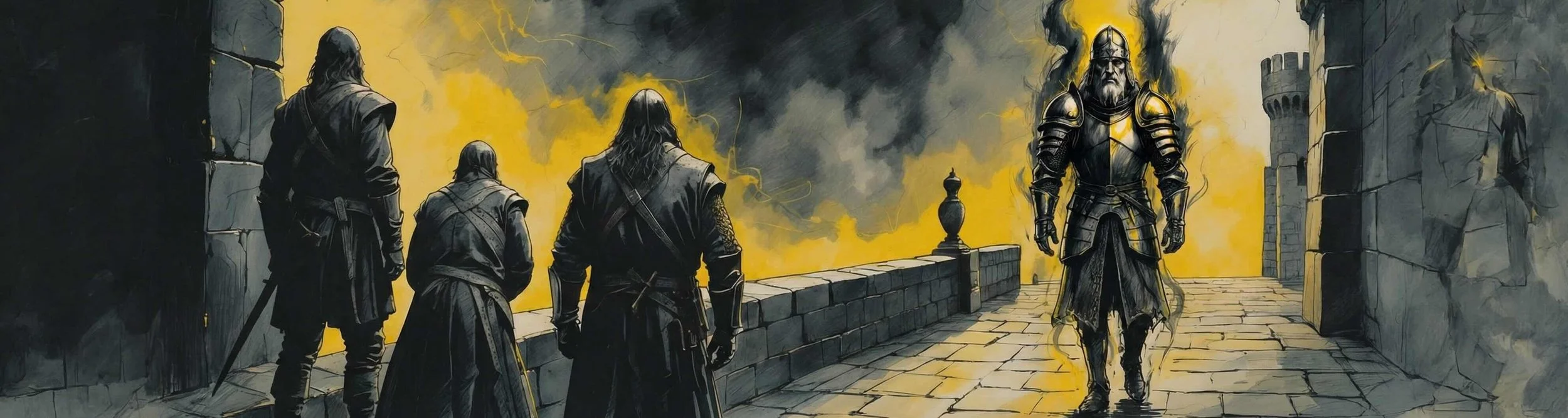
Scene Profile – At a Glance
- Location: A guard platform on the walls of Elsinore Castle, at midnight.
- What Happens: Two guards and the scholar Horatio keep watch and twice see a Ghost that looks exactly like the dead King Hamlet. Horatio explains the threat from young Fortinbras of Norway, and they agree to tell Prince Hamlet about the Ghost.
- Key Characters: Horatio, the Ghost, and the watchmen Bernardo, Francisco and Marcellus.
- Dramatic Function: The opening scene sets a mood of cold dread, introduces the Ghost that drives the whole plot, and tells us Denmark is uneasy and arming for war.
- Famous Quote:
"But, look, the morn, in russet mantle clad,
Walks o'er the dew of yon high eastward hill..."
(Horatio, Act 1, Scene 1) - Why It Matters: Everything that follows begins here. The Ghost's silent appearance raises the questions of revenge, truth and the afterlife that the rest of the play will wrestle with.
Scene Summary
It is midnight on the freezing battlements of Elsinore. The guard Bernardo arrives to relieve Francisco, and the very first words of the play are a nervous challenge in the dark: "Who's there?" Francisco is glad to go – he is cold and, he says, "sick at heart". Bernardo is joined by another soldier, Marcellus, and by Horatio, a scholar who has come because he does not believe the soldiers' story that a ghost has appeared two nights running.
As they talk, the Ghost appears, looking exactly like the recently dead King Hamlet in his armour. Marcellus urges Horatio, as an educated man, to speak to it. Horatio challenges the figure to explain itself, but the Ghost is offended and stalks away without a word. Shaken, Horatio admits that he would never have believed it without the proof of his own eyes.
Horatio then explains why Denmark is on edge. The dead King Hamlet once killed King Fortinbras of Norway in single combat and won his lands. Now young Fortinbras, the dead king's son, has gathered a band of desperate men to win those lands back by force, which is why the guards are working day and night to prepare for war. Horatio fears the Ghost is a warning that the state is heading for trouble.
The Ghost returns, and Horatio begs it to speak, but a cock crows and it vanishes again. The men discuss the old belief that spirits flee at dawn, and that no ghost dares walk during the holy Christmas season. As the sun rises, they agree the Ghost will surely speak to Prince Hamlet, the dead king's son, and they set off to find him.
"Who's There?" – A World of Cold and Fear
The play opens not with a king or a hero but with a frightened sentry calling into the dark. That first line, "Who's there?", is the question the whole play will keep asking – about the Ghost, about Claudius, about Hamlet himself. From the start, nobody is quite sure what is real or who can be trusted. The setting does the rest of the work: it is midnight, it is bitterly cold, and the soldiers are jumpy.
Original
For this relief much thanks: 'tis bitter cold,
And I am sick at heart.
(Francisco, Act 1, Scene 1)
Shakespeare Retold (Modern Verse)
My thanks for swapping; it is freezing here,
And I have lost the will to live.
Francisco cannot say why he feels so low, and that vague unease is the point. Shakespeare soaks the opening in a sense that something is wrong before we are told anything is wrong. The cold, the darkness and the changing of the guard create a world in which a dead king might well walk – and in which the living feel watched.
The Ghost and the Sceptic
Horatio is the play's reliable witness. He is a scholar who has come precisely because he doubts, so when even he is convinced, the audience is convinced too. When the Ghost appears in the old king's armour, Marcellus pushes Horatio forward to address it, and Horatio rises to a formal, fearless challenge.
Original
What art thou that usurp'st this time of night,
Together with that fair and warlike form
In which the majesty of buried Denmark
Did sometimes march? By heaven I charge thee, speak!
(Horatio, Act 1, Scene 1)
Shakespeare Retold (Modern Verse)
What are you, in this dreadful hour of night,
In splendid military regalia
Worn by the now departed King of Denmark
In battle sometimes? Speak up, I say! Speak!
The word "usurp'st" is loaded. Horatio accuses the Ghost of stealing the night and the dead king's shape, and the idea of usurping – taking what is not yours – will haunt the whole play, because Claudius has usurped the throne. The Ghost will not answer to a challenge; it has come for one person only, and it is not Horatio. Its refusal to speak builds the suspense that drives Hamlet to the walls in the scenes to come.
A State on a War Footing
Before the supernatural takes over, Shakespeare grounds the scene in hard politics. Horatio explains the long-running quarrel with Norway and the reason the guards labour through every night. Denmark, we learn, is not a settled kingdom but one bracing for invasion.
Original
But in the gross and scope of my opinion,
This bodes some strange eruption to our state.
(Horatio, Act 1, Scene 1)
Shakespeare Retold (Modern Verse)
But, honestly, in my humble opinion,
I fear our country's on the edge of turmoil.
"Eruption" is the key word, and it carries the play's recurring image of Denmark as a body that is diseased and about to burst. The Ghost is read at once as a political omen, a sign that something has gone wrong at the very top of the state. The audience does not yet know that the rot is Claudius's crime, but the language is already pointing to a sickness in the kingdom.
Omens, the Cock-Crow and the Coming Dawn
Horatio reaches for history to make sense of what they have seen, comparing the Ghost to the strange events that warned Rome of Julius Caesar's death. It is the moment the scene widens from one castle to the whole sweep of fate and disaster.
Original
In the most high and palmy state of Rome,
A little ere the mightiest Julius fell,
The graves stood tenantless and the sheeted dead
Did squeak and gibber in the Roman streets...
(Horatio, Act 1, Scene 1)
Shakespeare Retold (Modern Verse)
Back in the booming, balmy days of Rome,
Not long before the Emperor Caesar's death,
The dead rose – zombie-like – from buried graves
And squealed and groaned throughout the Roman streets...
When the Ghost reappears, Horatio begs it to speak, but the cock crows and it flees. The men turn the moment over: a spirit, they believe, must return to its "confine" at dawn. The scene ends with one of Shakespeare's loveliest dawn images, the morning "in russet mantle clad", and a decision – the Ghost would not speak to them, so they will fetch the one person it may have come for, young Hamlet.
Language and Technique
- Opening with a question: "Who's there?" plants uncertainty in the very first line, setting up a play obsessed with what is real and who can be trusted.
- Pathetic fallacy: The "bitter cold" and the dark midnight setting mirror the characters' fear, so the weather itself feels uneasy.
- Disease imagery: Words like "eruption" picture Denmark as a sick body, the first hint of the rot that runs through the play.
- Classical allusion: The comparison to ghosts in Rome before Caesar's murder lifts a local haunting into a grand omen of national disaster.
- Stichomythia: The quick, clipped exchanges between the frightened guards ("'Tis here!" "'Tis here!" "'Tis gone!") speed up the rhythm and crank up the tension.
Key Quotes from Act 1, Scene 1
Quote 1Most like: it harrows me with fear and wonder.
(Horatio, Act 1, Scene 1)
Shakespeare Retold (Modern Verse)
It's just like him. I'm terrified but stunned!
Thou art a scholar; speak to it, Horatio.
(Marcellus, Act 1, Scene 1)
Shakespeare Retold (Modern Verse)
You're brainy – speak to it, Horatio!
And then it started like a guilty thing
Upon a fearful summons.
(Horatio, Act 1, Scene 1)
Shakespeare Retold (Modern Verse)
And when it did, it quickly slunk away
Appearing panic-stricken.
Some say that ever 'gainst that season comes
Wherein our Saviour's birth is celebrated,
The bird of dawning singeth all night long...
(Marcellus, Act 1, Scene 1)
Shakespeare Retold (Modern Verse)
Some say that when the yuletide is approaching,
Whereby we celebrate Lord Jesus' birth,
The morning rooster crows from dusk till dawn...
Key Takeaways
- The play opens in fear: A midnight watch, bitter cold and a nervous "Who's there?" set a mood of dread from the first line.
- The Ghost starts everything: A silent figure of the dead king appears twice, but will not speak to the guards.
- Horatio is the trusted witness: A scholar who came to doubt is convinced, so we believe the Ghost is real.
- Denmark is on edge: The country is arming against young Fortinbras of Norway, so the haunting feels political as well as personal.
- It all points to Hamlet: The Ghost will not talk to the watch, so they resolve to bring the prince – setting up the next scenes.
Study Questions and Analysis
Why does Shakespeare open the play with the guards rather than the main characters?
Starting with two ordinary soldiers on a freezing battlement is a deliberate piece of stagecraft. It lets Shakespeare build atmosphere and suspense before any of the great figures appear, so that when the court finally assembles in the next scene we already sense that something is wrong beneath the surface. The guards are also neutral witnesses: they have no reason to lie, so their terror gives the Ghost instant credibility.
The opening also introduces the play's central mood of watchfulness and doubt. From the first challenge in the dark, characters are trying to identify who and what they are dealing with. Stephen Greenblatt, in Hamlet in Purgatory (2001), shows how carefully Shakespeare stages the Ghost so that the audience shares the guards' uncertainty about what it is and where it has come from. By the time Hamlet meets the Ghost himself, the groundwork of fear and mystery has already been laid by these minor figures.
Why is it important that Horatio is a sceptic?
Horatio arrives as the doubter. The soldiers half expect him to laugh at their story, and he says plainly that the Ghost is "but our fantasy". This matters because it means the play does not simply ask us to take a ghost on trust; it dramatises the very process of being convinced, through the eyes of an educated, reasonable man.
Before my God, I might not this believe
Without the sensible and true avouch
Of mine own eyes.
(Horatio, Act 1, Scene 1)
Shakespeare Retold (Modern Verse)
I swear to God, I never would believe this
Without the concrete proof and confirmation
Of my own eyes.
By insisting that he needed the "true avouch" of his own eyes, Horatio models the audience's own journey from doubt to belief. It also establishes him as the play's most trustworthy character: the one whose word we can rely on. That is why, at the very end of the tragedy, it is Horatio who is asked to live on and tell Hamlet's story truly – a role this first scene quietly prepares.
What does the Fortinbras backstory add to the scene?
Horatio's long explanation of the quarrel with Norway can seem like a digression, but it does two important jobs. First, it grounds the supernatural in real politics: the Ghost is not just a private family matter but a sign troubling a whole nation that is preparing for war. Second, it introduces young Fortinbras, a son seeking to avenge his father and recover his lost lands.
That detail plants the play's structure of fathers and avenging sons. Fortinbras acts where Hamlet hesitates, and the contrast runs through the entire tragedy until Fortinbras finally inherits Denmark in the last scene. By raising him here, in the opening minutes, Shakespeare frames Hamlet's coming struggle with revenge against a young man who simply gets on with it.
What is the significance of the Ghost wearing armour?
The Ghost appears not in royal robes but in the "fair and warlike form" of the armour the old king wore when he fought Norway. The detail links the supernatural directly to the political threat Horatio describes: the dead warrior-king returns just as his old enemy's son comes hunting for revenge. The armour makes the Ghost a figure of war and unfinished business.
It also raises a question the play never fully settles. A spirit dressed for battle suggests violence and grievance rather than peace, which feeds the suspicion that this Ghost wants vengeance. A. C. Bradley, in his 1904 Shakespearean Tragedy, treats the Ghost as a genuine and majestic presence rather than a delusion, but later critics have stressed how its martial, restless appearance keeps the audience uneasy about its true nature and its demands.
How does the language create a mood of dread?
The atmosphere is built from small, concrete details rather than grand statements. The "bitter cold", the midnight setting, the nervous half-line challenges and the careful listening for sounds all combine to make the audience as jumpy as the guards. The verse is broken into short, anxious exchanges that quicken when the Ghost appears.
Shakespeare also widens the dread outward through imagery of disease and disaster – the "eruption" in the state, the dead walking in Rome before Caesar's fall. These references turn a local haunting into a sign of something rotten and dangerous on a national scale. The technique is to let the language do the frightening, so that the Ghost feels like the symptom of a deeper sickness rather than a simple scare.
Why does the Ghost refuse to speak?
The Ghost appears twice and is challenged twice, but it will not answer the guards or Horatio. Dramatically, this silence is brilliant: it creates a mystery that can only be solved by bringing in Hamlet, which is exactly where the plot needs to go. A talking ghost in the first scene would give the game away; a silent one forces the prince onto the walls.
Within the world of the play, there were also old beliefs that a spirit would only speak to the person it had come for, or to one with the standing to hear it. Horatio guesses as much when he says the Ghost, "dumb to us, will speak to him". The refusal therefore deepens the sense that the Ghost has a specific, personal mission – a private message for a son about a father – that the audience is desperate to hear.
How does this scene set up the themes of the whole play?
For a scene with no main characters, the opening introduces a remarkable amount. The question "Who's there?" launches the play's obsession with appearance and reality – with telling truth from disguise, honest men from false ones. The "eruption to our state" begins the running idea that Denmark is diseased and corrupt. And the Ghost itself raises the questions of death, the afterlife and revenge that the tragedy will never stop circling.
Above all, the scene establishes uncertainty as the play's natural condition. Nobody on the battlements can be sure what the Ghost is, what it wants, or whether it should be trusted. Stephen Greenblatt, in Hamlet in Purgatory (2001), argues that this doubt about the Ghost's origin – heavenly, hellish, or a soul from Purgatory – is built into the play from the start and is never cleanly resolved. The first scene hands the audience that doubt and never quite takes it away.