Julius Caesar: Act 1, Scene 3 – Analysis
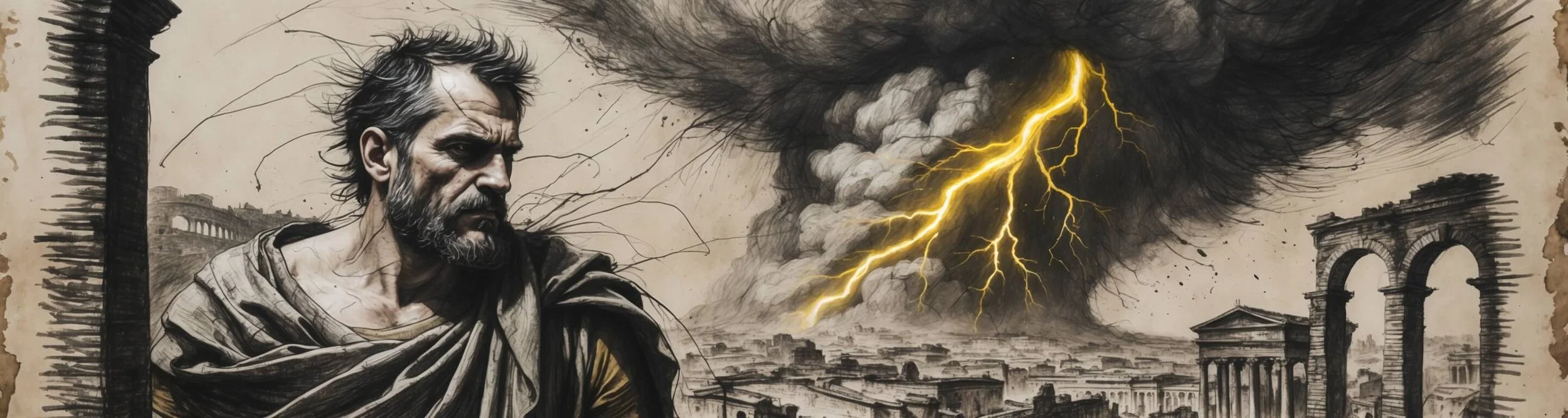
Scene Profile – At a Glance
- Location: A street in Rome, at night, during a violent storm.
- What Happens: Casca describes terrifying omens to Cicero. Cassius then interprets the storm as a warning about Caesar, recruits Casca to the conspiracy, and sets in motion a plan to win over Brutus.
- Key Characters: Cassius, Casca, Cicero, and Cinna.
- Dramatic Function: The storm sets a mood of cosmic disorder and the conspiracy takes firm shape, gathering members and turning towards Brutus.
- Famous Quote:
"But men may construe things after their fashion,
Clean from the purpose of the things themselves."
(Cicero, Act 1, Scene 3) - Why It Matters: It shows how the conspirators read the world to suit their purpose, and ends with the plot reaching for the one man who can make it respectable: Brutus.
Scene Summary
It is the night before the ides of March, and Rome is shaken by a supernatural storm. Casca, his sword still drawn, meets Cicero in the street and pours out a list of horrors he has witnessed: fire falling from the sky, a slave whose hand burned without being scorched, a lion loose by the Capitol, and an owl shrieking at midday. He is convinced these are warnings of disaster. Cicero replies calmly that men tend to interpret strange events to fit their own ideas, then goes home.
Cassius enters, walking openly through the storm with his coat unbuttoned, almost daring the lightning to strike him. Where Casca is frightened, Cassius is exhilarated. He argues that the storm is a sign sent by heaven to warn Rome about a man who has grown "prodigious" and dangerous – meaning Caesar – and he rages that Romans have become as weak as women, willing to suffer tyranny.
When Casca reports a rumour that the senators mean to crown Caesar king the next day, Cassius declares he would rather die than live as a slave, and Casca, won over, clasps his hand and joins the conspiracy. Cassius reveals that he has already recruited several noble Romans, who are waiting at Pompey's porch.
Cinna arrives, and Cassius gives him forged letters to plant where Brutus will find them – on the praetor's chair, through his window, on the statue of his ancestor. The scene ends with Cassius and Casca setting off to visit Brutus before dawn, confident that "three parts of him" are already theirs.
A Night Full of Portents
Shakespeare opens the scene with the natural world in uproar. Casca, normally dry and sceptical, is genuinely terrified, and his fear is the first sign of how far ordinary order has broken down. He has lived through storms before, he says, but never anything like this.
Original
But never till to-night, never till now,
Did I go through a tempest dropping fire.
(Casca, Act 1, Scene 3)
Shakespeare Retold (Modern Verse)
But not before tonight, never before,
Have I been in a storm that's spitting fire.
The storm is more than spectacle. In Shakespeare, disorder in nature usually mirrors disorder in the state, and a sky "dropping fire" tells the audience that something is badly wrong in Rome. The omens Casca lists – fire, a burning hand, a lion, a daytime owl – all break the natural order, just as the murder of Caesar will break the political order. The scene makes us feel the coming crime as a kind of unnatural event before anyone has lifted a knife.
Cassius Reads the Storm
Cassius takes the same terrifying night and turns it to his own use. Far from fearing the storm, he has been walking bare-chested in it, and he scolds Casca for being frightened. Then he gives the omens a political meaning, telling Casca that he could name a man who is as monstrous and threatening as the night itself.
Original
Now could I, Casca, name to thee a man
Most like this dreadful night,
That thunders, lightens, opens graves, and roars
As doth the lion in the Capitol,...
(Cassius, Act 1, Scene 3)
Shakespeare Retold (Modern Verse)
Now, Casca, I could tell you of a man
Who's like this dreadful night,
A thunderstorm, he opens graves and roars
Just like the lion in the Capitol;...
This is Cassius at his most cunning. He never names Caesar – he lets Casca do that – but he steers the whole conversation until the storm seems to be about one man's dangerous rise. It is the same technique he used on Brutus: shape the evidence so the listener reaches the desired conclusion himself. Cicero's warning that men "construe things after their fashion" is proved almost at once, as Cassius bends a thunderstorm into an argument for murder.
From Omens to Conspiracy
Having frightened and flattered Casca, Cassius moves to recruitment. He blames Caesar's rise not on Caesar but on the Romans who allow it, in an image that puts the shame squarely on his fellow citizens.
Original
Poor man! I know he would not be a wolf,
But that he sees the Romans are but sheep:
He were no lion, were not Romans hinds.
(Cassius, Act 1, Scene 3)
Shakespeare Retold (Modern Verse)
Poor man, he wouldn't have become a wolf
If all the Romans hadn't turned to sheep;
He'd be no lion if we were not prey.
The wolf-and-sheep image is Cassius's sharpest piece of persuasion. By arguing that Caesar is only a predator because Rome has become prey, he makes resistance sound like manliness and self-respect rather than treason. It works: Casca grips his hand and pledges himself to the cause. The scene then turns practical, with forged letters and a meeting place, and by its close the conspiracy has both members and a target – the noble Brutus, whose good name will make the killing look like patriotism.
Language and Technique
- Pathetic fallacy: The raging storm mirrors the political turmoil to come – nature itself seems disturbed by the plot against Caesar.
- Listing of omens: Casca piles up unnatural sights (fire, a burning hand, a lion, an owl at noon) to build a sense of mounting dread.
- Animal imagery: Cassius's wolf, sheep, lion, and "hinds" reduce Roman politics to predator and prey, shaming the citizens into action.
- Dramatic irony: Cicero's remark that men "construe things after their fashion" is immediately demonstrated by Cassius's self-serving reading of the storm.
- Imagery of bondage: Cassius's talk of daggers, dungeons, and chains frames the conspiracy as a fight for freedom against slavery.
Key Quotes from Act 1, Scene 3
Quote 1A common slave – you know him well by sight –
Held up his left hand, which did flame and burn
Like twenty torches joined, and yet his hand,
Not sensible of fire, remained unscorched.
(Casca, Act 1, Scene 3)
Shakespeare Retold (Modern Verse)
A common slave – you'd know him if you saw him –
Held up his left hand, which was burning brightly,
Like twenty flares together, though his hand,
Unsensitive to fire, remained unburnt.
But, woe the while! Our fathers' minds are dead,
And we are governed with our mothers' spirits;
Our yoke and sufferance show us womanish.
(Cassius, Act 1, Scene 3)
Shakespeare Retold (Modern Verse)
But, sadly, lack the spirit that they showed.
We're governed by a female intuition.
We suffer tyranny like women do.
Nor stony tower, nor walls of beaten brass,
Nor airless dungeon, nor strong links of iron,
Can be retentive to the strength of spirit;
But life, being weary of these worldly bars,
Never lacks power to dismiss itself.
(Cassius, Act 1, Scene 3)
Shakespeare Retold (Modern Verse)
Neither a tower of stone nor walls of brass,
A dungeon without air, nor iron shackles
Can ever hold the strength of spirit back;
But living people, locked in prison cells,
Will always have the power to kill themselves.
See Brutus at his house: three parts of him
Is ours already, and the man entire
Upon the next encounter yields him ours.
(Cassius, Act 1, Scene 3)
Shakespeare Retold (Modern Verse)
See Brutus at his house. Three quarters of him
Is now aligned with us; the rest of him
Will be so following our next encounter.
Key Takeaways
- The storm mirrors the state: Unnatural omens signal that the murder of Caesar will break the natural and political order.
- Cassius interprets to persuade: He reads the storm as a warning about Caesar, proving Cicero's point that men construe events to suit themselves.
- Manhood as a weapon: Cassius shames Romans as "womanish" to push them towards resistance.
- The conspiracy grows: Casca joins, other nobles are already recruited, and forged letters are planted to deceive Brutus.
- Brutus is the prize: The plot turns on winning Brutus, whose reputation can make assassination look like patriotism.
Study Questions and Analysis
What do the storm and omens represent?
The storm is Shakespeare's way of signalling that the natural order is about to be violated. Throughout his plays, upheaval in the heavens accompanies upheaval in the state, and here the fire, the burning hand, the lion, and the shrieking owl all break natural laws just as the assassination will break the law of Rome.
Either there is a civil strife in heaven,
Or else the world, too saucy with the gods,
Incenses them to send destruction.
(Casca, Act 1, Scene 3)
Shakespeare Retold (Modern Verse)
There's either something wrong up there in heaven,
Or else, because we disrespect the gods,
It's made them mad and they want to destroy us.
Casca's two explanations – "civil strife in heaven" or angry gods – both read the storm as meaningful. The audience, knowing what is coming, feels the omens as genuine warnings. Yet Shakespeare also keeps a sceptical voice in the room through Cicero, so the scene never quite tells us whether the heavens really are speaking or whether frightened men are simply seeing patterns in a bad night.
How does Cassius's response to the storm differ from Casca's?
The contrast is the point of the scene. Casca is terrified and reads the omens as signs of doom; Cassius is exhilarated and reads them as encouragement. Where Casca cowers, Cassius bares his chest to the lightning, treating the danger as a test of Roman courage.
Those that have known the earth so full of faults.
(Cassius, Act 1, Scene 3)
Shakespeare Retold (Modern Verse)
Those folk who've seen earth's multitude of faults.
For Cassius, the "faults" of the earth are political, not cosmic: the real horror is Caesar, not the weather. His fearlessness is partly genuine Roman stoicism and partly performance, designed to make Casca feel like a coward by comparison. The scene shows that the same events can be turned to opposite purposes, and that Cassius is the man most able to bend them to his will.
What does Cassius mean when he talks about the dagger and suicide?
Cassius insists that no tyrant can truly imprison a free man, because anyone can escape slavery through death. This is the Roman code of liberty in its starkest form: a life without freedom is not worth living, and the power to take one's own life is the final proof that the spirit cannot be enslaved.
I know where I will wear this dagger then;
Cassius from bondage will deliver Cassius:...
(Cassius, Act 1, Scene 3)
Shakespeare Retold (Modern Verse)
I know where I will put this dagger then:
I'll kill myself to free myself from slavery.
The speech matters because it explains the deaths at the play's end. When the conspiracy fails, Cassius and Brutus do not surrender; they fall on their own swords, exactly as this speech promises. M. W. MacCallum, in Shakespeare's Roman Plays and Their Background (1910), stressed how thoroughly Shakespeare absorbed this Roman ethic of honourable suicide, and here we hear it stated as a principle long before it is acted upon.
Why is winning Brutus so important to the conspiracy?
Cassius knows that a plot led by men like himself – resentful, ambitious, easily suspected of envy – will look like a grab for power. Brutus is different. He is widely loved and trusted, famous for his honour, and descended from the man who expelled Rome's last king. His name can transform the assassination from a crime into an act of principle.
O, he sits high in all the people's hearts:
And that which would appear offence in us,
His countenance, like richest alchemy,
Will change to virtue and to worthiness.
(Casca, Act 1, Scene 3)
Shakespeare Retold (Modern Verse)
All of the people think so highly of him,
And things we do that would offend the people,
His trusting face, like turning rock to gold,
Will change offences into worthy strengths.
Casca's image of "alchemy" is exact: Brutus's reputation can turn the base metal of murder into the gold of patriotism. This is why the conspirators court him so carefully, and it is also the play's bleakest comment on politics – that the rightness of an act may matter less than the reputation of the man who commits it.
How does Cicero's brief appearance shape the scene?
Cicero is on stage only for a moment, but his calm scepticism gives the scene its intellectual balance. While Casca trembles at the omens, Cicero observes that people read strange events "after their fashion" – that is, they interpret them to mean whatever they already believe. He then simply goes home, refusing to be swept up in the panic.
His detachment is important because it frames everything Cassius does next. The audience has just been warned that omens are unreliable guides, so when Cassius confidently reads the storm as a sign against Caesar, we are primed to see the reading as self-serving. Cicero never joins the conspiracy, and his cool distance quietly marks the difference between genuine wisdom and the persuasive certainty that drives the plotters.
How does this scene build tension towards the assassination?
Everything in the scene tightens the spring. The storm creates an atmosphere of dread; the omens promise catastrophe; the rumour that Caesar will be crowned king the next day supplies the conspirators with urgency and a justification. By the end, the plot has grown from a private conversation in the previous scene into an organised group with members, a meeting place, and a plan.
Ernest Schanzer, in The Problem Plays of Shakespeare (1963), noted how skilfully Shakespeare keeps the moral questions open even as the action accelerates: we are made to feel the gathering momentum without being told whether the conspirators are heroes or criminals. The forged letters in particular leave a sour taste, reminding us that this "honourable" enterprise is being built partly on deception – a shadow that will hang over Brutus's decision in the very next scene.