Julius Caesar: Act 2, Scene 2 – Analysis
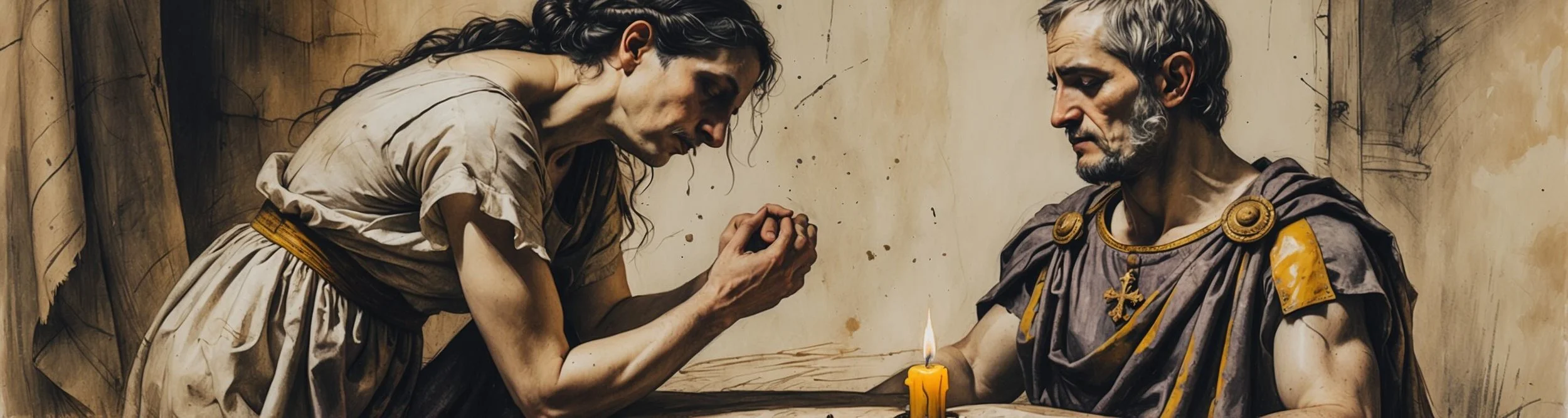
Scene Profile – At a Glance
- Location: Caesar's house in Rome, on the stormy morning of the ides of March.
- What Happens: Frightened by her dream and the night's omens, Calpurnia begs Caesar to stay home. He agrees, then Decius Brutus reinterprets the dream as lucky and shames him into going to the Senate after all.
- Key Characters: Julius Caesar, Calpurnia, and Decius Brutus.
- Dramatic Function: The last chance to avoid the assassination. Caesar is warned, almost stays safe, and is then talked into walking to his death.
- Famous Quote:
"Cowards die many times before their deaths;
The valiant never taste of death but once."
(Caesar, Act 2, Scene 2) - Why It Matters: The scene shows Caesar's fatal flaw at work – a pride so great that the fear of looking afraid outweighs every warning he is given.
Scene Summary
A violent storm rages as Caesar, unable to sleep, paces his house in his nightgown. His wife Calpurnia has cried out three times in her sleep that Caesar is being murdered. Caesar sends a servant to have the priests sacrifice an animal and report the omens.
Calpurnia enters and pleads with him not to leave the house. She lists the night's terrible portents – a lioness giving birth in the streets, graves opening, ghostly warriors fighting in the clouds – and tells him she is frightened. Caesar at first brushes her aside, declaring that what the gods intend cannot be avoided and that cowards die many times while the brave die only once.
The servant returns: the priests found a sacrificed beast with no heart, and they advise Caesar to stay home. Caesar twists even this into a point of pride, but when Calpurnia kneels and begs him to stay for her sake, he relents and agrees to send word that he is unwell.
Then Decius Brutus arrives to fetch him. Hearing that Caesar means to stay home because of Calpurnia's dream, Decius cleverly reinterprets it as a vision of good fortune, and warns that the Senate plans to crown Caesar that day and may mock him as henpecked if he stays away. Stung, Caesar dismisses Calpurnia's fears as foolish and calls for his robe. The other conspirators and Antony arrive to escort him, and he leaves to share wine with the very men who will kill him.
The Storm and the Dream
The scene opens in darkness and thunder. Calpurnia, terrified by her nightmare and the omens reported across Rome, tries to keep her husband safe. Her speech piles portent on portent, building a picture of a world turned monstrous and out of joint – the natural order itself seeming to warn against the day.
Original
When beggars die, there are no comets seen;
The heavens themselves blaze forth the death of princes.
(Calpurnia, Act 2, Scene 2)
Shakespeare Retold (Modern Verse)
When beggars die, there are no shooting stars;
But skies light up whenever princes die.
Calpurnia's argument is that the heavens do not bother to mark the death of ordinary people, but blaze with comets when a prince is about to fall – so the night's signs must point to Caesar. It is a powerful appeal, and the audience knows she is right. The dramatic irony is heavy: everything she says is true, the danger is real, and yet we already sense that her very correctness will not save him. The more the omens insist, the more Caesar's refusal to heed them will define his fall.
"Cowards Die Many Times"
Caesar's answer to his wife's fear is the most famous speech in the scene, and it shows exactly why he cannot be saved. For Caesar, to act on fear is to be a coward, and to be a coward is worse than death itself. He turns Calpurnia's love and worry into an attack on his courage, which he cannot allow to stand.
Original
Cowards die many times before their deaths;
The valiant never taste of death but once.
(Caesar, Act 2, Scene 2)
Shakespeare Retold (Modern Verse)
Cowards die many times before their deaths;
The bravest only die a single time.
The line is genuinely noble, and it is one of the reasons we cannot simply dismiss Caesar. His refusal to live in fear is courageous, and there is real grandeur in his refusal to cower at home. But it is also the trap. Because Caesar values the appearance of fearlessness above his own safety, any warning can be neutralised simply by framing avoidance as cowardice – which is exactly what Decius will do moments later. The very virtue that makes Caesar admirable is the lever his enemies use to walk him to his death.
Decius Turns the Dream
Caesar has been talked into safety by Calpurnia, but Decius Brutus undoes it in seconds. He is one of the conspirators, sent precisely because he knows how to handle Caesar, and he proves it. Where Calpurnia read the bloody dream as a warning, Decius reads it as a glorious prophecy – and then adds the killer detail that the Senate intends to crown Caesar that very day.
Original
Your statue spouting blood in many pipes,
In which so many smiling Romans bathed,
Signifies that from you great Rome shall suck
Reviving blood,...
(Decius Brutus, Act 2, Scene 2)
Shakespeare Retold (Modern Verse)
Your statue spouting blood from out its pipes,
In which so many smiling Romans bathed,
Means many Romans will rely on sucking
Your health-reviving blood,...
Decius's reinterpretation is brilliant and grotesque. The dream of Romans bathing their hands in Caesar's blood – an obvious vision of the murder – is recast as an image of Rome drawing life and strength from him. The reading is, in a dreadful way, half-true: Caesar's death will indeed flow through Rome and change it forever, just not as Decius pretends. By flattering Caesar's vanity with the crown and threatening his pride with the prospect of being mocked, Decius reverses Caesar's decision completely. It is a masterclass in manipulation, and the play's grim point is clear: Caesar can be moved by anything except the truth.
Language and Technique
- Pathetic fallacy: The thunder and unnatural omens mirror the disorder in Rome – the natural world seems to revolt against the coming murder.
- Dramatic irony: Calpurnia's fears are correct and Decius's flattery is false, yet the audience watches Caesar believe the lie and reject the truth.
- Speaking in the third person: Caesar repeatedly calls himself "Caesar", treating his own name as a public force he must live up to.
- Reinterpretation as persuasion: Decius does not argue against the dream; he simply re-reads it, showing how the same image can be turned to opposite meanings.
- Antithesis: Caesar's thinking runs on opposites – cowards against the valiant, danger against Caesar – that flatter his sense of his own greatness.
Key Quotes from Act 2, Scene 2
Quote 1Caesar shall forth: the things that threatened me
Ne'er looked but on my back; when they shall see
The face of Caesar, they are vanished.
(Caesar, Act 2, Scene 2)
Shakespeare Retold (Modern Verse)
Caesar will leave. The things that threaten me
Look at me from behind. But when they'll see
The face of Caesar, they will disappear.
What can be avoided
Whose end is purposed by the mighty gods?
(Caesar, Act 2, Scene 2)
Shakespeare Retold (Modern Verse)
But what can be avoided
If it is the intention of the gods?
The cause is in my will: I will not come;
That is enough to satisfy the senate.
(Caesar, Act 2, Scene 2)
Shakespeare Retold (Modern Verse)
My wish will be reason. I won't come.
That is enough to satisfy the Senate.
If Caesar hide himself, shall they not whisper
'Lo, Caesar is afraid'?
(Decius Brutus, Act 2, Scene 2)
Shakespeare Retold (Modern Verse)
If Caesar doesn't show, perhaps they'll whisper,
'Look, Caesar is afraid.'
Key Takeaways
- The last warning is ignored: Calpurnia's dream and the night's omens give Caesar every reason to stay home, and he almost does.
- Pride is Caesar's flaw: He fears looking afraid more than he fears death, which makes every warning useless against him.
- Decius is the master manipulator: He reinterprets the bloody dream as lucky and dangles the crown to talk Caesar into going.
- Fate and free will collide: Caesar leans on the gods' will to justify boldness, even as he chooses to walk into the trap.
- Dramatic irony runs throughout: The audience knows Calpurnia is right and Decius is lying, and watches Caesar choose the lie.
Study Questions and Analysis
What is the significance of Calpurnia's dream?
Calpurnia's dream is one of the play's great warnings, and its handling reveals the central conflict of the scene. She dreams of Caesar's statue spouting blood while smiling Romans bathe their hands in it – an unmistakable vision of the assassination, in which the conspirators will indeed dip their hands in his blood. Combined with the night's omens, it gives Caesar a clear, supernatural warning of exactly what is coming.
The dream's importance lies in how it is read. Calpurnia takes it as a portent of death, which is the truth; Decius re-reads it as a sign that Rome will draw life from Caesar, which is a flattering lie. Shakespeare uses the two readings to dramatise how truth can be smothered by interpretation. The same image can warn or reassure depending on who controls its meaning, and the tragedy is that Caesar chooses the comforting falsehood. The dream also keeps alive the question of fate: it seems to foresee the future accurately, yet it is human choice – Caesar's vanity, Decius's cunning – that turns the warning aside.
How does Shakespeare present Caesar in this scene?
This scene gives us the fullest private view of Caesar in the play, and it is carefully double-edged. On one hand he is genuinely impressive: brave, commanding, contemptuous of fear, and capable of the magnificent line that cowards die many times while the valiant die but once. On the other he is vain, superstitious, and easily flattered, a man who speaks of himself in the third person as though "Caesar" were a god rather than a husband standing in his nightgown.
Danger knows full well
That Caesar is more dangerous than he:
We are two lions littered in one day,
And I the elder and more terrible:
(Caesar, Act 2, Scene 2)
Shakespeare Retold (Modern Verse)
For danger knows
That Caesar is more dangerous than danger.
Danger and I are lions born together,
Yet I'm the elder and more terrifying.
The boast that he is "more dangerous" than danger itself captures the contradiction perfectly. It is impressive and absurd at once – the rhetoric of a man who has lost the ability to see himself as mortal. Shakespeare deliberately refuses to make Caesar simply heroic or simply foolish. He is both, and that doubleness is what makes his murder feel like a genuine tragedy rather than a deserved punishment: we see the greatness the conspirators fear and the blindness that destroys him.
How does Decius persuade Caesar to go to the Senate?
Decius succeeds where Calpurnia fails because he understands Caesar's psychology exactly. He uses three weapons in quick succession. First, he reinterprets the frightening dream as a happy omen, turning the blood into a symbol of Rome being revived by Caesar. Second, he reveals that the Senate plans to offer Caesar a crown that day, appealing directly to his ambition. Third, and most decisively, he warns that staying home will make Caesar look afraid and henpecked, the target of senators' mockery.
The genius of the approach is that Decius never confronts Caesar's reasons head-on; he simply rearranges what the day means. Calpurnia offers love and fear; Decius offers glory and the dread of ridicule, and against Caesar's pride the second pair always wins. The scene is a study in how flattery defeats good counsel. Many readers note that Caesar's downfall here is not really caused by the conspirators' swords but by his own vanity, which Decius merely plays like an instrument.
What does the scene contribute to the theme of fate versus free will?
The scene sits at the centre of the play's argument about whether men are ruled by destiny or by choice, and it refuses to settle it. On the side of fate, the omens and Calpurnia's prophetic dream seem to foresee Caesar's death with uncanny accuracy, suggesting the murder is written in the stars. Caesar himself leans on fate when he asks what can be avoided "whose end is purposed by the mighty gods".
Yet the scene also shows the murder being decided by very human choices. Caesar is offered a clear path to safety and turns it down; Decius chooses to manipulate him; Caesar chooses to mind his reputation over his wife's tears. Shakespeare lets both readings stand. Caesar is doomed, but he is also responsible – warned, given a way out, and walking knowingly past it because of his own character. The play's deepest suggestion may be that fate and character are the same thing: Caesar's end is "purposed" not by distant gods but by the fixed nature of the man, which makes his choice as good as predetermined.
Why does Caesar refuse to send word that he is sick?
When Calpurnia suggests telling the Senate that Caesar is unwell, he flatly refuses, asking whether Caesar, who has stretched his conquering arm across the world, should now be afraid to tell old men the truth. To lie about illness would be to admit weakness, and weakness is the one thing his self-image cannot survive.
The refusal is revealing on two counts. First, it shows how completely Caesar's public role has swallowed the private man: even a small white lie feels like a betrayal of the legend of "Caesar". Second, it sets up the trap Decius will spring, because a man who will not pretend to be sick to avoid embarrassment is a man who can be shamed into anything. The same pride that makes him refuse the dignified excuse makes him helpless against the charge of cowardice. It is a small moment that quietly seals his fate.
How does this scene compare with the earlier scene in Brutus's house?
Shakespeare places this scene deliberately alongside the earlier orchard scene in Brutus's house, and the parallels are striking. In both, a great man cannot sleep on the eve of the murder; in both, a devoted wife (Portia and Calpurnia) senses something terribly wrong and pleads to be let into her husband's confidence; in both, the domestic and the political collide.
The contrast lies in the men's responses. Brutus, moved by Portia, promises to share his secret; Caesar, after briefly yielding to Calpurnia, overrides her entirely. The pairing invites us to weigh the conspirator against his victim. Both are proud, both are blind to the disaster ahead, and both are undone partly by qualities they consider virtues – Brutus by his honour, Caesar by his courage. By staging the two households back to back on the same fatal morning, Shakespeare suggests that the assassin and the assassinated are more alike than either would admit, and that the tragedy is not a simple clash of good and evil but of two flawed greatnesses.